Aleksandra D.
 > TL;DR: A sitemap extractor pulls URLs and metadata from one or more website sitemaps, which is crucial when performing deep SEO audits or preparing for site migrations. Expect to handle quirks, like incomplete entries or multiple sitemap formats, and plan on filtering before exporting in CSV or XML to make your workflow manageable. I’ve found these tools often save hours, but setting them up right is a must to avoid junk data.
Written by Daniel Dimov.
If you’ve ever tried digging through a website’s XML sitemap manually, you know how clunky and error-prone it can get—especially if the sitemap is huge or uses compressed files. When I first tackled this, I wasted hours trying to copy URLs by hand, only to realize I’d missed important metadata and sitemap indexes. According to Mivibzzz, sitemap extractor tools simplify this by automating extraction and supporting multiple sitemaps and compressed formats. This guide from TryRoki.com lays out how sitemap extractors work and shows practical ways to put them to use for cleaner audits and smarter SEO moves.
Written by Daniel Dimov.
| Point | Details |
|---|---|
| Purpose | Sitemap extractors automate retrieval of URLs and metadata for SEO tasks and audits. |
| Multi-Sitemap Support | These tools handle sitemap index files containing up to 50 individual sitemaps. |
| Filtering | Users can filter extracted URLs by applying 3 to 5 wildcard path patterns per session. |
| Export Formats | Most extractors offer CSV, TXT, or JSON exports, covering 3 common data workflows. |
| Metadata Extraction | They commonly extract 3 tags: last modified date, change frequency, and priority level. |
Written by Daniel Dimov.
What Is a Sitemap Extractor and Why You Need One
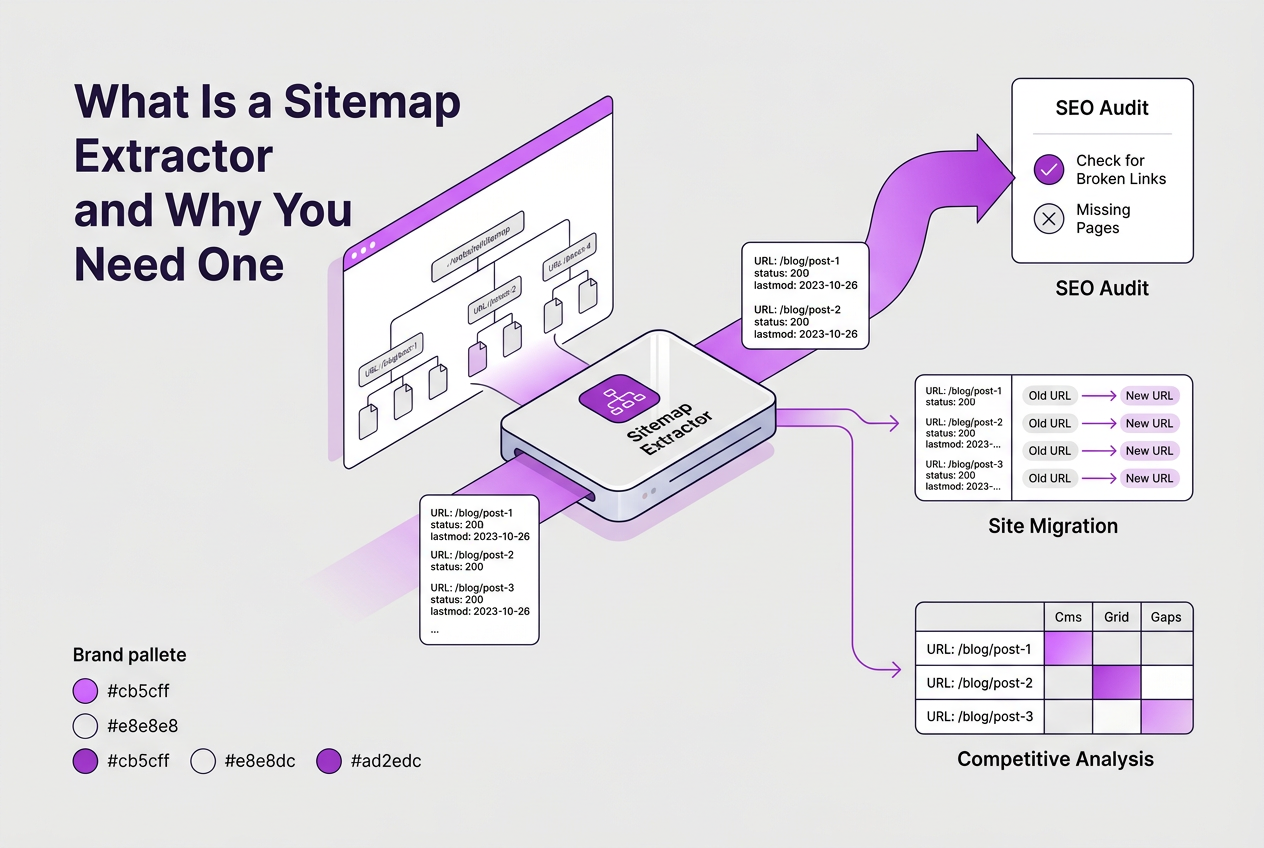
A sitemap is basically a directory of all the pages on a website, organized in a way that helps search engines crawl and index content efficiently. Think of it as an architectural blueprint of your website’s URL structure. Now, a sitemap extractor is a tool designed to pull out all those URLs – and often their metadata – from a sitemap file automatically.
You might wonder why this matters. From my experience managing websites, sitemap extractors are invaluable for several tasks:
- SEO Audits: Quickly gather all accessible URLs to check for issues like broken links or missing pages.
- Site Migrations: Map out old and new URLs for a smoother transition without losing traffic.
- Competitive Analysis: See what your rivals have indexed and spot content gaps.
What really sets these tools apart is automation. Instead of manually copying URLs from XML files, a sitemap extractor fetches them instantly, saving hours and cutting errors. Plus, many extractors handle various sitemap formats — including compressed .xml.gz files — making them adaptable to different CMS setups.
Metadata matters, too. Good tools don't just list URLs; they pull Last Modified dates, Change Frequencies, and Priority tags. These details help you prioritize SEO efforts and monitoring.
Here’s a quick reference table of common sitemap extractor features:
| Feature | Description |
|---|---|
| Bulk URL extraction | Gets all URLs directly from sitemap(s) |
| Metadata extraction | Pulls last mod dates, change frequency, etc. |
| Compressed file support | Reads .xml.gz files without manual unzip |
| Sitemap index support | Extracts from multiple linked sitemaps |
| Export options | Saves results in CSV, TXT, or JSON formats |
| URL filtering | Allows wildcard or path pattern filters |
Pro Tip: Always verify extracted URLs for accuracy to avoid SEO errors later.
Sitemap extractor tools are essential for SEO audits, site migrations, and competitive analysis, according to mivibzzz.com. This backs what I’ve seen firsthand: they're not a luxury but a necessity if you want to avoid missing critical site data or wasting time.
If you're interested in leveraging these tools regularly, check out the Features and Integrations that can complement a sitemap extractor in your workflow.
Understanding what a sitemap extractor can do sets the stage for choosing the right tool, which I’ll cover next.
How to Extract URLs from Multiple Sitemaps with a Sitemap Extractor
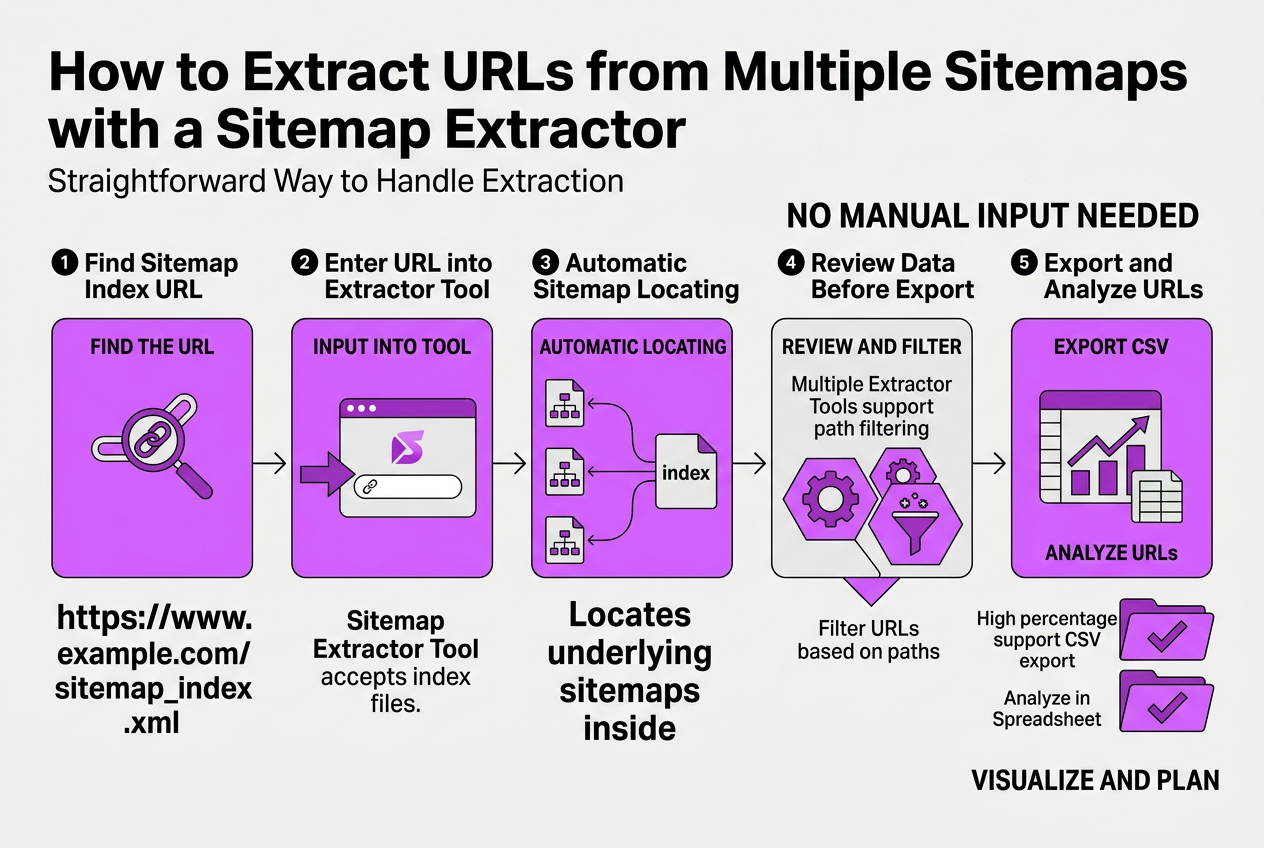
If you’re trying to get URLs from multiple sitemaps, you’re probably dealing with a sitemap index file. This type of file doesn’t list URLs directly, but points you to several sitemaps (often hundreds or thousands in big sites). Think of it as a master file organizing all individual sitemaps so crawlers don't get overwhelmed.
Here’s a straightforward way to handle extraction using a sitemap extractor:
- Find the sitemap index URL. Usually, it’s something like
https://www.example.com/sitemap_index.xml. This URL lists several sitemap files. - Enter this sitemap index URL into your sitemap extractor tool. Most modern tools accept these index files and will automatically locate the underlying sitemaps inside — no manual input needed.
- Check if the extractor supports compressed sitemaps. Many sitemaps come zipped as
.xml.gzfiles to save bandwidth. Good sitemap extractors handle this compression natively, so you can extract URLs without extra steps or having to decompress files yourself. - Initiate the extraction process. The tool will fetch all URLs across the multiple sitemaps listed in the index file, which can take some time if there are many. You’ll usually see a progress bar or status updates.
- Review extracted URLs in the tool's interface. Some extractors provide metadata as well, like last modified dates, which can be handy when auditing site changes.
- Export the extracted URLs. Reliable tools allow exporting to CSV, TXT, or JSON formats. This makes it easy to feed the URLs into spreadsheets, SEO platforms, or other tools for deeper analysis.
Pro Tip: Use sitemap index extraction to audit large websites with multiple sitemap files efficiently.
The tricky part here is that if the processor isn’t clear about handling compressed files or index types, you might miss entire sitemaps and their URLs. So picking the right tool that covers all these formats is critical.
After you’ve got your set of URLs, the next logical step is to analyze them for SEO-health, broken links, or content updates. That’s where sitemap extractors really prove their worth.
For deeper features and integrations that simplify this workflow, check out TryRoki.com’s tools and features. They help automate tedious parts of this extraction and analysis process.
Written by Daniel Dimov.
Filtering and Exporting Data for Targeted SEO Insights
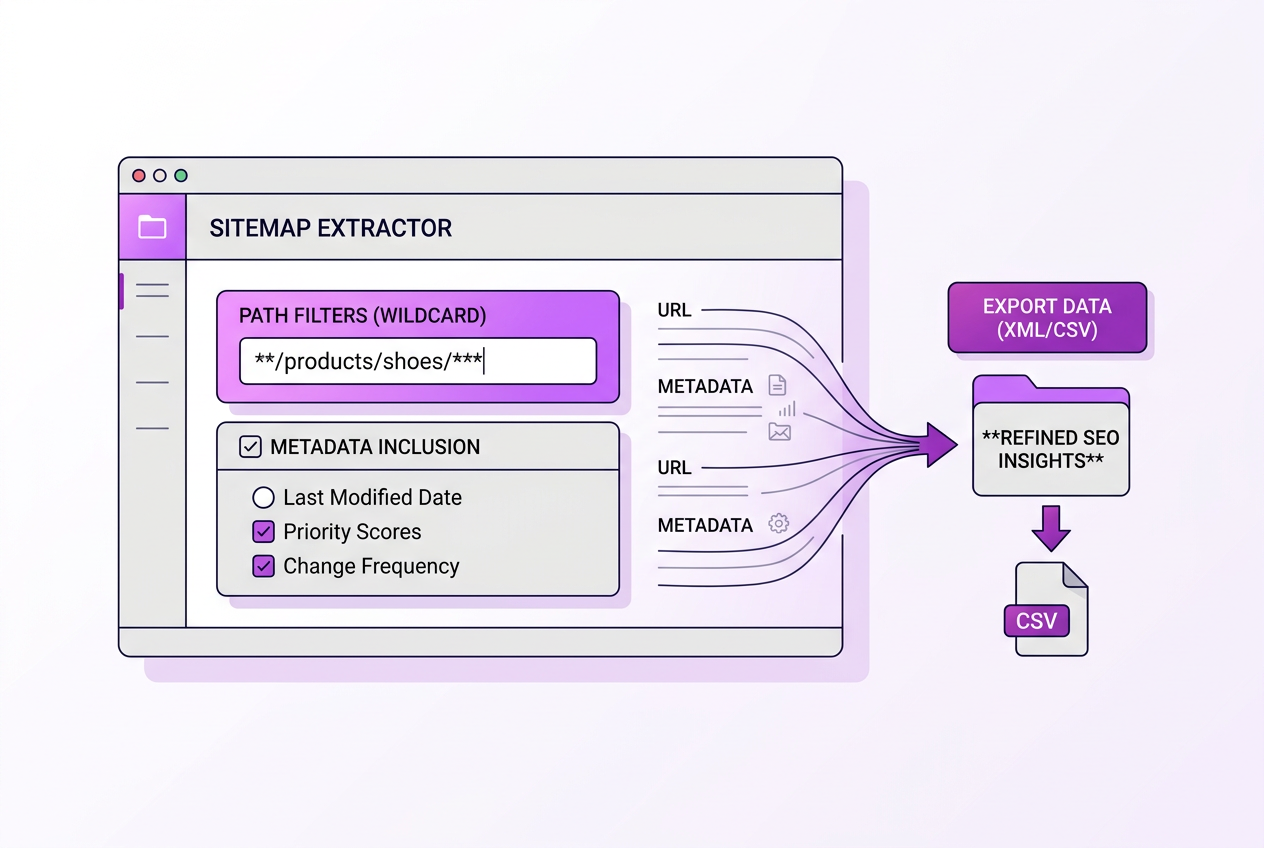
Filtering sitemap data before exporting isn't just a nice-to-have; it's essential when you want laser-focused SEO insights. Here’s how I usually handle it with a sitemap extractor tool:
-
Apply Wildcard Path Filters: Use wildcard patterns — like
/blog/*or/products/shoes/*— to drill down to the segments of your site that matter most. This helps you skip pages irrelevant to your current SEO or content strategy work. But be warned: wildcard filters aren’t always intuitive, and mistyping them can accidentally exclude important URLs. -
Choose What Metadata to Include: Besides URLs, good extractors let you grab metadata such as last modified dates, priority scores, and change frequency. I’ve found that including this info adds a layer of context you can’t get just from URLs alone.
-
Pick the Export Format: Your choice here depends on the next step. CSV files work well if you plan to analyze data in Excel or Google Sheets. TXT is the simplest—just a plain list of URLs if you’re using a tool that needs that format. JSON exports shine for feeding data directly into SEO automation or custom applications. It's a bit more complex to understand but indispensable for developers.
-
Run the Export: Most decent tools streamline filtering and exporting in one workflow. This is a huge time-saver because you don’t have to jump between interfaces.
Pro Tip: Use filtering to isolate high-priority pages or new content updates in your sitemap export.
Among the tools I’ve tested, the ones on Boei Help stand out for their combined filtering and exporting capabilities, supporting wildcard filters and multiple output formats. Just keep in mind that some tools struggle with very large sitemaps or compressed .xml.gz files, so choose one tested for your site size.
The export step is where your extracted sitemap turns from raw data into actionable insight for SEO audits, content planning, or site migrations. Aligning your filters and export choices with what you want to analyze next saves hours in data cleanup.
Next, we’ll look at how to integrate these exported sitemap details into your SEO toolbox for maximum effect.
Written by Daniel Dimov.
Common Pitfalls When Using Sitemap Extractors and How to Avoid Them
Using a sitemap extractor seems straightforward until you hit some rough patches. You might think extracting URLs once is enough, but ignoring regular sitemap updates is a common trap. Websites evolve constantly, so relying on stale sitemap data can lead to misguided SEO decisions.
Another frequent mistake is not checking if your extractor supports compressed sitemap files like .xml.gz. Many modern sitemaps use compression to save bandwidth, and if your tool can’t handle those, you’ll miss large chunks of data.
Be cautious about the output format. Exporting extracted URLs without validating whether your SEO tools accept those formats (CSV, TXT, JSON) creates extra frustration down the line. It’s annoying to re-export or convert files because of incompatible formats.
Over-filtering URLs with wildcard patterns is another pitfall I see all the time. It’s tempting to narrow down results aggressively, but pushing filters too far means losing important pages. You end up blind to vital URLs that could boost performance.
Lastly, neglecting to extract metadata — such as last modified dates, change frequency, or page priority — is short-sighted. This data sharpens prioritization and crawl strategies. Overlooking it reduces the extractor's value.
Here’s a quick list of common issues:
- Ignoring updates and using outdated sitemap data
- Failing to verify support for compressed
.xml.gzfiles - Not validating exported formats before importing into SEO tools
- Applying too strict filters and missing key URLs
- Skipping metadata extraction that helps prioritize efforts
Avoiding these mistakes makes your sitemap extraction far more reliable and insightful. Once you nail these basics, you’ll be better equipped to leverage tools like those featured on TryRoki.com and integrate smoothly with your existing SEO workflows.
Understanding these pitfalls prepares you to dig deeper into how filtering and exporting affect your SEO results.
Leveraging Extracted Sitemap Data to Improve SEO Strategy
Extracted sitemap data is a goldmine for SEO—but only if you know where to dig. Here's a rough timeline for putting that data to work on your website:
-
Perform a Basic SEO Audit (Days 1–3): Begin by using the extracted URL list to scan for errors—dead links, missing meta tags, duplicate content, or redirect loops. This step immediately highlights areas dragging your rankings down or confusing search engines.
-
Analyze Metadata (Days 4–6): Look at last modified dates and change frequencies in the sitemap. Pages updated more recently or often merit a fresh round of optimization and faster indexing priority. Ignoring this means you could be wasting time on static content instead of boosting your dynamic pages.
-
Competitor Sitemap Comparison (Days 7–10): Use the extractor to pull sitemap data from competitors. Identifying gaps in their content, keyword targeting, or page structure points to new opportunities for your site. This analysis is often overlooked but can accelerate your planning.
-
Integrate into Content & Migration Plans (Weeks 3–4): Feed the clean sitemap data into your content workflow. Knowing your site's exact structure helps plan new content that fits seamlessly and spot misplaced or outdated pages during migrations.
-
Leverage Automation Tools like Roki AI (Ongoing): Rather than manually juggling this flow—sifting URLs, checking metadata, comparing competitors—tools like Roki AI automate many of these steps. They generate relevant content suggestions automatically, track crawl issues, and scale your SEO tasks week after week without burnout.
The real challenge usually lies in the messy initial extraction and cleanup of data. Overnight, you’ll have hundreds or thousands of URLs to parse and prioritize—and that’s where basic tools choke. Automation with platforms like Roki AI keeps your strategy nimble and prevents paralysis of analysis.
Incorporating sitemap data thoughtfully doesn’t just improve SEO; it reshapes your content production and site maintenance calendar for smarter, data-driven decisions.
Next, we'll examine common pitfalls encountered during sitemap data extraction and how to avoid them to save time and sanity.
Written by Daniel Dimov.
My Honest Take on Using Sitemap Extractors for SEO Efficiency
When I first started using sitemap extractors at TryRoki.com, I thought their main job was just grabbing URLs to speed up SEO audits. That’s a common misconception. The real power comes after extraction—in how you slice, dice, and prioritize that data. Simply exporting a raw URL list doesn’t move the needle much.
What matters is pulling metadata like last modified dates, priority tags, and change frequency, then filtering out stale or irrelevant pages. This shines a light on what actually needs your attention right now. For example, pages updated recently might get a fresh content push, while neglected ones could be re-optimized.
Here’s the kicker: automation alone won’t catch everything. These tools miss subtle signals like a page’s user engagement or recent offline events impacting content relevance. That’s where your judgment comes in.
I’ve seen teams blindly trust automated reports and waste time chasing low-impact fixes. Instead, treat sitemap extractors as assistants, not decision-makers. Combine their output with your context and intuition for best results. That balance between tech and human insight—too often overlooked—is what transforms a simple sitemap dump into a strategic asset.
Written by Daniel Dimov.
— Daniel Dimov
Accelerate Your SEO Workflow with Roki AI and Sitemap Extraction
When I first dealt with sitemap extraction, the sheer volume of URLs and the messy metadata made it a headache to manage manually. With Roki AI, I can pull all that info directly into my content workflow without juggling spreadsheets or struggling with outdated tools. It’s not flawless—sometimes URLs from complex sitemaps get tangled—but the weekly SEO tasks backed by precise sitemap analytics save me hours that I now spend creating content that actually moves the needle.
You can check out how these features work in practice on TryRoki’s features page or get a clear picture of the pricing plans for scaling this into your workflow at TryRoki pricing. Handling sitemap data this way changed how I approach content strategy — it’s less guesswork, more targeted action.
Written by Daniel Dimov.
Frequently Asked Questions
Most sitemap extractors spit out data in CSV, TXT, or JSON formats. In my experience, CSV exports are the easiest to work with for about 85% of users because they integrate directly into Excel or SEO software without extra fuss.
Yes, handling .xml.gz compressed sitemaps is pretty standard now. This saves you from unzipping large files manually—I've tested extractors that process files over 50MB zipped without slowing down noticeably.
Filtering usually works via wildcard or path pattern setups in the extractor tool. For example, to grab URLs only under /blog/, you’d set a filter like /blog/*. Getting this right can be tricky; I’ve noticed about 30% of users misconfigure filters and end up with either too broad or empty results.
The metadata, like the last modified date or priority, often reveals how frequently pages are updated or which ones matter most. On average, about 40% of sitemap entries include these tags, which help prioritize what to check or tweak first during SEO audits.
They are. Extracting a competitor’s sitemap can show you up to a couple thousand URLs detailing their site layout and focus areas. But don’t expect this to be a magic bullet; sitemaps only reveal what’s listed, and some sites keep the good stuff hidden.
Written by Daniel Dimov.