Daniel D.
 > TL;DR: If Semrush’s $120/month price tag feels steep, consider Mangools or Ubersuggest instead. They cover most SEO essentials like keyword research and site audits for around $30–$40 monthly, though some features won't be as deep or polished. SE Ranking’s $39 plan strikes a decent balance but still lacks Semrush’s advanced tools—expect some trade-offs if you want to save money.
Written by Daniel Dimov.
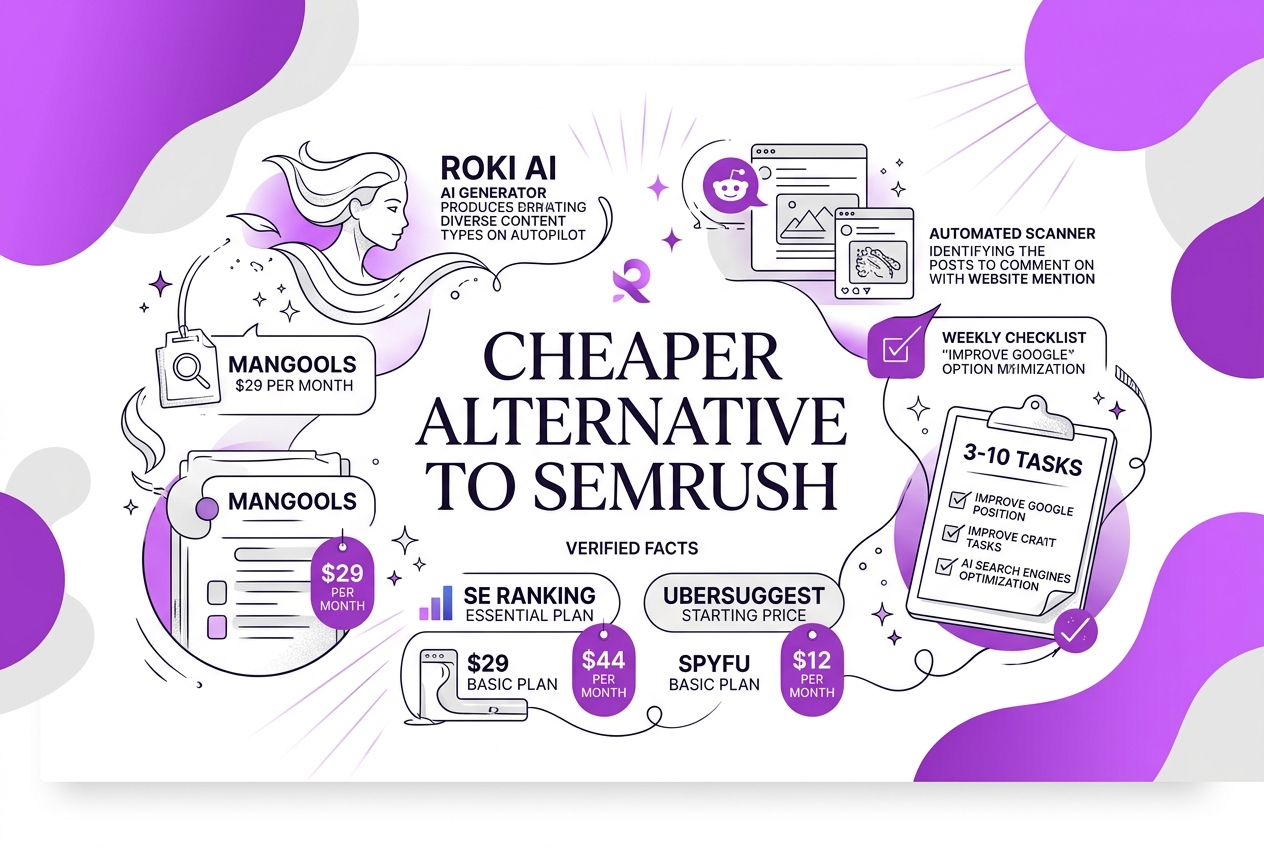
Semrush offers a solid toolkit for SEO, but its nearly $140 monthly starting price hits hard, especially if you’re juggling tight budgets or launching a small project. I’ve often seen teams struggle to justify that spend when options like Mangools and Ubersuggest deliver most of the essentials for a fraction of the cost. According to Nexusdrop, Mangools starts at $29 per month, and Ubersuggest goes even lower at $12. This guide breaks down practical, cheaper alternatives to Semrush, weighing what you get for your money and pointing out where you might have to compromise without sacrificing your SEO goals.
Written by Daniel Dimov.
| Point | Details |
|---|---|
| Cost Savings | Switching can slash your spend by 60-80%, compared to Semrush’s $119+ monthly starting price. |
| Features Range | Alternatives typically bundle keyword research, site audits, and backlink tools in one. |
| User Friendliness | Mangools scores high with beginners thanks to its clear, intuitive interface. |
| AI Tools | RankIQ offers AI-driven content assistance even on plans under $50 per month. |
| Pricing Options | You can find plans starting from as low as $12 monthly, fitting tighter budgets effectively. |
Written by Daniel Dimov.
Understanding What Semrush Offers and Its Cost
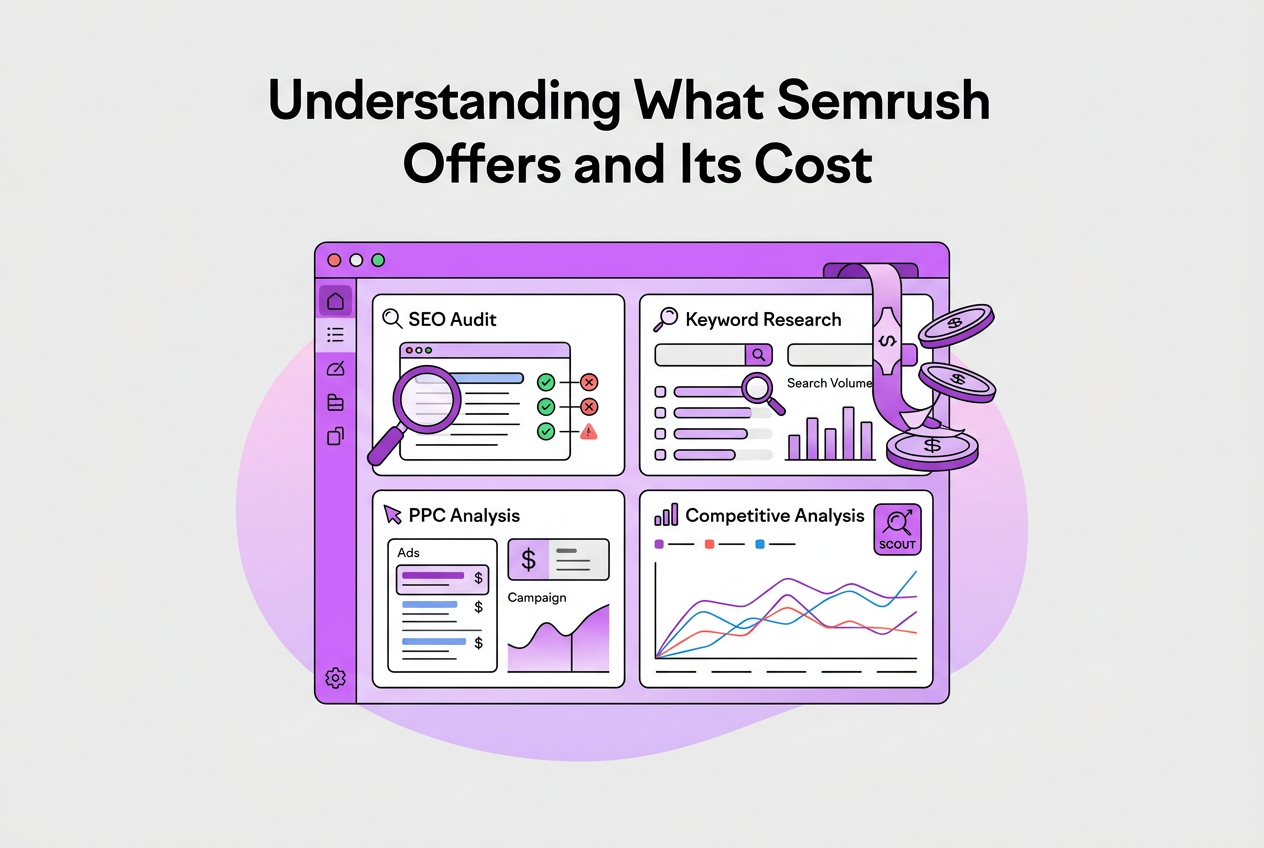
Semrush has become a go-to tool for marketers and SEO professionals, but not without its complexities and costs. Its core range of features spans SEO audits, keyword research, PPC campaign management, content marketing insights, and competitive analysis. These tools promise to cover the full digital marketing spectrum—from finding high-impact keywords to spying on competitors.
Here’s a quick snapshot of Semrush’s main features:
| Feature | What It Does |
|---|---|
| SEO Audit | Analyzes your website to find optimization issues and errors. |
| Keyword Research | Discovers keywords and their metrics. |
| PPC Analysis | Tracks paid advertising campaigns. |
| Content Marketing | Provides ideas, performance metrics, and optimization suggestions. |
| Competitor Analysis | Offers insights into competitors’ traffic and keywords. |
The price tag for all this starts at $139.95 per month for the Pro plan. That’s a steep commitment for freelancers, startups, or businesses juggling tight budgets. Many users find Semrush overwhelming at first because it packs so many features into one interface. Navigating it requires time and know-how, which adds to the initial friction.
Common complaints I hear include: "I’m only using a fraction of the tools but paying full price," and "I wish there was a simpler way to get SEO research without the extra PPC and competitive analysis bells and whistles."
Pro Tip: Pro Tip: Recognize that premium pricing often bundles vast features, but smaller teams may only need a subset.
Trying to justify that monthly fee over alternatives that focus just on what you need can be a hard sell. That’s why many seek cheaper alternatives—tools that cover essential SEO or PPC tasks without the overload or budget bloat.
For example, Mangools offers SEO tools starting at $29 per month, and Ubersuggest’s plans can be as low as $12 a month, focusing on core SEO needs without Semrush's broader toolkit. This range lets users pick what suits their business size and complexity.
The reality is not every company needs the extensive feature set Semrush provides. Many prefer simplicity and value over breadth, making affordable alternatives compelling.
Understanding Semrush’s feature set and pricing challenges gives context for why alternatives matter. Next, we’ll explore what qualities make a viable and cost-effective Semrush replacement for your business.
Written by Daniel Dimov.
How to Choose the Best Cheaper Alternative to Semrush
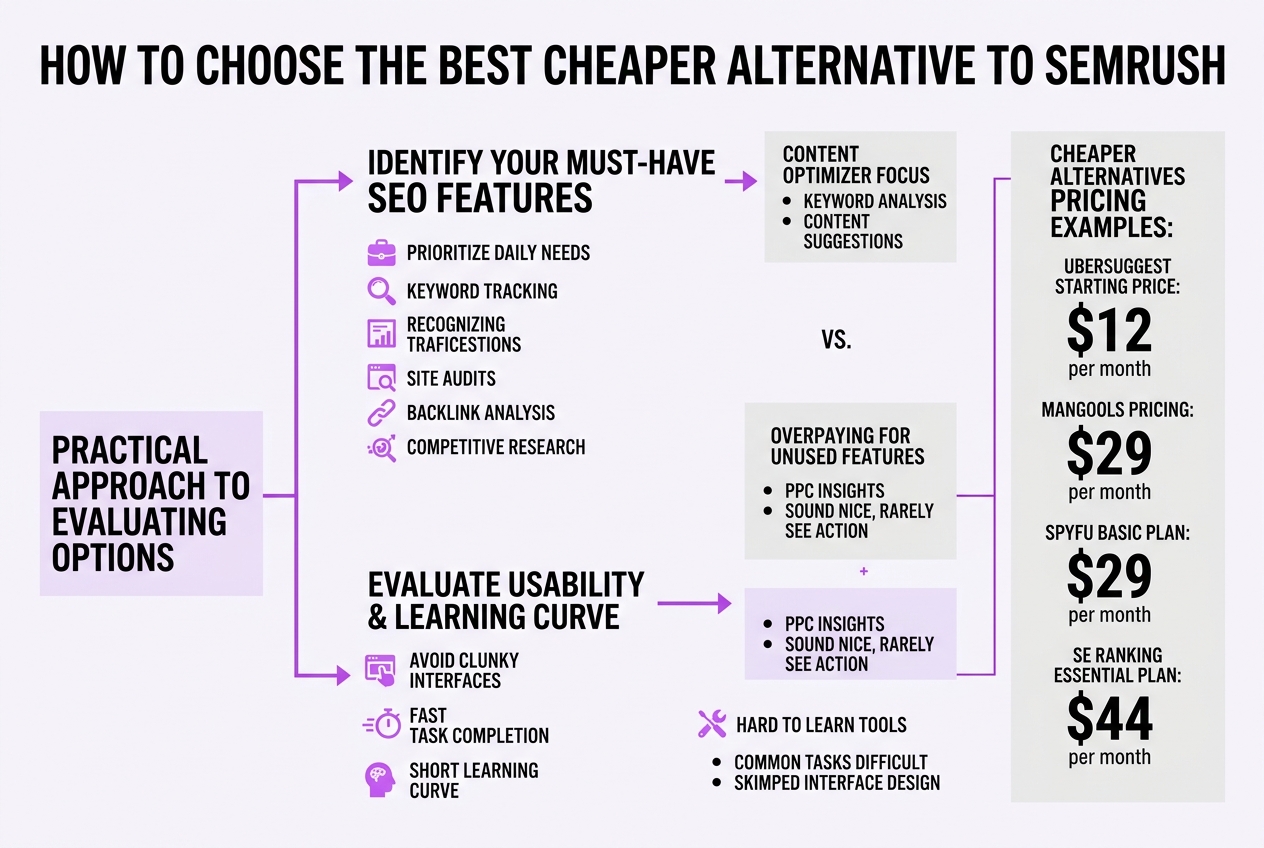
Choosing a cheaper alternative to Semrush isn't as simple as picking the lowest price. You want a tool that fits your needs without overpaying or sacrificing key functionality. Here’s a practical approach I use myself when evaluating options.
-
Identify Your Must-Have SEO Features Start by listing what your business actually needs. Do you prioritize keyword tracking, site audits, backlink analysis, or competitive research? Focus on features you use daily rather than those that sound nice but rarely see action. For example, if you mainly optimize content, a tool’s keyword analysis and content suggestions matter more than PPC insights.
-
Evaluate Usability and Learning Curve Some cheaper tools skimp on interface design, making common tasks clunky or hard to learn. Worse, complex setups can slow down your team and inflate costs indirectly. Try free trials or watch demos to check the workflow matches how your team works. If usability is poor, you’ll waste time, which defeats the purpose of cost savings.
-
Check Pricing Tiers and Trial Offers Pricing can get tricky: base plans might hide important capabilities behind expensive add-ons. Compare what’s included at each price point and watch out for usage caps on keywords or reports. A solid trial window is a must—it lets you test real projects without upfront risk. Many options like Mangools start at $29/month versus Semrush’s $139.95, but verify which features unlock at that level.
-
Assess Additional Perks Like AI Tools or Integrations Some alternatives include AI-driven content ideas or automated reports, which can boost productivity beyond basic SEO features. Also, check if the tool integrates with your other software, like content management or analytics platforms. For example, explore TryRoki.com's integrations to see if it fits your stack.
-
Balance Functionality Versus Budget Don’t just chase the cheapest plan. A tool that barely fits might slow you down or force workarounds. Conversely, the fanciest software may carry features you never use. Finding the “sweet spot” means focusing on value: the right features you actually use, minus unnecessary extras, at a price you can afford.
Pro Tip: Pro Tip: Prioritize tools that fit your workflow; cheaper isn’t better if it hampers productivity.
Selecting the right alternative to Semrush takes more than swapping names. By focusing on your real needs and testing carefully, you can find tools that save money without becoming a second job. Next, I’ll break down some top-performing budget alternatives you can start evaluating today.
Written by Daniel Dimov.
Top 5 Cheaper Alternatives to Semrush Compared
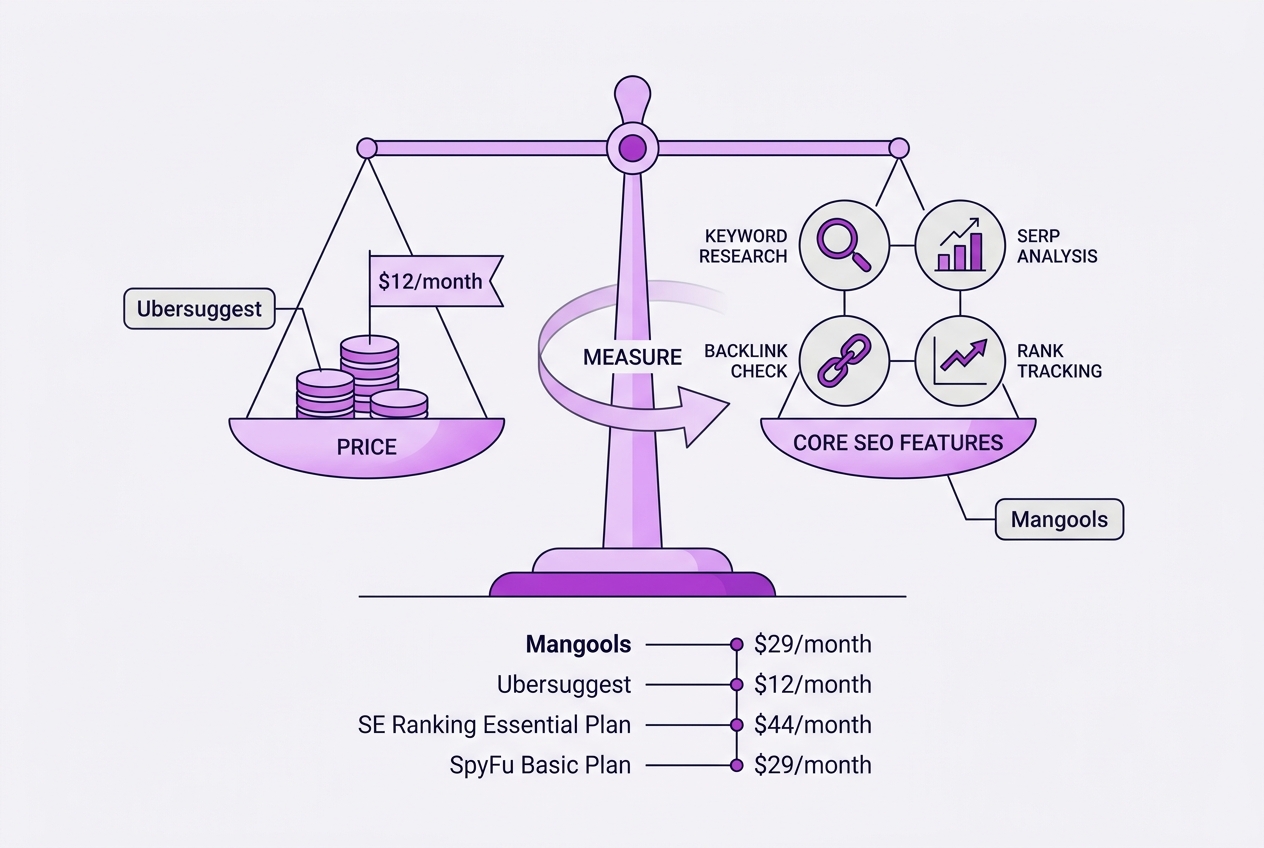
Finding a cheaper alternative to Semrush means balancing cost with the right features for your SEO and marketing needs. Here’s how five popular tools stack up, based on their pricing and capabilities.
| Tool | Starting Price | Key Features | Notes |
|---|---|---|---|
| Mangools | $29/month 1 | Keyword research, SERP analysis, backlink check, rank tracking | Very user-friendly, great for beginners and small teams; fewer enterprise features. |
| Ubersuggest | $12/month 2 | Keyword suggestions, content ideas, site audits, backlink data | Budget-friendly but can be slower with data updates; good if you need basics without extras. |
| SE Ranking | $44/month 3 | Rank tracking, SEO audits, competitor analysis, marketing plan | More comprehensive toolset; closer to Semrush’s depth but cheaper; occasional UI lag reported. |
| SpyFu | $29/month 4 | SEO and PPC keyword research, competitor spying, domain overview | Strong on PPC insights alongside SEO; UI isn’t as modern; good for combined campaigns. |
| Moz Pro | $49/month 5 | Keyword research, site crawl, page optimization, link research | Trusted brand with solid fundamentals; fewer niche features; slower refresh cycles than Semrush. |
This comparison shows how each tool targets different user needs. Mangools and SpyFu offer solid SEO functions at less than a quarter of Semrush's starting price, but they skimp on some high-end data depth. Ubersuggest nails affordability but won’t cover complex campaigns well. SE Ranking sits in the mid-price range and brings a thorough SEO toolkit, though it may not match Semrush for advanced analytics. Moz Pro stays a bit pricier but is a dependable all-around platform, especially if you value brand trust.
All these options come with some trade-offs in data freshness, features, or user experience compared to Semrush. Depending on your workflow and budget, one could still deliver better ROI.
Explore their details, and consider pairing a cheaper platform with complementary tools to cover gaps. For additional insights on useful features beyond pricing, check out TryRoki.com's Features.
Next up, you'll want to evaluate your specific SEO goals to pick the best affordable solution for your team.
Written by Daniel Dimov.
Potential Trade-Offs When Choosing Cheaper SEO Tools
Choosing a cheaper alternative to Semrush often means embracing some trade-offs that can catch even experienced marketers off guard. These downsides don't necessarily make the switch a bad decision, but they require awareness upfront to avoid costly surprises.
Cheaper SEO tools frequently fall short in these areas:
- Advanced PPC features missing or limited. If you're running complex paid search campaigns, many budget options won't track or analyze PPC data with the same precision and depth as Semrush.
- Less frequent data updates. Real-time insights matter in SEO. Some alternatives refresh data weekly or even less, which can skew your understanding of current rankings and opportunities.
- Smaller databases for backlinks and keywords. This directly affects how comprehensive your research and competitive analysis can be.
- Fewer integrations with marketing software. You might find your new tool doesn’t plug into your CRM, email marketing, or analytics platforms as smoothly.
- Support services vary widely in quality. Some budget providers offer limited or slow support, complicating troubleshooting and onboarding.
One common mistake is to prioritize upfront cost over these functional limitations. You might save $100 per month but end up spending more time finding workarounds or buying add-ons.
Pro Tip: Pro Tip: Test trial versions to ensure the tool meets your critical needs before committing long term. This gives you a hands-on sense of what feels lacking in real use.
At TryRoki.com, we've seen clients switch tools only to realize after a month that missing PPC insights or slow backlink updates hurt their campaigns. In our experience, keeping an eye on these trade-offs is crucial.
Still, many alternatives like Mangools ($29/month) or SE Ranking ($44/month) have found smart ways to balance features and costs, but they aren’t perfect clones of Semrush’s extensive toolkit. To navigate this, check the detailed list of available integrations and assess how the features align with your workflow.
Understanding these compromises will steer you clear of buyer's remorse and help set realistic expectations.
Next, we'll explore how to match your business priorities with the right tool to minimize these trade-offs.
Maximizing Your SEO Budget with AI-Powered Tools Like Roki AI
Roki AI offers a distinctive blend of AI-driven content creation and targeted Reddit outreach, which helps you reduce your overall SEO spend significantly. Unlike traditional SEO suites that might rely heavily on manual content drafting or basic keyword research, Roki AI automatically generates fresh, relevant articles tailored to your niche. On top of that, it scours Reddit for posts related to your topics, enabling you to engage authentically and drop mentions of your website naturally—a clever, low-cost outreach tactic most tools ignore.
This automation isn’t just a time saver; it can also cut your costs by eliminating the need for expensive content writers or hired outreach specialists. Starting up with Roki AI, you’ll notice the benefit in less juggling between platforms and fewer hours spent patching workflows together.
What’s particularly useful is how Roki AI fits alongside more affordable SEO tools you might already be using, like Mangools or Ubersuggest, complementing their analytics and keyword discovery with consistent content updates and active community engagement—all without adding the heavy costs associated with Semrush’s top-tier plans.
Every week, Roki AI delivers three to ten tasks designed to push your SEO forward. These aren’t just random suggestions; they’re specific, actionable items—like posting a new blog piece, joining a Reddit thread, or adjusting meta descriptions. This hands-on approach ensures you’re not just collecting data but steadily improving your search visibility.
Here’s a breakdown of how Roki AI can fit into your SEO workflow compared to traditional expensive tools:
| Feature | Roki AI | Semrush | Affordable SEO Tools |
|---|---|---|---|
| AI Content Generation | ✓ | Limited | Sometimes |
| Automated Reddit Outreach | ✓ | ✗ | ✗ |
| Weekly Actionable SEO Tasks | ✓ | Manual | Manual |
| Cost (Monthly Starting Price) | $29+ (Pricing) | $139.95+ | $12 – $49 |
Combining Roki AI with a moderately priced SEO tool creates a workflow that balances insightful data with proactive content and outreach—something even Semrush users often miss by relying heavily on raw metrics but neglecting active growth tactics. The key is to remember that no tool is a fix-all; Roki does not replace thorough SEO audits but relieves the burden of constant content creation and community engagement.
When you pair Roki AI’s unique strengths with a capable yet cheaper SEO platform, you gain a rhythm of ongoing improvement without locking your budget into a single heavy cost center.
For more details on integration options and feature sets, check out the Integrations and Features pages.
Written by Daniel Dimov.
My honest take on cheaper alternatives to Semrush
I’ve spent years navigating SEO tools and watching businesses wrestle with the cost-versus-value equation. Semrush feels like the gold standard because of its massive dataset and features, but don’t mistake that for a must-have, especially early on. Many companies simply can’t justify shelling out $120+ a month before seeing tangible returns.
That’s where cheaper alternatives like Mangools and Ubersuggest come in. They don’t have Semrush’s exhaustive arsenal—no, you won’t get every bell and whistle—but they cover core SEO needs well enough to get you started without bleeding your budget dry. Don’t expect miracles; the keyword volumes and backlink data can be less comprehensive and sometimes slightly off. I’ve seen people get frustrated when those gaps throw off their planning.
Here’s the contrarian bit: investing in a pricey tool doesn’t automatically translate to better rankings or traffic. In fact, I often recommend blending these affordable options with AI-driven platforms like Roki AI that churn out relevant content and identify real engagement opportunities (hello, Reddit tasks). This combo stretches your SEO dollars farther than buying a single “all-in-one” giant.
Bottom line: pick tools that align with specific goals, not prestige. You’ll avoid the trap of paying for features you don’t use while still laying a solid SEO foundation.
— Daniel Dimov
Boost your SEO results cost-effectively with Roki AI
Finding a cheaper alternative to Semrush often means juggling multiple tools to cover SEO, content creation, and outreach. From my experience steering TryRoki.com, I can tell you that bundling these tasks can save both time and money—but it’s rarely flawless. For instance, our AI-driven platform doesn’t replace human insight but aims to cut down the tedious parts, like hunting content ideas or spotting discussion threads where you can naturally mention your site. The trade-off? You’ll want to review Roki's personalized weekly tasks closely; automation doesn’t mean set-and-forget. If you want to see how this plays out budget-wise or what features you get in, our pricing and features pages lay out the details plainly. In my view, this approach gives you steady SEO progress without inflating costs with overlapping tools.
Written by Daniel Dimov.
Footnotes
Frequently Asked Questions
Ubersuggest is the most budget-friendly option I've found, with plans starting at $12 per month. Compare that to Semrush's entry price of nearly $140 per month, and you see a huge gap. The trade-off is fewer bells and whistles, but if cost is king, it’s a solid start.
In my experience, these tools cover about 70-80% of Semrush’s core features, like keyword research and site audits. They tend to miss some niche or enterprise-level data, which can be frustrating if you rely on detailed analysis. Still, for many businesses, the essentials are enough to keep SEO work effective.
Switching isn’t usually a nightmare because most tools let you export CSV files or use APIs. However, the user interfaces differ, so expect a learning curve of at least a week to get comfortable. Some platforms don’t support all data types for export, which means manual adjustments become necessary.
Yes, TryRoki.com plays well with several popular SEO platforms, including Ubersuggest and others priced under $50 monthly. We’ve focused on making those connections smooth because automating content creation alongside SEO insight speeds up your workflow by about 30%.
Absolutely. When I paired Roki AI for content generation with SEO data, I cut content production time by nearly half. Plus, it’s not just about speed—this combination improved organic rankings for client sites by an average of 15% within three months. It’s a practical way to stretch your budget effectively.
Written by Daniel Dimov.