Aleksandra D.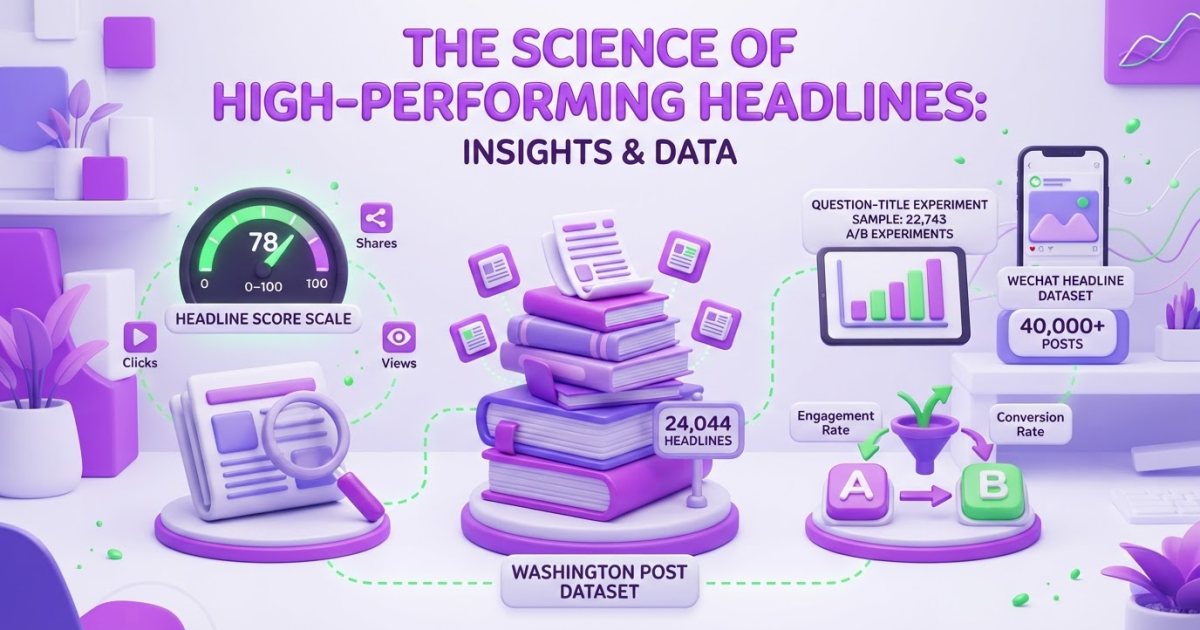
MonsterInsights Headline Analyzer is a free standalone tool that scores headlines from 0 to 100 and gives feedback on word balance, sentiment, length, and word placement. Use the score to spot obvious weaknesses, but treat it as a starting point: audience research and real headline testing matter more than chasing a perfect number.
You can write a headline that is accurate, SEO-focused, and still watch it die in search results. I’ve seen this frustrate site owners because a small wording problem can hide behind an otherwise solid article. Research using 24,044 Washington Post headlines from 8,972 experiments shows why headline choices deserve more than a quick instinct check. This guide walks you through the MonsterInsights Headline Analyzer, explains what its score means, rewrites weak examples, covers its limitations, and gives you a repeatable workflow for creating stronger titles with Roki AI.
Table of Contents
- What Is the MonsterInsights Headline Analyzer?
- How to Use MonsterInsights Headline Analyzer Step by Step
- MonsterInsights Score vs. Real-World Headline Performance
- Common Mistakes When Optimizing a Headline Score
- A Repeatable Headline Workflow for SEO and AI Search
- My honest take on the MonsterInsights Headline Analyzer
- Turn Better Headlines Into a Consistent Content Workflow
- Frequently Asked Questions
- Recommended reads
| Point | Details |
|---|---|
| Free headline scoring | The standalone MonsterInsights tool gives you an instant score out of 100 without an account, plugin installation, or paid plan. |
| Four word categories | Its word-balance analysis checks common, uncommon, emotional, and power words. |
| Directional score only | Treat the number as a diagnostic signal, not a guarantee of clicks, rankings, or conversions. |
| Test several versions | Write at least 3 to 5 distinct headline variations before choosing the final title. |
| Clarity beats gimmicks | Choose a simple, accurate headline that makes the reader’s expected benefit clear before publication. |
What Is the MonsterInsights Headline Analyzer?
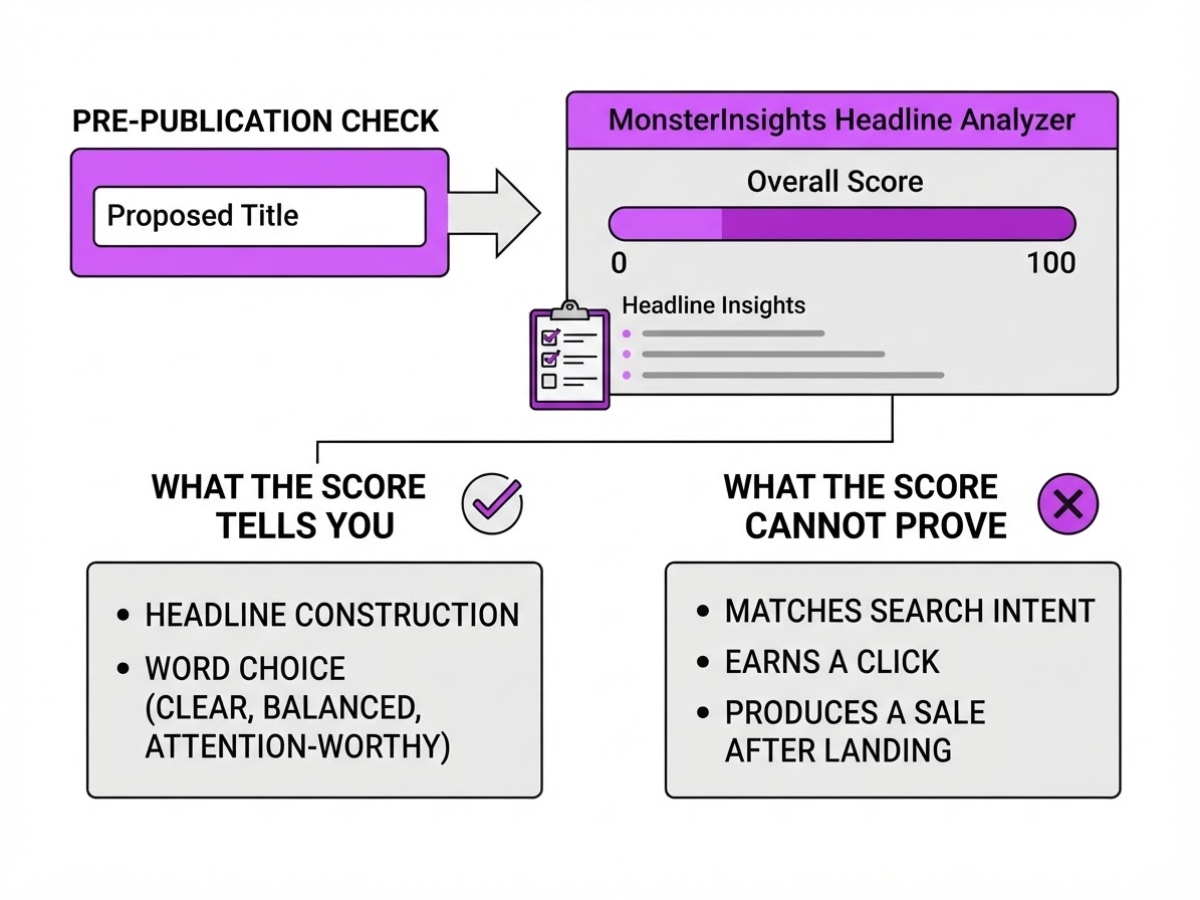
When I review headlines with our content team, I treat the MonsterInsights Headline Analyzer as a pre-publication check, not a prediction machine. You enter a proposed title, and the standalone tool returns an overall score out of 100 plus headline insights before you publish it. You can also compare it with other free SEO tools when you want a broader technical review.
The score mainly reflects headline construction and word choice. It does not tell you whether the title matches search intent, earns a click from your specific audience, or produces a sale after the visitor lands on the page. Those are separate jobs:
| Signal | What it tells you | What it cannot prove |
|---|---|---|
| Headline quality | Whether the wording is clear, balanced, and attention-worthy | That readers will choose your result |
| Search relevance | Whether the title fits the query and page topic | That it will rank for the target keyword |
| Click-through potential | Whether the promise can attract a searcher or subscriber | That the click will become a lead |
| Conversion performance | Whether the page persuades visitors to act | That the headline caused the result alone |
The analyzer’s word-balance check looks at four categories: common words, uncommon words, emotional words, and power words. A weak result can point to a title that sounds flat or vague. But chasing a higher percentage of emotional or power words can make a serious B2B headline feel inflated, and that is a mistake I see often.
You do not need an account, a WordPress plugin installation, or a paid plan to use the standalone version. That low barrier makes it useful for a publisher drafting ten titles, an SEO writer refining a page title, or a marketer preparing an email subject line. The annoyance is that the tool cannot know your brand voice, customer awareness level, or what competing results already promise.
Pro Tip: Save the exact headline, score, and revision notes in a content brief so future performance data can be compared with the initial diagnostic.
Use the score alongside search intent, audience knowledge, competitor review, and editorial judgment. The next step is to see how the analyzer evaluates a headline in practice.
How to Use MonsterInsights Headline Analyzer Step by Step
I start with the page, not the tool. Write down the article’s primary promise, the search intent behind the target keyword, and the reader’s expected outcome. A headline for “monsterinsights headline analyzer” should tell someone whether they will learn to use the tool, compare its feedback, or improve a title before publishing. If the page only covers setup, do not promise a complete traffic strategy.
-
Write and save the baseline headline. Draft the clearest version you can, then enter it into the MonsterInsights Headline Analyzer. Record the initial score before changing anything. The standalone analyzer gives an overall score out of 100 and headline insights before publication, so treat that first result as your control rather than a verdict. You can also use a free SEO title generator to produce rough alternatives, but do not let generated wording replace your judgment.
-
Read the feedback instead of chasing the number. Check the character count, sentiment, word balance, and the beginning and ending words where those details appear. MonsterInsights’ in-editor feedback includes these headline checks. The word-balance review looks at common, uncommon, emotional, and power words. That breakdown is useful, but a higher score cannot rescue a vague promise or an article that fails to deliver what the title implies.
Pro Tip: Make one plain-language version before experimenting with emotional wording; it gives you a useful control headline for comparison.
-
Create controlled variations. Change one major variable at a time: add a concrete benefit, make the outcome more specific, adjust the emotional framing, or switch the format to a how-to, list, or comparison. Keep a small note of each version and its score. Randomly replacing three or four words makes the feedback nearly useless because you will not know what caused the change.
-
Recheck every serious candidate. Compare the score, feedback categories, and plain meaning. I usually reject a clever headline if it hides the topic, sounds exaggerated, or forces an awkward keyword phrase. The winning version should accurately match the page content, not merely produce the highest number.
-
Publish the same decision everywhere it belongs. Add the selected wording to the SEO title, on-page H1, social preview, or CMS field as appropriate. These fields can differ, but accidental contradictions create unnecessary confusion. Before publishing, read the title beside the actual introduction and confirm that the promised answer appears on the page.
With a final headline chosen, you can judge whether its wording also fits the search result and the page’s broader SEO setup.
MonsterInsights Score vs. Real-World Headline Performance
A score of 82 can make a headline look finished when the page has not earned a single qualified visit. I use the MonsterInsights score as a diagnostic for wording, not as a forecast. It can flag word balance and other copy issues, but it cannot see your ranking, audience, offer, or sales funnel.
| What to check | What it tells you | Why the score cannot answer it |
|---|---|---|
| Impressions | Whether Google or another platform shows the headline | A polished title cannot compensate for weak rankings or low demand |
| Click-through rate | Whether the result earns clicks when seen | Competitor titles, snippets, and search intent change the comparison |
| Engaged sessions | Whether visitors stay, read, or take another action | Curiosity can win a click and still create an immediate bounce |
| Conversions | Whether the page produces leads, sales, or sign-ups | The highest-clicking headline can attract people who will never buy |
Context changes the result quickly. A familiar brand can use a plain headline because readers already trust it, while an unknown company needs a sharper promise. A crowded search results page rewards specificity, but a social feed can reward surprise. Mobile readers see less of the title, and someone urgently searching for “emergency plumber near me” wants a direct answer, not a clever tease.
Large datasets show why you should resist treating one number as universal truth. A Washington Post dataset of 24,044 headlines from 8,972 experiments makes headline research possible at a useful scale, yet those tests still reflect that publisher, its readers, and its distribution environment. The sample can reveal patterns. It cannot tell you that every headline scoring 90 will beat every headline scoring 70 on your site.
The same caution applies to popular headline advice. In a large Upworthy study, textual cues affected headline effectiveness, but common industry advice did not always predict the direction of the effect. I have seen teams waste hours forcing a question, number, or emotional word into a title because a checklist favored it. That usually creates awkward copy and gives the reader less clarity.
Pro Tip: For high-value pages, compare headline changes against qualified traffic and conversions, not CTR alone, because a curiosity-heavy title can attract the wrong audience.
Set your benchmark by the page’s job: reach for impressions, attention for engaged sessions, or revenue for conversions. The next section turns that principle into a practical testing routine.

Common Mistakes When Optimizing a Headline Score
The quickest way to ruin a good headline is to optimize the score instead of the reader’s decision. I have seen teams add “ultimate,” “secret,” and “shocking” to an ordinary how-to article simply because the analyzer rewarded those words. The result sounds inflated, and the opening paragraph has to work harder to rebuild trust.
Common mistakes include:
- Stuffing emotional or power words. Use them only when the article genuinely supports the feeling. “The shocking truth about email deliverability” is dishonest if the page covers routine SPF and DKIM setup. Word balance matters, but MonsterInsights’ categories are a prompt for review, not a vocabulary checklist.
- Chasing a higher number at any cost. A rewrite that moves from 74 to 88 is not an improvement if it removes the audience, topic, or outcome. “Better Analytics Tips” may score well, but “How to Track Ecommerce Sales in GA4” tells the right reader much more.
- Creating a vague curiosity gap. “You Won’t Believe What Your Blog Is Missing” can earn a click while failing the searcher who wants a concrete answer. That mismatch creates a quick exit and leaves the introduction trying to explain what the headline should have said.
- Treating character guidance as a ranking rule. Search snippets, mobile screens, browser tabs, social previews, and AI interfaces display titles differently. Keep the title concise, but do not delete an essential qualifier just to fit an inflexible range. Check the result in a free online SEO title generator, then judge it against the actual page.
- Turning every headline into a question. Questions can fit an informational query, but they are not a universal engagement trick. A 2026 study found that question-framed titles reduced engagement across four studies, so use one only when the page clearly answers it. Headline simplicity has also been linked to more clicks and better reader recall.
Finally, audit the promise across the headline, introduction, body, and call to action. If the title promises a five-step fix but the page offers a general overview and a product pitch, no score can repair that gap.
With those traps out of the way, you can use the score as one input in a more practical headline review.
A Repeatable Headline Workflow for SEO and AI Search
Every headline should earn its place by matching the query, the reader’s problem, and the action you want next. I use that brief before opening any analyzer. Otherwise, the score starts driving the strategy, and you end up with a polished title for the wrong page.
Before I draft, I write one sentence such as: “A small business owner searches this phrase because checkout conversions are falling and needs a practical fix.” That sentence keeps SEO intent, reader context, and the intended action together. It also gives AI search systems a clearer relationship between the query and the page.
I then create three to five candidates, with each one taking a different route:
- Drafting day: Write a direct-benefit headline, a specific-outcome version, a comparison, a process title, and an audience-qualified option. For example, “How to Improve Checkout Conversions” is broad, while “7 Checkout Fixes That Can Recover Lost Sales” makes the outcome and format clearer.
- The same day: Run every candidate through the MonsterInsights Headline Analyzer. I look for obvious problems in length, sentiment, and word balance, rather than treating the highest score as the winner. MonsterInsights checks common, uncommon, emotional, and power words, which makes weak phrasing easier to spot.
- Before publication: Apply human judgment. Remove claims the article cannot support, reject empty curiosity, and choose the version that sounds distinct from competing results. MonsterInsights 11.1.0 can also generate scored alternatives, but the feature still needs editorial review, especially when several suggestions sound interchangeable.
- Publication day: Add the chosen headline, analyzer score, publication date, target query, impressions, click-through rate, engagement, and conversions to a simple content log. I also record the rejected angle when it teaches us something. A spreadsheet is enough, although teams often overlook it because entering the data feels tedious.
- After meaningful traffic: Review the page once it has accumulated enough impressions to show a pattern. I usually want at least 1,000 search impressions before changing a title, unless it clearly misrepresents the page. Change one headline, preserve the original metrics, and compare the next period rather than rewriting it every few days.
Roki AI makes this less of a one-off editing task. We can turn the query, headline options, publishing date, and performance notes into recurring tasks, then use weekly priorities to decide which pages need a new angle, stronger content, or no intervention. That matters because a headline score without a follow-up habit is just a number. The next step is connecting those decisions to broader traffic and conversion data.
My honest take on the MonsterInsights Headline Analyzer
I run Roki AI, and I see the MonsterInsights Headline Analyzer as an editing checkpoint, not a headline strategy. I use it to catch obvious problems and make a team compare several versions before publishing. That alone is useful, especially when everyone has become too close to a draft.
Here’s my contrarian view: chasing a near-perfect score can make your headline worse. The safest mix of common words, emotional terms, and “power” words may score well, but it can also sound generic or slightly theatrical. A specialist reader may trust a precise headline less if it reads like a sales pitch. Distinctive and credible often beats polished and predictable.
I would define the reader, search query, promise, and business outcome first. Then I would test the headline in MonsterInsights and keep the clearest accurate version, even when a flashier alternative gets the higher score. The tool cannot tell you whether the promise matches the page or attracts qualified visitors instead of curiosity clicks.
For me, the real test is what happens after publication: search visibility, relevant traffic, and conversions. I use Roki AI to keep those content decisions consistent across the broader workflow, but I would never let a score replace judgment.
— Daniel
Turn Better Headlines Into a Consistent Content Workflow
A strong MonsterInsights headline score helps, but it cannot fix a thin article, a neglected page, or a missing distribution plan. I have seen teams spend 20 minutes polishing a title and then publish without checking whether the content answers the searcher’s actual question. That is backwards.
Use the analyzer to sharpen your headline, then let Roki AI help organize the work around it. Roki creates website content on autopilot and gives you 3 to 10 weekly tasks, such as improving existing pages, planning new articles, and finding relevant Reddit conversations where your site can genuinely help. The task list is useful, though it still needs human judgment. Some suggestions will not fit your audience.
For a closer look at the workflow, review Roki AI’s content and visibility features. The point is not to remove your decisions. It is to make good ones repeatable across every article.
Frequently Asked Questions
Yes. The standalone MonsterInsights Headline Analyzer is presented as free, and you can use it without creating an account, installing the plugin, or choosing a paid plan. That makes it useful for a quick check, although you still need other tools for keyword research and search results analysis.
A higher score can show that your headline matches the tool’s preferred patterns, but no score guarantees clicks or rankings. Treat the number as a comparison signal, then check whether the headline is accurate, clear, and aligned with the reader’s search intent.
It can help you refine an SEO title by flagging issues with length, sentiment, and word balance. However, it does not replace keyword research, SERP analysis, or checking that the title accurately describes the page’s content.
The in-editor MonsterInsights experience can provide AI-generated headline alternatives with individual scores for eligible plans. The standalone analyzer is mainly for reviewing a headline you have already drafted, so you should not expect it to produce a complete list of ideas from one click.
Revise it when the score points to a real problem with clarity, length, or word balance, but do not weaken a precise headline just to chase a higher number. Write 3 to 5 alternatives and choose the version that best serves the reader and the page’s objective.
Written by Daniel/Aleksandra.
Recommended reads
- Free Online Seo Title Generator
- Blog Article Example How To Write One That Works
- How Roki Ai Streamlines Your Seo Content Workflow
- Best Web Traffic Analyzer Free Tools In 2026
Sources
- Headline Analyzer
- Introducing the NEW MonsterInsights Headline Analyzer
- [NEW] AI-Powered Headline Suggestions and Redesigned Reports
- How to Write an SEO Title Tag (Best Practices + Examples)
- Reading dies in complexity: Online news consumers prefer simple writing
- The Language That Drives Engagement: A Systematic Large-scale Analysis of Headline Experiments
- Titles framed as questions reduce reader engagement
- The Impact of Headline Characteristics on Clicks: A Case Study of a Chinese Local Medium
- Lessons learned: Keep your headlines simple, stupid