Daniel D.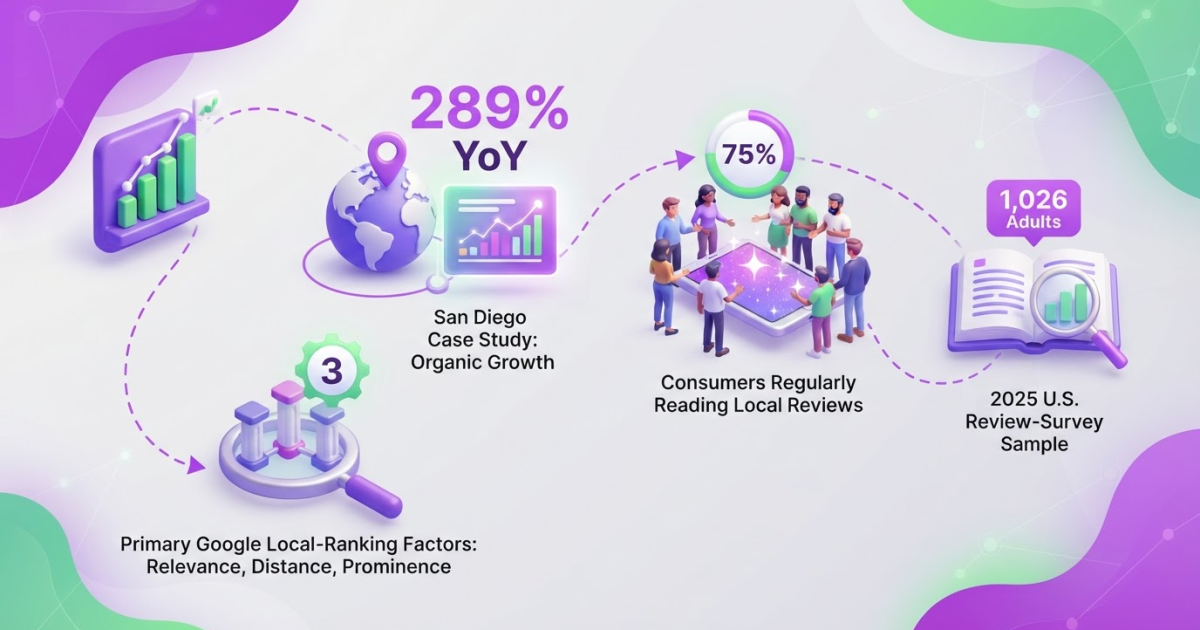
A San Diego SEO agency should improve local visibility through Google Business Profile optimization, location-focused content, technical SEO, reviews, authority building, and conversion tracking. Compare agencies by their process, reporting, and business outcomes, then use tools such as Roki AI’s 3 to 10 weekly SEO tasks to keep execution moving.
Running a business in San Diego means competing block by block, from North Park to La Jolla, while dozens of firms in your industry chase the same searches. Generic blog posts rarely solve that problem when your Google Business Profile, reviews, service pages, and lead tracking need equal attention. Seventy-five percent of consumers said they always or regularly read online reviews when researching local businesses in BrightLocal’s 2024 survey, so reputation can decide whether visibility turns into a call. This guide shows you how to choose a San Diego SEO agency, audit local search fundamentals, build a 90-day plan, measure calls and leads, and use TryRoki for supporting work without handing over strategic judgment.
| Point | Details |
|---|---|
| Audit Local Foundations | Check Google Business Profile completeness, location consistency, service pages, technical access, and conversion tracking before approving a 12-month SEO retainer. |
| Prioritize Buyer Intent | Build pages around the San Diego services and areas most likely to generate qualified calls, forms, bookings, or store visits instead of chasing high-volume keywords. |
| Measure Business Outcomes | Track rankings alongside calls, website clicks, direction requests, qualified leads, and revenue by service and location every month. |
| Demand Useful Content | Require every published page to answer one real customer question, demonstrate local expertise, and provide a clear next step. |
| Scale Execution Carefully | Use automation for research, drafting, and task management while keeping local facts, claims, and final editorial judgment human-led across 3 to 10 weekly tasks. |
What a San Diego SEO Agency Actually Does
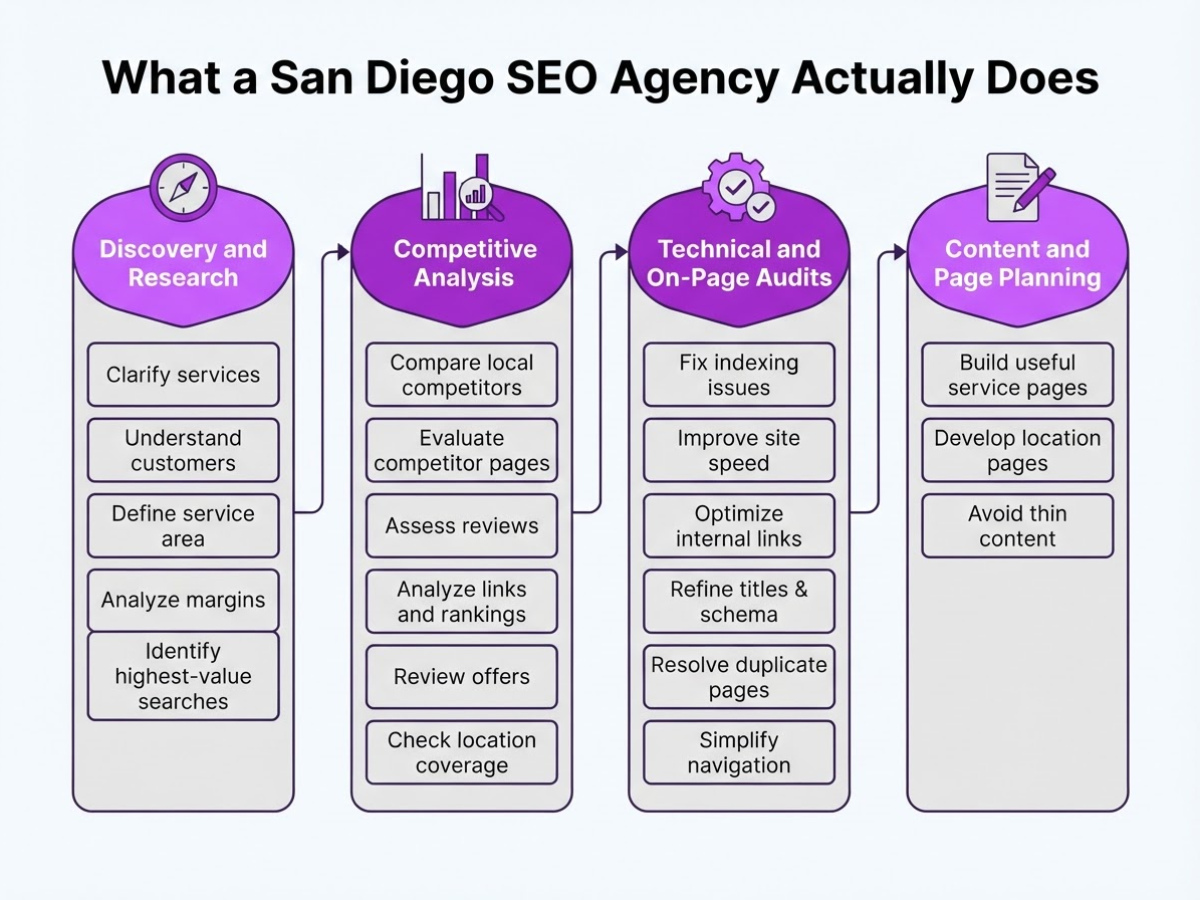
A San Diego SEO agency should do more than publish blog posts or repair broken links once. It connects local SEO, traditional organic search, Google Business Profile visibility, and conversion work so the right customer can find you and take action.
The work usually includes:
- Discovery and research: Clarify your services, customers, service area, margins, and highest-value searches.
- Competitive analysis: Compare local competitors’ pages, reviews, links, rankings, and offers. A competitor ranking above you may have better location coverage, not better service.
- Technical and on-page audits: Fix indexing, speed, internal links, titles, schema, duplicate pages, and confusing navigation.
- Content and page planning: Build useful service and location pages instead of stuffing the site with near-identical neighborhood copy. Google recommends helpful, reliable, people-first content.
- Local authority work: Improve your Google Business Profile, review process, citations, relevant links, and business details.
- Conversion optimization and reporting: Strengthen calls to action, forms, phone tracking, and landing-page paths, then report on calls, direction requests, website clicks, rankings, and qualified leads.
Google says local results rely mainly on relevance, distance, and prominence. San Diego is a collection of smaller search markets, not one uniform territory. A plumber in Chula Vista, a dentist in La Jolla, and a home remodeler serving North County face different competitors, customer intent, and proximity limits. One broad “San Diego” page rarely handles all three jobs well.
| Agency deliverable | Business outcome it can influence |
|---|---|
| Optimized profile and citations | More accurate local discovery |
| Service and location pages | More relevant organic traffic |
| Review and link campaigns | Greater trust and authority |
| Tracking and reporting | Better decisions about leads and budget |
The distinction matters: an agency controls research, implementation, testing, and reporting. It does not control rankings or lead volume. Competition, site quality, search demand, your team’s approval speed, and sales follow-up all affect results. Promises of guaranteed rankings usually signal a packaged task list, not a serious growth program.
Pro Tip: Ask an agency to show how one target query will move from search intent to page brief, optimization, conversion path, and measurement before signing.
Expect an ongoing program with monthly priorities and regular adjustment, not a one-time technical fix. The next question is what that program should cost and include.
Is Hiring One Right for Your San Diego Business?
The right moment to hire a San Diego SEO agency depends less on company size than on whether your business can turn search demand into revenue. I look for a clear offer, a working sales process, and someone who can answer a qualified local lead quickly.
You are probably a good fit if you run:
- A service business serving areas such as North Park, La Jolla, Chula Vista, or Carlsbad
- Multiple locations that need distinct Google Business Profiles and location pages
- A professional practice where one new client has substantial lifetime value
- A hotel, restaurant, venue, or other hospitality brand competing for local bookings
- A company facing established competitors for valuable San Diego searches
A trial law firm in San Diego reported a 289% year-over-year increase in organic traffic after combining content, on-site SEO, and off-site authority work. Traffic alone does not guarantee cases, reservations, or signed contracts, but the example shows why an integrated program can make sense when each new customer is worth thousands of dollars.
Hiring an agency is premature when your offer is still unclear, your forms or phone tracking do not work, or nobody has time to respond to inquiries. Website access problems matter too. If the developer will not provide hosting, CMS, analytics, or Business Profile access, an agency can spend its first month chasing permissions instead of improving visibility.
Pro Tip: Calculate the maximum acceptable monthly SEO investment from gross profit per new customer and the number of additional customers required to break even.
Decide what you actually need before buying a package:
| Need | Typical agency role |
|---|---|
| Strategy | Research, priorities, and a local growth plan |
| Production | Pages, content, citations, and ongoing updates |
| Technical support | Indexing, speed, tracking, and site fixes |
| Reputation | Review requests, responses, and profile accuracy |
Ask about monthly reporting, account and content ownership, response times, approval steps, and who makes technical changes. Expect meaningful local SEO progress to take several months, not two weeks. The next decision is finding an agency whose process matches that timeline and your internal capacity.
How to Build a 90-Day Local SEO Plan
A 90-day plan keeps your San Diego SEO agency focused on work that can change rankings, qualified leads, and booked jobs. Assign one owner for approvals, one for implementation, and one person who checks the numbers. Without clear ownership, even good recommendations sit in a project tool for six weeks.
- Days 1–30: establish the baseline. Record rankings for priority services such as personal injury law, emergency plumbing, or dental implants, along with organic sessions, form leads, tracked calls, and revenue where possible. In Google Business Profile, capture calls, website clicks, and direction requests, which are included in Google’s performance reporting. Review technical errors, indexation, page speed, mobile issues, title tags, review count and rating, competitors in the local pack, and the services that produce the best margin.
Map every target keyword to one primary URL before changing copy. “San Diego plumber” might belong to the main service page, while “emergency plumber in San Diego” deserves a distinct page only if the offer and search intent differ. Do not publish ten nearly identical pages for La Jolla, Clairemont, and Pacific Beach. Thin neighborhood pages frustrate visitors, compete with one another, and create maintenance work with little ranking value. Google’s guidance favors content that is helpful, reliable, and people-first, not location words pasted into a template.
Pro Tip: Create a single baseline dashboard before making changes so the team can distinguish real growth from seasonal demand or tracking changes.
-
Days 31–60: fix the commercial foundation. Rewrite priority service and location pages around real customer questions, proof, pricing context, service areas, and clear next steps. Strengthen internal links from relevant articles and the main navigation. Resolve accidental noindex tags, duplicate canonicals, redirect chains, broken pages, and slow templates. Then review Business Profile categories, services, hours, photos, and service descriptions. Start a review request process tied to completed jobs, with a simple email or text sent within 24 to 48 hours. Never ask only delighted customers or script identical reviews.
-
Days 61–90: earn attention and test conversion. Publish useful local content based on questions your team hears, such as permit requirements, seasonal maintenance, or neighborhood-specific service constraints. Google’s local rankings rely mainly on relevance, distance, and prominence, so pursue relevant partnerships with trade groups, local nonprofits, suppliers, and credible San Diego directories rather than buying random citations. Test call buttons, form length, trust signals, and appointment language, then identify pages that deserve additional authority from internal links or legitimate outreach.
Keep a weekly rhythm: Monday reviews priorities and approvals, Tuesday publishes or updates pages, Wednesday updates the Business Profile, Thursday handles outreach and review requests, and Friday reports rankings, traffic, leads, calls, and completed tasks. A local SEO program should produce decisions every week, not just a monthly spreadsheet. From there, judge which results justify deeper investment and which tactics need to be cut.

Agency, Freelancer, or In-House SEO: Which Model Fits?
The delivery model affects more than your monthly invoice. As a company owner, I look first at who will make decisions, who will do the work, and what happens when technical fixes, content, reviews, and local listings all compete for attention.
| Model | Usually strongest for | Main trade-off |
|---|---|---|
| Agency | Multi-channel strategy, reporting, technical SEO, content, and local growth | Higher fees and possible account-team changes |
| Freelancer | Direct access, focused expertise, and flexible project work | Limited capacity and fewer backup specialists |
| In-house team | Fast collaboration and deep knowledge of your customers and operations | Hiring cost and gaps across SEO disciplines |
| Hybrid | Internal expertise paired with outside strategy or technical support | Requires clear ownership and tighter coordination |
An agency earns its fee when you need several specialists working from one plan. Mature agencies normally have repeatable audits, reporting routines, editorial processes, and someone accountable for connecting rankings to leads. The frustration is real, though: some clients speak to an account manager who cannot answer technical questions, while specialists rotate behind the scenes.
A freelancer can be the better choice for one site, a defined technical cleanup, or a local campaign that needs fast decisions. You usually get direct access and sharper subject knowledge. Capacity becomes the risk when a site migration, content backlog, and Google Business Profile work land in the same month.
An in-house team knows your sales process, locations, margins, and seasonal demand. Collaboration is quick, but one hire rarely covers technical SEO, content, digital PR, analytics, and local listings well. Salary, benefits, tools, and management time also cost more than the job title suggests.
Hybrid setups often work best for growing businesses: keep customer and subject-matter knowledge inside, then bring in outside strategy, technical support, or content operations. Use free SEO tools for lightweight checks, but do not mistake a tool for an accountable operator.
Score your options from 1 to 5 on budget, monthly execution capacity, technical complexity, number of locations, and lead value. Low budget and one location may suit a freelancer. High technical complexity, multiple locations, and expensive leads usually justify an agency or hybrid team. Do not choose on the lowest fee or the biggest promise; choose the model that can actually finish the work.
Next, match that choice to the results and reporting a San Diego business should expect.
How to Judge Results Without Chasing Vanity Metrics
A useful SEO report should answer one business question: is search producing more qualified demand at an acceptable cost? Rankings matter, but a single keyword position cannot represent local search performance. Google weighs relevance, distance, and prominence, so your visibility can change by neighborhood, device, search intent, and competitor activity.
Start with leading indicators. These show whether the work is moving before revenue catches up:
- Days 1 to 30: Track technical issues resolved, priority pages indexed, completed content milestones, and baseline impressions. Confirm that important service and location pages are crawlable, useful, and visible in Search Console.
- Days 31 to 90: Add local pack visibility, branded versus non-branded impressions, review velocity, and clicks from target areas. Review velocity means the number and quality of new reviews over time, not a one-week spike caused by an awkward request to every customer.
- At 90 days: Compare qualified calls, form submissions, bookings, and direction requests with the baseline. Google Business Profile reporting measures calls, website clicks, and direction requests as customer actions, so your agency should include those figures rather than burying them under average position.
- At six months: Evaluate assisted conversions, customer acquisition cost, closed revenue, and revenue by service line. If leads increased but sales did not, inspect call quality, response time, pricing, and booking friction before blaming SEO.
Require segmentation in every monthly report. Break results down by service, location, device, branded versus non-branded queries, and new versus returning visitors. A rise in branded traffic can show stronger awareness, but it does not prove the agency won new demand. Likewise, mobile direction requests can matter more than desktop clicks for a local contractor.
The agency should add commentary, not just export charts: what changed, what was learned, what underperformed, what happens next, and what you must approve. At the 90-day review, continue, revise the plan, or end the engagement. At six months, make the same decision using qualified pipeline, acquisition cost, and revenue, not promises about future rankings.
With that evidence in hand, judge whether the proposed work deserves more budget and attention.
My Honest Take on Hiring a San Diego SEO Agency
I run TryRoki, and I treat choosing an SEO agency as an operating decision, not a marketing purchase. The right partner should show you how demand becomes pages, how those pages earn trust, and how visitors turn into calls, bookings, or sales. If the agency cannot connect its work to customer actions, monthly ranking reports are mostly decoration.
My less popular view is that publishing more content is often the wrong first move. A business with vague positioning, thin service pages, broken conversion tracking, or an incomplete Google Business Profile should fix those issues before adding 20 new articles. I have seen teams spend weeks producing posts while their most valuable local page gives prospects no clear reason to call. That is not a content problem.
Automation can make consistent execution more practical, but it should support local judgment rather than imitate it. At TryRoki, I value systems that surface useful tasks and reduce repetitive research, while still leaving room for someone who understands San Diego customers, neighborhoods, and buying habits. The agency I would hire explains trade-offs, owns the measurement, and tells me what not to do. I would avoid anyone promising instant dominance for every San Diego keyword, because that promise usually hides weak prioritization and poor accountability.
I use three checks before recommending an agency:
- Can it connect a page or profile change to a customer action?
- Does someone with local context review claims, offers, and neighborhood details?
- Will the team explain what it will not do, not just list monthly deliverables?
— Daniel/Aleksandra
Turn the SEO Plan Into a Consistent Weekly Workflow
A San Diego SEO agency can set the strategy, but execution usually breaks down between client calls, content approvals, and the next urgent task. I built TryRoki for that gap. It can help generate website content, find relevant Reddit discussions where a thoughtful mention may fit, and assign 3–10 weekly tasks focused on visibility in Google and AI search engines. Use TryRoki to keep your SEO work moving without treating it as a replacement for your strategist.
The trade-off is important: the tool cannot add genuine local knowledge or approve claims for you. You still review the drafts, explain what matters to San Diego customers, and measure qualified leads rather than vanity traffic. Start with one service area, one audience, and a defined weekly workflow. If Reddit research is your bottleneck, find relevant discussions with TryRoki, then expand only after the process proves useful.
A practical weekly setup looks like this:
- Monday: review the task queue and approve priorities.
- Wednesday: check drafts, local facts, and links before publishing.
- Friday: record completed work, leads, and questions for the next week.
Frequently Asked Questions
A San Diego SEO agency typically charges about $1,000 to $5,000 per month, depending on competition, location count, technical complexity, content, and authority work. Compare monthly deliverables, actual execution capacity, account ownership, and measurement instead of choosing the cheapest package, since vague “activity” often produces little business value.
Technical fixes and Business Profile updates can produce early signals within 2 to 6 weeks, but meaningful local growth usually takes 3 to 6 months of consistent work. Your timeline depends on the site’s starting condition, local competition, demand, authority, and how quickly you approve recommended changes.
Look for defined deliverables, reporting access, approval responsibilities, cancellation terms, account and content ownership, response expectations, and a clear statement that rankings are not guaranteed. A contract should tell you what happens each month, because promises of a fixed position or vague “optimization” create frustration after the first 30 days.
Yes, especially if you can spend 3 to 5 hours each week keeping business information accurate, publishing useful service content, requesting reviews appropriately, and tracking qualified leads. An agency earns its fee when competition, technical issues, multiple locations, or limited owner time makes that routine impossible to maintain.
AI can help with research, drafting, and workflow management, but generic content rarely builds durable trust or produces qualified calls on its own. Add firsthand knowledge, verify every claim, protect customer privacy, and review results after at least 8 to 12 weeks, because publishing 50 thin pages is often worse than publishing 5 genuinely useful ones.
Written by Daniel/Aleksandra.
Recommended reads
- Free Seo Tools
- How Roki Ai Streamlines Your Seo Content Workflow
- Creating High Quality Seo Content With Roki Ai
- Avoiding Common Ai Content Mistakes For Better Seo
Sources
- San Diego Trial Firm Increased Organic Traffic by 289% Year-Over-Year
- Local Consumer Review Survey - BrightLocal
- Local Consumer Review Survey 2024: Trends, Behaviors, and Platforms Explored
- Tips to improve your local ranking on Google - Google Business Profile Help
- Understand your Business Profile performance & insights - Google Business Profile Help
- Local Business (LocalBusiness) Structured Data | Google Search Central
- 2023 Local Search Ranking Factors Report from Whitespark – Increase local SEO rankings
- SEO Starter Guide: The Basics | Google Search Central | Documentation | Google for Developers