
Low Competition Keywords: How to Find and Use Them Effectively
 > TL;DR: Low competition keywords have lower difficulty scores, making it easier and faster to rank for them, especially when you focus on longer, more specific phrases. Targeting these keywords can drive relevant traffic without constantly fighting bigger sites. But don’t get complacent—some low competition keywords still require careful content strategy to convert well.
Written by Daniel Dimov.
Trying to rank for popular keywords is a brutal slog. You’re up against websites with huge budgets, long-established authority, and more content than you can manage. Yet around 25% of keywords still see lower competition, offering real chances to make your mark without spending months in the trenches. Finding these keywords isn’t always straightforward, though. You need to balance search volume with how crowded the field is without falling into traps like “keyword cannibalization.” This guide breaks down how to identify genuinely low competition keywords and fold them into your content so you get better results with less burnout.
Written by Daniel Dimov.
| Point | Details |
|---|---|
| Keyword Distribution | About 25% of keywords have low competition (KD < 30) as of 2024, so don't ignore them. |
| Long-tail Advantage | Long-tail keywords tend to have 80% less competition than short-tail ones, making them easier to rank for. |
| Faster Ranking | Low competition keywords often rank within weeks because fewer high-authority sites compete. |
| Avoid Cannibalization | Roughly 55% of marketers struggle with keyword cannibalization, which tanks ranking efforts. |
| Domain Authority | Keywords with high competition usually need domain authority above 40 to perform well. |
Written by Daniel Dimov.
What Are Low Competition Keywords and Why They Matter
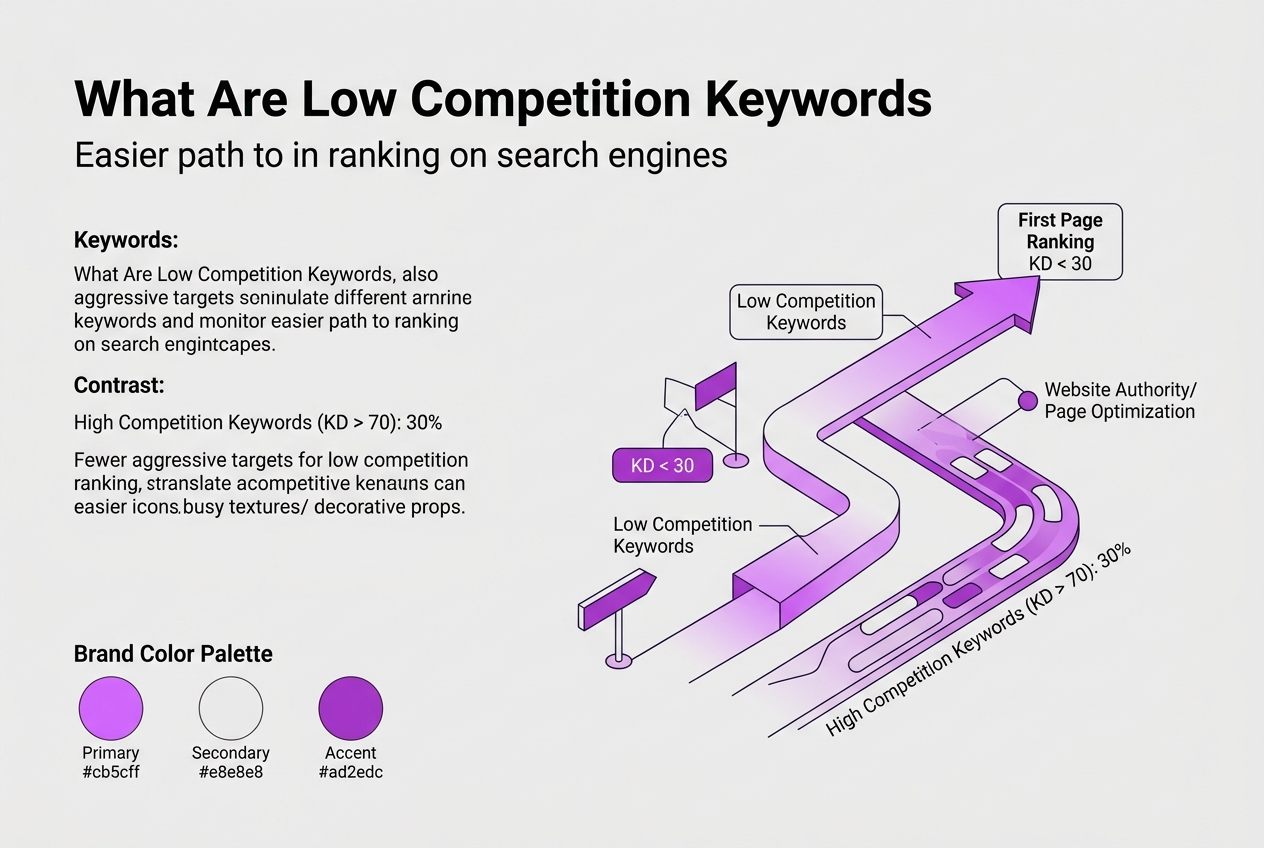
Keyword difficulty, or KD, is a score that signals how hard it is to rank for a particular keyword on search engines. Typically, this score ranges from 0 to 100. A keyword with a KD below 30 is considered low competition, meaning fewer websites are aggressively targeting that term. This low competition often translates into an easier path to ranking on the first page of Google and other search engines.
Competition metrics factor in several elements, such as how many other sites are ranking for the keyword, their authority, and how well-optimized those pages are. Essentially, these metrics estimate the ranking difficulty you’ll face compared to other sites. This is where many content creators stumble: they pick keywords with deceptively high competition and end up wasting time and resources without meaningful traffic returns.
Prioritizing low competition keywords can accelerate your SEO gains by allowing you to capture niche but highly relevant traffic faster. Instead of battling big players for broad keywords, you focus on areas where your content can realistically shine. This strategy also helps to avoid keyword cannibalization, which nearly 55% of marketers flagged as a top SEO headache in 2024.
Here’s a quick snapshot of keyword competition distribution in 2024:
| Competition Level | Keyword Difficulty (KD) Range | Percentage of Keywords |
|---|---|---|
| Low Competition | 0 - 29 | 25% |
| Medium Competition | 30 - 70 | 45% |
| High Competition | 71 - 100 | 30% |
What's surprising is that despite a good chunk (30%) of keywords being high competition, about 60% of these keywords do get ranked on the first page within 3 to 6 months after serious optimization. However, that generally demands strong domain authority—something smaller sites often lack.
Pro Tip: Pro Tip: Always verify competition scores across multiple tools to avoid misleading metrics.
For those adopting AI-driven content creation platforms like TryRoki, focusing on low competition keywords creates a realistic foundation. The AI can help identify these pockets and generate content that is tailored and timely without getting lost in oversaturated keyword battles.
Understanding these basics sets the stage for showing how to identify and target these keywords effectively with practical tools and strategies, which we’ll explore next.
How to Identify Low Competition Keywords Using Data-Driven Tools
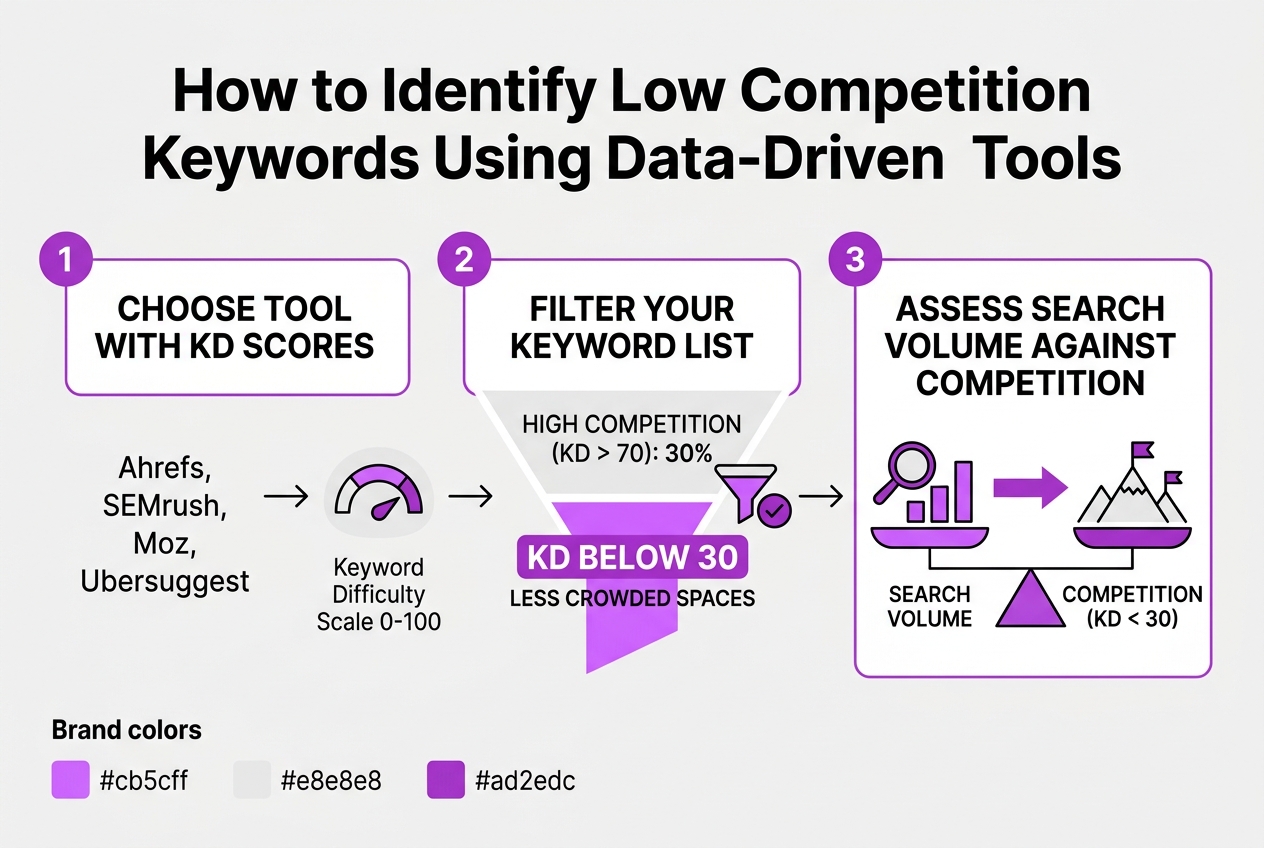
Discovering low competition keywords requires more than guesswork; you need reliable data paired with a smart strategy. Here’s how you can methodically find these opportunities using popular tools and sensible filters:
-
Choose a Keyword Research Tool with KD Scores. Tools like Ahrefs, SEMrush, Moz, and Ubersuggest provide Keyword Difficulty (KD) scores, usually on a scale from 0 to 100. Aim for keywords with a KD below 30, which typically indicates less crowded spaces you might compete in.
-
Filter Your Keyword List. After generating a broad list, narrow it down by setting a KD filter under 30. This step weeds out overly competitive terms that are hard to rank for without high Domain Authority or backlinks.
-
Assess Search Volume Against Competition. Don’t just chase low competition; balance it with meaningful search volume. A keyword with very low competition but only 10 monthly searches won’t justify the effort. Target those with at least moderate volume (e.g., 100+ monthly searches) but still low KD.
-
Leverage Long-Tail Keywords. These longer, more specific phrases often have 80% lower competition than short-tail terms. They attract smaller but more targeted audiences, improving your chances to rank and convert. For example, "affordable ergonomic office chairs for back pain" instead of just "office chairs."
-
Monitor Competition Over Time. Keyword difficulty isn’t static. Popularity can spike, and competitors might jump in. Regularly revisit your keyword rankings and adjust your focus. Some tools let you set alerts for shifts in KD or competitor activity.
-
Automate Discovery with AI Tools Like TryRoki. Manual research can be tedious and easy to overlook promising keywords. Platforms like TryRoki help automate keyword detection and even generate related content ideas, accelerating your workflow and helping bypass common oversights.
Pro Tip: Pro Tip: Use keyword cannibalization reports to avoid internal ranking conflicts when selecting multiple related keywords.
Finding the right mix of low competition and decent traffic isn't foolproof, and occasionally you’ll have to test keywords in practice to gauge real results. But following these steps consistently will significantly improve your keyword strategy and content ROI.
Understanding keyword difficulty and search volume is just the start. Next, we’ll explore how to integrate these keywords seamlessly into your content to maximize their potential.
Written by Daniel Dimov.
Crafting Content That Ranks for Low Competition Keywords

Creating content that ranks for low competition keywords demands a tight focus on relevance and clarity. Here’s how you can nail it:
-
Choose topics that naturally fit your low competition keywords. Don't force keywords into unrelated content just to get traffic. Instead, find angles that genuinely relate to what people search for around those terms.
-
Write deeply about the chosen topic. This means addressing the core questions, pain points, or needs your audience has. Low competition doesn’t mean low effort. In fact, detailed content often ranks quicker because it satisfies search intent clearly.
-
Ensure your SEO basics are on point but tailored. Use the low competition keyword in your title, headings, and meta tags, but avoid overstuffing. Your titles should be compelling and naturally incorporate the keywords to attract clicks.
-
Build topical clusters around your main keywords. This means creating several pieces of content that link to each other around a central theme. It reinforces your authority on the subject without making your pages compete for the same keyword, which is a common mistake called keyword cannibalization.
-
Use tools like TryRoki to help plan and generate your content outlines. AI tools can save tons of time and help maintain quality across large volumes of content, especially when you need to scale quickly without dropping the ball on relevance.
Pro Tip: Pro Tip: Integrate low competition keywords within natural language, avoiding keyword stuffing to satisfy AI-based search algorithms.
Low competition keywords are a chance to start ranking faster, but only if your content is laser-focused and well structured. Tools can help, but the real work is in aligning content with searcher intent and building a supporting cluster of related articles.
Next, we’ll explore how to track and measure the effectiveness of your low competition keyword strategy to keep improving your rankings.
Written by Daniel Dimov.
Common Mistakes to Avoid with Low Competition Keyword Strategies
Tackling low competition keywords might seem like an easy win, but there are plenty of traps that catch people off guard. Here are the most common mistakes I've seen that wreck your keyword strategy:
- Ignoring Search Intent: Focusing purely on keywords without understanding what users want leads to poor engagement and high bounce rates. You might rank, but nobody sticks around.
- Overlooking Keyword Cannibalization: Having multiple pages competing for the same keyword dilutes your authority and confuses search engines. This is a huge issue—over half of marketers highlight it as a major problem.
- Picking Keywords with Low Search Volume: Targeting keywords nobody searches for might get you rankings but little traffic.
- Not Updating Content: Keywords and search trends evolve. Stagnant content quickly loses relevance and ranking power.
- Sticking Only to Low Competition Keywords: As your website gains authority, ignoring higher-volume keywords becomes a missed opportunity for bigger gains.
The trickiest mistake is ignoring search intent. You might find an easy keyword with low competition, but if your content doesn’t give the user what they’re actually searching for, you’ll see little benefit. For example, if a keyword implies informational intent but your page is sales-focused, visitors will bounce.
Keyword cannibalization is a silent killer of SEO campaigns. I’ve worked with clients who had several articles fighting for the same keyword. Instead of adding up, they dragged each other down. Merging or distinct targeting fixes this but requires time and careful auditing.
Also, low search volume keywords can be a false friend. I once wasted weeks optimizing for a phrase that barely anyone searched for. It ranked well but delivered no leads. Balance is key.
Content needs constant care. Even if you rank initially, competitors adapting to new trends can steal your spot. Refresh your content regularly — updating facts, stats, and relevance.
Finally, once your domain authority grows, don’t forget to also target moderate or even higher competition keywords. Ignoring these means you’re leaving valuable traffic on the table.
Avoiding these mistakes will make your low competition keyword strategy clearer and more effective. Next, let’s explore how to measure the real potential of those keywords beyond just ranking.
Written by Daniel Dimov.
Measuring Success: How Low Competition Keywords Impact SEO Results
Tracking success with low competition keywords requires patience and realistic expectations. While high competition keywords might show substantial rank shifts within 3–6 months, low competition keywords generally move faster but not overnight. Here's a rough timeline to consider:
-
Weeks 1-2: Initial Indexing and Baseline Metrics
At this stage, search engines discover your optimized pages. You'll start recording baseline rankings, traffic, click-through rate (CTR), and early user behavior to set a reference point. -
Month 1: Early Ranking Movements
Low competition keywords often begin ranking on page two or three during this period if your domain authority is moderate. Sites with higher authority push these rankings further up faster. -
Months 2-3: Noticeable Position Gains
Expect to see your keyword rankings enter the first page brackets, especially for long-tail variants with 80% lower competition than head terms. Traffic and CTR usually ramp up here, providing clearer signals of organic interest. -
Months 4-6: Conversion Impact Analysis
By now, enough consistent traffic allows you to assess how well these keywords contribute to conversions. Tracking conversion rates alongside rankings tells you if your content attracts the right audience. -
Beyond 6 Months: Stabilization and Expansion
Keywords with sustained performance can justify expanding content around related low competition terms or branching into medium competition areas.
Key SEO metrics to monitor through this timeline include:
- Keyword Rankings: Are you moving closer to page 1?
- Organic Traffic: Is the steady climb in visitors matching ranking improvements?
- Click-Through Rate (CTR): Are impressions converting into clicks?
- Conversions: Are you meeting your business goals from this traffic?
Keep in mind, domain authority (DA) still matters. In 2024, 75% of top results for competitive keywords shared a DA above 40. While low competition keywords are easier, a weak domain means the ranking progress can stall or take longer than expected.
In one case with a DA of 25, a client using low competition keywords saw page 1 entry around 3 months but needed until Month 5 to approach top 5 rankings consistently. That patience paid off with a 30% traffic increase over six months.
To take the friction out of this monitoring, TryRoki provides task notifications and real-time progress tracking so you don’t miss a beat as your rankings shift. By automating these updates, you can focus more on content and less on manual checking. See TryRoki features to explore how to integrate these tools into your SEO routine.
Understanding these milestones helps set realistic goals for low competition keyword strategies. Next, we’ll examine expert insights to sharpen your approach further.
Written by Daniel Dimov.
My honest take on targeting low competition keywords
Low competition keywords get a lot of buzz as the “easy win” for SEO beginners or small websites. But here’s a reality check from someone who’s been deep in this battle: focusing only on those low-hanging fruits will stunt your organic growth over time. Yes, they’re less competitive and yes, they’ll start bringing in traffic quickly. However, they often lack the search volume and user intent strength that higher competition keywords bring, which means limited long-term payoff.
The sweet spot is a blend. Start strong with low competition terms to build your site’s authority and get some quick wins under your belt. But don’t get comfortable there. Gradually layer in medium to higher competition keywords as your content arsenal and trustworthiness grow.
Another pitfall I see is manual keyword hunting—scouring Google for hours trying to guess which low competition terms might work. It’s slow and often misses trends or nuances. That’s where AI-assisted tools like TryRoki shine, helping you automate this process with data-driven insights. It lets you be quicker and smarter about where you place your efforts.
In short, low competition keywords aren’t a silver bullet. They’re a tactical piece in a bigger strategy that must evolve if you want sustained SEO success.
Written by Daniel Dimov.
— Daniel Dimov
Boost your SEO with TryRoki’s AI-powered keyword strategies
When I first tried to crack low competition keywords, I wasted hours sifting through tools that overpromised and underdelivered. TryRoki changes that by actually finding keywords that suit your niche instead of throwing random suggestions your way. It’s not perfect—you’ll still need to tweak your content strategy—but the platform’s AI-driven keyword discovery cuts straight to what’s doable. What sets TryRoki apart for me isn’t just the keyword research; it’s how these insights flow directly into content creation, saving me from juggling multiple apps or browser tabs. For anyone tired of manual SEO grunt work, checking out TryRoki’s features shows how this blend of keyword discovery and guided writing can speed up ranking improvements. Plus, their pricing plans are straightforward—no hidden surprises—so you know exactly what you’re getting into.
Written by Daniel Dimov.
Frequently Asked Questions
What defines a low competition keyword in SEO?
A low competition keyword usually has a keyword difficulty (KD) score under 30. This signals fewer websites are trying to rank for it, making it far easier for you to show up on page one of search results. But watch out—sometimes the trade-off is lower search volume, so it’s about finding the right balance.
How do long-tail keywords relate to low competition?
Long-tail keywords often have roughly 80% less competition compared to short, broad keywords. Since they’re more specific, fewer sites target them, which gives you a better shot at ranking. The catch? They may attract smaller but more interested audiences.
Can low competition keywords still drive significant traffic?
Absolutely. Individually, many low competition keywords bring fewer searches—sometimes under 100 per month. However, combining dozens or hundreds into your content strategy can generate substantial, highly relevant traffic overall.
What are signs that a keyword has too high competition?
Keywords with a KD above 70 are typically very crowded. To rank well for these, you usually need a domain authority north of 40, which is tough if you're just starting. High competition means you might spend months or years chasing results with little payoff.
How often should I update my keyword strategy?
Keyword landscapes aren’t static—they can shift every few months. Revisiting your strategy every 3 to 6 months helps you spot new opportunities or dead ends before wasting resources. It’s a hassle, but skipping it risks falling behind.
Written by Daniel Dimov.