Aleksandra D.
Content gaps are valuable topics, keywords, questions, and page elements your competitors cover while your website misses, giving you clear opportunities to attract more qualified search traffic. Find them by comparing competing pages with your own, prioritize gaps by search intent and business value, then close them with original, useful content instead of thin or repetitive AI-generated pages.
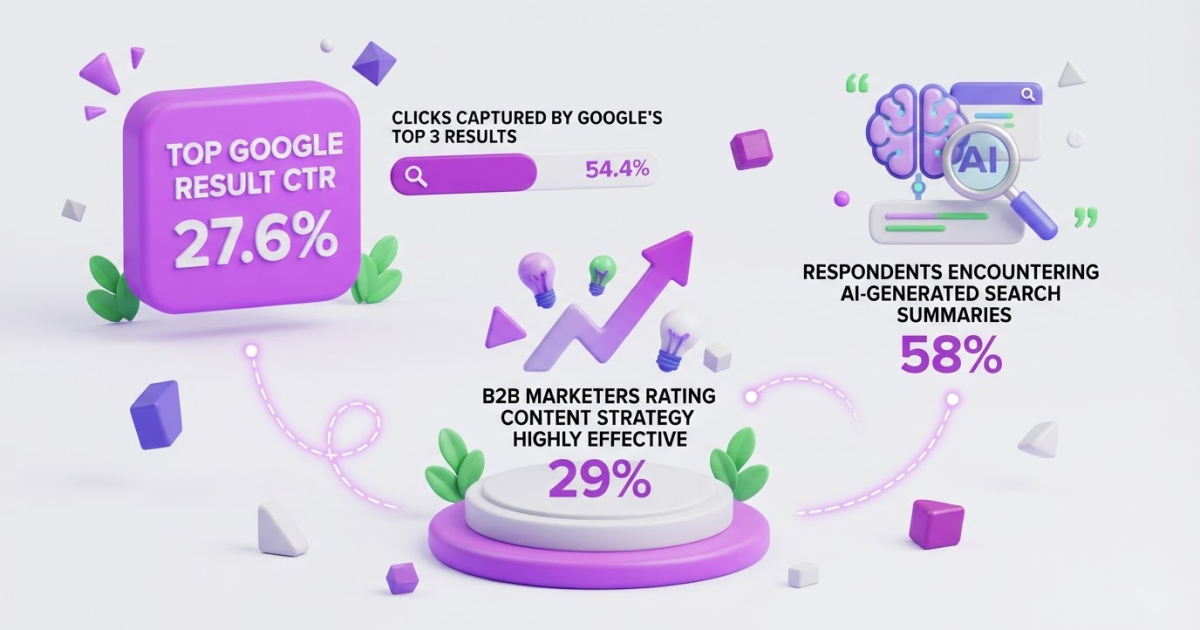
You can publish consistently and still miss the searches that matter. When competitors cover questions you have ignored, your team wastes time repeating crowded topics while high-intent demand goes unanswered, and nobody knows which idea deserves attention first. That uncertainty is common: only 29% of surveyed B2B marketers rated their content strategy as extremely or very effective. Content gaps give you a practical way to find what is missing without churning out filler. The process below shows how to define the gap, compare competing pages, validate intent, prioritize opportunities, create useful content, and measure results while keeping the work people-first.
| Point | Details |
|---|---|
| Define the gap | A content gap is a keyword, topic, question, or page detail competitors cover while your site does not. |
| Compare competitors | Review at least 3 relevant competing pages or domains to separate durable opportunities from one-off ranking anomalies. |
| Prioritize opportunities | Score each gap for business relevance, search intent, ranking potential, effort, and content quality before assigning work. |
| Improve existing pages | Page-level analysis can uncover long-tail opportunities and strengthen relevance for your primary keyword without creating 10 new pages. |
| Reject scaled content | AI can speed up research and drafting, but every published page still needs original value, editorial judgment, and a clear benefit for its audience. |
What Are Content Gaps in SEO?
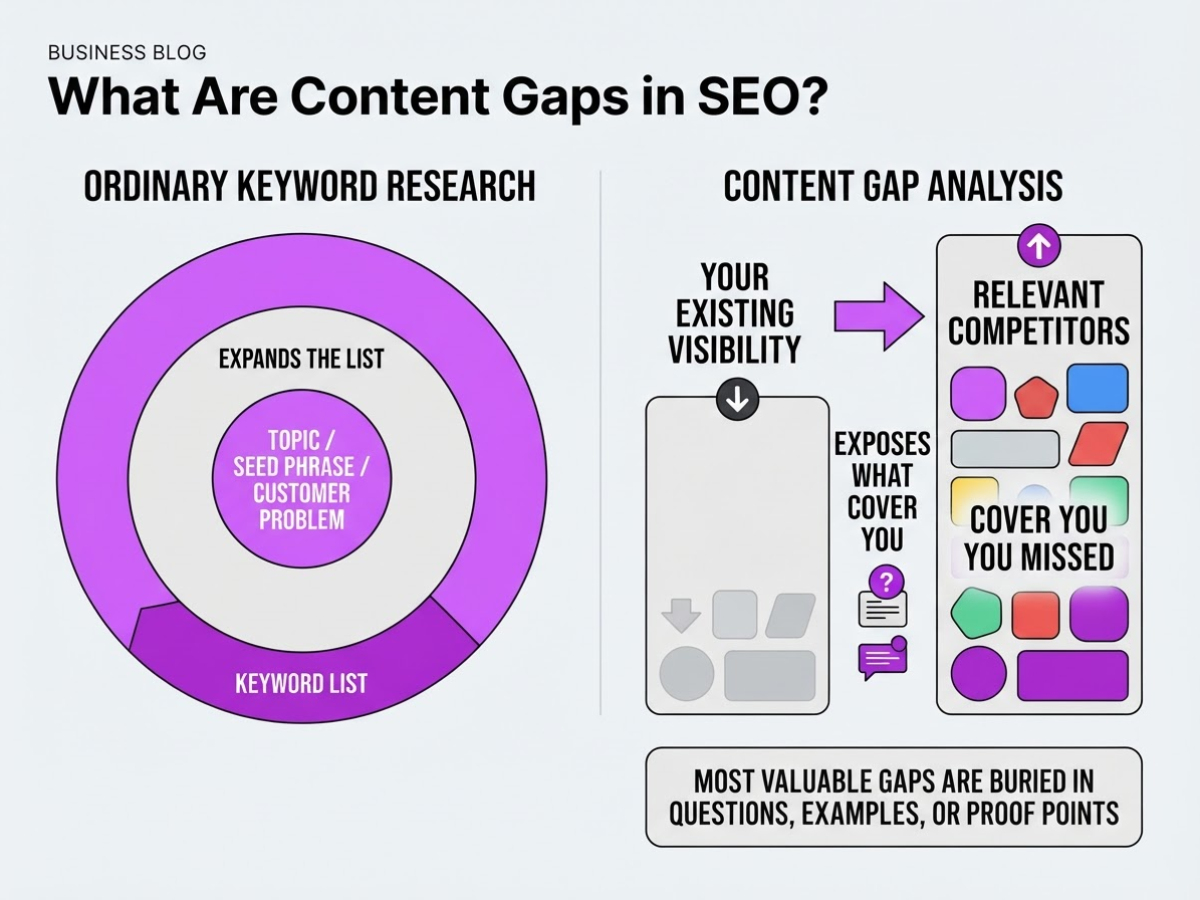
A content gap is a keyword or topic that competing websites rank for while your site does not. Ahrefs uses this definition, but the idea is broader than finding a list of phrases. You are looking for useful information your audience expects and your site currently fails to provide.
That makes content gap analysis different from ordinary keyword research. Keyword research starts with a topic, seed phrase, or customer problem and expands the list. Gap analysis starts with your existing visibility, compares it with relevant competitors, and exposes what they cover that you have missed. When I review a site, the most valuable gaps are often buried in questions, examples, or proof points rather than obvious high-volume keywords.
| Gap type | What you can uncover |
|---|---|
| Domain-level | Entire topics, supporting articles, glossaries, or comparison pages your site lacks |
| Page-level | Missing subtopics, questions, examples, formats, statistics, case studies, or evidence within an existing page |
A competitor ranking does not make a keyword an automatic opportunity. Reject it if the subject is irrelevant to your customers, has weak commercial value, or serves a different search intent. A product page should not chase an informational query simply because a competitor ranks for it. That usually creates thin traffic and a frustrating reading experience.
Pro Tip: Start with competitors that serve the same audience and business model, not simply the sites with the highest domain authority.
In practice, gap analysis usually produces one of three decisions:
- Create a new page when the topic deserves its own search result and does not fit naturally elsewhere.
- Improve an existing page by adding missing answers, examples, format choices, or supporting evidence. Page-level analysis can help you capture more long-tail searches while strengthening the main topic.
- Build internal links when you already cover the subject but have not connected related pages clearly. A simple SEO roadmap can help you assign these fixes instead of letting them disappear into a spreadsheet.
Treat competitor rankings as evidence for investigation, not instructions to copy. Google recommends people-first content, and copying a competitor’s headings without adding firsthand detail rarely earns trust. The next step is learning how to find and qualify these gaps without filling your site with pages nobody needs.
How to Find Content Gaps: A Six-Step Workflow
Start with the outcome you need, not a spreadsheet full of keywords. I use content gap analysis to find traffic opportunities, but traffic alone is a weak editorial target if it never supports the business.
-
Set the business goal. Decide whether the gap should attract qualified visitors, support a product page, capture a comparison query, or strengthen an existing topic cluster. Write one sentence such as, “We need more qualified visitors comparing AI content tools.” Without this decision, teams usually chase high-volume terms that produce attention but no useful action.
-
Choose three to five close competitors. Pick sites that compete for the same customers, not simply the biggest publishers in your industry. Export their ranking keywords and your own keywords from a trusted SEO data source such as Ahrefs or Semrush, then compare domains. Ahrefs defines a content gap as organic keywords competitors rank for while the target site does not, which gives you a practical starting definition.
-
Clean and cluster the export. Remove irrelevant brands, misspellings, duplicate terms, and keywords outside your market. Group the remaining phrases by search intent and topic, so 200 variations of “AI content tools” become one opportunity rather than 200 tasks. I prefer clusters built around the question a reader wants answered, not just matching words.
-
Inspect the search results yourself. Open the top results for each promising cluster and note the expected format, freshness, depth, and audience. A keyword calls for a guide, template, tool, comparison, or product page based on the results. Do not trust a metric to make that call for you.
Pro Tip: Review the search results manually before assigning a gap to a writer; the same keyword can require a guide, template, tool, comparison, or product page.
-
Choose the right fix. Create a new page when the intent has no suitable URL. Update an underperforming page when the topic already exists, expand a thin section when competitors answer an overlooked question, add an FAQ for a narrow sub-intent, or improve internal links when the information exists but search engines and readers cannot reach it. Page-level gap analysis can help a page target more long-tail keywords and improve its main-keyword ranking, but adding words to a page that serves the wrong intent rarely works.
-
Turn the decision into a brief. Include the target intent, primary and secondary terms, required sections, unique angle, evidence to collect, conversion path, and one success metric. For example, measure qualified organic visits and demo clicks after 90 days, not just word count. When producing drafts with Roki AI, keep human review in the brief and a defined content workflow, because publishing many similar pages without added value creates clutter and editorial debt.
With the backlog prioritized, the next task is deciding which content gaps deserve attention first.
Content Gap vs Keyword Gap vs Competitor Analysis
Teams often use these labels interchangeably, which creates bad briefs. I separate them before deciding whether we need a new page, a better page, or no action at all. The distinction matters because a spreadsheet can reveal an opportunity without proving that the opportunity deserves budget.
| Analysis | What it usually examines | Best decision |
|---|---|---|
| Content gap | Missing topics, coverage, page information, and sometimes competitor keywords | Create a page or expand an existing one |
| Keyword gap | Search terms competitors rank for while your domain does not | Validate demand and prioritize queries |
| Competitor analysis | Content, keywords, backlinks, formats, messaging, offers, and product positioning | Choose an SEO, authority, product, or positioning response |
Ahrefs defines a content gap through keywords competitors rank for that your site does not. In practice, I use “content gap” more broadly because a competitor may answer an important question, show a comparison table, or explain a product limitation that your page completely skips. A keyword gap is narrower. It usually starts with ranking terms, not the quality or completeness of the page behind them.
Use a domain-level comparison when you want to find missing subject areas, authority opportunities, or entire pages. Use a page-level comparison when your URL already targets the right intent but loses because it lacks examples, depth, current details, or useful sections. Page comparisons are often more practical, though they are also more annoying because you must inspect the actual search results instead of trusting export columns.
I score each finding on four questions: Is it relevant to our offer? Does the intent match the page we could build? Is the existing URL worth improving? Will the traffic support revenue, retention, or a strategic market? High scores usually mean create or improve a page. Low URL quality may justify a rebuild; strong relevance with weak authority points to links. Poor business value means ignore it.
Pro Tip: Do not treat every competitor keyword as a content task; some gaps are better addressed through product improvements, links, or clearer positioning.
That filter also keeps teams from publishing thin pages merely to copy competitors, a problem I address in our high-quality SEO content workflow. Next, turn the chosen gap into a page brief with a clear search intent and scope.

Five Content Gap Mistakes That Waste SEO Effort
Competitor research is useful only when it gives you a starting point. Copying the outline and changing a few sentences gives readers the same article with less credibility. I see this often in content briefs: no customer example, product evidence, original data, or clearer explanation survives into the draft.
Common mistakes include:
-
Copying competitor outlines without adding insight. Use competing pages to spot missing questions, not to reproduce their headings. Add firsthand examples, screenshots, tests, expert input, or a simpler process. Otherwise, you are producing a weaker imitation.
-
Creating one page for every keyword variation. “Content gap analysis,” “content gap SEO,” and “SEO content gaps” may reflect one search intent. Splitting them across thin pages can make the pages compete with each other. Consolidate overlapping topics, choose a primary URL, and use supporting terms naturally.
-
Chasing search volume instead of customer fit. A 10,000-volume keyword is worthless if it attracts students while you sell enterprise software. Check commercial relevance, ranking difficulty, and buyer stage before you approve the brief. A lower-volume problem from an active prospect can be worth far more.
-
Publishing unchecked AI pages at scale. AI can produce a draft quickly, but it cannot verify your pricing, product limitations, customer language, or market nuance without direction. Google warns that generating many pages with AI without adding user value may qualify as scaled content abuse. I would rather publish three reviewed pages than 30 interchangeable ones. This guide to avoiding common AI content mistakes covers the review problems teams usually miss.
-
Measuring traffic while ignoring business value, then refreshing pages mechanically. Rankings and sessions tell you visibility, not whether the right people arrived, converted later, or assisted a sale. Track qualified leads, assisted conversions, engagement quality, and pipeline influence. Before a refresh, check whether the intent, competitors, product, or customer questions changed. Rewriting an outdated page word for word is busywork.
The safer approach is to judge each content gap by usefulness, ownership, and commercial fit before you assign it to a writer.
How to Measure Whether You Closed a Content Gap
A gap is closed only when the new page attracts the right people and helps the business, not when a tracking tool shows more keywords. Before publishing, record the relevant cluster’s indexed URLs, ranking positions, impressions, clicks, click-through rate, conversions, and assisted conversions. Save the baseline by page and by topic, because a cluster can gain visibility while the page that should drive revenue loses attention.
Track keyword coverage and ranking distribution, including the number of terms in positions 1-3, 4-10, 11-20, and beyond. Do not treat every ranking as progress. A page ranking for an informational query can bring thousands of visits but few product actions, while a lower-volume comparison term can produce qualified leads. The first organic result receives a 27.6% click-through rate in one large Google search analysis, but traffic quality still matters more than chasing position one for an irrelevant phrase.
At page level, monitor impressions, CTR, engaged visits, scroll depth, leads, product actions, and clicks on internal links. I also check whether visitors move from the new page to a commercial page. That step is easy to miss, and a content gap can look successful while acting like a dead end.
Use this review rhythm:
- At 30 days: Confirm indexing, crawlability, initial queries, impressions, and early engagement. Do not panic if rankings move slowly. Indexing delays, seasonality, stronger competitors, and limited site authority can distort this first read.
- At 60 days: Compare ranking distribution, CTR, engaged visits, internal-link clicks, leads, and assisted conversions with the baseline. Check whether the page matches the intent behind the queries it actually attracts.
- At 90 days: Decide whether the gap is closed, needs another iteration, or was not worth pursuing. If performance is weak, revise the angle, add evidence, strengthen internal links, consolidate overlapping pages, or drop the opportunity.
This is where Roki AI’s SEO content workflow helps me turn recurring issues into 3-10 weekly tasks. The system can surface opportunities, but my team still decides whether the evidence, audience, and business case justify the work. That judgment should not be automated.
Once measurement exposes the weak spots, the next step is deciding which content gaps deserve another investment.
My honest take on content gaps
I see content-gap analysis as a prioritization system, not a license to copy competitors or publish fifty pages because a spreadsheet says you can. When I review a proposed gap, I ask whether it answers a real customer question, supports a business decision, or gives someone a reason to trust the company. A keyword score alone is not enough.
Here is the less obvious part: some of the best content gaps will never appear in a competitor keyword export. A repeated objection on a sales call, confusion during onboarding, a frustrating product workaround, or a question from a new market can matter months before it generates measurable search volume. If you only chase visible rankings, you will miss the subjects that could make your brand distinct.
At TryRoki, I built Roki AI to reduce the operational burden around finding and acting on opportunities. It can surface practical tasks, help maintain a weekly publishing workflow, and identify Reddit discussions where a useful, relevant contribution makes sense. That saves time, but it does not replace judgment. I still expect a human to choose the angle, check the facts, remove thin ideas, and decide whether a page deserves to exist.
The trade-off is deliberate. I would rather see a smaller backlog of differentiated pages than a large library of interchangeable content that nobody remembers or trusts. More output is often the easier goal, not the better one.
My review questions are straightforward:
- Does this gap reflect a real customer problem?
- Can we add evidence or experience competitors do not have?
- Is the expected business value worth the production and review time?
— Daniel/Aleksandra
Turn Content Gaps Into a Consistent SEO Workflow
Finding content gaps is usually easier than closing them. The frustrating part is turning a long list of promising ideas into work your team can actually finish each week. I built Roki AI for that handoff: it generates website content on autopilot and gives you 3 to 10 weekly tasks tied to visibility in Google and AI search engines, including content improvements and relevant Reddit discussions where you can contribute your expertise.
Start by reviewing the gaps with the clearest business value. Then use Roki AI’s weekly workflow to select a few opportunities and turn them into scheduled actions instead of another neglected spreadsheet. The task suggestions will not replace your judgment, and generated content still needs editorial review. That extra check matters, especially when accuracy, brand voice, or a customer’s real question is at stake.
A workable weekly loop looks like this:
- Review the 3 to 10 suggested tasks.
- Keep only tasks tied to a real audience and business goal.
- Check the facts, add firsthand detail, and approve the final work before publication.
Frequently Asked Questions
Use Google autocomplete, related searches, competitor pages, customer-support questions, and your Google Search Console data. For a practical manual audit, compare 3 to 5 competing pages with one target page and note missing questions, examples, formats, evidence, and internal links.
No. A gap may be a missing explanation, example, original statistic, image, FAQ, product context, or format that better matches the reader’s intent, even when your page already includes the main keyword. Keywords provide clues, but I focus on what would help a real visitor finish the task without opening 4 more search results.
Run a focused review every 3 months, then check priority pages whenever rankings, competitors, products, or customer questions change. For high-value commercial pages, a light monthly check can make sense, but repeating a full-site comparison every month usually creates busywork instead of useful updates.
Yes. If a page already serves the main intent, adding missing subtopics, long-tail answers, evidence, examples, and internal links is often better than creating a new URL. I also look for overlapping pages, because merging 2 weak articles can close a gap more cleanly than publishing a third version of the same topic.
AI use is not automatically harmful, but publishing dozens of lightly edited pages can create quality and spam-policy risks. Use AI for research, outlines, drafts, or workflow support, then add original insight, verify every claim, edit for your audience, and review the final page yourself before publication.
Written by Daniel/Aleksandra.
Recommended reads
- How Roki Ai Streamlines Your Seo Content Workflow
- Avoiding Common Ai Content Mistakes For Better Seo
- Seo Roadmap Template A Practical 90 Day Plan
- Creating High Quality Seo Content With Roki Ai
Sources
- How to use Content Gap to find keyword ideas from Competitor Websites
- Keyword Competitive Analysis: How to Find Your Competitors' Keywords
- Creating Helpful, Reliable, People-First Content
- Spam Policies for Google Web Search
- B2B Content Marketing: 2025 Benchmarks & Trends
- We Analyzed 4 Million Google Search Results. Here's What We Learned About Organic CTR
- What Americans See About AI Online