Daniel D.
Restaurant SEO services focus on local search visibility — your Google Business Profile, your reviews, your menu pages, and how fast your site loads on a phone. The research is clearer on reviews and speed than on any single "do this and get X% more bookings" promise. Expect a few months of unglamorous work before the traffic curve moves.
Getting your restaurant noticed online is genuinely hard, and not because you're doing something wrong. Aggregators like Yelp, OpenTable, and DoorDash have spent years and enormous budgets colonising the first page for exactly the queries your future customers type. When someone searches "best Italian near me," you are competing for scraps of a page that was designed to keep people on someone else's platform.
The good news is that local search is one of the few areas where a single independent restaurant can still outrank a national platform, because Google weighs proximity, prominence, and relevance in ways that favour the actual business over a directory listing. This guide covers what restaurant SEO services actually do, which parts you can handle yourself, and how to tell a useful provider from an expensive one.
| Point | Details |
|---|---|
| Market size | The global SEO services market was estimated at roughly $81.5B in 2024, projected to reach about $172B by 2030 (MarkNtel Advisors, ~13.2% CAGR). Other firms put the 2030 figure closer to $204B — estimates vary widely by methodology. |
| Reviews and revenue | A one-star increase in Yelp rating is associated with a 5–9% revenue increase for independent restaurants (Michael Luca, Harvard Business School). |
| Mobile speed | Akamai's analysis of ~10 billion retail sessions associated a 100ms delay with a ~7% drop in conversions. Google found 53% of mobile visitors abandon a page that takes over 3 seconds. |
| Speed as a ranking factor | Core Web Vitals have been a confirmed Google ranking signal since 2021. Target an LCP under 2.5 seconds for at least 75% of real visits. |
| Where the searches happen | Local "near me" dining queries skew heavily mobile — assume most of your discovery traffic is on a phone, standing outside somewhere, deciding fast. |
What Are Restaurant SEO Services and Why They Matter
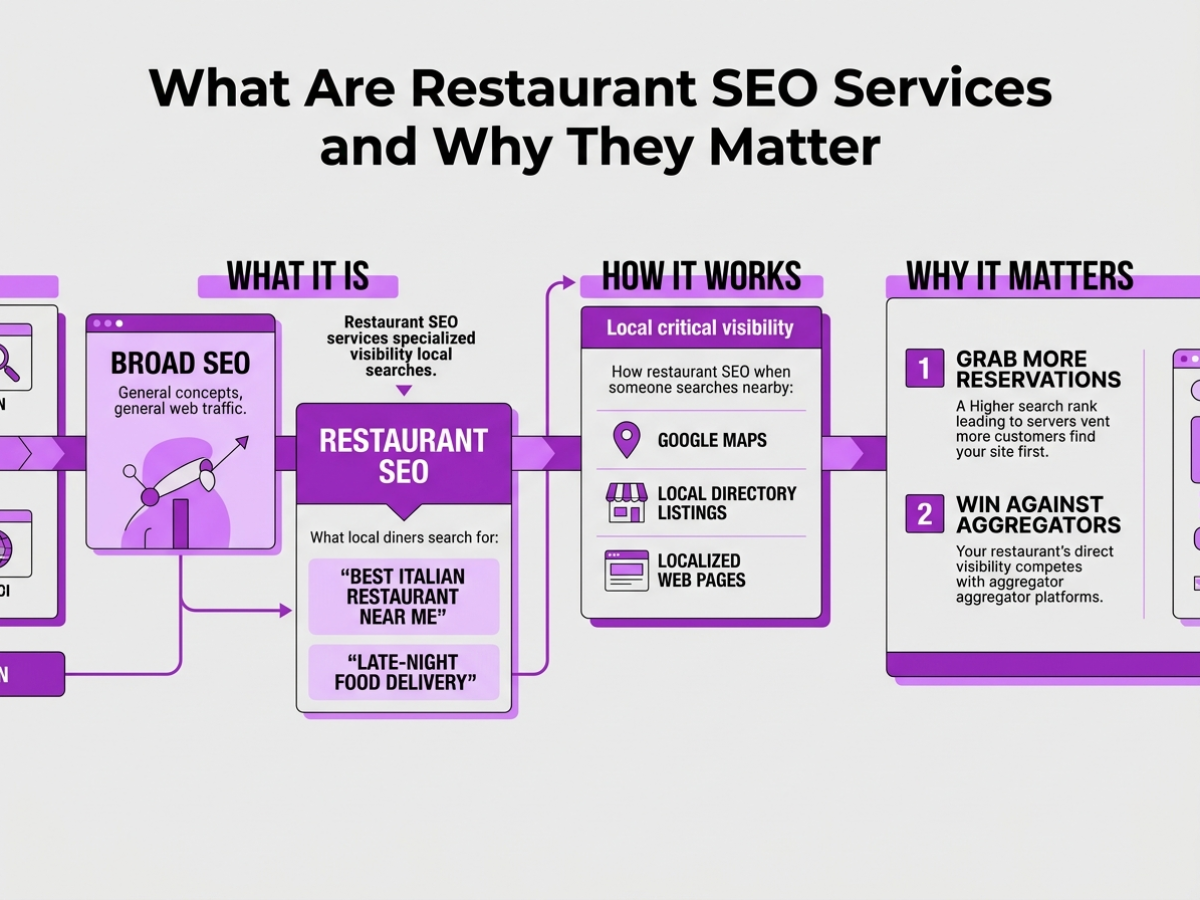
Restaurant SEO services are strategies aimed at improving a restaurant's visibility in search, with the weight placed almost entirely on local results rather than national ones. The distinction matters. Broad SEO chases informational queries and builds domain authority over years. Restaurant SEO chases someone who is hungry, nearby, and will decide in the next four minutes.
That means the queries look different: "best Italian restaurant near me," "late-night food delivery," "brunch spots open now," "[neighborhood] tapas." These are almost entirely transactional and almost entirely local, and they resolve in the map pack far more often than in the classic blue links.
Here's why it matters:
- Reservations follow rank. In local search, the top three map results absorb the large majority of clicks. Position four might as well be page two.
- Aggregators own the organic results, not the map pack. Yelp and OpenTable dominate the traditional listings, but the map pack is drawn from Google Business Profiles — which is where an individual restaurant can genuinely win.
- Intent is already high. Nobody searches "restaurants near me" to browse. Traffic from these queries converts at rates that content marketing in other industries can only envy.
Key components of restaurant SEO:
| Component | Purpose |
|---|---|
| Website optimization | Fast mobile loading, crawlable menus, working reservation flow |
| Local SEO | Google Business Profile, local keywords, consistent citations |
| Reputation management | Monitoring and responding to reviews, sustaining rating volume |
On reviews specifically, the most credible research is Michael Luca's Harvard Business School work on Yelp, which found a one-star rating increase associated with a 5–9% revenue lift for independent restaurants — chains showed no such effect, since their brand already does the trust-signalling. That's a smaller number than the inflated figures that circulate in SEO marketing, but it comes from actual revenue data rather than a vendor's blog post.
Be skeptical of anyone quoting you a precise reservation lift from a rating change. The honest version is: reviews measurably matter, the effect is real, and the size depends on your market.
Understanding how these pieces fit together sets up the practical work — starting with the site itself.
How to Optimize Your Restaurant Website for SEO Success
Most of the highest-leverage work here is work you can do yourself, or brief someone to do in an afternoon. That doesn't make it optional; it makes it the thing to fix before you pay anyone a retainer.
- Make the site fast on a real phone on a real connection Test on a mid-range Android over 4G, not your laptop on the restaurant's wifi. Google's benchmark is a Largest Contentful Paint under 2.5 seconds for at least 75% of visits. The usual culprits in restaurant sites are enormous unoptimized food photography and a pile of third-party scripts from reservation widgets and analytics. Run PageSpeed Insights, then check the Core Web Vitals report in Search Console for field data.
- Put your menu in HTML, not a PDF This is the single most common technical failure in restaurant sites. A menu locked in a PDF or rendered as a JPEG is close to invisible to search engines, which means every dish name you serve is a keyword you're not ranking for. Plain HTML with real headings and real text.
- Optimize on-page elements with local terms Titles, meta descriptions, and H1s should carry your neighborhood or city alongside the cuisine. "Wood-Fired Neapolitan Pizza in Kreuzberg" beats "Home | Luigi's" every time.
- Implement restaurant schema markup
Use the
Restaurantschema type withservesCuisine,priceRange,openingHoursSpecification,menu, andacceptsReservations. This is what lets Google display your hours and menu directly in results. Validate it in Google's Rich Results Test — schema with errors does nothing. - Create separate pages for separate locations Each location needs its own page with genuinely different content: its own address, its own hours, its own staff, its own neighborhood context. Duplicating one page five times with the address swapped is worse than having one page.
- Make the reservation path obvious Menu, hours, address, phone, book. Above the fold, on mobile, without a hamburger menu. A hidden phone number kills more conversions than a slow load ever will.
Pro Tip: Check your Core Web Vitals field data in Search Console monthly. Lab scores from PageSpeed Insights tell you what's theoretically wrong; field data tells you what your actual customers experience.
None of this ranks you overnight. It builds the foundation that local SEO then amplifies.
Next, the local signals that decide whether you appear in the map pack at all.
Leveraging Local SEO and Reviews to Drive More Reservations
Local SEO is where restaurants win or lose. Here's the order I'd work through it.
- Claim and fully populate your Google Business Profile Formerly Google My Business, renamed in 2021 — you'll still see the old name everywhere, including in the dashboards of agencies that haven't updated their templates. Fill in every field: hours, holiday hours, attributes, service options, price range, and a menu link. Add photos regularly; profiles with recent photo activity tend to perform better. Post updates for events and seasonal menus. This profile, not your homepage, is what most people will actually see.
- Build review volume steadily, not in bursts Recency and volume both matter, and a sudden flood of five-star reviews in one week is a pattern Google is specifically looking for. Ask consistently: a line on the receipt, a QR code on the table tent, a follow-up message with a direct review link. Never offer anything in exchange — review gating and incentivised reviews violate Google's policies and can get your profile suppressed.
- Respond to every review, especially the bad ones Replies are visible to future customers, who read them as evidence of how you handle problems. Skip canned responses. For a negative review, acknowledge the specific issue, don't argue the facts publicly, and offer to continue offline. A well-handled one-star review does more for trust than a dozen unanswered five-stars.
- Keep NAP consistent across every listing Name, address, and phone must match exactly across Google, Apple Maps, Yelp, TripAdvisor, and local directories. "St." on one and "Street" on another is enough to fragment your signals. Audit quarterly — listings drift on their own as data aggregators sync bad information.
- Publish genuinely local content Your neighborhood, your suppliers, the market you shop at, the festival you cater. This is the content that earns local links from community sites and news outlets, which is the hardest local ranking signal to fake.
Pro Tip: Set a calendar reminder to check your Google Business Profile for unauthorized edits. Anyone can suggest a change to your hours or category, and those edits sometimes go live without notifying you.
Consistent effort here translates more directly into filled tables than anything else on this list.
Next, the piece most restaurants skip entirely: making the menu itself work as a search asset.
Menu Page SEO and Local Keyword Research
Your menu is the highest-intent page on your site and usually the worst-optimized. Someone searching for a specific dish is much closer to booking than someone searching a category.
Structure the menu for search. One page per menu if you have distinct services — lunch, dinner, brunch, tasting. Real HTML headings for each section. Each dish gets its name and a short description containing the words people actually search: "cacio e pepe," "gluten-free," "vegan," "wood-fired." Add Menu and MenuItem schema so Google can parse the structure.
Do keyword research the local way. Standard keyword tools underreport local dining terms badly, because the volume is fragmented across thousands of neighborhood variations. Better sources:
- The search terms report inside your Google Business Profile insights — this is real query data from real people who found you
- Google autocomplete for "[cuisine] in [neighborhood]" and "[dish] near"
- The "People also ask" boxes on your target queries
- What your competitors' menu pages rank for
Target the long tail deliberately. "Restaurant" is unwinnable. "Neapolitan pizza [neighborhood] outdoor seating" is winnable, converts better, and there are hundreds of variations of it. Low individual volume, meaningful aggregate traffic.
A note on the keyword data for this article: the primary term "restaurant seo services" shows a monthly search volume of 140 with a difficulty of 0. That's a low-volume, low-competition term — worth ranking for, but the traffic ceiling is modest. The real value is in the long-tail variations and the topical authority it builds.
Next, the mistakes that undo all of the above.
Common Mistakes in Restaurant SEO to Avoid
- Menu as a PDF or image. Worth repeating because it's that common. Every dish name becomes invisible to search.
- Ignoring mobile speed. Restaurant sites are photo-heavy by nature, and unoptimized hero images are the usual reason a page takes six seconds on 4G. Google's data has 53% of mobile visitors leaving before three seconds.
- Inconsistent listings. Conflicting addresses and hours across directories dilute your local signals and irritate customers who show up to a closed door.
- Treating reviews as a chore. Volume, recency, and responses all feed local ranking. An abandoned review profile is a decaying asset.
- Chasing generic keywords. Ranking for "Italian restaurant" nationally is both impossible and useless. Local intent is the entire game.
- Duplicate content across location pages. Copy-pasting one page per location gives Google no reason to rank any of them.
- Buying reviews or gating them. Filtering for happy customers before asking, or paying for reviews, violates platform policy and risks profile suppression. The short-term rating bump isn't worth it.
Most SEO frustration in this industry comes from paying for content and link building while the menu sits in a PDF and the Business Profile has 2019 hours on it. Fix the basics first.
Next, how to evaluate a provider once the fundamentals are handled.
Choosing the Right SEO Service for Your Restaurant
You have three broad options: agencies, freelancers, and AI-assisted platforms. Each fits a different situation.
Agencies offer full service — audits, content, technical fixes, link building, reporting — with the corresponding overhead. Freelancers cost less and can be excellent, but you're buying one person's specific skill set, so verify it covers local SEO specifically. AI-assisted tools automate content production and parts of outreach, which is a real efficiency gain, but they still need someone with judgment reviewing output.
On pricing: published SEO retainer figures vary enormously depending on who's surveying and who's answering, and the widely quoted "median retainer" numbers should be treated as loose reference points rather than benchmarks. What matters more is what's included and whether local SEO is genuinely part of it.
| Type | Typical monthly range | Best for | Limitations |
|---|---|---|---|
| Agencies | $2,000–$8,000+ | Multi-location groups, full service | Higher cost, longer contracts |
| Freelancers | $500–$3,000 | Single locations, specific projects | Narrower scope, quality varies |
| AI-assisted platforms* | $100–$1,000 | Content volume, ongoing publishing | Requires human review and strategy |
*TryRoki is one example of an AI-assisted platform for content generation and SEO workflows.
Questions worth asking any provider:
- Show me a restaurant client whose map pack rankings improved, with the Search Console and Business Profile data behind it.
- What's your approach to review generation, and does it comply with Google's policies?
- How do you handle multi-location structure if we open a second site?
- What happens to the work if we stop paying you?
That last one matters more than people expect. Content and technical fixes stay with you. Rented links and third-party listing subscriptions don't.
For single locations, weight everything toward the Business Profile and reviews. For groups, weight toward scalable location-page architecture and consistent citation management across the estate.
My honest take on restaurant SEO services
Running TryRoki and working with restaurants on this taught me one thing above the rest: the gap between restaurants that do well in local search and those that don't is almost never sophistication. It's maintenance. The winners have current hours, a menu in HTML, recent photos, and someone who answers reviews within a day. That's it. That's most of the advantage.
The thing I'd push back on in most SEO sales pitches is the precision of the promises. You'll see confident claims that a specific rating gets you a specific percentage more bookings, or that trimming a second off load time moves you three positions. Those numbers get repeated across the industry until they feel like established fact, and when you chase them back to a source, there frequently isn't one. The genuinely well-evidenced findings — Luca's Yelp revenue research, the Deloitte and Akamai speed studies — are more modest and more useful, because you can actually plan against them.
Where I do think AI changes the picture is volume. Producing enough genuinely local content to compete used to require either time you don't have or a retainer you don't want. That constraint has loosened. What hasn't changed is that someone with judgment still has to decide what's worth publishing and check that it's true. Automating the writing without automating the fact-checking is how you end up with a site full of confident, wrong statistics.
Treat SEO as a long game with a short daily habit. The habit is what compounds.
— Daniel
Boost Your Restaurant SEO with TryRoki
TryRoki cuts down the guesswork on the content side of SEO — keyword-to-article generation, publishing workflow, and backlink opportunity surfacing. It isn't a replacement for fixing your Business Profile or getting your menu out of a PDF; nothing is. But once the fundamentals are in place, consistent publishing is usually the constraint, and that's the part it removes.
It fits best if you don't have a dedicated SEO person and don't want to run four separate tools. Pricing is straightforward and scales with output rather than seats.
Explore how TryRoki simplifies SEO for restaurants or check the details on TryRoki's pricing page.
Frequently Asked Questions
Restaurant SEO services improve your visibility in local search through three main levers: optimizing your website so it loads fast and exposes your menu as crawlable text, managing your Google Business Profile and local listings so they're accurate and consistent, and building review volume and responses. Most of the ranking movement for restaurants comes from the Business Profile and reviews rather than from traditional website SEO.
It ranges widely. Freelancers focused on local SEO often work in the $500–$3,000 per month range, full-service agencies from roughly $2,000 to $8,000 and up, and AI-assisted platforms considerably less. Published "median retainer" figures for the industry vary a lot between surveys, so treat them as rough context rather than a benchmark. Judge on scope and on whether local SEO is genuinely included.
Two reasons. Google confirmed Core Web Vitals as a ranking signal in 2021, with a target of Largest Contentful Paint under 2.5 seconds. And separately, speed affects whether visitors stay at all — Google's research found 53% of mobile visitors abandon a page taking longer than three seconds, and Akamai's analysis associated a 100-millisecond delay with roughly a 7% drop in conversions. Restaurant sites are especially vulnerable because of heavy food photography.
Reviews feed local ranking through volume, recency, rating, and response rate. On the revenue side, Harvard Business School research by Michael Luca found a one-star increase in Yelp rating associated with a 5–9% revenue increase for independent restaurants, with no equivalent effect for chains. Be cautious of much larger figures quoted without a source.
The highest-impact work is doable yourself: claiming and completing your Google Business Profile, getting your menu into HTML, compressing images, and responding to reviews. That covers most of the available gain for a single location. Consider hiring once you're running multiple locations, competing in a dense market, or find you simply aren't maintaining it — an unmaintained SEO effort is worse than none, because you've spent the money either way.
Written by Daniel.
Recommended reads
- Best Restaurant Marketing Agency Alternatives
- AI SEO Agent
- Automated Backlinks Generator: How to Boost SEO Efficiently
- Meta Description Writer: How to Craft Effective SEO Snippets
Sources
- Reviews, Reputation, and Revenue: The Case of Yelp.com — Michael Luca, Harvard Business School
- Milliseconds Make Millions — Deloitte & Google
- Core Web Vitals and Google Search results — Google Search Central
- Restaurant structured data — Google Search Central
- SEO Services Market Size and Forecast to 2030 — MarkNtel Advisors
- Google Business Profile review policies