Aleksandra D.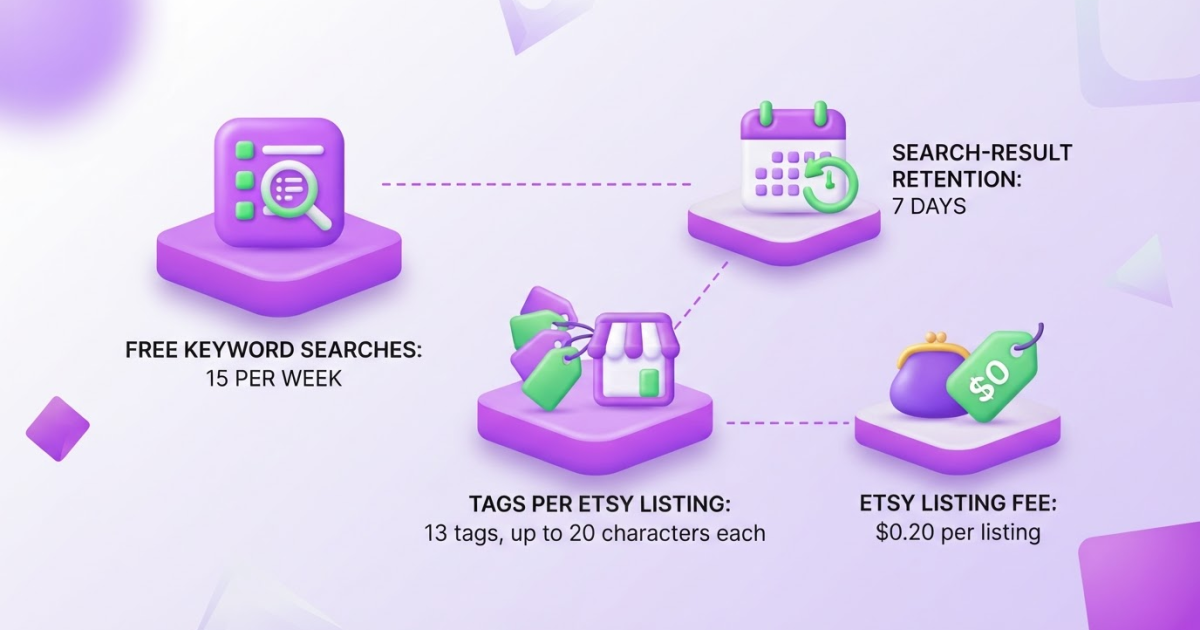
A free Etsy keyword tool helps you find relevant search phrases, compare demand with competition, and improve listing tags without paying for premium software. Use Etsy’s free Marketplace Insights searches, then evaluate keywords, update your tags and titles, and track performance for at least 30 days.
You can find hundreds of Etsy keyword ideas in a free tool and still feel stuck when it is time to choose one for your title or tags. Long lists rarely tell you whether a phrase has buyer intent, brutal competition, or a realistic chance of bringing views. Etsy’s Marketplace Insights lets sellers run up to 15 free keyword searches per week, but you still need a method for using the results. You will learn how to find long-tail phrases, check competition, fill Etsy’s 13-tag allowance, avoid misleading keywords, validate traffic in Shop Stats, and decide where broader SEO work can support your Etsy business.
Key Takeaways
| Point | Details |
|---|---|
| Start With Intent | Prioritize phrases that name the buyer’s specific product, use case, style, or recipient instead of broad category terms. |
| Plan Free Searches | Etsy Marketplace Insights allows up to 15 free keyword searches per week, so prepare a shortlist before researching. |
| Build Long Tails | Use specific multi-word phrases to match shopper intent more closely and attract visitors who are more likely to convert. |
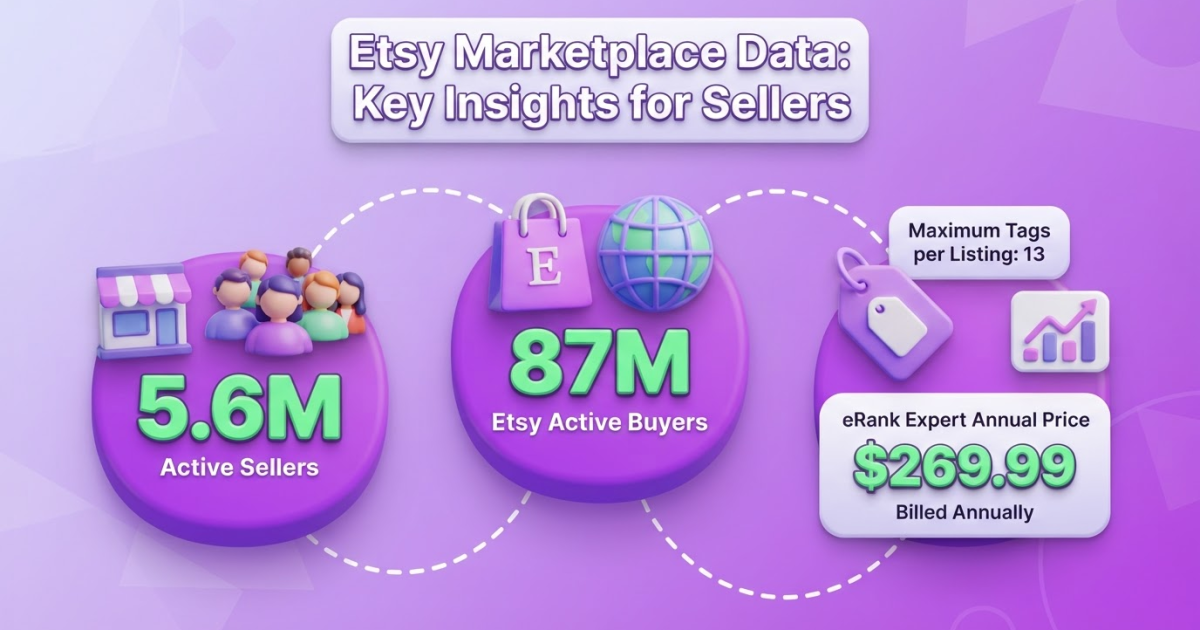
| Fill Every Tag | Etsy allows up to 13 tags per listing, and each tag can contain no more than 20 characters. |
| Measure Before Changing | Review keyword-driven traffic and listing engagement for at least 30 days before replacing a relevant phrase. |
What Counts as a Free Etsy Keyword Tool?
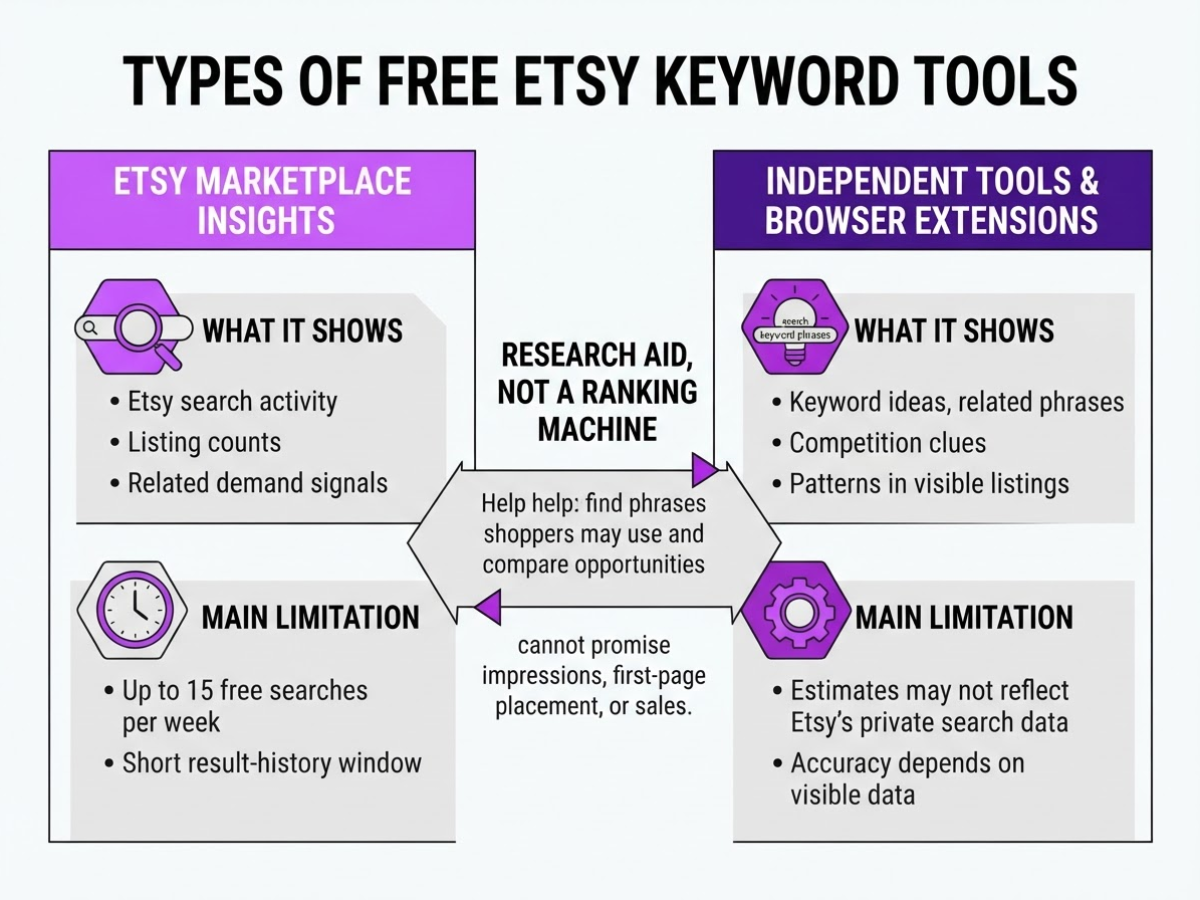
A free Etsy keyword tool is a research aid, not a ranking machine. It helps you find phrases shoppers may use and compare possible opportunities, but it cannot promise impressions, first-page placement, or sales.
You will usually encounter two types:
| Tool type | What it can show you | Main limitation |
|---|---|---|
| Etsy Marketplace Insights | Etsy search activity, listing counts, and related demand signals | Limited free searches and a short result-history window |
| Independent generators and browser tools | Keyword ideas, related phrases, competition clues, and patterns in visible listings | Estimates may not reflect Etsy’s private search data or your exact product |
Etsy Marketplace Insights gives sellers up to 15 free keyword searches per week. Its data covers Etsy search activity and listing information from the previous 30 days, while each free result remains available for only seven days. That window is easy to waste if you search casually, close the tab, and expect to find the same result later.
Pro Tip: Create one spreadsheet tab for raw keyword ideas and another for phrases you have mapped to a product, title, tag, or description.
When I review a phrase for a product, I score it against five practical checks:
- Relevance: Does it describe what you actually sell?
- Specificity: Does it clarify style, recipient, material, size, or use?
- Apparent demand: Do shoppers appear to search for it?
- Competition: Are competing listings numerous or tightly matched?
- Product fit: Can you deliver the promised item at the expected price and quality?
A phrase such as “gift” may look attractive but says almost nothing. “Personalized walnut desk name plate” gives you a clearer buyer, product, and use case. Our Etsy keyword research guide covers how to turn that kind of idea into listing decisions.
Keyword research supports your title, tags, attributes, and description. It does not repair dark photos, an uncompetitive price, slow fulfillment, confusing variations, or poor customer service. Etsy’s search guidance makes clear that listing quality and customer and marketplace experience also affect search placement. Compare the free tools by the evidence each one actually provides before choosing a workflow.
How to Research Etsy Keywords Without Paying
Start with the thing you sell, not a vague description of your shop. If the product is a necklace, write necklace first. Then build variations around the buyer’s reason for purchasing it: recipient, occasion, material, size, style, and use case.
-
Create a raw keyword list. For “necklace,” add phrases such as “gold necklace,” “birthday gift necklace,” “personalized necklace,” “small pendant necklace,” and “necklace for daughter.” Include wording a real shopper might type, even if it sounds less polished. I usually prepare 20 to 30 variations before opening Etsy’s research tool because improvising inside the tool wastes searches.
-
Spend Marketplace Insights searches carefully. Etsy gives sellers up to 15 free keyword searches per week, so start with the most important variations, not every synonym. Search the core noun, the clearest product phrase, and several high-intent combinations. Results remain available for seven days, which is useful, but it also makes a rushed research session easy to forget.
-
Record the evidence. For each search, save the search activity, listing count, and related phrases shown by Etsy. The tool reports data from the previous 30 days, so you are working from recent marketplace behavior rather than personal intuition. A simple spreadsheet works. Add columns for phrase, searches, listings, related terms, product fit, and notes. For a broader process, this practical Etsy keyword research guide can help you structure the sheet.
-
Group phrases by meaning. Put terms into product, audience, and intent groups. “Ceramic mug” describes the product, “gift for teacher” describes the audience or occasion, and “coffee cup with name” signals a specific use or feature. Remove any phrase that promises something you do not sell. A shop offering plain mugs should not target “custom photo mug” simply because the phrase looks busy.
Pro Tip: Research adjacent buyer language, such as gifting occasions and recipient descriptions, only when the listing genuinely satisfies that intent.
-
Choose the listing’s keyword hierarchy. Select one primary phrase that best describes the exact item. Add two or three supporting phrases for the title and description, then shortlist tag candidates that fit the product. Etsy allows up to 13 tags, with each tag limited to 20 characters, so favor specific multi-word phrases over repeated broad terms.
-
Use Etsy’s built-in relevance signals. Select the most specific category and accurate attributes, such as color, material, size, or style. Etsy explains that categories and attributes can act like additional keyword signals, so do not force every useful phrase into a manual tag. After publishing, compare your choices with listing traffic and revise only when the data gives you a reason.
With this shortlist in hand, you can compare free tools and decide which research method deserves a regular place in your Etsy workflow.
Free Etsy Keyword Tools Compared: Which One Fits?
The right free Etsy keyword tool depends on the question you are trying to answer. When I review a shop’s listings, I separate discovery, validation, and feedback because no single source handles all three well.
| Source | Best use | Main limitation |
|---|---|---|
| Etsy search suggestions and Marketplace Insights | Checking phrases shoppers use on Etsy | Limited free searches and short data windows |
| Free third-party generator | Brainstorming synonyms, seasonal ideas, and long-tail phrases | Suggestions may not reflect current Etsy demand |
| Competitor observation | Finding wording, categories, and angles used in comparable listings | You cannot see a competitor’s actual traffic or conversions |
| Shop Stats | Confirming which keywords and traffic sources bring visits | It reports your past performance, not future demand |
A free generator makes sense at the beginning. Give it a small seed list such as “linen tote,” “teacher gift,” or “minimalist bag,” then use the suggestions to uncover synonyms, gift occasions, seasonal wording, and more specific phrases. It is useful when you have ten ideas and need thirty candidates before narrowing them down. I would not treat its volume scores as Etsy facts. Many tools combine databases, estimates, or time periods that do not match Etsy’s data.
Marketplace Insights is the better choice when you need to validate a phrase inside Etsy. Free sellers get up to 15 keyword searches per week, and each result remains available for seven days. The tool uses the previous 30 days of Etsy search and listing data, so it is more useful for checking current demand and competition than a generic generator.
Pro Tip: The best free stack is usually complementary: generate broadly, validate inside Etsy, then let your own traffic data decide what survives.
Shop Stats answers a different question: what actually brought people to your listings? Etsy’s Shop Stats reports show views from traffic sources and keywords, which helps you see whether a tag or external channel produces visits. The data arrives after publishing, so it cannot replace research, and low traffic may reflect photos, pricing, or conversion problems rather than bad keywords.
My decision rule is simple: use a free tool or competitor review for discovery, Etsy data for validation, and listing analytics for feedback. Never compare numbers from different tools as if they share the same database or time window. Turn the surviving phrases into listing titles and tags without forcing every keyword into one listing.

Keyword Mistakes That Waste Free Etsy Research
The biggest mistake I see when reviewing Etsy listings is treating search activity as a verdict. A phrase with many searches may also have thousands of competing listings, while a specific phrase can bring fewer visitors who already know what they want. Etsy recommends long-tail keywords because they often match buyer intent more closely and can convert better than broad terms. That difference matters when you compare free keyword research results.
Watch for these mistakes:
- Choosing volume over relevance. “Necklace” may look attractive, but “personalized birthstone necklace” tells you far more about the buyer and the product. If your item does not satisfy the search, ranking for it creates wasted clicks.
- Copying a competitor’s wording without checking the fit. A rival may sell sterling silver earrings, while you sell gold-plated hoops. Their material, style, size, and buyer intent may not describe your listing at all.
- Repeating one idea across every tag. Using several variations of “custom mug” leaves less room for useful phrases such as “teacher gift,” “coffee cup,” or “office gift.” Give each tag a distinct job when relevant terms are available.
- Ignoring Etsy’s tag limits. Each tag can contain up to 20 characters, and Etsy allows 13 tags per listing. Etsy recommends using all 13 tags and favors specific multi-word phrases, so shorten awkward phrases rather than abandoning useful coverage.
- Writing for a robot instead of a shopper. Titles such as “Custom Mug Coffee Cup Personalized Gift Mug Teacher Mug” look careless. Keyword stuffing makes the offer harder to understand and can weaken trust before a shopper reaches the photos.
- Reacting to one short-term result. Marketplace Insights uses search and listing data from the previous 30 days, and each free result remains available for seven days. That is a narrow snapshot, not a permanent market judgment. Save your observations and compare patterns over several checks.
- Blaming keywords for a conversion problem. Etsy considers listing quality and shopper engagement, not relevance alone. A relevant phrase cannot rescue dim photos, unclear sizing, slow replies, or an offer that feels overpriced.
I usually change one meaningful element at a time, then give the listing enough time to collect useful data. That approach feels slower, but it prevents you from mistaking a weak thumbnail or confusing description for a keyword failure. Use the same discipline to decide which listing changes deserve testing first.
How to Turn Keyword Research Into Measurable Listing Improvements
A keyword list only earns its keep when it changes a listing and gives you a result to measure. Treat each product as its own search problem. A handmade wedding invitation may target “editable wedding invitation” as its primary intent, with supporting phrases such as “minimalist wedding invite,” “instant download,” and “templett editable invitation,” rather than copying one generic keyword set across your shop.
Put the clearest product phrase where shoppers need it first, usually near the start of the title and in the opening description language. Then spread close variations through all 13 tags, relevant attributes, and the rest of the description. Etsy says categories and attributes can act like additional keyword signals, so choose the most specific options instead of wasting tags on information Etsy already understands. The practical Etsy keyword research guide can help you build this phrase set before editing.
Do not judge the change by visibility alone. Record listing impressions or visits, traffic from specific keywords, favorites, and purchases when those figures are available. Shop Stats can show which keywords sent traffic to a listing, but a phrase that produces 200 visits and no favorites or orders deserves less attention than one that sends 30 highly interested shoppers.
Use this working timeline for each test:
- Day 0: Save the listing’s current title, tags, visits, keyword traffic, favorites, and orders. Change one listing or one clearly defined batch, not the entire shop.
- Days 1 to 7: Check for indexing and unusual changes, but do not declare victory or failure from a single day. Early numbers bounce around, especially on low-volume listings.
- Days 14 to 30: Compare qualified traffic and shopper response with the previous period. If impressions rise but favorites and purchases fall, the wording may attract the wrong intent.
- Day 30: Keep, revise, or roll back the change. Note exactly what changed so your next test has a usable baseline.
I recommend a monthly listing audit, with a smaller weekly glance for obvious problems. Etsy search also considers listing quality, customer experience, recency, and other factors beyond keywords, so a ranking lift cannot always be credited to one edit. With that baseline in place, assess the wider search factors without mistaking noise for progress.
My honest take on free Etsy keyword tools
I see free Etsy keyword tools as decision-support systems, not shortcuts to ranking. They lower the cost of testing ideas, which matters when you are a new seller who cannot justify a large subscription before you have a repeatable product and sales process.
Here is my contrarian view: most sellers spend too much time collecting keywords and too little time deciding which listings deserve them. A spreadsheet with 500 phrases will not rescue a shop with a vague audience, a weak offer, or a product angle that looks like every competitor’s. I would rather see you research 15 carefully selected phrases, map each one to a specific listing, and review the resulting traffic and sales.
My practical rules are:
- Use Etsy’s data to validate demand, not a generator’s score.
- Give every chosen phrase a clear job in one listing.
- Test a meaningful change for 30 days before judging it.
- Check photos, pricing, and product fit before blaming keywords.
Etsy’s own data should serve as your platform-specific validation layer. Use third-party tools to expand ideas, group related terms, and spot language you might miss. Do not treat every suggested phrase as an opportunity. Some have attractive search numbers but describe buyers who will never choose your product.
My workflow favors fewer, better phrases and a documented testing cycle. Change one meaningful element, give the listing enough time to collect data, then decide what earned another test. Constantly rewriting tags feels productive, but it often prevents you from learning which product, image, price, or promise actually won the click.
— Daniel
Turn keyword ideas into a consistent growth workflow
An Etsy keyword tool can show you what shoppers search for, but it cannot write the buying guide, seasonal article, or product education page that builds demand beyond Etsy. I built Roki AI’s website content workflow for that gap: it helps you keep useful content moving without spending every Sunday staring at a blank document.
Roki also surfaces three to 10 Reddit opportunities each week, so you can answer relevant questions and mention your shop or website only when it genuinely fits. That part takes judgment. Forced promotion will annoy people, and the first suggestions may need filtering. Start with the listing and audience priorities from your Etsy research, then use Roki AI to turn one useful idea into a repeatable weekly habit.
Frequently Asked Questions
Yes, Etsy gives sellers free access to a limited number of Marketplace Insights searches, and independent tools may provide free keyword ideas or basic research features. You may see different results across 2 tools because each one uses its own data, so check important phrases in Etsy before using them.
Use only keywords that accurately describe the product, and fill all 13 Etsy tag slots when you have relevant options. Each tag can contain up to 20 characters, but forcing unrelated phrases into those slots usually hurts relevance more than it helps visibility.
Start with the main product phrase, then add specific details such as material, recipient, occasion, style, or size to create 3 to 5-word variations. Compare those phrases in Etsy Marketplace Insights and remove any term that does not describe what you actually sell.
Review your keywords about once a month, or after your listing has received enough traffic to reveal a meaningful pattern. Check Shop Stats, visits, favorites, and orders over at least 30 days before changing tags, since daily edits create noise and make results difficult to judge.
No. A keyword tool can help you match your listing with relevant searches, but sales also depend on at least 5 factors, including product fit, photos, pricing, listing quality, and customer experience. A phrase may attract clicks yet produce no orders if shoppers wanted something different.
Written by Daniel/Aleksandra.
Recommended reads
- Best Free Etsy Keyword Tool 2026 Guide
- Etsy Keyword Research A Practical Guide
- Etsy Analytics Tool How To Use One Well
- Etsy Seo Tools Guide Boost Your Shop Visibility Effectively
Sources
- How Do I Use Etsy's Marketplace Insights Tool?
- Keywords 101: Everything You Need to Know
- Improving Our Marketplace Through Search
- Shop Stats: How Shoppers Find Your Listings
- Now It’s Easier to Add Categories to Your Listings, Helping You Get Found
- Creating Listings That Convert
- Fees & Payments Policy - Our House Rules