
Meta Description Writer: How to Craft Effective SEO Snippets
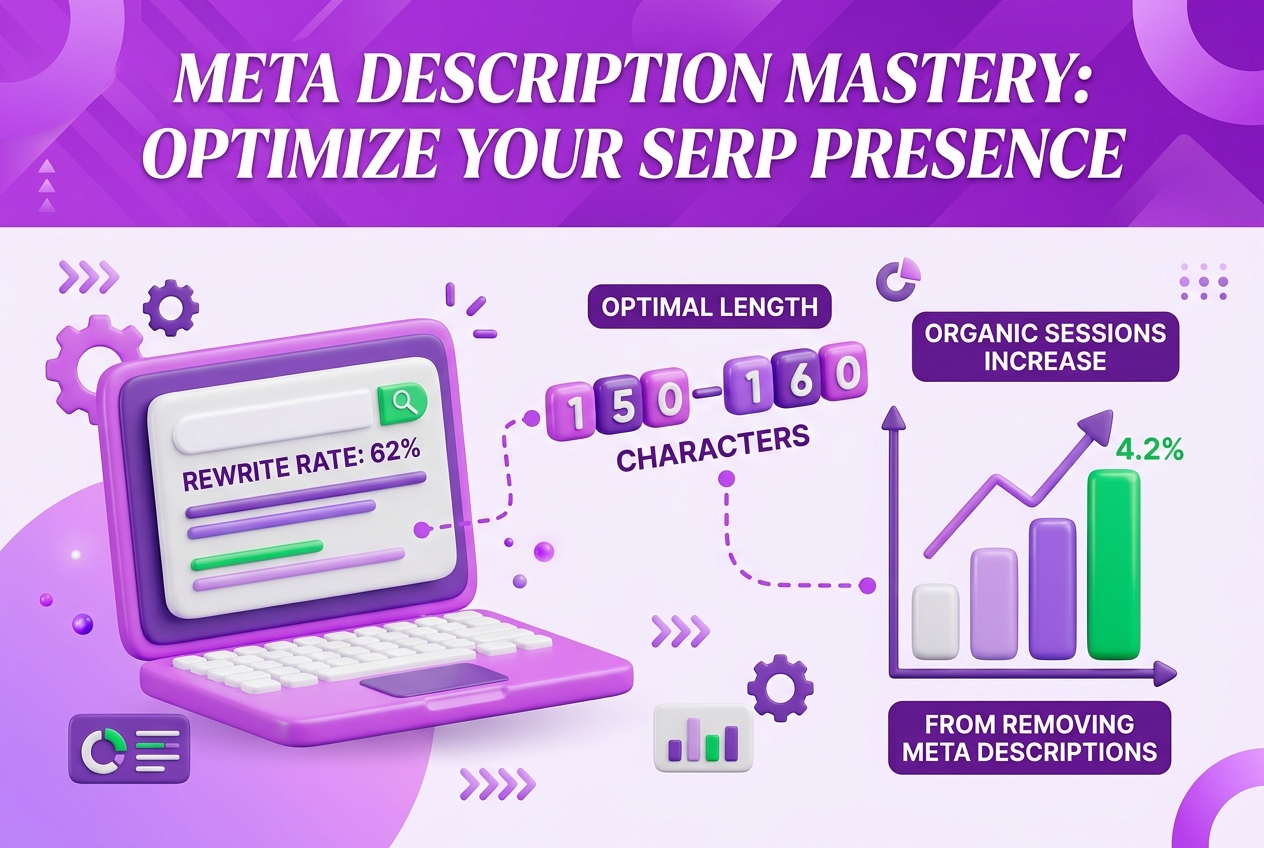 > TL;DR: Writing meta descriptions isn’t just about filling a field; it’s about crafting a 150-160 character pitch that boosts your page’s chance of getting clicked. Using AI tools can cut the hassle, but you still need to tweak outputs to avoid generic fluff that kills your SEO edge. Done right, it’s a small effort that can drive significantly better traffic results.
Crafting a solid meta description feels more like guesswork than strategy most days. You put effort into writing them only to discover that Google rewrites over 62% of meta descriptions anyway, stripping away your carefully chosen words. Worse, too long or too short, and you might as well not bother. I’ve seen teams waste hours on meta descriptions that hardly move the needle. Interestingly, removing them altogether yielded a 4.2% boost in organic sessions in one recent test. This guide cuts through the noise with practical advice on writing meta descriptions that help your pages get noticed, including ideal length, AI tools you can try, and tips for click-worthy copy that stands a chance against Google’s edits.
| Point | Details |
|---|---|
| Meta Description Impact | A sharp meta description can lift click-through rates by 10-15%, but crafting that perfect line takes time and patience. |
| Length Optimization | The sweet spot for meta descriptions is 150-160 characters; too long or short, and you risk poor display or truncation. |
| AI Assistance | Using AI meta description tools speeds up writing and nudges you toward SEO-friendly phrasing, though it’s not foolproof. |
| Google Rewrites | Google rewrites around 62% of meta descriptions, so even a well-written one might get changed oddly or incorrectly. |
| Avoid Removal | Dropping meta descriptions can see session spikes of about 4.2%, but most of the time, a clear description wins on CTR. |
What Is a Meta Description Writer and Why It Matters
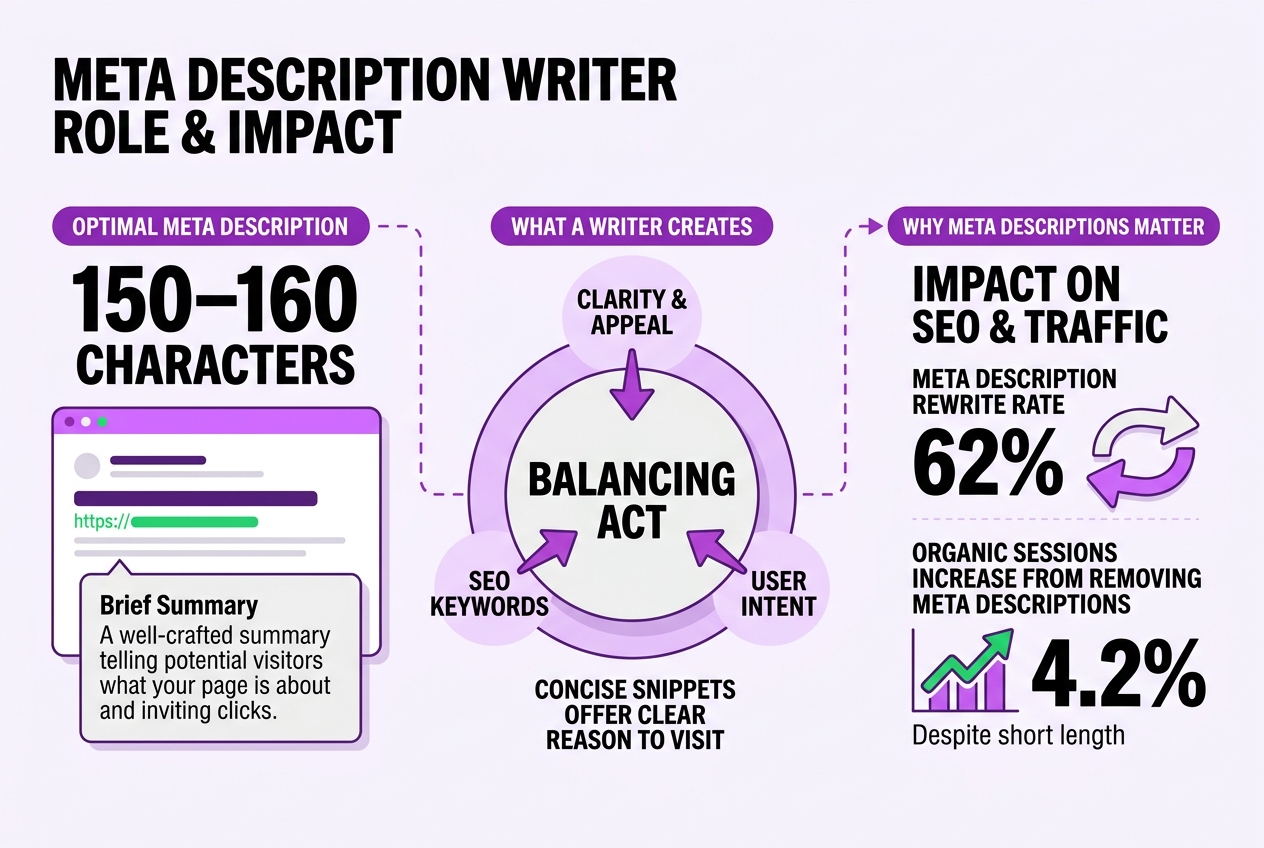
A meta description is a brief summary—usually between 150 and 160 characters—that shows up under your page title in search results. Its main job is to tell potential visitors what your page is about and convince them to click through to your site. Despite its short length, a well-crafted meta description can make a huge difference in attracting the right audience.
A meta description writer specializes in creating these concise snippets. They balance clarity, appeal, and SEO by including relevant keywords while making the text inviting. The goal isn’t just to cram keywords but to match user intent and offer a clear reason to visit.
Here’s a quick look at why meta descriptions matter so much:
| Why Meta Descriptions Matter | Impact on SEO and Traffic |
|---|---|
| Improved Click-Through Rate (CTR) | Good meta descriptions can increase CTR by making listings more clickable. |
| Better User Experience | Clear summaries help users decide quickly if your page fits their needs. |
| Search Engine Interpretation | Google uses meta descriptions to understand your content’s focus. |
| Visibility in Search Results | Strong descriptions can make your listing stand out visually. |
Google often rewrites meta descriptions for about 62% of pages, which can be frustrating for those of us who put a lot of effort into writing them. That means your text should be strong, relevant, and aligned with the page content to reduce the chance of a rewrite and maintain your intended message.
Pro Tip: Focus on user intent and relevance to the page content when writing meta descriptions.
Creating effective meta descriptions is tricky but worth it. They directly influence whether someone chooses your link over others. Ignoring them or using generic text is a missed opportunity for better traffic and engagement.
The next step is learning how to actually write meta descriptions that convert visitors into clicks and boost your SEO performance in practice.
How to Write Meta Descriptions That Google Won't Rewrite
Crafting meta descriptions isn’t just about jamming keywords into a sentence; it’s about striking a balance between length, relevance, and appeal. Google is picky—it rewrites over 62% of meta descriptions, even well-written ones, so the goal is to minimize that chance. Here’s how I approach it step-by-step:
-
Stick to 150–160 characters: This range isn’t random. It fits what Google displays in search results without cutting off your message. Go under 150 and you might be underselling your page; exceed 160 and Google is more likely to rewrite your description entirely. Check this meta description length guide for precise character limits.
-
Place primary keywords naturally: Don’t force keywords or overload the description. Instead, weave them in smoothly where they fit the context. This helps both Google and users understand the page focus without looking spammy.
-
Reflect page content accurately: Don’t bait users with unrelated promises. If your page dives into local gardening tips, don’t tease a general landscaping guide. Inaccurate descriptions frustrate visitors and increase bounce rates, hurting your SEO.
-
Make it engaging: Your meta description should invite clicks. Use a clear value proposition or intriguing question that matches searcher intent. Aim to stand out by promising a specific benefit or solution.
-
Test variations: What works for one page or audience might flop for another. Run A/B tests or swap out meta descriptions to see which drives higher click-through rates. Keep an eye on your analytics to refine over time.
Pro Tip: Use AI tools to generate multiple meta description variants to test effectiveness and adherence to length guidelines. Tools like this can save time and reveal options you might not consider.
While these steps help reduce the chance of Google rewriting your meta descriptions, know it’s not 100% avoidable. Google’s goal is always to deliver the best snippet to users—sometimes that means replacing yours. Still, following this approach gives you a solid shot at control.
If you want to speed up testing and generation, check out our Ai Meta Description Generator Boost Your Seo Click Through Rates for practical help.
Next up, we’ll explore how a meta description writer like Roki AI can automate this process while you focus on creating even better content.
Leveraging AI Tools for Efficient Meta Description Writing
AI tools like TryRoki’s meta description generator can save you serious time, but they don’t just spit out random text. They analyze your page content to understand search intent and match keywords smartly. That means your meta description isn’t just stuffed with keywords—it actually connects with what users are looking for.
Here’s how you can get the most from AI when writing meta descriptions:
- Start by feeding the AI your main keywords and a brief summary of your page.
- Review the AI’s suggestions carefully; it will generate options based on search intent and keyword relevancy.
- Tweak the tone and phrasing to better fit your brand voice or target audience.
- Shorten or lengthen the description to hit the ideal range of 150–160 characters for SEO.
- Test the description’s impact by monitoring click-through rates and making adjustments.
Pro Tip: Integrate AI tools with your SEO workflow to iteratively improve descriptions based on real-time search data.
Even with solid AI-generated drafts, human editing remains crucial. AI can miss nuances or produce descriptions that feel generic. A quick manual pass helps tailor the message, iron out awkward phrasing, and add personality—elements AI still struggles with.
TryRoki’s AI meta description generator features an intuitive interface where you input your content and get options that balance keyword prominence and readability. It offers batch processing to handle numerous pages, which is a lifesaver for bigger sites. Plus, it keeps the description length in check and flags when it’s too long or too short.
No tool is perfect—Google rewrites over 60% of meta descriptions, so flexibility in your approach is essential. But pairing AI capabilities with your judgment will speed up your workflow and boost SEO impact without feeling robotic.
Next, let’s look at how to nail meta description writing so Google won’t rewrite yours.

Common Mistakes Meta Description Writers Make
When writing meta descriptions, I've seen countless attempts stumble right out of the gate. These mistakes aren't just minor slip-ups—they can actually sabotage your SEO efforts.
Here are some of the most common errors meta description writers make:
-
Overstuffing keywords: Jamming every possible keyword into your meta description feels like it should help your rankings. It doesn't. It makes your snippet look spammy and off-putting to readers.
-
Descriptions too long or too short: Google typically displays around 150–160 characters. Too short, and you miss the chance to persuade clicks; too long, and Google will often rewrite or cut off your description, sometimes in awkward spots.
-
Generic or duplicate descriptions: Copy-pasting the same description across multiple pages kills your chance to stand out. Every page needs a unique snippet that reflects its specific content.
-
Ignoring user intent and relevance: If the meta description doesn't match what searchers are looking for, they won't click. I've found tailoring descriptions to the user's mindset at the time of search makes a big difference.
-
Not updating regularly: Your website changes over time, and so should your meta descriptions. Leaving them stagnant means missing out on highlighting new, important content or updated offerings.
It's frustrating to watch many pay little attention to these details, especially when the fixes are straightforward. Meta descriptions need time and thought—they’re not a “set-it-and-forget-it” element.
Google even rewrites over 62% of meta descriptions, including many that are carefully crafted, which shows how tricky it can be to get it right on the first try. Adjusting based on performance and keeping descriptions fresh is crucial.
Addressing these common mistakes head-on will give you a much stronger foundation for your SEO strategy. Up next, we'll look at how to tune your meta descriptions so Google leaves them alone and boosts your click-through rates naturally.
Measuring the Impact of Your Meta Descriptions on Organic Traffic
Tracking how your meta descriptions affect organic traffic isn’t just about watching visits roll in. It starts with the right metrics. Key ones to track include the click-through rate (CTR), impressions, and keyword rankings. CTR tells you how many people actually click your link after seeing the description. Impressions measure how often your page shows up in search results, and rankings reveal where your page stands for relevant queries.
Google Search Console is where I spend most of my time for this kind of insight. Here’s a rough timeline I follow:
-
Set a baseline: Before making any changes, gather data for at least two weeks. Note your CTR, impressions, and rankings for the pages in question.
-
Implement meta description tweaks: Focus on one or two pages at a time. This limits noise and helps isolate changes.
-
Run an A/B test: Create two different versions of the meta description for each target page. Use Google Search Console data to track which version yields higher CTR and engagement over a period of 2-4 weeks.
-
Analyze results: If a revised meta description improves CTR and maintains or improves rankings, keep it. If performance drops, reconsider—it might be less relevant or compelling.
-
Consider removal: In some cases, removing meta descriptions entirely has led to better traffic. Studies have shown a 4.2% session increase after removal, likely because Google then finds better snippets to display to searchers. Removing descriptions isn’t a guaranteed win but can be worth testing, especially if Google frequently rewrites your meta descriptions.
Most teams overlook the subtlety needed here. Google rewrites a large portion of meta descriptions anyway, so obsessing over perfect copy can miss bigger wins from strategic tweaks or removals.
The key is consistent tracking and testing—backed by data from tools like Google Search Console. From there, use the insights to decide if you keep, refine, or drop a meta description entirely.
Up next, I’ll explain how to avoid common pitfalls when writing your meta descriptions to keep your SEO efforts on track.
My honest take on meta description writing in 2024
When I started TryRoki, meta descriptions were mostly just short snippets squeezed with keywords, seen as an SEO afterthought. Now, they’re pivotal to drawing the right visitors. A lot of folks argue these days that skipping meta descriptions altogether can help rankings because Google’s smart enough to generate them automatically. I disagree. Trust me, a well-crafted meta description still hooks qualified clicks better than any auto-generated line — but the trick is to sound authentic, not robotic.
The brutal truth is that writing good meta descriptions is harder than it looks. It’s tempting to stuff phrases that SEO tools highlight, but that can turn off real readers. We’ve seen this enough: when AI helps us draft descriptions, it often gets the structure right but misses the human touch. That’s why I insist on combining AI assistance with real human judgment at TryRoki. This blend gives us descriptions that respect Google’s guidelines and speak naturally to humans scanning search results.
The trade-off isn’t trivial: overly optimized and you lose credibility; too natural and you might miss ranking signals. Balancing this is an art and a science. For anyone ignoring meta descriptions as old news, I’d say rethink that stance — they remain a vital piece of your SEO puzzle.
— Daniel
Boost Your SEO with TryRoki’s AI Meta Description Writer
When I started using TryRoki’s AI meta description writer, I wasn’t expecting it to handle the trickiest part of SEO—getting clicks—from just a few lines of text. It’s not perfect; sometimes the suggestions miss the mark or sound a bit generic out of context. But the ease of generating tailored descriptions based on your actual content keywords saves hours compared to manual drafting.
TryRoki doesn’t just spit out snippets; it offers weekly tasks and insights that help me refine my SEO strategy over time. That hands-on aspect feels more grounded than just automating for automation’s sake. If you care about improving click-through rates without drowning in tedious editing, exploring TryRoki's AI meta description generator could be a practical next step. Pricing is straightforward, so you can test how it fits into your workflow without surprises.
Frequently Asked Questions
What is a meta description writer?
A meta description writer is someone who crafts brief summaries for webpages, usually around 150-160 characters. These snippets are meant to capture what the page is about and persuade people to click through from search results. Writing them isn’t just about summarizing; it’s about pitching the page in a punchy way.
How long should a meta description be?
The sweet spot for meta descriptions is 150 to 160 characters. Anything longer risks getting cut off in search results, which means your message might not make it through. Keeping it concise forces you to focus on what really matters to attract the right clicks.
Can Google rewrite my meta descriptions?
Yes, and it happens more often than you might expect. Google rewrites over 62% of meta descriptions to better fit what it thinks users are searching for. Even a well-written meta description might get tweaked, so relying solely on your original snippet isn’t a safe bet.
Does removing meta descriptions improve SEO?
Some experiments show that dropping meta descriptions can bump organic sessions by about 4.2%. But this isn’t a guaranteed win—usually, well-targeted meta descriptions improve click-through rates and keep users engaged. Removing them might help in very specific cases, but it’s far from a universal strategy.
How can AI help in writing meta descriptions?
AI speeds up the process by generating several meta description options tailored for relevance and length. I’ve seen it cut the content creation time in half, but it’s not perfect; you still need to pick which suggestions actually sound natural and align with the page’s purpose. It’s a helpful tool, not a complete replacement.
Written by Daniel.
Recommended reads
- Ai Meta Description Generator Boost Your Seo Click Through Rates
- Seo Description Generator How To Boost Your Click Through Rates
- Features
- Organic Traffic Insights A Guide To Boost Your Website Visitors