Daniel D.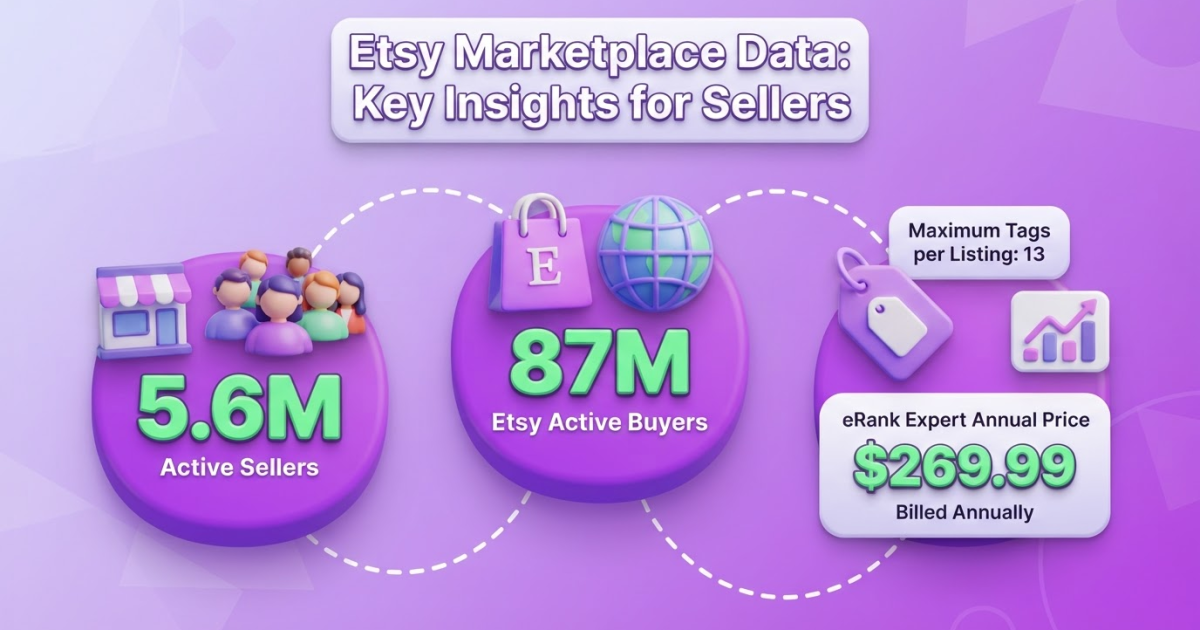
The best Etsy SEO tool depends on your job: use eRank or Marmalead for keyword and competitor research, Etsy’s own data for shop-specific decisions, and AI assistance to improve titles, tags, and listing copy. Compare these 4 approaches, but treat tool scores as suggestions rather than ranking guarantees because Etsy still judges the full listing, including its 3 core SEO areas: titles, tags, and listing quality.
You can spend hours tweaking Etsy titles and tags, then watch your listings disappear beneath better-optimized competitors. With 87 million active buyers, 5.6 million active sellers, and 100 million items for sale, guesswork gets expensive quickly, especially when a promising keyword brings views but no orders. This guide gives you a practical way to choose the best Etsy SEO tool for your shop by comparing tool capabilities, pricing, keyword research, listing audits, Etsy’s own search signals, and a repeatable workflow for turning findings into better listings instead of another pile of confusing data.
| Point | Details |
|---|---|
| Match Your Goal | Choose keyword research, listing audits, competitor analysis, or workflow automation based on the first bottleneck you need to fix. |
| Use Etsy’s Framework | Etsy search has 2 phases, query matching and ranking, so a keyword tool cannot replace strong listings, customer service, and engagement. |
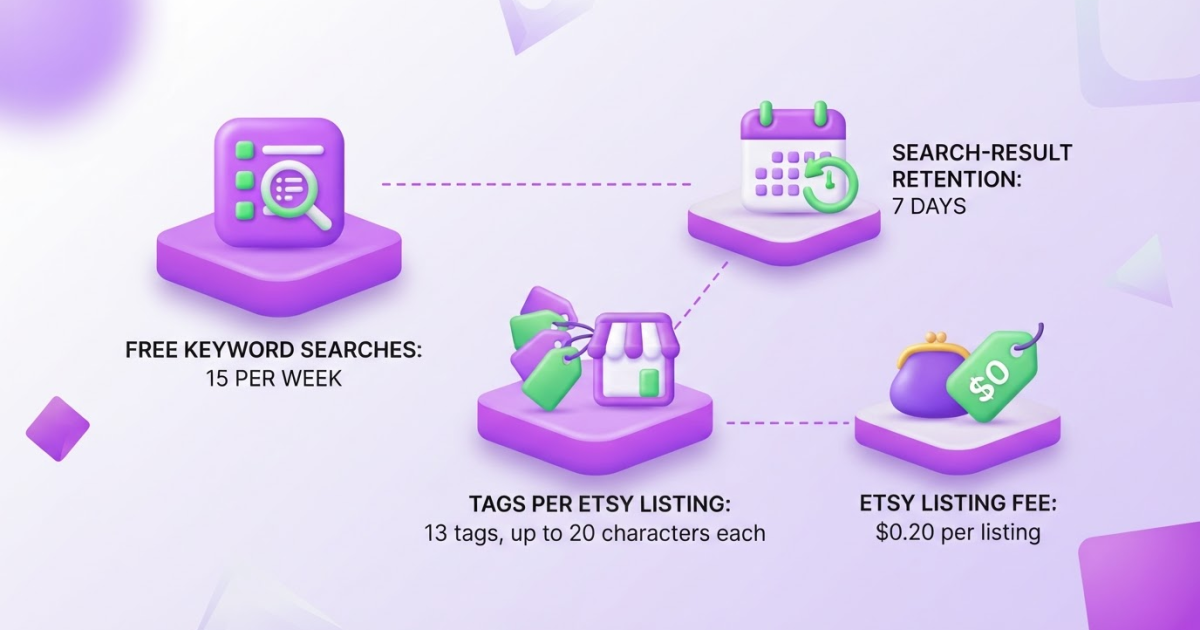
| Prioritize Specificity | Etsy allows up to 13 tags per listing, and each tag can contain 20 characters, so focused multi-word phrases usually beat random broad terms. |
| Validate Shopper Behavior | Track listing views and purchases alongside keyword metrics because engagement shows whether shoppers actually respond to your listing. |
| Build A Routine | Review search terms, update titles and tags, improve conversion elements, and reassess performance every 30 days instead of making isolated edits. |
What an Etsy SEO Tool Actually Does
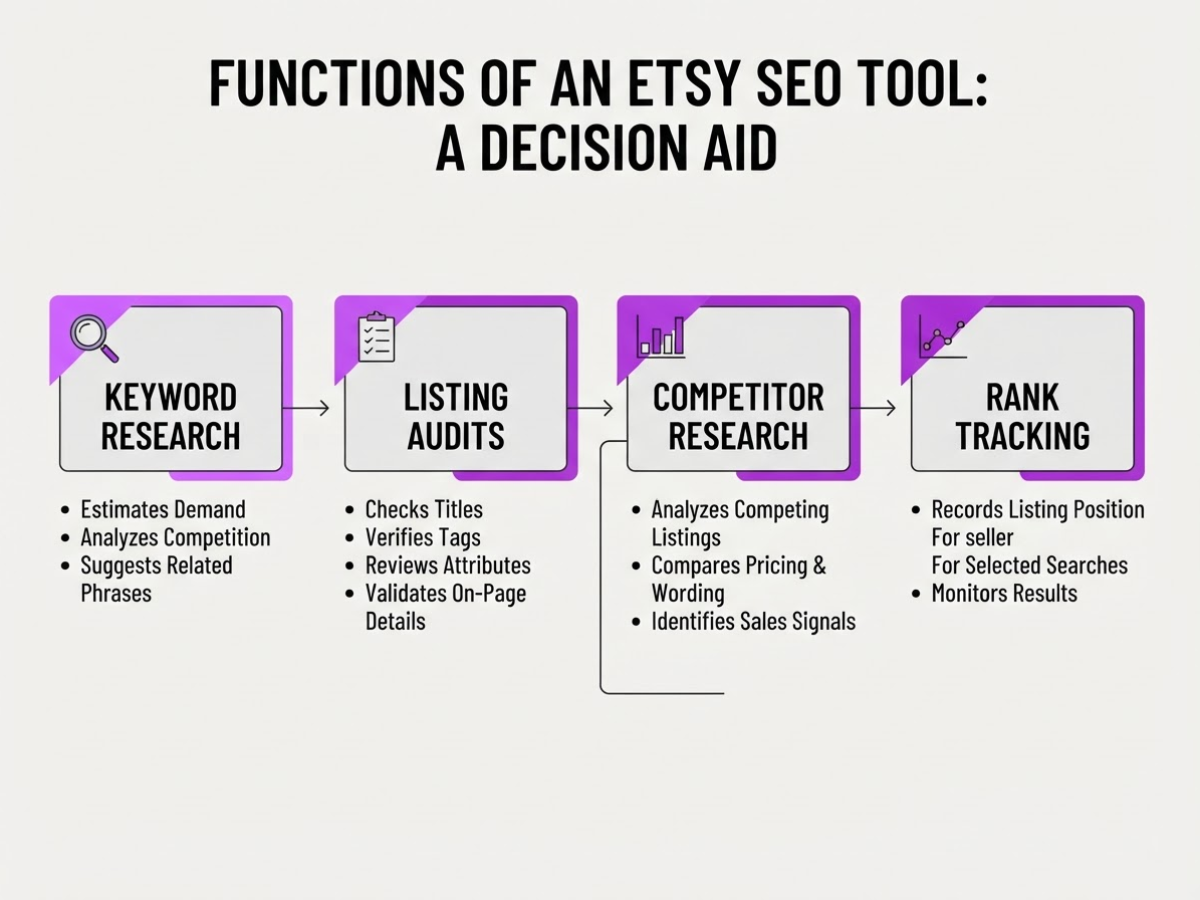
An Etsy SEO tool is a decision aid, not a switch that moves your listings to page one. When I review tools with sellers, I first check whether the product helps with one clear job or simply bundles six shallow dashboards together. The difference matters when you are choosing where to spend limited time and money.
Most tools cover some combination of these functions:
- Keyword research: Estimates demand, competition, and related phrases before you write a listing.
- Listing audits: Checks titles, tags, categories, attributes, and other on-page details against a checklist.
- Competitor research: Shows patterns in competing listings, such as wording, pricing, reviews, and visible sales signals.
- Rank tracking: Records where a listing appears for selected searches. Results can vary by shopper, location, and personalization.
- Trend analysis: Flags rising or declining search interest, although trends can lag behind sudden seasonal demand.
- Shop analytics: Uses your own visits, views, orders, conversion behavior, and revenue to show what is actually happening.
The first five usually rely on third-party estimates, scraped marketplace data, models, or samples. They can help you compare “wedding guest book” with a narrower phrase, but they do not know Etsy’s complete search database or every factor affecting your listing. Your Etsy Shop Stats and Search Visibility page provide first-party evidence for your shop, including personalized actions across listings, the shop, and customer service. For a practical walkthrough, see this guide to using an Etsy analytics tool.
Etsy search itself works in two stages: query matching and ranking. Etsy first identifies listings that match the query, then ranks them using signals such as relevancy, customer service quality, engagement, recency, and shopper habits. A tool can suggest better inputs, but it cannot control those outcomes or guarantee a position.
I score each product on five practical criteria:
| Criterion | What to check |
|---|---|
| Data quality | Source, freshness, sample size, and clear limits |
| Usability | How quickly you can reach a useful decision |
| Pricing | Cost relative to your listing volume and revenue |
| Listing workflow | Whether recommendations fit your actual editing process |
| Shop fit | Whether it suits a new, growing, or large shop |
Pro Tip: Treat a tool’s score as a prioritization signal, not as an Etsy ranking prediction.
With that definition in place, the next step is comparing the tools by the jobs they handle well, rather than by the number of features on their pricing page.
Best Etsy SEO Tools Compared by Seller Need
Your seller profile should determine the tool you choose, not a leaderboard claiming that one platform wins every category. I would start with Etsy’s own Search Visibility dashboard because it is free, tied to your shop, and points to issues across listings, the shop itself, and customer service. Its weakness is just as clear: it does not give you the broad keyword discovery or competitor context that a dedicated research platform provides.
| Tool or workflow | Best for | Core strengths | Limitations | Pricing approach | Ideal seller profile |
|---|---|---|---|---|---|
| Etsy Search Visibility | Fixing Etsy-identified issues | Shop-specific recommendations and visibility checks | Limited keyword and market research | Free inside Etsy | New sellers and lean shops |
| eRank | Keyword lookups and listing audits | Keyword research, tags, trends, competitor checks, and audits | Daily limits can interrupt bulk research; scores are estimates | Basic $5.50/month, Pro $7.92/month, Expert $22.50/month when billed annually | Sellers managing many listings |
| Marmalead | Evaluating keyword engagement and demand | Search volume, engagement, shipping time, pricing, and trend data | $19 monthly can feel steep for a small shop; its scores still need judgment | $19/month, $16/month annually, or $300 lifetime | Sellers validating product ideas and pricing |
| AI-assisted content workflow | Drafting titles, descriptions, and testing variations | Faster writing, consistent formatting, and repeatable updates | Can produce bland or inaccurate copy without human review | Usually subscription or usage-based | Sellers with frequent launches or large catalogs |
For eRank, the limits matter more than the headline feature list. Basic allows 100 keyword lookups and 50 listing audits per day; Pro raises both to 200; Expert allows 500 of each. The annual-equivalent prices are listed by eRank, but paying more does not make a weak keyword relevant. I have seen sellers chase a high score, then place an awkward phrase in a title that attracts clicks but fails to convert.
Marmalead is more useful when the decision involves demand and commercial fit, not just a keyword list. Its data covers engagement, shipping time, market pricing, and trends, which helps when you are choosing between “linen pouch” and “linen travel pouch.” Still, no dashboard knows your production costs or customer expectations. You must check the actual search results and your shop’s conversion data.
AI belongs after research, not before it. Use it to turn a short list of specific phrases into readable titles and descriptions, then edit every claim, material detail, and delivery promise. This Etsy SEO tools guide explains that workflow in more detail.
Pro Tip: Compare tools using the same five listings and the same keyword set before committing to a subscription.
A free or native setup is enough when you have fewer than 20 listings and can review performance weekly. A paid platform earns its cost when research saves several hours per month or prevents repeated weak launches. Next, the practical test is how each tool fits into your listing optimization routine.
How to Use the Best Etsy SEO Tool on a Listing
-
Write down the product facts first. Before opening a keyword tool, describe the item in plain language: what it is, who buys it, how they use it, and what it is made from. Add objective details such as material, color, style, size, occasion, personalization options, and quantity. “Gift” is too vague on its own; “personalized walnut desk name plate” gives the tool and the shopper something useful to work with.
-
Build a broad seed list. Enter the product type and its obvious uses to collect starting terms. For a handmade ceramic mug, you might begin with “ceramic mug,” “coffee cup,” “pottery mug,” and “housewarming gift.” I prefer several modestly relevant seeds over one fashionable phrase because a single trend can distort the whole listing plan.
-
Narrow the list by buyer intent. Turn broad terms into specific, multi-word phrases such as “blue ceramic coffee mug” or “handmade housewarming mug.” Etsy recommends specific phrases because long-tail keywords can describe shopper intent more precisely and may convert better. Remove phrases that describe a different product, attract gift browsers with no clear fit, or sound unnatural when spoken by a buyer.
-
Judge the numbers together. Review estimated demand, competition, engagement, relevance, and commercial fit. Do not automatically choose the phrase with the largest search estimate. A smaller phrase that matches your item, price, shipping promise, and buyer may produce more useful visits than a crowded term like “gift.” Tool data is directional, not a sales forecast, so treat suspiciously precise scores with caution.
-
Map the winning phrase across the listing. Choose one primary phrase, then assign close variations to the title, tags, description, category, and attributes. Use all 13 tags when they genuinely describe the item, and keep each tag within Etsy’s 20-character limit, as Etsy’s tag guidance requires. Do not paste the same phrase 13 times. That wastes space and makes the listing look careless.
Pro Tip: Create a change log for every listing edit so you can distinguish a useful optimization from normal marketplace fluctuation.
-
Rewrite the title for people first. Etsy’s April 2026 guidance says to state the item clearly, put important objective traits near the front, avoid repetition, and consider fewer than 15 words. “Blue Ceramic Coffee Mug, Handmade Pottery Cup” is clearer than a string of repeated gift keywords. Then improve the first photo, price, delivery information, and description so search visibility has a fair chance to become a click and purchase.
-
Test one meaningful revision. Record the original title, tags, photos, price, and dates, then wait through a defined window, such as 30 days, before judging the result. Compare visits, clicks, favorites, orders, and conversion behavior. If traffic rises but sales do not, the keyword may be relevant while the photo, price, shipping cost, or description creates the real problem.
With the listing updated and measured, the next step is comparing tool features against the type of seller support you actually need.

Common Etsy SEO Tool Mistakes That Waste Time
Keyword tools save time only when you treat their output as evidence, not instructions. When we review Etsy shops, the same mistakes appear repeatedly, especially when sellers chase impressive dashboards instead of improving the listing in front of them.
- Picking the biggest database: More keyword records do not automatically make a tool better. Choose one that fits your workflow, budget, and listing volume. A smaller tool you use every week beats a huge database you open once a quarter.
- Copying competitor tags: A rival’s tag may describe a different material, style, size, or buyer. Check product relevance and intent first. “Wedding gift” attracts a different shopper from “personalized wedding gift for bride,” even when both appear on similar listings.
- Stuffing every keyword into the copy: Etsy allows up to 13 tags, but that does not mean you should cram every phrase into the title and description. Repetition makes the listing awkward and can weaken clicks. Etsy now recommends clear titles that state the item and its important traits without unnecessary repetition.
- Ignoring categories and attributes: Sellers often obsess over tags while leaving the category, color, occasion, or other attributes incomplete. Those fields help Etsy understand what you sell, so fill them in accurately before hunting for another keyword.
- Changing everything at once: If you rewrite the title, replace all tags, change photos, cut the price, and alter shipping on the same day, you cannot identify the cause of a result. Test one meaningful variable, then give the listing enough time to collect useful data.
- Treating estimates as Etsy facts: Search volume, competition, and opportunity scores are modeled estimates. They are useful for comparing phrases, not guarantees of traffic or sales. Our practical Etsy keyword research guide explains how to use those estimates without overtrusting them.
- Forgetting the buying experience: Keywords cannot rescue dark photography, vague shipping details, slow replies, an uncompetitive price, or a weak product. Etsy says listing engagement includes shoppers viewing and purchasing, so relevance must lead to a satisfying purchase.
- Ignoring Etsy’s own diagnosis: Check the Search Visibility page for recommendations covering listings, your shop, and customer service before trusting a third-party score.
Once you avoid these traps, you can measure tool results against the signals that actually shape your shop’s performance.
How to Measure Whether Your Etsy SEO Tool Is Working
A tool score can look impressive while your shop earns nothing. When I review Etsy SEO work, I start with business results: impressions, visits, favorites, orders, conversion rate, revenue, and average order value. Record each metric before you change a title or tag, even if some numbers are zero.
Track individual listings, not only total shop traffic. A new product, a sale, or a seasonal spike can make overall visits rise while the listing you optimized loses traction. A simple change log beside your Etsy Analytics data usually tells you more than a dashboard grade. This Etsy analytics tool guide covers the workflow in more detail.
Use this review timeline for each meaningful optimization:
- Day 0: Save the listing’s current title, tags, impressions, visits, favorites, orders, conversion rate, revenue, and average order value.
- Days 1 to 14: Check that the listing receives impressions and clicks after the keyword or title change. Do not rewrite it again after three quiet days.
- Days 15 to 30: Compare clicks with purchases. Etsy evaluates listing engagement partly through shopper behavior, including views followed by purchases, so traffic without orders is not a win.
- Day 30: Mark the change keep if relevant traffic and sales improve, stop if impressions or conversion fall, or test again with one controlled change.
Treat Etsy’s Search Visibility recommendations as diagnostic clues, not commands. Check whether the advice fits your product, photos, price, delivery promise, and customer experience. Also note holidays, promotions, stockouts, price changes, and shipping updates before blaming a keyword.
A free workflow is enough when you manage a small catalog and can review ten to twenty listings monthly. Pay for research or automation when manual comparisons consume several hours each week, you sell hundreds of listings, or you need repeated audits across many products. The tool should save decision time, not give you another score to monitor.
With the measurement rules set, you can choose an Etsy SEO workflow that fits your catalog and workload.
My honest take on the best Etsy SEO tool
I own Roki AI, and I do not believe the best Etsy SEO tool is automatically the one with the largest keyword database. A huge list can feel useful, but it often leaves you with 200 phrases and no clear decision about which one belongs in your title, tags, photos, or description.
My less popular view is that Etsy sellers usually over-invest in keyword discovery and under-invest in conversion quality. A beautifully scored keyword will not fix a dim product photo, unclear positioning, or a title that reads like it was assembled for a robot. I have seen sellers spend hours refining phrases while overlooking the listing elements that determine whether a shopper clicks, trusts, and buys.
I would start with Etsy’s own guidance and native visibility information. Then I would add a specialist tool when deeper research justifies the subscription cost. The annoying part is that no tool removes the need to test, wait, and interpret buyer behavior. AI should speed up structured content work, not invent bland copy that every competitor could publish.
That is the operating mindset behind Roki AI: practical tasks completed consistently, with attention to content quality and visibility beyond Etsy when it supports the wider business. The tool is not a shortcut around judgment. It is a way to make better decisions more regularly.
— Daniel/Aleksandra
Turn Etsy SEO insights into a consistent growth workflow
Choosing the best Etsy SEO tool is only the first step. The harder part is keeping keyword research, listing updates, content work, and off-platform visibility moving while you run the shop. Most sellers do a burst of optimization, then abandon the routine when orders pile up.
I built Roki AI’s weekly visibility workflow to make that follow-through more practical. Each week, Roki AI gives you 3 to 10 tasks, helps create website content on autopilot, and surfaces Reddit discussions where a relevant, thoughtful mention of your site may fit. The Reddit suggestions still need judgment, and the setup is not a replacement for Etsy’s native data or specialist Etsy tools.
If you want broader search momentum around your shop and brand rather than another isolated dashboard, try the free SEO tools and see whether Roki fits your working rhythm.
Frequently Asked Questions
eRank suits sellers who want keyword lookups and listing audits, while Marmalead focuses more on keyword engagement, shipping time, and market pricing. Compare both with your shop size, budget, and workflow for at least 2 weeks before choosing, because neither tool guarantees higher Etsy rankings.
Etsy provides search guidance and a Search Visibility dashboard, and you can begin with free keyword and listing reviews before paying for third-party software. Use Etsy’s own data for your first 10 to 20 listings, then pay for deeper research only if repeated audits save you enough time to justify the cost.
Review important listings every 30 to 60 days, but do not change every field at once. Make 1 focused update, record the date and reason, then compare performance over a consistent period while accounting for seasonality, promotions, and stock changes.
Usually not: third-party tools provide estimates or modeled data rather than Etsy’s complete internal search data. Treat a volume score as 1 comparison signal alongside relevance, competition, engagement, conversion behavior, and the fit between the phrase and your product.
AI can organize keyword research and draft options, but you should verify every suggestion for accuracy, product relevance, readability, and Etsy’s current guidance. Review at least 3 title or tag variations yourself, because automation should speed up testing rather than replace your understanding of the product and buyer.
Written by Daniel/Aleksandra.
Recommended reads
- Etsy Seo Tools Guide Boost Your Shop Visibility Effectively
- Best Free Etsy Keyword Tool 2026 Guide
- Etsy Keyword Research A Practical Guide
- Etsy Analytics Tool How To Use One Well
Sources
- How Etsy Search Works
- How to Use Tags to Get Found in Search – Etsy
- Keywords 101: Everything You Need to Know
- How to Use the Etsy Search Visibility Page
- New Guidance for Listing Titles, and a Tool to Help
- eRank Plans — Find the perfect plan to grow your Etsy shop
- Marmalead Chrome Extension: AI SEO Coach for Etsy - Marmalead
- Marmalead
- Since 2005, Etsy has connected millions of buyers and sellers around the world through a shared mission to Keep Commerce Human.