Daniel D.
The 4Ps of marketing are product, price, place, and promotion. This guide uses 5 practical 4P examples, from backpacks and smartphones to SaaS, to show how each decision shapes a complete marketing plan.
A good offer can still stall when customers cannot connect what you sell with its price, availability, and message. I have seen website owners polish the product while treating distribution and promotion as afterthoughts, then wonder why traffic does not turn into sales. OpenStax defines the 4Ps as product, price, place, and promotion, but the framework only helps when it drives decisions. The examples below show how to adapt the mix to a website or SaaS offer such as Roki AI.
| Point | Details |
|---|---|
| Four core decisions | The 4Ps are product, price, place, and promotion, the 4 decisions that connect an offer with its market. |
| Start with customers | Define the customer’s problem and desired outcome before choosing features, channels, or promotional tactics. |
| Price signals value | Price is the only 1 of the 4Ps that directly generates revenue while shaping perceived value and profitability. |
| Place means access | Place covers how customers discover, purchase, and receive an offer across physical and digital channels. |
| Promotion needs coordination | Promotion can combine 5 methods: advertising, personal selling, sales promotion, direct marketing, and digital marketing. |
What Are the 4Ps? The Framework in Plain English
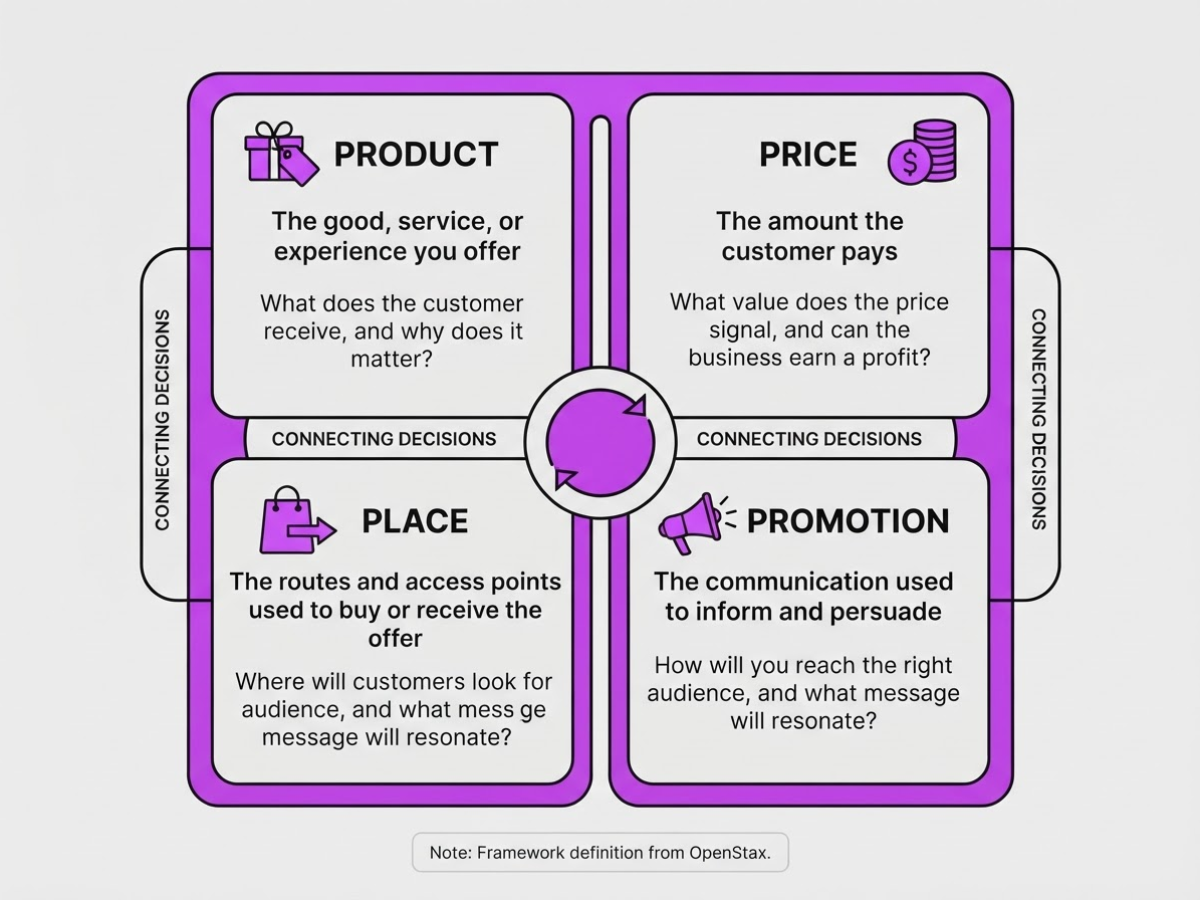
The 4Ps are four connected decisions that shape how you bring an offer to market: product, price, place, and promotion. OpenStax defines the framework as four parts of the marketing mix, but you should not treat them as separate boxes. A cheap product sold through an inconvenient channel and promoted to the wrong audience is still a weak plan.
| P | What it means | The question to answer |
|---|---|---|
| Product | The good, service, or experience you offer | What does the customer receive, and why does it matter? |
| Price | The amount the customer pays | What value does the price signal, and can the business earn a profit? |
| Place | The routes and access points used to buy or receive the offer | Where will customers look for it, and how will it reach them? |
| Promotion | The communication used to create awareness, interest, and action | What will make the right people notice, understand, and choose it? |
Product includes more than features. For a backpack, it can include padded shoulder straps, a laptop sleeve, organizer pockets, and reflective tape. Price is not just a number either. A $9 monthly subscription, a $99 annual plan, and a $999 business package each create a different expectation about value. Price is the only 4P that directly produces revenue; the other three require spending.
Place covers access, not merely a storefront. An offer might reach customers through a website, retail partners, marketplaces, sales representatives, or an app. Promotion carries the message through advertising, sales conversations, email, social posts, search content, and other channels. These blog writing examples show promotion as a series of deliberate messages rather than random publishing.
Pro Tip: Write the four Ps in one sentence before making a campaign decision; a missing P usually reveals a positioning or distribution gap.
The examples below show how these decisions reinforce one another in real markets.
How to Build a 4P Marketing Plan Step by Step
Start with the customer, not the product. A 4P plan gets easier when every decision answers one question: why should this person choose you instead of doing nothing or choosing a competitor?
-
Define the customer and promise. Write down the target customer, the job they need done, and the problem that makes it urgent. Complete this sentence: “For [customer], our [product, service, or website] helps them [result] by [distinctive approach].” “Better marketing” is weak; “publish two search-focused articles each week without hiring a writer” gives you something to build around.
-
Shape the product. List the offer’s features, benefits, proof, packaging, and service experience. For a website, include page structure, content, speed, forms, and support. Most teams overvalue feature lists and undervalue proof, onboarding, and the support questions that decide whether customers stay.
-
Set the price. Test the price against customer value, competitor prices, delivery costs, and desired margin. Price is the only marketing-mix element that directly produces revenue, while the other three create costs, as pricing guidance from OpenStax explains. Try a realistic range instead of pretending one number is correct from day one.
-
Map the place. Record where customers search, compare, purchase, receive the offer, and get support. This includes Google, marketplaces, your website, retail stores, email, or a video call. Place covers access and delivery, not merely your office location, so the channel decision includes how and where customers receive the product.
-
Choose promotion. Match each message and channel to the buying stage. Use educational content for discovery, comparisons and demonstrations for research, and testimonials or a clear offer for people ready to buy. Study these blog writing examples before filling your calendar with topics nobody wants.
-
Check the fit. Read all four decisions as one customer. If your promise says “simple,” but setup requires three calls, the plan contradicts itself. Give each P one measurable outcome, such as qualified leads, gross margin, checkout conversion, or support response time.
Pro Tip: Audit the plan from the customer’s point of view: ask what they see first, what they pay, where they buy, and why they should trust the offer.
Use this worksheet: “Our customer is ___; their job is ___; our promise is ___; product includes ___ and proves value with ___; price is ___ because ___; customers find and buy through ___; support happens via ___; promotion says ___ on ___; and the outcome for each P is ___.”
A clear worksheet makes the examples useful without turning them into scripts to copy.
5 Real-World 4P Examples—and What to Borrow
A framework becomes easier to use when you watch it change shape in the real world. The same four questions produce different answers for a backpack, a phone, a soft drink, a fast-food meal, and a SaaS product.
| Example | Product | Price | Place | Promotion | Strategic lesson |
|---|---|---|---|---|---|
| Backpack | Water-bottle pocket, padded straps, reflective tape, laptop sleeve, and organizer pockets | Mid-range pricing can signal useful quality without becoming a luxury item | Sporting-goods stores, department stores, marketplaces, or a direct website | Photos showing capacity, commuter use, weather resistance, and short seasonal offers | Match features to a specific job. A student, cyclist, and frequent traveler do not need the same bag. |
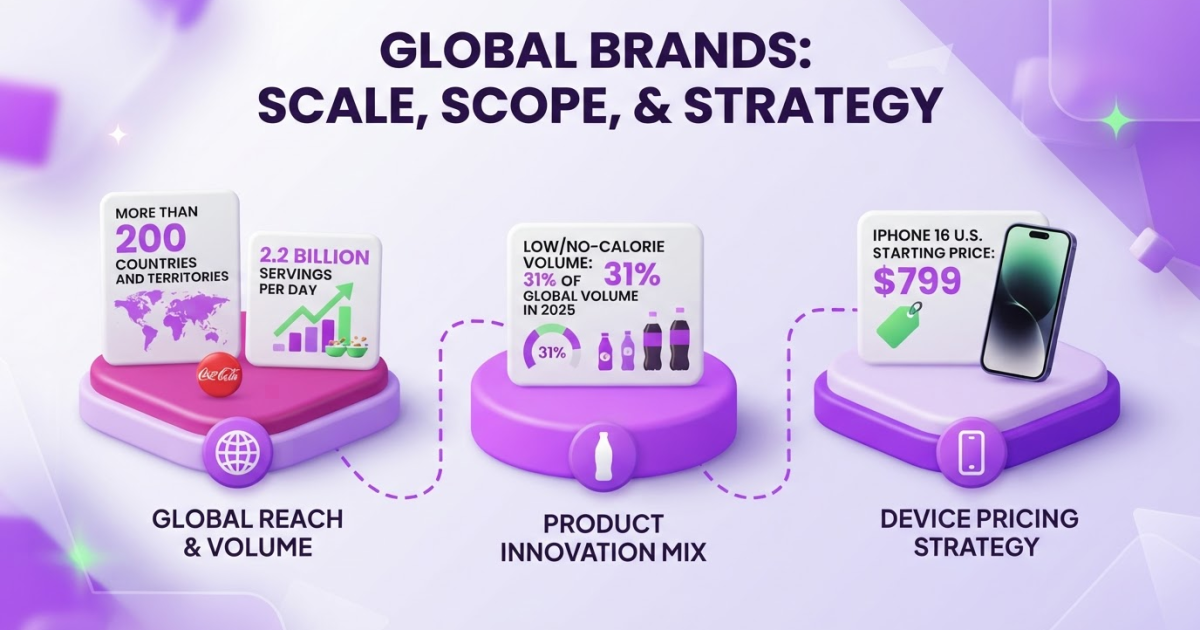
| iPhone 16 | 128GB, 256GB, and 512GB storage options | Starts at $799 in the United States | Preorders opened across more than 58 countries and regions, with general availability from September 20, 2024 | Launch announcements, carrier offers, reviews, and upgrade messaging | Product tiers let Apple serve different budgets without creating a confusing range of models. Borrow the tiering logic, not Apple’s scale. |
| Coca-Cola | A broad beverage portfolio, including low- and no-calorie choices | Accessible mass-market pricing | More than 200 countries and territories through bottlers, distributors, retailers, and other partners | Familiar branding, advertising, sponsorships, and constant visibility | Distribution is part of the value proposition. A product customers cannot find loses to an ordinary one on the shelf. |
| McDonald’s | Core menu plus limited-time items | Value messaging and bundle economics | Restaurants, drive-throughs, delivery apps, and mobile ordering | MONOPOLY and The Grinch Meal created urgency and repeat visits | Scarcity works when the offer is clear and fits an existing buying habit. |
| SaaS product | Useful features, integrations, templates, and a clear onboarding path | Monthly or annual subscription with visible plan limits | Website signup, product-led trials, and self-service checkout | Search content, demonstrations, email, and practical use cases | Sell the job the software completes, not a long feature list. Pricing confusion and a weak first session can cancel out good promotion. |
The backpack example comes from specific product-feature decisions, while Apple shows how storage, price, and launch access reinforce one another. Neither is a template. A $799 phone and a $40 backpack face different replacement cycles, margins, and purchase anxieties.
Pro Tip: Compare examples by customer access and buying context, not just industry; a SaaS company can learn more from a retailer’s distribution logic than its visual branding.
For a SaaS company such as TryRoki, content-led promotion should answer a real question before asking for a subscription. A useful article earns attention, but a confusing plan page or trial with no clear first task creates friction. The next step is turning these observations into decisions your own marketing mix can defend.

How to Apply the 4Ps to a Website or SaaS Business
For a website or SaaS business, the 4Ps become decisions about what people see, pay, find, and do next. I use the framework to expose gaps between a good product and a business that earns customers.
-
Product, from promise to first result. Define the outcome in one sentence, then build onboarding around reaching it quickly. A project-management SaaS might promise “your team sees every launch deadline in one place.” Product decisions include templates, integrations, setup guidance, customer proof, and implementation content. A long feature list is not proof of value. If new users need a call before understanding the first screen, onboarding is doing too little.
-
Price, from trial to perceived value. Choose a free trial, freemium plan, or paid entry point based on how quickly customers experience the outcome. Set tiers around meaningful differences such as seats, automation runs, storage, or support. Usage limits should be clear, not a surprise trap. Constant discounts teach people to wait. Make the trade-off visible on your pricing page.
-
Place, as customer access. Online place includes the channels that make an offer accessible to likely buyers, not just your homepage. Map search results, comparison pages, marketplaces, social communities, referrals, and partner listings, then connect each route to a relevant landing page. Someone searching “best CRM for agencies” needs comparison evidence; a referral visitor may need a short proof-led signup path.
-
Promotion, tied to funnel stages. Use educational articles for awareness, SEO pages for research, email for evaluation, social posts for repeated exposure, ads for controlled tests, and community participation for trust. Promotion includes advertising, personal selling, sales promotion, direct marketing, and digital marketing, so publishing blog posts is only one part of it. A platform such as Roki AI can help produce and distribute articles, but someone still needs to choose the audience, offer, channel, and next action. Our blog writing examples help with formats, not positioning.
Track qualified visits, activation, conversion rate, retention, and assisted conversions. Traffic alone can hide weak intent and expensive acquisition. Review those numbers weekly, then adjust the P blocking the next customer step.
The same discipline helps when you compare 4P examples across markets.
Common 4P Mistakes That Weaken Good Marketing
A finished-looking 4P plan can fail because the decisions do not connect to how customers buy. I see this when teams fill every box with plausible language, then skip uncomfortable tests around demand, margin, and behavior.
Common mistakes include:
- Listing features as benefits. “Padded laptop sleeve” describes the product, not the result. The benefit might be fewer damaged devices during a commute. Prove it through interviews, reviews, trials, or conversion data.
- Making the price as low as possible. A cheap offer can attract attention while leaving too little margin for delivery, support, or acquisition. Price affects both perceived value and company profitability, so test packages, prices, or deposits before committing.
- Relying on one place. Selling only through your website fails when buyers discover products on marketplaces, compare options in stores, or need a sales call. Place means access and delivery, not merely where your company operates.
- Calling every message “promotion.” A blog post, discount email, sales demo, and retargeting ad serve different people at different stages. Define the audience, message, stage, and goal for each activity.
- Copying a famous brand. A campaign backed by global reach and a large media budget may waste money for a small company. Borrow the principle, not the visible tactic.
- Changing all four Ps together. If you alter the offer, price, channel, and campaign in one week, you cannot tell what improved sales or caused the drop.
Use this quick audit before launch:
- Can you state the customer outcome in one sentence?
- Does the price cover required margin after delivery and support?
- Where do customers research, compare, and buy?
- Does each promotion have one audience and one goal?
- What single assumption will you test first?
Change one major assumption at a time, then give the result enough traffic to judge it. That turns the framework into evidence rather than a planning exercise.
My honest take on using 4P examples
I still use the 4Ps because they force me to connect the offer with the route to market. They do not hand me a strategy. They expose whether the product solves a clear problem, whether the price makes sense, whether customers can reach it, and whether promotion reflects value rather than noise.
The uncomfortable part is that many teams treat promotion as the first lever. They publish twice as much content or buy more reach while the product description stays vague, the pricing logic feels arbitrary, or customers lack a simple path to purchase. More attention makes those flaws more expensive.
I treat 4P examples as diagnostic patterns, not templates. A competitor’s pricing or channel can fail for your audience because the margins and buying process differ. TryRoki uses automation to help businesses produce consistent content and spot relevant promotion opportunities, while leaving judgment with the owner. The tool can suggest a Reddit discussion or content task; it cannot decide whether joining that conversation makes sense for your customer.
I recommend reviewing the four Ps once a month. Change the assumption that new evidence challenges instead of rewriting the whole plan after one weak campaign.
— Daniel/Aleksandra
Turn Your 4P Promotion Plan Into Consistent Execution
Once product, price, and place are clear, promotion still needs consistent execution. I built Roki AI’s content workflow for that gap, not to replace customer research or positioning. If the offer is unclear, automation only publishes unclear content faster.
Roki AI creates website content on autopilot and finds relevant Reddit posts where you can contribute a useful comment while mentioning your site appropriately. Reddit work takes judgment, and generic replies usually hurt more than they help, so review each opportunity before posting. Every week, Roki gives you 3 to 10 practical tasks to keep SEO and AI-search visibility moving without turning promotion into a second full-time job.
You can review the available features, then explore the platform or start with its pricing page when your broader 4P decisions are ready.
Frequently Asked Questions
The 4P marketing mix includes product, price, place, and promotion. For a backpack, the product might include a padded laptop sleeve, the price could be $79, place could include an online store and 20 retail locations, and promotion could highlight comfort through email ads and social posts.
The 4Ps help you check whether your offer, pricing, availability, and messaging support the same customer decision. Reviewing all 4 elements can reveal a good product sold through the wrong channel or promoted to people who cannot justify the price.
A small business can define its 4Ps by choosing one focused offer, setting a sustainable price, using channels customers already visit, and selecting a manageable promotion plan. Start with 1 measurable goal for each P, such as reaching 100 qualified visitors or generating 10 trial purchases.
The 7Ps add people, process, and physical evidence to the original 4Ps: product, price, place, and promotion. Those extra 3 factors matter most for services, where staff behavior, delivery steps, and visible proof such as a clean clinic or detailed client results shape the experience.
No single P is always most important because the constraint changes from one business to another. A weak product can waste a $1,000 advertising budget, while the wrong price or sales channel can stop conversions even when customers want the offer.
Written by Daniel/Aleksandra.
Recommended reads
- Boosting Seo With Automated Content Generation Tips
- How Roki Ai Streamlines Your Seo Content Workflow
- Pricing
Sources
- 1.2 The Marketing Mix and the 4Ps of Marketing - Principles of Marketing
- 12.1 Pricing and Its Role in the Marketing Mix - Principles of Marketing
- 13.1 The Promotion Mix and Its Elements - Principles of Marketing
- February 20, 2026 - 10-K: Annual report [Section 13 and 15(d), not S-K Item 405]
- The Coca-Cola Company Brands and Beverage Portfolio
- Apple introduces iPhone 16 and iPhone 16 Plus - Apple
- Annual Letter for Shareholders