Aleksandra D.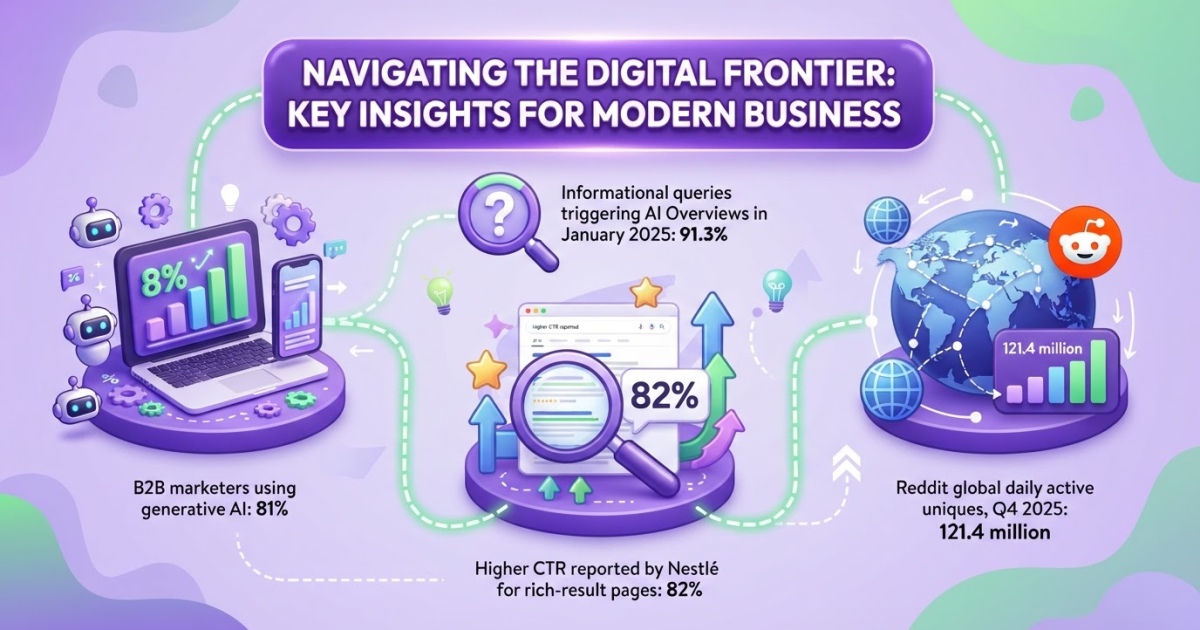
TryRoki brings AI content creation, recurring SEO tasks, Google and AI search performance improvements, and relevant Reddit post discovery into one workflow, cutting down the repetitive work without removing human review. Each week, Roki AI assigns 3–10 practical tasks, while you still check originality, technical SEO, and Search Console data before publishing or changing your strategy.
SEO teams often lose momentum while moving from keyword research to briefs, writers, optimization checklists, publishing systems, and promotion channels. By Friday, a promising topic can be stuck in a spreadsheet, with nobody sure what to fix next. In 2025, 81% of surveyed B2B marketers said they use generative AI tools, but adoption only pays off when AI fits a repeatable workflow instead of adding another dashboard to manage. In this guide, I’ll show how Roki AI supports planning, drafting, optimization, Reddit opportunity discovery, weekly task priorities, quality control, publishing, and measurement, including where the workflow still needs your judgment.
| Point | Details |
|---|---|
| Centralize SEO work | Roki AI connects content creation with recurring SEO tasks, so publishing is not treated as a one-off job. |
| Keep humans involved | Have a person review every AI draft for accuracy, originality, audience fit, and first-hand expertise before publishing. |
| Build useful content | Follow Google’s guidance by creating unique, valuable pages for people instead of mass-producing content only to capture rankings. |
| Use weekly momentum | Roki AI assigns 3–10 tasks each week, giving your team a manageable rhythm for improving visibility in Google and AI search. |
| Measure real outcomes | Track impressions, clicks, and queries in Search Console, then use analytics to see what visitors do after arriving. |
What an SEO Content Workflow Should Actually Include
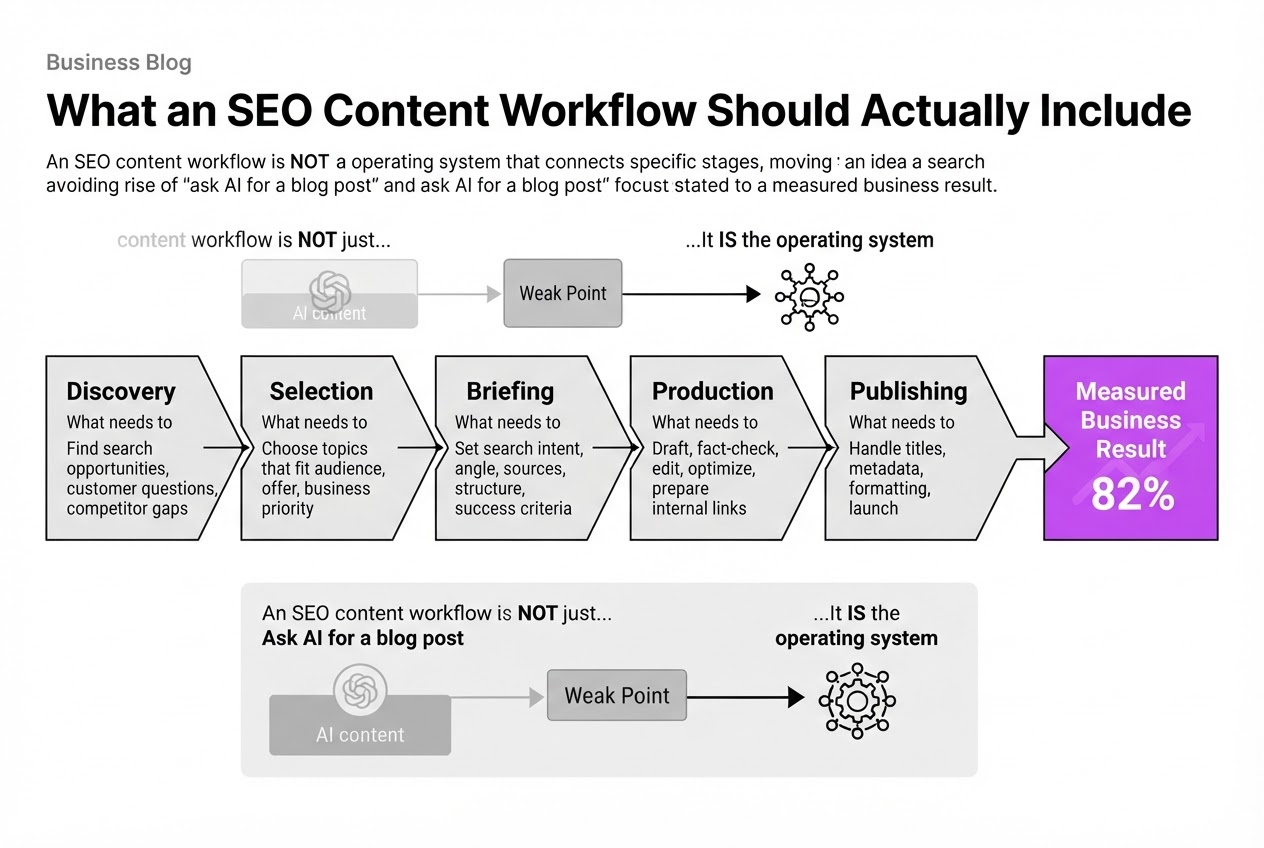
An SEO content workflow is not “ask AI for a blog post.” It is the operating system that moves an idea from a search opportunity to a measured business result. When we review a content process, the weak point is usually not writing. It is the messy space between writing, publishing, promotion, and learning what happened next.
A complete workflow should connect these stages:
| Stage | What needs to happen |
|---|---|
| Discovery | Find search opportunities, customer questions, and competitor gaps. |
| Selection | Choose topics that fit your audience, offer, and business priority. |
| Briefing | Set the search intent, angle, sources, structure, and success criteria. |
| Production | Draft, fact-check, edit, optimize, and prepare internal links. |
| Publishing | Handle titles, metadata, formatting, schema, URLs, and indexing. |
| Promotion | Share the piece through relevant communities, email, and social channels. |
| Measurement | Review rankings, impressions, clicks, conversions, and next actions. |
Most teams split these jobs across spreadsheets, chat threads, SEO tools, and a CMS. That creates handoff delays, duplicate keyword research, missing approvals, and three different opinions about what “optimized” means. I have seen a writer finish an article only to discover that nobody chose a target page, checked the claims, or assigned promotion.
Roki AI fits into the middle of this system. It can generate website content on autopilot, then surface three to ten recurring tasks each week to support visibility in Google and AI search. Those tasks might point you toward content gaps, updates, technical checks, or relevant Reddit discussions. This is coordination, not a replacement for judgment. Google says its existing SEO practices still apply to AI Overviews and AI Mode, with no extra technical requirements for supporting links.
Pro Tip: Pro Tip: Define a “ready to publish” checklist before increasing production volume; otherwise automation only makes inconsistent quality move faster.
Keep people responsible for factual verification, strategic positioning, brand claims, and final approval. Reddit deserves separate treatment: use discovery to find genuine audience questions, then leave useful, relevant comments. Dropping promotional links into unrelated threads is spam, not distribution.
With the workflow defined, the next question is how Roki AI handles the first production stage without flattening your editorial standards.
The Roki AI Workflow: From Opportunity to Published Asset
When I run this process at TryRoki, I treat Roki AI as the operating assistant, not the editor-in-chief. The order matters because a polished page aimed at the wrong reader is still wasted work.
-
Define the opportunity before requesting content. Write down the target audience, business goal, primary query, search intent, and page type. Decide whether you need a comparison, service page, product page, tutorial, or opinion piece. For example, “rank for restaurant SEO services” needs a different structure from “how to write restaurant menu descriptions.”
-
Generate the working draft in Roki AI. Give it the query, audience, offer, competing angles, and any constraints you already know. Use the output for structure and momentum, then add what the model cannot know: proprietary insights, customer wording, original examples, internal data, expert quotes, and credible evidence. Google warns that mass-producing AI pages without added user value may violate its scaled content abuse policy. That is not a theoretical concern. Thin drafts create editing work without creating a useful asset.
-
Optimize the page for people first. Tighten the title, headings, meta description, internal links, images, alt text, and page structure. A meta description guide can help with the snippet, but do not cram the exact keyword into every heading. Replace vague sections, answer the obvious follow-up questions, and make the next action clear.
Pro Tip: Pro Tip: Assign one owner to each workflow stage, even when Roki AI automates the task. Clear accountability prevents drafts from sitting unreviewed between automation steps.
-
Run the human checks. I review every factual claim, citation, statistic, product detail, and customer reference. I also check originality, brand voice, grammar, accessibility, and whether the page actually satisfies the searcher’s intent. The awkward sentence that sounds machine-written is usually easy to spot, but unsupported claims are the bigger liability.
-
Publish and capture the baseline. Confirm the canonical URL, indexability, links, images, schema where appropriate, and mobile layout. Publish, submit the URL for indexing when appropriate, then record the target query, current ranking, impressions, clicks, and conversions. Google identifies Search Console as the source of truth for search performance, while Analytics covers on-site behavior.
-
Use the weekly 3–10 tasks to keep moving. Work through the highest-value tasks first: refresh declining pages, fix technical issues, improve weak sections, add internal links, and review new opportunities. When Roki AI finds a relevant Reddit discussion, contribute a genuinely useful answer and mention your site only when it fits. That follow-up work is where most teams lose momentum.
The next section examines how to judge whether this workflow is producing business results, not merely more published pages.
Roki AI Versus a Disconnected SEO Tool Stack
The difference becomes obvious after publication. A disconnected stack can produce one article, but it often leaves you coordinating exports, repeated prompts, separate task lists, and reports that nobody checks until the next monthly meeting. I have seen teams spend more time moving SEO data between tools than improving the page itself.
Roki AI is built around recurring actions rather than a single writing session. It can help create the article, surface weekly priorities, suggest SEO improvement work, and find relevant Reddit discussions where a useful comment may mention your site. That matters because publishing is only the midpoint of content work.
| Workflow test | Disconnected tool stack | Roki AI-centered workflow |
|---|---|---|
| Time to first draft | Export keywords, brief a writer, repeat context in a prompt | Move from an opportunity to a usable draft with the project context in one place |
| Review consistency | Each writer follows a different checklist | Apply the same SEO and content expectations across recurring work |
| Task follow-through | Copy recommendations into project software and assign them manually | Receive 3 to 10 weekly actions focused on practical SEO improvements |
| Publishing cadence | Delays build between research, writing, optimization, and promotion | Keep creation, improvement, and opportunity discovery in one operating rhythm |
| Learning loop | Reporting sits apart from the work that produced the result | Use completed actions and observed opportunities to decide what to do next |
The trade-off is important. Roki AI can streamline content creation, prioritization, on-page improvements, and Reddit discovery, but it is not a replacement for every specialist system. I would still keep a serious crawler for technical audits, a dedicated rank tracker for granular historical positions, and established analytics for traffic and conversion analysis. Larger teams may also need separate editorial approvals, CMS permissions, and governance rules that an AI workflow should not bypass.
I also would not use automation as an excuse to publish thin pages. Google warns that generating many pages without adding user value can violate its scaled content abuse policy. Use Roki AI to reduce coordination work, then apply judgment to the angle, evidence, links, and final edits. For a closer look at automated drafting, see this SEO AI generator guide.
The real test is not how many tools you own. It is whether the next useful action gets completed, and the next section examines how that rhythm supports ongoing SEO growth.

Five Workflow Mistakes That Reduce AI Content Results
Automation exposes weak decisions quickly. As the owner of TryRoki, I have seen teams publish more pages in a week and still lose ground because nobody decided what deserved to exist, who should review it, or how success would be judged. Watch for these five mistakes:
-
Publishing the first draft: A grammatically clean article can still say nothing worth remembering. Add first-hand observations, original analysis, customer language, screenshots, or examples for your audience. Google warns that mass-generated pages without added user value may violate its scaled content abuse policy, so human review cannot mean a five-minute spellcheck.
-
Scaling before validating the opportunity: Do not order 100 pages because a keyword tool produced 100 ideas. Check search intent, topical fit, demand, competitors, and whether your business has credible expertise to support the subject. A local restaurant should not publish generic medical advice simply because the volume looks attractive.
-
Skipping the release checklist: AI will not reliably catch a wrong canonical URL, missing metadata, broken internal links, inaccessible image descriptions, or a page blocked from indexing. Those errors are boring, but they can erase the value of good writing. I prefer a short pre-publication check over discovering 40 orphaned pages after a launch.
-
Using Reddit as a backlink vending machine: Posting “check out my site” in every relevant subreddit is not distribution. It is usually deleted, ignored, or remembered for the wrong reason. Answer the actual question with useful detail, disclose your connection when relevant, and link only when the page genuinely helps. Roki AI can surface conversations, but judgment still belongs to you.
-
Counting output instead of business results: “We published 50 posts” is not an SEO result. Track qualified organic traffic, rankings, clicks, conversions, assisted revenue, and content decay. Search Console shows queries, impressions, and clicks, while Analytics shows what visitors do afterward. Review winners when customer needs, products, query language, or result formats change.
Pro Tip: Pro Tip: Put a “stop publishing” trigger in the workflow: pause expansion if review rework, factual corrections, or declining engagement rises for two consecutive cycles.
The next step is deciding how an AI workflow should measure those outcomes without burying you in another dashboard.
How to Measure Whether the Workflow Is Working
I measure the workflow in two layers: how much work the team completes and whether that work produces better search and customer results. A shorter draft cycle means little if the pages attract no qualified visitors, so I refuse to judge Roki AI by publishing volume alone.
Start with a baseline before changing the process. Record the average time from idea to approved draft, weekly publishing count, review cycles per article, completed Roki AI tasks, and how often older pages receive meaningful updates. Also capture current impressions, clicks, queries, click-through rate, indexed pages, engaged sessions, landing-page behavior, and conversions.
Use this timeline to avoid declaring victory too early:
- Before launch: Export 28 days of Search Console and analytics data. Tag every existing page as new, refreshed, or unchanged, and note Reddit-referred visits separately. This gives you a comparison set instead of a vague “traffic feels up” opinion.
- After 30 days: Check operational movement first. Is an approved draft taking fewer hours? Are reviews dropping from three rounds to two? Did the team complete its weekly tasks and publish consistently? Search visibility may still look flat, especially for new pages.
- After 60 days: Review Search Console by page and query. Compare impressions, clicks, CTR, indexing, and average position for new pages against refreshed pages. A page gaining impressions but no clicks may need a better title or snippet, which is where a meta description writer can support a focused test.
- After 90 days: Connect visibility to behavior. Examine engaged sessions, landing-page exits, form submissions, purchases, and assisted conversions. Segment Reddit visits as well. A referral can show useful awareness even when it does not appear in organic search data.
Google identifies Search Console as the source of truth for search performance and Analytics as the source of truth for on-site behavior. Use both, because clicks alone can hide poor-fit traffic and conversions alone can miss early visibility gains.
I review the task queue monthly and remove activities that do not improve visibility, usefulness, or customer outcomes. More tasks are not progress. If a recurring activity produces no measurable signal after a fair test, cut it and give the team time to work on pages that can matter.
That measurement habit sets up the next question: which workflow mistakes quietly erase those gains?
My honest take on automating SEO content with Roki AI
I do not see Roki AI’s strongest advantage as producing more words. More output is easy to celebrate and surprisingly easy to regret when a small team ends up with dozens of interchangeable pages, weak internal links, and no clear owner for updates. The better use is maintaining a steady operating rhythm across planning, writing, optimization, promotion, and review.
My contrarian view is that publishing less can produce better growth. I would rather see a focused set of pages answer real customer questions, earn useful mentions, and support a measurable business goal than watch a team flood its site with thin variations of the same topic. Roki AI can help remove repetitive coordination and surface practical weekly tasks, including content work and relevant Reddit conversations, but it cannot take responsibility for accuracy or judgment. That part stays with you.
I would start with a small group of pages, define the quality bar, and track outcomes such as qualified leads, assisted conversions, and useful search visibility. The first setup may feel tedious, especially when you must reject generic suggestions or correct context the system missed. That friction is valuable. Once the workflow shows what works, you can expand production without turning the site into an AI content warehouse. The lasting advantage is the learning loop: each published asset should improve your next decision.
— Daniel/Aleksandra
Build a More Consistent SEO Workflow with Roki AI
If your SEO process feels like a pile of half-finished briefs, try Roki AI with a small publishing and improvement cycle instead of launching a huge content push. Start with a few pages, review the recommendations, and see whether the weekly workflow fits how your team actually works.
Roki AI can generate website content on autopilot, assign 3–10 weekly tasks, and surface relevant Reddit posts where a thoughtful answer may help people discover your brand. The trade-off is important: Roki AI supports the process, but it cannot replace your judgment. You still need to add expertise, check facts, edit drafts, and participate on Reddit without spamming.
Explore the task-driven SEO workflow or test the free SEO tools, then decide whether TryRoki fits your current process.
Frequently Asked Questions
AI can handle drafting, content organization, and recurring task suggestions, but it cannot replace human review, subject-matter knowledge, or publishing decisions. Before publishing, check at least 4 things: accuracy, originality, search intent, and whether the page gives readers a useful answer.
Publish at the pace your team can properly review and improve, rather than chasing an arbitrary quota. For many small teams, 1 to 3 carefully edited pages per week will outperform dozens of thin pages that no one checks.
AI assistance does not guarantee rankings because Google evaluates usefulness, relevance, quality, and eligibility for search features. Treat the draft as a starting point, then add original examples, accurate details, and clear answers that satisfy the reader’s specific query.
Choose discussions where your expertise genuinely answers the question, provide useful context first, and mention your website only when it helps the reader and the community’s rules allow it. Repeating promotional comments across 10 unrelated threads will look like spam, not thoughtful participation.
Use Search Console to monitor impressions, clicks, queries, and visibility, then review analytics data for engagement and conversions after visitors arrive. Compare performance after 30, 60, and 90 days because rankings and content results often change slowly.
Written by Daniel/Aleksandra.
Recommended reads
- How Roki Ai Generates High Quality Blogs On Autopilot
- Seo Ai Generator How To Automate Content Creation Effectively
- Future Proofing Your Content Planner In An Ai World
- Best Ai Content Optimization Platforms 2026 A Strategic Guide
Sources
- AI Features and Your Website | Google Search Central | Google for Developers
- Top ways to ensure your content performs well in Google's AI experiences on Search | Google Search Central Blog
- Google Search's Guidance on Generative AI Content on Your Website | Google Search Central | Google for Developers
- Introduction to structured data markup in Google Search | Google Search Central | Google for Developers
- Using Search Console and Google Analytics Data for SEO | Google Search Central | Google for Developers
- B2B Content Marketing: 2025 Benchmarks & Trends
- Semrush Report: AI Overviews’ Impact on Search in 2025
- Reddit Reports Fourth Quarter and Full Year 2025 Results; Announces $1 Billion Share Repurchase Program