Aleksandra D.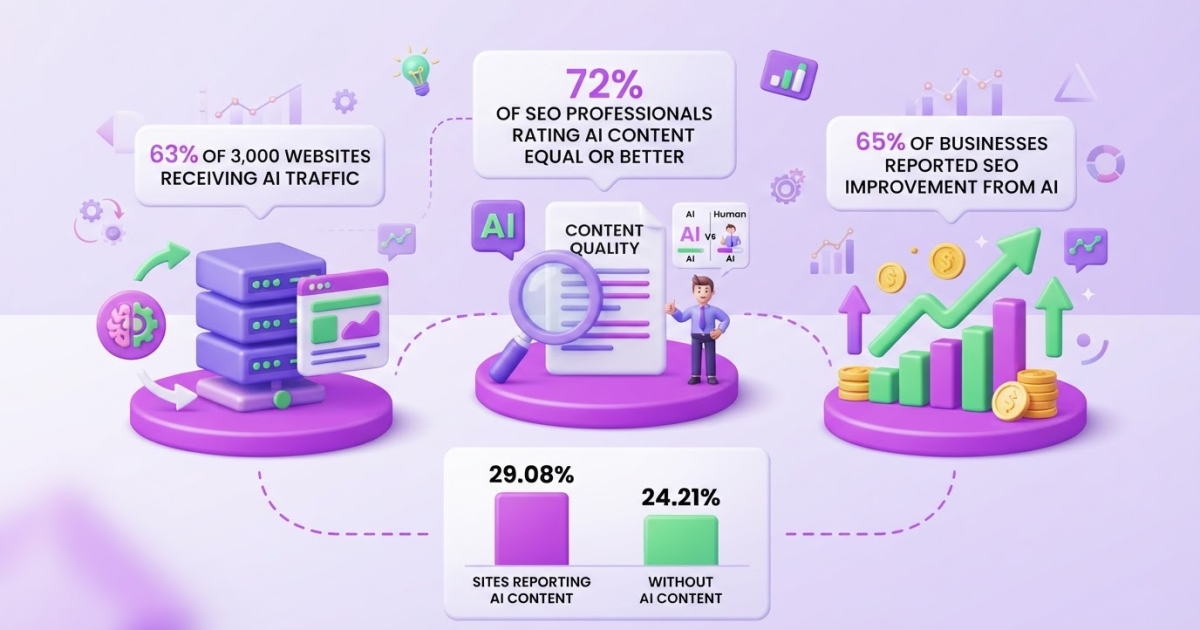
Boost SEO with automated content generation by automating research, outlines, drafts, optimization, internal-link suggestions, and performance monitoring, then adding human review, original insights, and first-hand experience before publishing. Avoid mass-producing thin pages: a practical workflow, such as Roki AI’s 3-10 weekly SEO tasks, works best when every page answers a real search question and gives readers something genuinely useful.
Publishing consistently is difficult when you are also reviewing briefs, fixing weak drafts, and trying not to flood your site with pages nobody needs. I have seen teams publish faster with AI, then spend even longer repairing thin content and confused rankings. Google warns that generating many pages without adding value for users may violate its scaled-content-abuse policy, while 63% of 3,000 websites in one study received traffic from AI chatbots. At TryRoki, we treat automation as a working system, not a shortcut: this guide covers topic selection, briefing, first-hand experience, search and AI discovery, contextual links, quality review, and Search Console measurement.
| Point | Details |
|---|---|
| Automate the Workflow | Use automation for research, briefs, drafts, optimization, and monitoring while keeping editorial judgment in human hands. |
| Add Original Expertise | Give every publishable page at least 1 first-hand example, opinion, dataset, or customer insight that a generic draft cannot provide. |
| Avoid Scaled Abuse | Automation is not the problem, but publishing 100 pages mainly to manipulate rankings can create scaled content abuse. |
| Strengthen Discovery | Add descriptive internal links so important pages connect contextually and users and search engines can find them more easily. |
| Measure Real Outcomes | Review clicks, impressions, CTR, and average position in Google Search Console over a consistent 28-day reporting period. |
What Automated Content Generation Should Actually Do for SEO
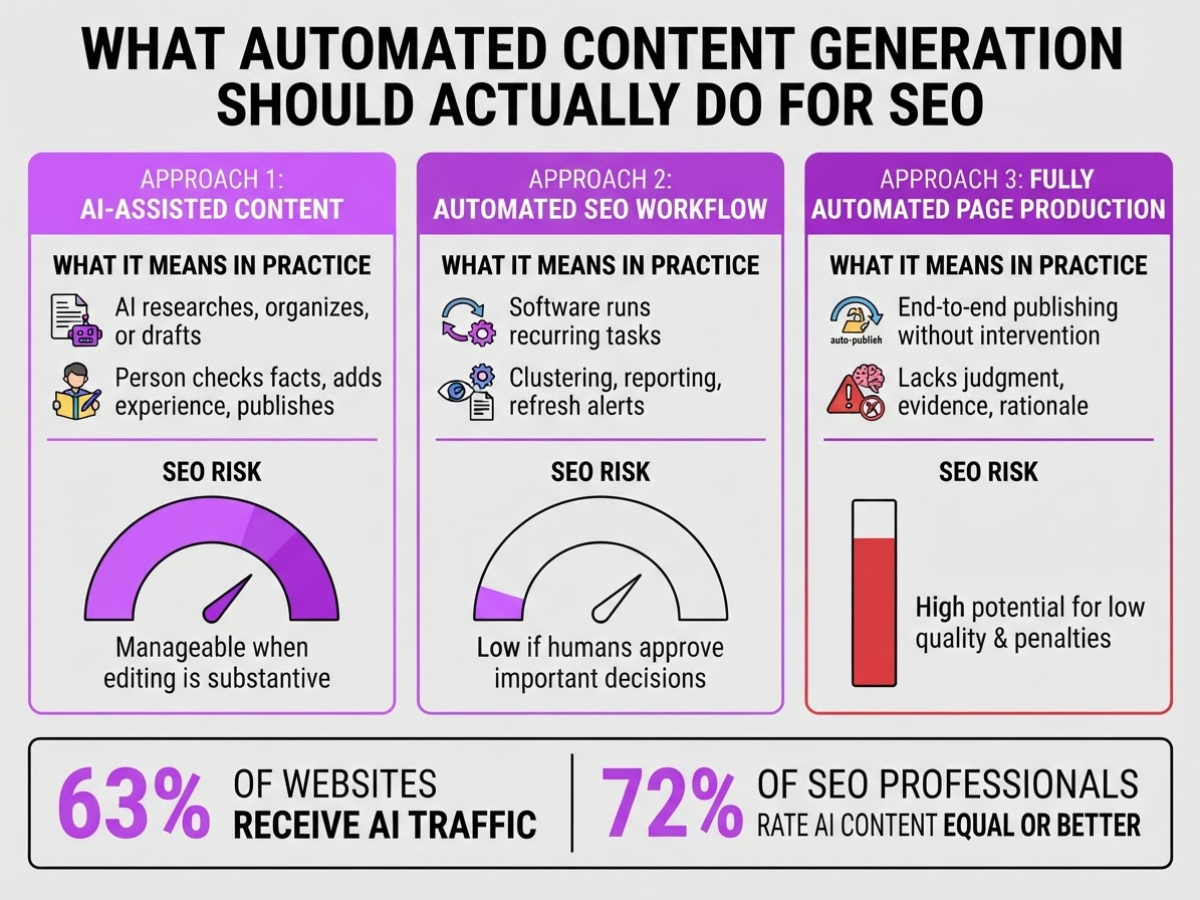
When I review an AI content workflow, I start with one question: does it help a real person solve a specific problem? Automated content generation is responsible when software handles repeatable work while an accountable editor supplies judgment, evidence, and a reason for the page to exist.
These three terms are often mixed together, but they describe different levels of involvement:
| Approach | What it means in practice | SEO risk |
|---|---|---|
| AI-assisted content | AI researches, organizes, or drafts; a person checks facts, adds experience, and publishes | Manageable when editing is substantive |
| Automated SEO workflow | Software runs recurring tasks such as clustering, reporting, and refresh alerts | Low if humans approve important decisions |
| Fully automated page production | A system creates and publishes large numbers of pages with little or no review | High when pages repeat ideas or add no user benefit |
Google warns that creating many pages with generative AI without adding value may violate its scaled-content-abuse policy. The issue is not the presence of AI. It is publishing search-first pages that exist mainly to capture rankings, rather than helping someone make a decision or complete a task.
In my own workflows, I automate the tedious parts first:
- Grouping related keywords into topic clusters
- Comparing search intent and identifying content gaps
- Creating outlines and first drafts
- Suggesting titles, meta descriptions, and internal links
- Flagging older pages that need factual or competitive updates
- Reporting clicks, impressions, rankings, and pages that are losing traffic
That list creates publishing consistency and gives an editor more capacity. It does not justify producing 200 near-identical pages about minor keyword variations. The most underrated control is ownership: every page needs a named reviewer, a clear audience, and someone responsible for correcting it when facts change.
Pro Tip: Create a written “human value” field in every content brief before asking an AI tool to draft the page.
Roki AI combines drafting with recurring SEO tasks, including weekly opportunities to join relevant Reddit discussions. That can reveal real questions and bring useful context back into your content, but a comment is not a substitute for a genuinely useful page. I still review the thread, avoid forced promotion, and reject suggestions that do not fit the conversation. Our SEO content workflow works best as a queue for decisions, not a publishing button.
Before publication, I require five checks: usefulness, originality, accuracy, intent match, and clear ownership. The next step is turning those checks into a repeatable production process.
Build a Repeatable Automated SEO Content Workflow
I treat automated content as a production assistant, not an author. The system handles repetition, while my team supplies judgment, evidence, and the customer details that make a page worth reading.
-
Choose the topic first. Start with an audience pain, then test four things: business relevance, search intent, realistic ranking potential, and whether you can say something useful. A keyword with high volume is a poor choice if it attracts people who will never buy. I would rather publish a focused page for 200 qualified searches than chase a broad term dominated by established publishers.
-
Write the brief before prompting the tool. Include the primary keyword, related questions, likely intent, your unique angle, evidence requirements, proposed headings, and conversion goal. Specify whether the reader needs a comparison, tutorial, checklist, or buying guide. Vague briefs produce vague drafts, and correcting that later takes longer than writing three good paragraphs yourself.
-
Automate the repetitive research. Ask the system for research notes, a source list, an outline, a first draft, title options, meta description ideas, and relevant internal-link candidates. I use automation to widen the first pass, not to decide what is true. Google supports using generative AI for research and structure when the finished page follows its Search Essentials and spam policies, so avoid common AI content mistakes for better SEO before publishing.
Pro Tip: Ask the tool to list unsupported claims and missing evidence separately before asking it to polish the prose.
-
Add what the tool cannot know. Insert customer wording from support tickets, examples from real projects, screenshots, original data, product limitations, or commentary from a subject expert. This is the step most teams skip, then wonder why the draft sounds interchangeable. Google’s guidance also emphasizes first-hand experience and clear authorship, particularly where readers need to trust the information.
-
Run a publication check. Verify every factual claim and citation, check originality, confirm that the page matches intent, and test headings, links, images, alt text, contrast, and mobile readability. Review the title too: Google recommends concise, descriptive, unique titles rather than repeated boilerplate or keyword stuffing. A final human read catches awkward claims that automated checkers routinely miss.
-
Schedule the refresh. Review performance every 90 days in Search Console, then update pages when rankings, clicks, or impressions weaken. Also revisit outdated claims, new product capabilities, and shifts in search demand. Put the next review date in your content calendar instead of relying on memory.
That workflow creates a review-ready asset, which gives you a stronger starting point for measuring and improving results.
The Quality Controls That Keep AI Content Competitive
A draft can sound polished and still fail the reader in under a minute. I have seen automated pages repeat the same advice, bury the answer under introductions, and cite claims no one on the team had checked. Those weaknesses hurt trust before rankings become the problem.
Watch for these failures before you publish:
- Factual errors: dates, prices, product details, and statistics can be wrong or outdated.
- Repetitive phrasing: every section uses the same sentence shape, so the page feels machine-made.
- Shallow summaries: the draft restates search results without examples, decisions, or useful detail.
- Unsupported claims: it promises results without evidence, context, or a credible citation.
- Mismatched intent: an informational query receives a sales pitch, or a buyer gets a generic definition.
- Keyword stuffing: the target phrase appears where a normal writer would use a pronoun or related term.
- Invented expertise: the page implies customer results, testing, or first-hand experience that never happened.
Human review should start with the search results, not the draft. Ask whether your page answers the query faster and more completely than the competing results. If a reader must scroll through 500 words before finding the definition, price, steps, or recommendation they searched for, rewrite the opening. I also compare examples and caveats, because automated drafts often cover the headline points while omitting the detail that helps someone act.
Treat ownership as part of quality control. Use an accurate byline, identify the company responsible for the page, and send topics involving health, money, law, safety, or hands-on work to a subject-matter reviewer. Google recommends first-hand experience and accurate authorship information, while its spam guidance warns against producing large volumes of pages mainly to manipulate rankings rather than help users. That is why avoiding common AI content mistakes matters more than adding another automation step.
Do not publish a separate page for every minor keyword variation. Merge overlapping drafts, choose one primary intent, redirect weaker URLs where appropriate, and give the surviving page genuinely distinct information.
Pro Tip: Have a reviewer delete the most generic paragraph in each draft; the remaining page often reveals where original evidence is still missing.
Before approval, check usefulness, accuracy, originality, readability, citations, internal and external links, title clarity, and conversion relevance. The final question is simple: does the page help the right visitor take the next sensible step, or does it merely look optimized? That review standard sets up the measurement work that follows.

Optimize Automated Content for Google and AI Search Discovery
A page can rank for a target keyword and still miss the way people search. If you optimize only for “automated content generation,” you may attract an early-stage reader while ignoring the follow-up questions: Is it safe for Google? How do I edit the draft? What evidence should I add? I plan each page around the full question, the reader’s decision stage, and the next decision they are likely to make.
That approach also helps AI-mediated discovery. A concise answer near the top, descriptive headings, plain-language definitions, concrete examples, evidence, and consistent names for products or concepts give search systems material they can identify and reuse. You are not writing awkward sentences for machines. You are making the page easier for a busy reader to scan and trust. My team still catches annoying failures here, such as an answer buried after 900 words or an acronym used three different ways.
| Optimization focus | Traditional search signals | AI-search usefulness | Quality practice shared by both |
|---|---|---|---|
| Direct answers | Relevance to the query and clear page sections | Easy extraction for summaries and follow-up answers | Answer the real question early |
| Topic coverage | Related terms and useful supporting sections | Context across the complete user journey | Define terms, show examples, and cite evidence |
| Site structure | Crawlable paths and internal authority | Connected context across related pages | Use descriptive internal links |
| Trust | Helpful, accurate, people-first content | Sources and claims that can be checked | Add experience, authorship, and careful review |
Internal links are not decoration. Google recommends contextual links with descriptive anchor text, and I use them to move someone from a general guide to a practical resource, such as creating high-quality SEO content with Roki AI. Avoid vague anchors such as “click here,” and do not link every sentence. That creates clutter and makes the page feel assembled.
Structured data can help a page qualify for a rich result, but Google says eligibility does not guarantee that the rich result will appear. It cannot rescue thin writing, missing evidence, or a page that answers the wrong question. I treat schema as a labeling aid, not a substitute for editorial judgment.
With those foundations in place, the next section can focus on measuring whether your automated pages earn useful visits rather than merely impressions.
Measure Whether Automation Is Improving SEO, Not Just Output
Output is the easiest metric to inflate. I have watched teams publish 40 automated articles, celebrate the production speed, and discover that qualified leads had not moved at all. Before publishing, record impressions, clicks, CTR, average position, indexed pages, conversions, assisted conversions, and the time required to research, review, publish, and update each page.
Use a fixed baseline, such as the previous 28 days, and label every automated page with its topic, content type, author review level, and publication or update date. Track publishing time separately from editorial review time. Otherwise, automation can appear efficient simply because someone quietly absorbs the fact-checking work.
- Day 0: Export the baseline and record the URLs entering the test. Define one business conversion, such as a demo request or sign-up, plus assisted conversions for visitors who read the article before converting elsewhere.
- Days 7 to 28: Check indexing and early impression changes, but do not rewrite pages because of two noisy days. Google Search Console’s Performance report shows clicks, impressions, CTR, and average position, with filters for queries, pages, countries, devices, search appearance, and dates.
- Days 29 to 90: Compare cohorts against the baseline. Review pages by topic, content type, review level, and update date. A human-reviewed comparison guide may outperform lightly edited definitions, while one automated topic cluster may create impressions but no useful visits.
- Day 90: Decide what to keep, revise, combine, or remove. Save the decision and its reason so the next publishing cycle learns from evidence rather than enthusiasm.
Separate leading indicators from outcomes. Rising impressions, more ranking queries, and movement from position 35 to position 18 suggest that Google is testing or understanding a page. They do not prove commercial value. Qualified leads, sign-ups, revenue, and assisted conversions matter more, even when their numbers are smaller and slower to appear.
Set blunt thresholds. If impressions rise but CTR stays weak, rewrite the title and description. If a page gains impressions and relevant queries, expand the sections answering those queries. If two pages attract the same intent, merge them and redirect the weaker URL. Retire content with no meaningful demand, no conversions, and no clear job for the reader. I would rather own 60 useful pages than 300 URLs that make reporting impossible.
That measurement discipline also shows where human judgment still earns its place, which is the next part of the workflow.
My honest take on automated SEO content
As the owner of TryRoki, I see automation as a way to give a small team its thinking time back. Roki AI handles recurring SEO work, including content tasks and relevant Reddit conversations, so we can spend more time checking claims, adding firsthand detail, and deciding what deserves attention. The setup is not magic, though. Generated drafts still need fact-checking, editing, and a clear reason to exist.
Here is the contrarian point: publishing more is not automatically a growth strategy. In many niches, five genuinely useful pages will beat fifty interchangeable articles because searchers need a better answer, not another summary. I would rather delay a page than add thin content to a library that already says the same thing in slightly different words.
I think of Roki AI as an operating system for recurring SEO actions, not a button that replaces judgment. Its weekly 3 to 10 tasks can surface practical work, but I still decide whether a task fits our audience and whether the result is worth publishing. Reddit requires the same restraint. A relevant, specific answer can earn attention, while a comment that drops a link without helping the discussion looks like spam.
My personal publication test is simple: if a human reviewer cannot explain the page’s unique value in one clear sentence, it is not ready.
— Daniel/Aleksandra
Turn These SEO Content Tips Into a Weekly System
If your team wants more consistent SEO work without handing quality decisions to a machine, TryRoki is a practical next step. Roki AI can draft website content on autopilot and surface three to ten weekly tasks, including relevant Reddit conversations where a useful, website-related answer may fit.
The important part is what you do with those suggestions. You choose the tasks that match your strategy, add your experience, review every draft, and track whether the work earns meaningful results. Some recommendations will be too broad, and a Reddit thread will not always deserve your time. That friction is useful because it keeps automation from replacing judgment. If you prefer to see the process before committing, start with Roki’s SEO content workflow and build from there.
Frequently Asked Questions
Yes, AI-assisted content can rank when it is accurate, useful, original, and matched to the searcher’s intent. Before publishing, review every factual claim and add firsthand insight, because Google evaluates the page’s value rather than whether automation helped create it.
Use AI for research, outlining, drafting, optimization, and analysis, but add human review, original expertise, and fact-checking before publication. A practical rule is to inspect every paragraph and avoid releasing dozens of near-duplicate pages whose main purpose is to manipulate rankings.
The right tool depends on whether you need basic drafting or a wider workflow for recurring SEO tasks, publishing, and opportunity discovery. Test each option with at least 10 real briefs and check factual controls, editorial review, integrations, reporting, and whether it helps you publish useful pages instead of chasing volume.
Review important pages at least once every 3 months, then update them sooner when facts, products, search intent, or rankings change. Start with pages that have lost clicks, gained impressions but have a weak click-through rate, or attracted traffic without producing a result.
It can help when the content gives clear answers, supports claims with evidence, and includes distinctive experience that an AI search system can identify and cite. Use descriptive headings, direct responses, and strong internal links, but treat inclusion as uncertain because no format guarantees a place in AI-generated results.
Written by Daniel/Aleksandra.
Recommended reads
- Creating High Quality Seo Content With Roki Ai
- Avoiding Common Ai Content Mistakes For Better Seo
- How Roki Ai Streamlines Your Seo Content Workflow
- Optimizing Ai Content For Google S 2026 Algorithms
Sources
- What web creators should know about our March 2024 core update and new spam policies
- Google Search's guidance on using generative AI content on your website
- Creating Helpful, Reliable, People-First Content
- Creating Helpful, Reliable, People-First Content
- 63% of Websites Receive AI Traffic (New Study of 3,000 Sites)
- Does AI content rank well in search? [Survey + Data study]
- The State of AI. 2024 Report
- The State of AI in Content Marketing
- Performance report (Search results): Overview and basic setup
- SEO Link Best Practices for Google
- General Structured Data Guidelines
- Influencing Title Links in Google Search