Aleksandra D.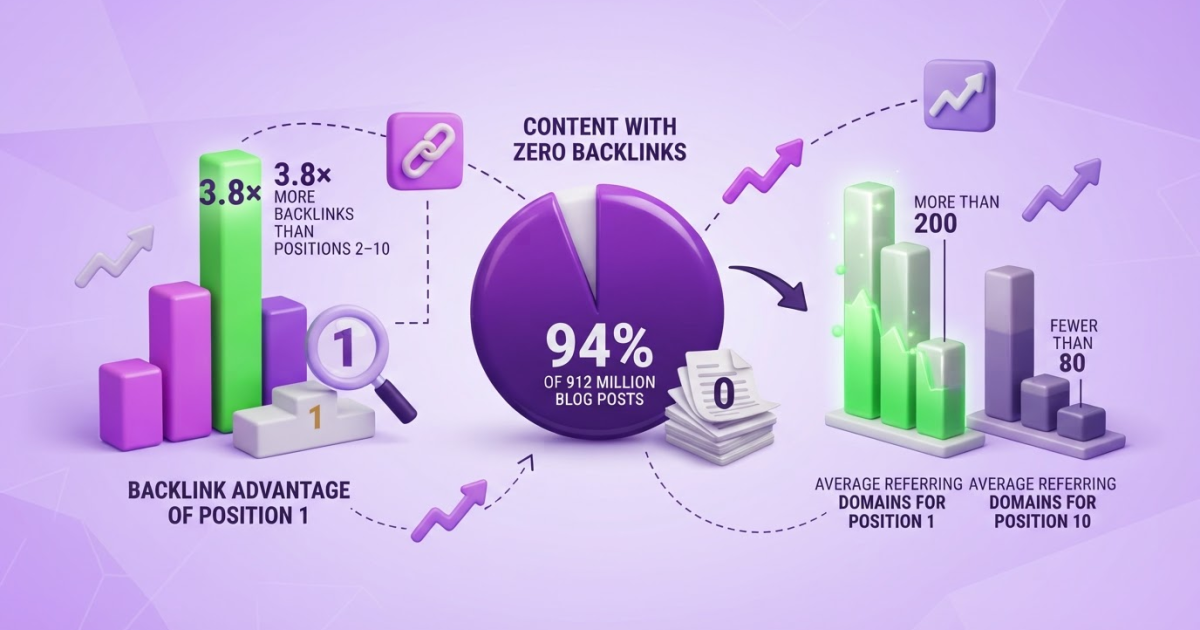
Off-page SEO means actions taken outside your website to improve its authority, visibility, trust, and search rankings, including earning relevant backlinks, gaining genuine brand mentions, joining credible communities, and promoting useful content. It is not a license to buy links or spam forums: focus on relevance and credibility, then use practical outreach and content promotion to build trust over time.
If you searched “off-page SEO means” after watching competitors outrank you, you may be wondering whether the answer is simply buying more backlinks. It isn’t. Off-page SEO covers the reputation and discovery work happening beyond your own pages, and Google says links help it discover pages and assess their relevance. The gap can matter: Backlinko found that the top Google result had 3.8 times more backlinks than results ranked second through tenth. From my work building Roki AI, I’ve seen teams waste weeks chasing random links. This guide covers what off-page SEO means, which activities deserve priority, safe link earning, Reddit participation, and practical progress tracking.
| Point | Details |
|---|---|
| Core definition | Off-page SEO means building external signals of relevance, trust, and authority instead of changing elements directly on your website. |
| Links still matter | Google uses links for discovery and relevance, but quality, context, and editorial value matter more than collecting 100 low-quality backlinks. |
| Earn, don’t manufacture | Buying ranking links, automating link creation, and adding optimized forum comments are 3 examples of link spam under Google’s policies. |
| Communities need value | Reddit participation can support visibility and referral traffic when your comments genuinely answer questions rather than dropping promotional links. |
| Measure diversified progress | Track referring domains, qualified referral visits, brand mentions, and rankings together instead of relying on 1 backlink total. |
What Off-Page SEO Means in Plain English
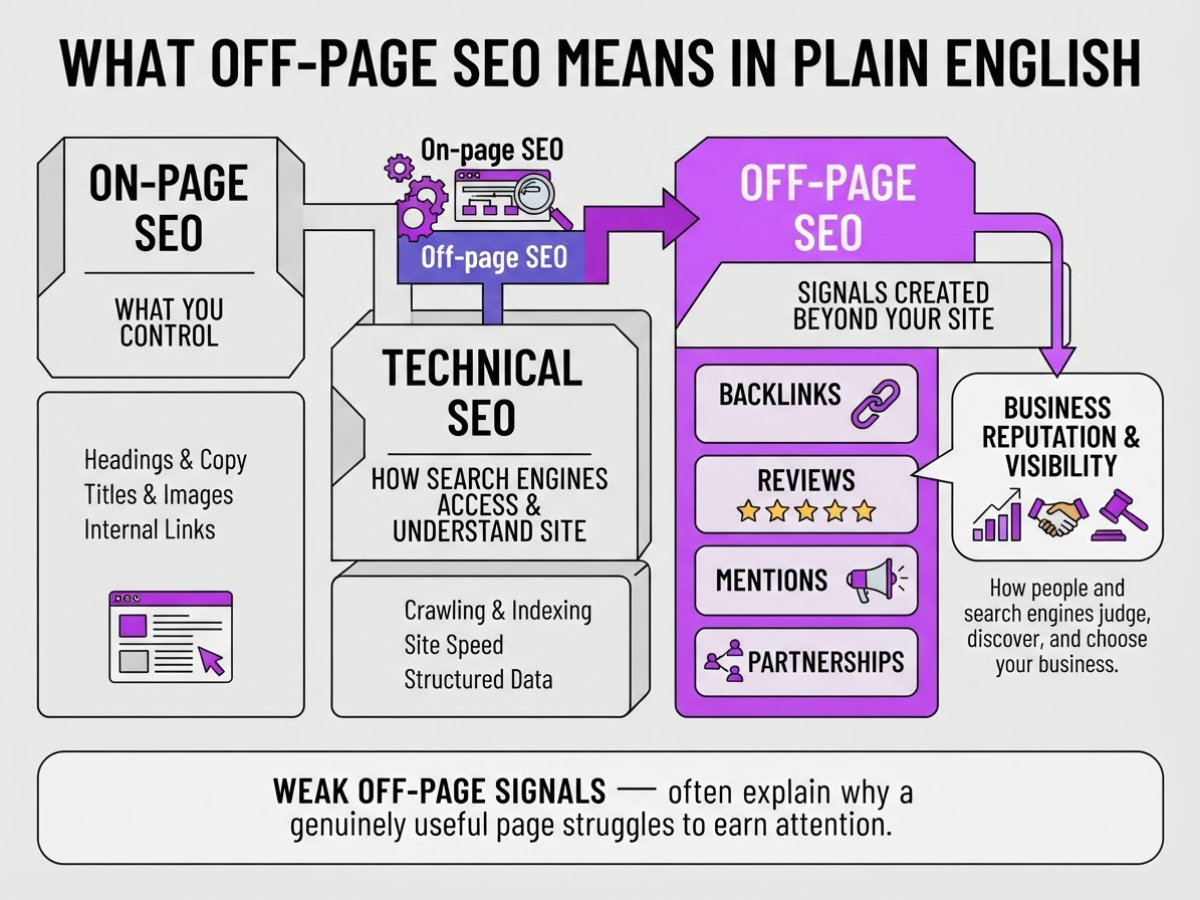
Off-page SEO means the work you do outside your website to influence how people and search engines judge, discover, and choose your business. It includes reputation, visibility, relationships, and demand, not just rankings. When I review a company’s search performance, weak off-page signals often explain why a genuinely useful page struggles to earn attention.
Here is the practical distinction:
| SEO area | What you control | Typical examples |
|---|---|---|
| On-page SEO | The content and elements on a page | Headings, copy, internal links, titles, and images |
| Technical SEO | How search engines access and understand the site | Crawling, indexing, speed, redirects, and structured data |
| Off-page SEO | Signals created beyond your site | Backlinks, reviews, mentions, partnerships, PR, and community activity |
A backlink is not a vague endorsement. Google defines it as a link from another site to a page on your site. Those links can help Google judge a page’s relevance and discover new pages for crawling, as Google explains in its guidance on crawlable links.
Off-page work also covers unlinked brand mentions, journalist coverage, useful partnerships, customer reviews, conference appearances, and thoughtful participation in relevant communities. A local plumber mentioned by a respected home-improvement publication may gain trust even when the article does not link to the plumber’s site. That attention can lead to searches, referrals, and future links.
Most teams overestimate link volume. Off-page SEO is not a license to drop your URL into every forum, buy random placements, or trade links at scale. Those shortcuts create irrelevant links, waste money, and can look manipulative. Relevance, editorial context, and genuine usefulness matter more than a large spreadsheet of referring domains. Use backlink research software to investigate patterns, not to chase an arbitrary number.
Pro Tip: Start by auditing how a prospect’s brand is discussed externally before recommending a link-building campaign; the gap between reputation and visibility often reveals the highest-leverage work.
Next, the focus shifts from the definition to the specific signals that make off-page SEO credible.
Which Off-Page SEO Activities Are Worth Your Time?
The right off-page SEO mix depends on your stage, audience, and tolerance for wasted effort. I would not send a new local business after national media coverage when three strong local partnerships could produce customers this month. Likewise, a content-led SaaS company should not spend its limited time collecting directory listings that its buyers never use.
Here is how I usually rank the activities by likely value:
| Priority | Activity | Best fit |
|---|---|---|
| 1 | Helpful digital PR | Original data, useful commentary, timely expertise |
| 2 | Expert contributions | SaaS founders, specialists, and credible operators |
| 3 | Partner relationships | Local firms, integrations, suppliers, and associations |
| 4 | Resource outreach | Genuinely useful guides, tools, and research |
| 5 | Reviews | Local businesses and products with active customers |
| 6 | Selective community participation | Places where your audience already asks questions |
Digital PR and expert contributions can bring both links and qualified visitors, but they take real preparation. You need a clear point of view, evidence, and a pitch that helps the publisher. Generic guest posts and mass outreach usually create more inbox clutter than demand. For content planning, even a free SEO title generator can help you turn original research into a sharper headline, but it cannot supply the research itself.
A small business should usually start with accurate local citations, customer reviews, and partnerships with nearby organizations. A restaurant might work with a local event venue; a photographer could partner with wedding planners. A SaaS company with a content program should prioritize research assets, expert commentary, and distribution through people who already serve its target users.
Judge every opportunity on four points: topical relevance, audience fit, editorial standards, and likely referral traffic. One relevant referring domain can matter more to your business than dozens of unrelated placements. Semrush’s 2024 study placed referring-domain diversity among its most influential ranking factors, but diversity does not guarantee rankings. It simply supports the case for earning links from different, credible sites instead of repeating one easy tactic.
Pro Tip: Score each opportunity from 1–5 for relevance, editorial credibility, referral potential, and effort; reject opportunities with a low relevance score even when the domain looks powerful.
Unlinked brand mentions still have value because people may discover and search for your company through them, even when they do not immediately pass link equity. Treat them as awareness signals, then request a link only when it genuinely helps the reader. Next, assess which risks can quietly undermine otherwise useful off-page work.
How to Build an Off-Page SEO Plan Step by Step
I build off-page SEO plans around pages that can earn attention, not around a monthly quota of backlinks. That distinction matters: a link may help discovery and relevance, but a pile of unrelated links usually creates noise, risk, and very little business value. Google confirms that links help it discover pages and assess relevance.
-
Choose the pages that deserve attention. Pick one to three priority pages, then write down each page’s search intent, target audience, and missing proof. A product page may need customer evidence and comparisons; a research guide may need original data and expert citations. I also note the conversion I expect, because traffic without a useful next action is a poor definition of success.
-
Research the right places. Search for publications, partners, communities, newsletters, and existing pages that already discuss the subject. Check whether those pages attract the people you want, whether they update their content, and whether they send referral traffic. Domain authority lists are convenient, but they often hide irrelevant audiences.
Pro Tip: Build the outreach list from pages that already send qualified visitors, not only from high-authority domain lists; referral quality is a faster reality check than domain metrics.
-
Create something worth referencing. Build original survey data, a practical calculator, a comparison, a useful template, or an expert-led guide. A rewritten listicle rarely earns voluntary citations. Before publishing, ask one blunt question: what can another writer use here that they cannot copy from the first page of search results? For production support, Roki AI’s content workflow can help keep research, drafting, and updates moving, but you still need to verify claims and add real expertise.
-
Personalize the outreach. Mention the recipient’s specific page, identify a gap, and explain how your resource improves that page or its reader experience. Do not send 200 identical emails. One relevant suggestion beats a polished template sent to strangers, and a clear “no” is better than repeated follow-ups that annoy an editor.
-
Participate before you promote. Answer questions in relevant communities, including Reddit, with practical detail. Mention your site only when it directly solves the question, disclose your connection when appropriate, and accept that many useful answers will earn no click. Google classifies automated link creation and optimized forum-comment links as spam, so Roki AI surfaces three to 10 weekly Reddit tasks while leaving the answer, judgment, and posting decision with you. That keeps participation consistent without automating spam.
-
Review a monthly dashboard. Record new links, brand mentions, referring domains, referral visits, rankings, and conversions by page. Use Search Console, analytics, and your link tracker together because no single report shows the whole picture. Drop tactics that create impressions but no qualified visits, then repeat the work that earns genuine attention.
With that workflow in place, you can judge off-page SEO by business evidence rather than backlink counts alone.

Off-Page SEO Mistakes That Create Risk
Fast link acquisition is not the same as sustainable off-page SEO. I have seen campaigns collect hundreds of referring URLs in a few weeks, only to leave the site with irrelevant anchors, no referral visits, and a cleanup job nobody budgeted for. A large backlink count can look impressive while saying very little about trust.
Common mistakes include:
- Buying ranking links: Paid placements intended to manipulate rankings can violate Google’s spam policies. If you pay for a genuine sponsorship, mark the link with
rel="sponsored"instead. - Excessive reciprocal exchanges: A useful partner link is reasonable. “You link to me and I’ll link to you” repeated across dozens of sites looks manufactured.
- Automated link creation: Software can produce volume quickly, but it often creates the same thin comments, directory pages, or irrelevant anchors everywhere. Treat claims about automated backlink tools with suspicion.
- Private network placements: A network of sites built mainly to pass ranking signals may collapse when Google detects the pattern. The links can disappear, and the domains themselves may carry little real audience value.
- Keyword-stuffed forum comments: Dropping “best emergency plumber in Austin” into unrelated discussions is promotion, not participation.
Mass Reddit commenting falls into the same trap. Posting 50 comments a day that mention your website does not make you an expert, and moderators or readers usually notice the pattern. Reddit can send qualified visitors when you answer a specific question from real experience, disclose your connection, and accept that most useful comments will not contain a link. Automating discovery may save research time, but it cannot supply judgment or community credibility.
For user-added links, rel="ugc" or rel="nofollow" may be appropriate, while paid links should use rel="sponsored", as Google’s link-qualification guidance explains. Judge each link by topical relevance, whether Google can index the source page, referral traffic, anchor context, and the reason a reader would click it, not by the total count alone.
Also, do not treat Search Console as a complete backlink database. Its Links report is a sample, may omit URLs, and can be truncated at 1,000 rows, according to Google’s documentation.
If a tactic has gone wrong, stop it first. Document questionable links, remove the ones you control, preserve dates and vendor details, then review Google’s spam guidance before considering further action. The next step is to build authority through work people would cite even without an SEO incentive.
How to Measure Whether Off-Page SEO Is Working
A backlink count is a progress signal, not a business result. When I review campaigns, I start by recording referring domains, target-keyword positions, organic clicks, referral sessions, branded searches, and conversions before any outreach begins. Without that baseline, a ranking improvement can feel impressive while qualified leads stay flat.
Separate outputs from outcomes. Outreach emails sent, mentions earned, and new links are outputs. Qualified organic visits, demo requests, sales, and assisted conversions are outcomes. I have seen campaigns win 30 links that sent almost no relevant visitors, while one mention on a respected industry site produced fewer links but better leads.
Review every link for relevance, placement, anchor context, and the performance of its target page. A contextual link in a useful article usually tells you more than a sitewide footer link. Also track domain diversity, because acquiring 20 links from one network does not equal earning links from 20 independent sites. Backlinko’s analysis found that the number-one result had 3.8 times more backlinks than results in positions two through ten, but that does not make raw volume a sensible target.
Use three data sources together: Google Search Console for impressions, clicks, queries, and its sampled links report; analytics for referral behavior and conversions; and a backlink index for discovered domains, pages, and link changes. Search Console does not show the complete external link graph, and third-party databases miss links too. Treat every tool as a partial view, not a final verdict.
A practical review rhythm looks like this:
- Month 0: Save the baseline and identify priority pages, competitors, and branded-search demand.
- Months 1 to 3: Confirm that relevant links are discovered, referral visits are real, and rankings are moving beyond normal weekly noise.
- Months 4 to 6: Compare qualified traffic, assisted conversions, branded searches, and target-page performance against the baseline.
- Every month after: Keep activities that produce useful visits or demand, stop low-quality channels, and turn winning topics into stronger content assets.
Authority building is cumulative, not instant. Competition, content quality, crawl discovery, and existing demand can move that timeline in either direction, so judge trends over several months rather than celebrating a single ranking spike. The next step is applying that evidence without ignoring the risks that can undo the gains.
My honest take on what off-page SEO means
I define off-page SEO as a credibility system, not a link-acquisition department. Links matter, but the durable advantage comes from giving other people a reason to reference, recommend, discuss, or visit your business. If your company has nothing useful to point to, outreach mostly creates noise and awkward emails.
My contrarian view is that many companies should do less outreach at the beginning. Publish one sharper asset, contribute thoughtfully in a few relevant communities, and watch which messages earn attention before you increase activity. A hundred unrelated links can look productive in a spreadsheet while sending no qualified visitors. Five relevant mentions may expose a better content angle, a clearer market position, or a partnership worth pursuing.
At TryRoki, I see automation as a way to create consistency, not to remove judgment. Weekly prompts and three to ten Reddit opportunities can help a team keep moving, but each response still needs human context and a genuine contribution. The annoying part is that useful participation takes longer than dropping a link, and shortcuts are usually obvious.
I measure external work by discovery, trust, qualified visits, and conversions. If it only increases the backlink count, the strategy is serving the report instead of the business.
— Daniel/Aleksandra
Turn Off-Page SEO Into a Consistent Weekly Habit
Off-page SEO means earning attention and references beyond your own website, but the difficult part is keeping a useful cadence without turning every interaction into promotion. As a company owner, I have seen teams spend hours hunting for opportunities, then publish rushed Reddit comments that nobody trusts. That approach usually creates noise, not qualified visits.
TryRoki helps by generating website content on autopilot and sending you 3–10 weekly tasks, including relevant Reddit posts where a thoughtful mention may genuinely help. Treat those tasks as a review queue, not instructions to publish everything. Choose opportunities that match your expertise, write answers that stand alone, and create pages worth referencing. The tool saves time, but it cannot replace your judgment. Start with a small weekly routine, track qualified visits and mentions, and expand only the activities that earn a real response.
Frequently Asked Questions
No. Link building is one part of off-page SEO, which also covers digital PR, brand mentions, reviews, partnerships, and community participation. I judge the work by whether it builds relevant visibility and trust, not by the number of links it produces.
Most campaigns need at least 1 to 3 months before meaningful patterns appear, although competitive industries may take longer. Review rankings, referring domains, referral traffic, branded searches, and conversions monthly instead of expecting one immediate jump.
Social links are not a guaranteed ranking shortcut, but social activity can help more people discover your content and create secondary mentions. In practice, the value usually comes from the audience and relationships built through distribution, not from the social link itself.
A high-quality backlink is relevant to the topic, placed editorially on a credible page, and capable of sending a genuinely interested visitor. Check 3 things first: topical context, the referring site’s credibility, and whether its audience actually fits your business.
Only comment when you can answer the question directly and a link adds legitimate value. One useful, transparent link is better than 10 promotional comments, which can be removed, ignored, or treated as spam; use Reddit mainly to contribute expertise and learn how your audience describes its problems.
Written by Daniel/Aleksandra.
Recommended reads
- Seo Backlinks Software How To Use Tools To Boost Your Rankings
- How Roki Ai Streamlines Your Seo Content Workflow
- Automated Backlinks How To Use Them Effectively For Seo
- Competitive Keywords A Strategic Guide To Win In Seo
Sources
- Links report - Search Console Help
- SEO Link Best Practices for Google | Google Search Central | Documentation | Google for Developers
- A guide to Google Search ranking systems | Google Search Central | Documentation | Google for Developers
- In-Depth Guide to How Google Search Works | Google Search Central | Documentation | Google for Developers
- Spam Policies for Google Web Search | Google Search Central | Documentation | Google for Developers
- Qualify Outbound Links for SEO | Google Search Central
- We Analyzed 11.8 Million Google Search Results. Here’s What We Learned About SEO
- Google Ranking Factors and How to Optimize for Them
- What Are Referring Domains? + How They Affect SEO