Daniel D.
The best blog examples use a repeatable format that matches a specific reader need and business goal, not just an attractive layout. This guide covers 15 formats, a practical selection process, and a review cycle at 30, 60, and 90 days, with Roki AI assigning 3–10 weekly tasks to support visibility in Google and AI search.
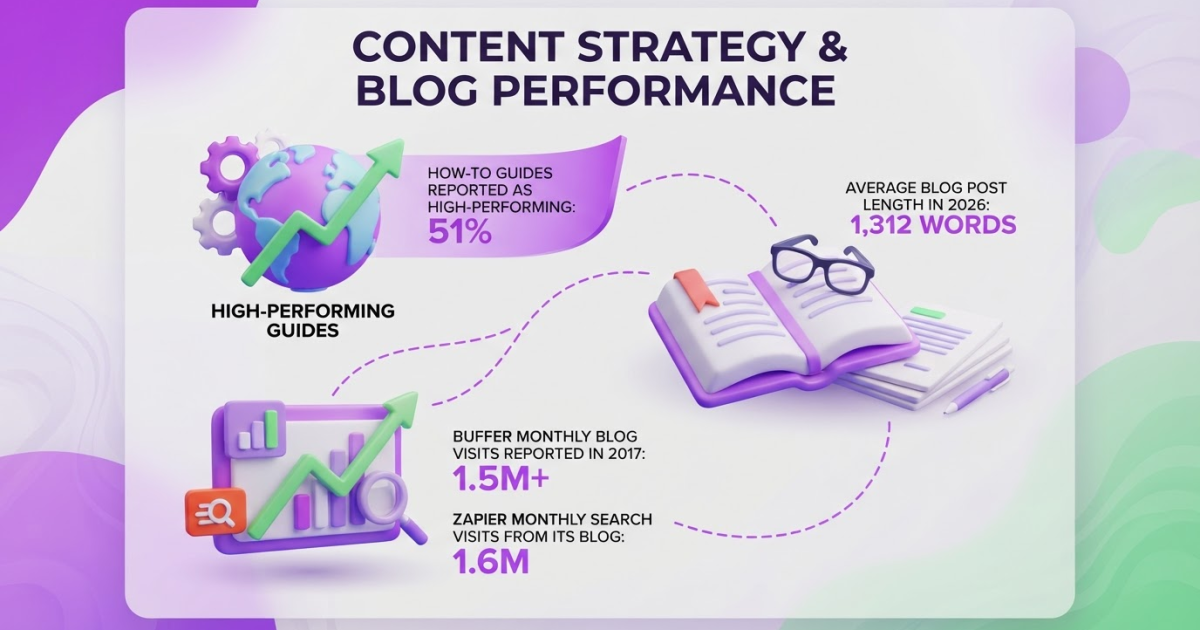
You can collect dozens of blog examples and still feel stuck when the keyword, reader, and business goal point in different directions. A format that attracts beginners may frustrate buyers, while a polished case study can miss the search intent entirely. 51% of businesses in HubSpot’s 2025 blogging survey said how-to guides perform well for them, making them the most commonly reported high-performing format measured. I’ll show you 15 formats, how to match each one to intent and conversion stage, a practical production workflow, and ways to measure organic growth.
| Point | Details |
|---|---|
| Match Search Intent | Choose a format based on the reader’s question, buying stage, and desired next action rather than copying a popular post type. |
| Start With Proven Formats | How-to guides were reported as high-performing by 51% of blog-producing businesses in HubSpot’s 2025 survey. |
| Build Reusable Outlines | Create a brief with 1 audience, 1 primary keyword, 1 promise, and 1 conversion goal for every post. |
| Add Original Evidence | Use examples, firsthand observations, data, screenshots, or expert input to make a familiar format more credible. |
| Improve After Publishing | Review rankings, engagement, conversions, and assisted sign-ups after 30, 60, and 90 days before deciding what to update. |
What Makes a Blog Example Worth Copying?
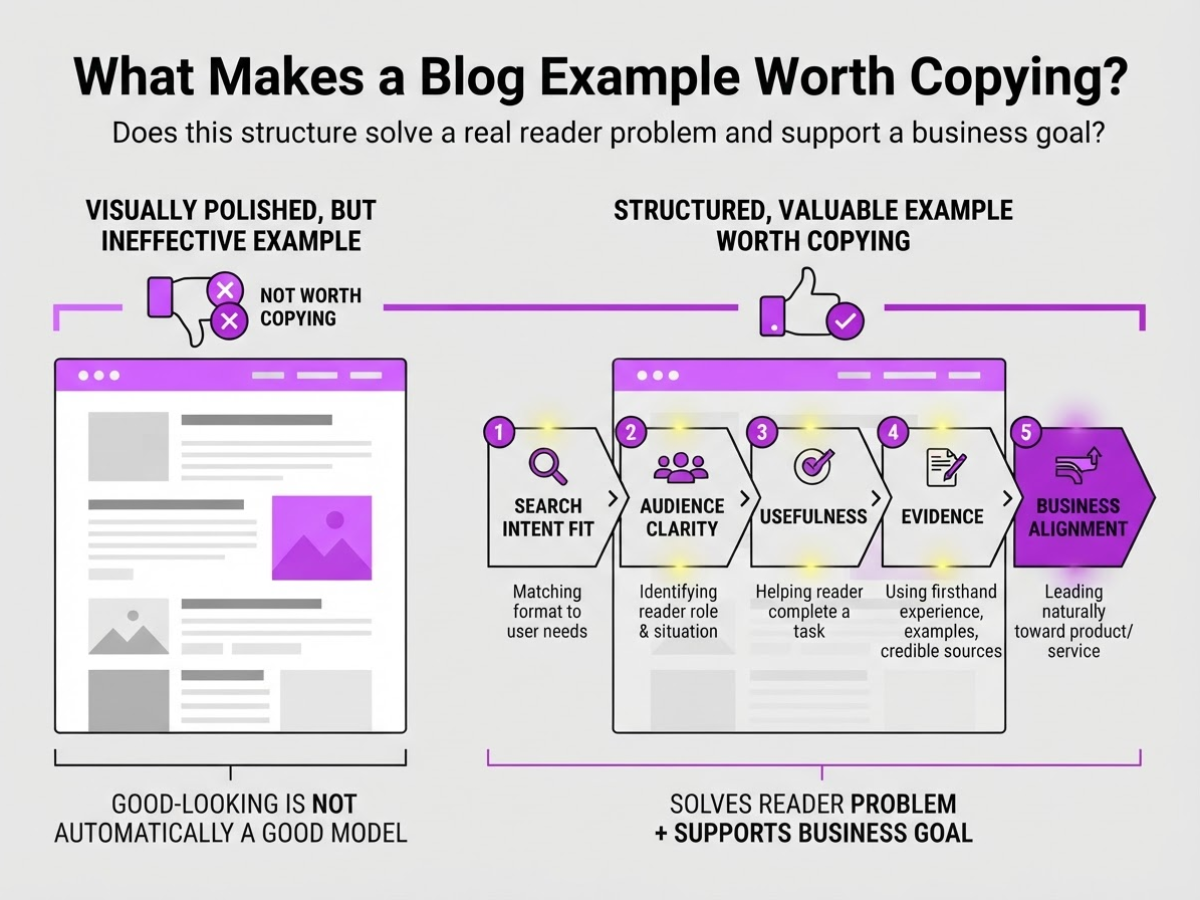
A good-looking blog is not automatically a good model. When I review content plans, teams often save posts because the layout feels polished, then skip the harder question: does the structure solve a real reader problem and support a business goal?
Start with five checks:
- Search intent fit: Does the format match what people want, such as instructions, options, proof, or original data?
- Audience clarity: Can you identify the reader’s role, situation, and level of knowledge?
- Usefulness: Does the post help someone make a decision or complete a task?
- Evidence: Does it use firsthand experience, testing, examples, or credible sources instead of unsupported claims?
- Business alignment: Does it lead naturally toward your product, service, email list, or another sensible next step?
A format is the post’s organizing shape, not its subject, personality, or visual treatment. A topic such as “how to improve blog traffic” could become a step-by-step guide, a comparison of traffic channels, a case study from one campaign, a weekly checklist, or a research post based on performance data. The topic stays similar, but the reader’s job changes.
That distinction matters more than glossy design. A collection of blog post formats can spark ideas, but you still need to test each idea against your audience and offer.
Use this rough scoring grid before imitating an example. Give each category a score from 1 to 5, where 5 means the idea is a strong fit or requires reasonable effort for its likely return.
| Criterion | Question to ask |
|---|---|
| Relevance | Does it answer a current audience need? |
| Originality | Can you add a view, example, or finding others lack? |
| Effort | Can your team produce it accurately and maintain it? |
| Conversion potential | Is there a credible next step for the reader? |
Pro Tip: Save strong examples by format and funnel stage, then annotate the exact reader problem each one solves instead of bookmarking them without context.
A high score does not give you permission to copy wording, claims, screenshots, or conclusions. Borrow the structure and reader experience, then rebuild the substance from your own evidence, customers, and point of view. The next decision is which format fits the job.
15 Blog Formats to Put on Your Shortlist
For TryRoki, I match the format to the decision a reader needs to make, not to whatever headline style is trending. These 15 blog formats cover practical choices and their drawbacks: research reports take longer, reviews need credibility, and news analysis expires quickly.
HubSpot’s 2025 survey found that how-to guides were the most commonly reported high-performing format, at 51%, while case studies reached 42%. Those figures describe reported performance, not a promise, but they are useful starting signals.
| Format | Best use, intent, evidence | Stage and CTA | Effort | Update | Differentiation |
|---|---|---|---|---|---|
| How-to guide | Solve a task; informational; tested steps | Awareness; try tool | M | 6–12 mo | High with original process |
| List post | Offer options; commercial research; examples | Awareness; read related post | L | 6–12 mo | Medium unless deeply curated |
| Beginner guide | Teach fundamentals; informational; plain examples | Awareness; download guide | M | 12 mo | High through clarity |
| Case study | Prove an outcome; commercial; first-party metrics | Consideration; book demo | H | 12–24 mo | Very high with numbers |
| Comparison | Support a shortlist; commercial; feature tests | Consideration; compare plans | M | 3–6 mo | High with hands-on testing |
| Product review | Evaluate one product; commercial; use evidence | Consideration; start trial | M | 3–6 mo | High when candid |
| Checklist | Prevent missed steps; informational; checklist itself | Awareness; download template | L | 12 mo | Medium |
| Template | Help readers execute; transactional; usable file | Conversion; get template | M | 6–12 mo | High if editable and specific |
| Definition | Explain a term; informational; examples and sources | Awareness; read guide | L | 12–24 mo | Low unless contextualized |
| Interview | Capture expert experience; informational; direct quotes | Awareness; follow expert | M | 12 mo | High with unusual access |
| Expert roundup | Compare informed views; informational; attributed opinions | Awareness; join newsletter | M | 12 mo | Medium, often overused |
| Research report | Create a reference point; informational; original data | Awareness; download report | H | 12–24 mo | Very high |
| Opinion piece | Take a defensible position; informational; reasoning | Awareness; discuss or subscribe | L | Rarely | High, but polarizing |
| News analysis | Explain implications; informational; primary reporting | Awareness; read update | M | Weekly or monthly | High if interpretation is yours |
| Curated resources | Save research time; informational; vetted links | Consideration; visit resource | L | Monthly or quarterly | Medium with annotations |
Pro Tip: When two formats seem equally suitable, choose the one that lets your company add original experience or data; differentiation usually matters more than novelty.
My rule is simple: use awareness formats for reach, consideration formats for comparison, and conversion formats for proof or action. That funnel match gives you a publishing mix instead of a calendar full of identical post shapes.
How to Choose the Right Blog Example for Any Topic
Start with the query, not the template you happen to like. At TryRoki, I use this six-step filter before approving a blog example.
-
Identify the searcher’s job. Ask what the person needs to accomplish after typing the query. “Blog examples” suggests research and comparison, while “how to write a blog post” signals a need for instructions. Separate informational, commercial, navigational, and transactional intent, then write the desired answer in plain language.
-
Place the reader on the awareness path. A beginner may need definitions and a simple example. Someone comparing tools needs proof, trade-offs, and a clear next action. Decide whether that action is reading a related guide, joining your email list, booking a call, or trying the product. If you cannot name it, the article probably has no business objective.
Pro Tip: Before drafting, write the intended answer in one sentence; if the format cannot deliver that answer quickly, choose another format.
-
Study the current results. Look at the first page and record repeated structures, such as numbered lists, screenshots, templates, or case studies. Then note what feels thin: missing steps, old examples, vague pricing, unsupported claims, or no advice for a specific audience. Do not copy the headings. Find the useful gap competitors ignored.
-
Choose the direct format, then add an angle. Use a tutorial for a how-to query, a comparison for a shortlist query, and a case study when readers need evidence. HubSpot’s 2025 survey found that 51% of businesses reported how-to guides as high-performing, ahead of industry news at 45%. Our 15 blog post formats help you compare options, but format alone cannot rescue weak advice. Add a specific audience, original data, a tested workflow, or an opinion.
-
Outline before you draft. Write a promise in the introduction, arrange H2s in the order a reader needs them, and assign proof points to each major claim. Add relevant internal links, examples, and one CTA. I check whether the outline answers the query before it wanders into background material. That check prevents bloated posts and frustrating rewrites. See these blog writing examples for practical structure ideas.
-
Set a measurable objective. Track impressions and rankings for early visibility, then clicks and qualified visits. For commercial content, add sign-ups, leads, or assisted conversions. Give the page a review date at 30, 60, and 90 days instead of judging it after one week.
Roki AI helps me turn this process into weekly work by generating drafts and assigning 3 to 10 SEO tasks, including opportunities from Reddit. It saves time, but it does not own accuracy, judgment, or differentiation. Human review still has to check sources, examples, tone, and whether the article says anything worth remembering. The next test is whether the finished post provides enough evidence and practical detail.

The Details That Separate Generic Posts From Strong Ones
At TryRoki, I see the same failure repeatedly: a post looks finished because the layout is attractive, but it answers the wrong question. Teams choose a listicle because it is quick to outline, an opinion post because it sounds distinctive, or a case study because it feels persuasive. That choice is lazy when the reader needs a definition, comparison, or direct process.
How-to guides perform well for 51% of businesses that publish blogs, but that statistic does not make every query a how-to query. A “what is canonicalization?” search needs a clear definition first. A “how do I fix it?” search needs ordered actions, screenshots, and warnings. Use 15 blog post formats to compare the options, but do not let the template drive the answer.
Common mistakes I check before approving a post include:
- Opening with three paragraphs of generic background before addressing the reader’s problem.
- Making claims without firsthand evidence, dates, data, or transparent source links.
- Using vague examples such as “a small business” instead of naming the action, tool, audience, or result.
- Leaving outdated screenshots that show an old menu, interface, or pricing page.
- Publishing AI-written filler such as “in today’s digital landscape” without a real observation from the author.
- Hiding who wrote the piece when the topic requires practical expertise, such as finance, health, or technical implementation.
- Adding internal links only to increase the count. A link should help the reader complete the next task. For example, send someone learning structure to this guide to writing effective blog posts, not to an unrelated product page.
Before publication, I run a blunt checklist: Are the facts accurate and current? Is the wording original? Can keyboard and mobile users read and navigate it? Does the title promise exactly what the page delivers? Are the metadata fields useful rather than stuffed? Does every example earn its place? Is the CTA relevant to the reader’s immediate next step? Blog teams are also increasing primary-source citations and author expertise signals, with 39% and 43% reporting those changes in HubSpot’s survey.
Once the draft passes those checks, presentation should help readers act rather than distract them.
How to Turn Blog Examples Into a Publishing System
A publishing system earns its place by producing useful business signals, not by filling a calendar. As a company owner, I would rather publish four posts that attract the right buyers than twelve articles that collect impressions and go nowhere.
Start with a format library. Tag each idea by topic cluster, funnel stage, search intent, and production effort. A how-to guide might target an informational query at the awareness stage and take two days, while a customer comparison belongs closer to conversion and needs interviews, screenshots, and approval. Our blog post examples can help you build the first version, but do not treat the list as a permanent recipe.
Keep the operating side boring and repeatable. Batch keyword research on one day, outlines on another, then draft similar formats together. Store source files, screenshots, and approved brand assets in centralized asset management for marketing teams, because hunting through old folders can waste more time than writing. A realistic starting cadence is two useful posts per month if one person owns the work. Weekly publishing sounds impressive until quality slips and updates never happen.
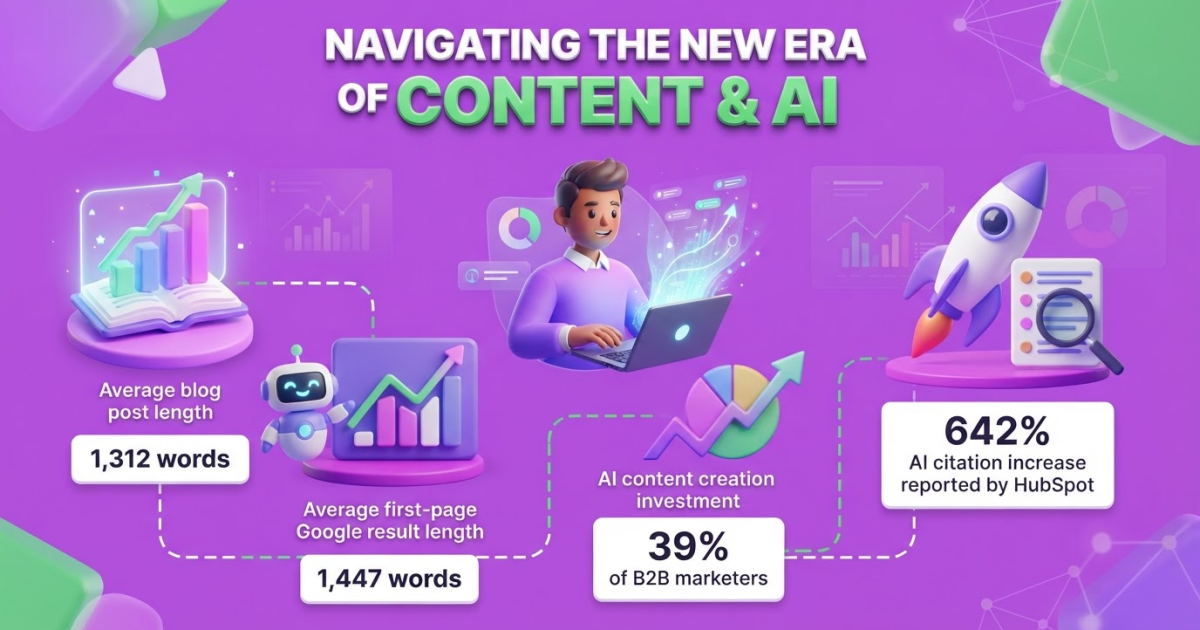
Orbit Media’s 2026 blogging research reported an average article length of 1,312 words, yet only 13.9% of respondents said their blog delivered strong results. Length and output are inputs, not outcomes. Track qualified organic traffic, rankings for valuable queries, conversion rate, assisted conversions, and content decay, such as a post losing clicks or slipping from page one.
Use this review rhythm:
- At 30 days: Check indexing, impressions, early rankings, and whether the post attracts the intended query. Fix obvious intent or internal-link problems.
- At 60 days: Compare qualified visits and assisted conversions with similar posts. Refresh weak sections, add missing examples, or expand a promising angle.
- At 90 days: Choose clearly: refresh, expand into a supporting post, consolidate overlapping pages, or retire the article. Do not keep a page alive because someone worked hard on it.
A smaller library of genuinely helpful posts can beat a high-volume stream of undifferentiated content. The remaining question is which examples deserve your team’s limited production time.
My honest take on blog examples
I have reviewed hundreds of blog examples while building TryRoki, and I keep coming back to one test: does this example help you make a better decision? If it clarifies the format, sharpens the angle, shows what evidence belongs in the piece, or improves your workflow, it earns your attention. If it only looks polished, it is decoration.
Here is the contrarian point: publishing more blog posts is not automatically a growth strategy. A smaller library of distinctive, well-maintained pages can be worth more than a high-volume archive of interchangeable AI drafts. I have seen teams spend weeks filling a content calendar while leaving outdated pricing, vague claims, and weak examples untouched. That creates activity, not trust.
The strongest blog examples should be studied as systems, not copied as templates. Look at how the writer chooses a reader, frames a problem, supports a claim, and moves someone toward a sensible next step. Copying the surface usually produces a strange fit for your business.
That is also how I think about Roki AI. Automation should keep execution consistent, including finding relevant Reddit conversations and giving you weekly tasks, but it cannot own your positioning, accuracy, or trust. Those decisions still belong to you. The setup is imperfect, and reviewing drafts takes time, but skipping that judgment is more expensive.
- What I would copy: the decision logic, evidence standard, and reader handoff.
- What I would not copy: the wording, unsupported claims, or visual polish without substance.
— Daniel
Turn Strong Blog Examples Into Consistent Output
Once you know which blog examples fit your audience, the harder part is publishing consistently. As a company owner, I have seen good content plans stall because nobody has time to turn five promising formats into drafts, updates, and distribution work each week.
TryRoki helps you create website content through an autopilot-oriented workflow, then assigns 3 to 10 practical tasks each week. Those tasks might cover a new article, a content improvement, or a relevant Reddit post where a thoughtful comment can mention your website. That Reddit angle needs judgment: forced promotion will usually hurt more than help.
You still need to review claims, edit the voice, and decide which ideas deserve your brand’s attention. If that trade-off suits your process, explore Roki AI’s workflow and features and assess whether it can keep your chosen blog formats moving.
- Choose the format and audience before turning on automation.
- Review every factual claim and Reddit response before publishing.
- Measure qualified visits and conversions, not task count alone.
Frequently Asked Questions
Start with a how-to guide, beginner explainer, checklist, or curated resource post. These formats give you a clear structure and reader promise, but choose based on the question your audience asks rather than the format that seems easiest to produce.
A strong post needs a defined audience, a clear promise, useful structure, accurate evidence, practical examples, descriptive headings, relevant internal links, and one logical next action. Before publishing, review readability and factual accuracy, especially if AI helped draft any content.
Write as much as the topic requires to satisfy the reader without repetition. Orbit Media’s 2026 research reported an average article length of 1,312 words, but completeness and relevance matter more than reaching that figure.
Add something competitors cannot easily reproduce, such as firsthand experience, original data, clear examples, expert commentary, useful tools, or a more actionable process. Strong sourcing and visible author expertise build credibility, while copied generic advice leaves your post forgettable.
Choose a cadence your team can sustain without rushing the research, such as 1 well-developed post each week or 2 per month. Review performance after 30, 60, and 90 days, then put more effort into topics and formats that attract qualified readers and business outcomes.
Written by Daniel/Aleksandra.
Recommended reads
- Blog Post Examples 15 Formats That Work
- Blog Writing Examples How To Craft Effective Posts
- Blog Article Example How To Write One That Works
- Boosting Seo With Automated Content Generation Tips
Sources
- HubSpot's 2025 State of Blogging Report [Data from 500+ Marketers]
- 2026 Blogging Statistics: Blogger Data Shows Trends and Insights Into Blogging
- How We Increased the Readership of Buffer’s Blog to Over 1.5 Million Visits
- Our Top 5 Blog Posts of 2025 (And What Made Them Work)
- 15 SEO Case Studies You Can Learn From
- Cocoon