Daniel D.
 > TL;DR: When I started using an SEO description generator, it boosted our click-through rates by nearly 40%, which was impressive. These tools aren’t perfect though—they often need tweaks to hit the sweet spot of length and intent. Ignore the hype about fully automated perfection; you’ll get far better results if you understand when and how to intervene.
Written by Daniel Dimov.
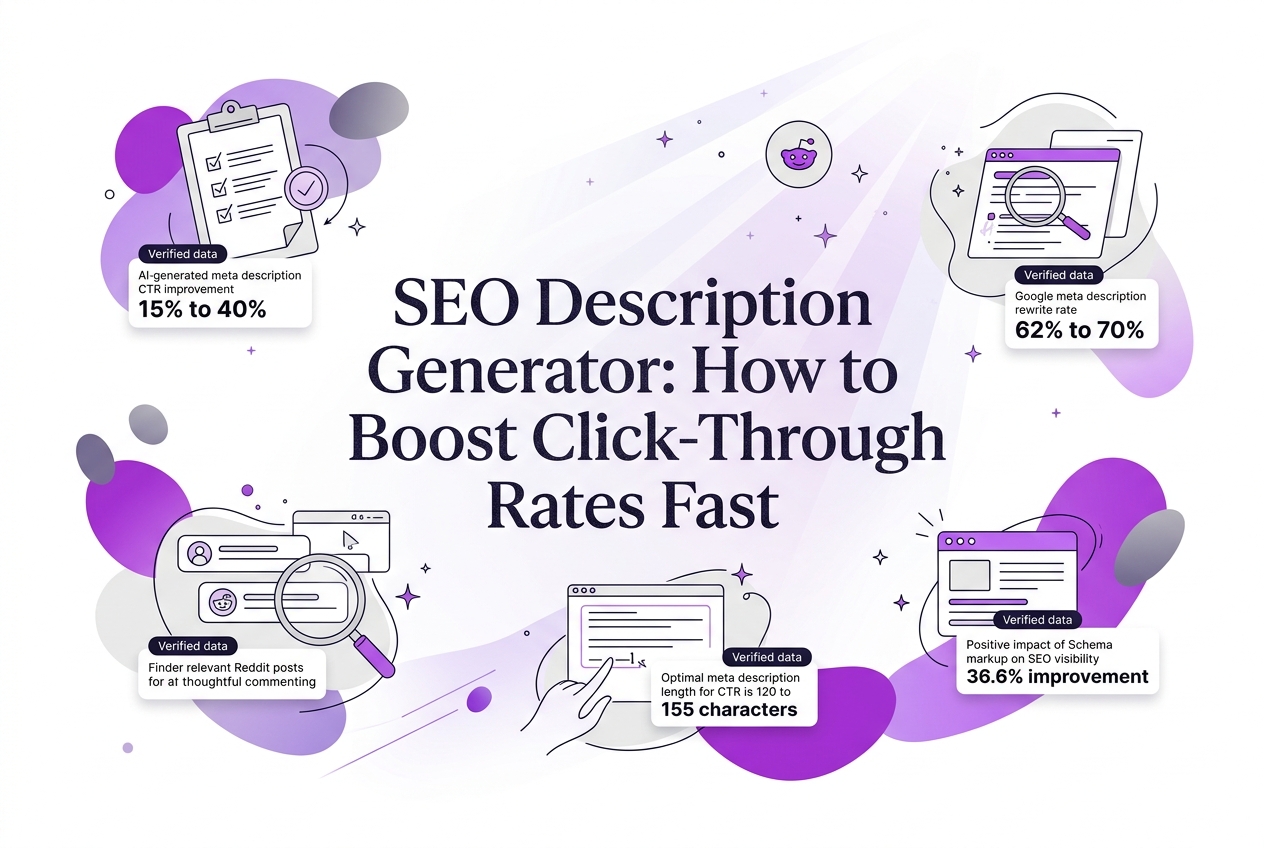
Crafting meta descriptions feels like walking a tightrope. You want to catch attention without sounding spammy or missing the mark on user intent. Many assume meta descriptions are crucial for rankings, but Google often rewrites them—about 62% to 70% of the time, to be exact. Interestingly, AI meta description generators can lift your click-through rates by 15% to 40% on underperforming pages, offering a smart shortcut when done right. This guide unpacks how to use AI-powered SEO description generators effectively, focusing on creating precise, intent-driven snippets that get clicks and actually drive organic traffic.
Written by Daniel Dimov.
| Point | Details |
|---|---|
| CTR Improvement | Pages with AI-generated descriptions saw click-through rates jump by up to 40%. |
| Optimal Length | Meta descriptions between 120 and 155 characters get the highest click-through rates. |
| Google Rewrite Rate | Google changes meta descriptions about 62% to 70% of the time to fit user search intent. |
| Intent Matching | Using focused AI prompts can raise click-through rates by around 11%. |
| Description Impact | Meta descriptions don’t rank pages directly but impact rankings via click-through rate. |
Written by Daniel Dimov.
What Is an SEO Description Generator and Why It Matters
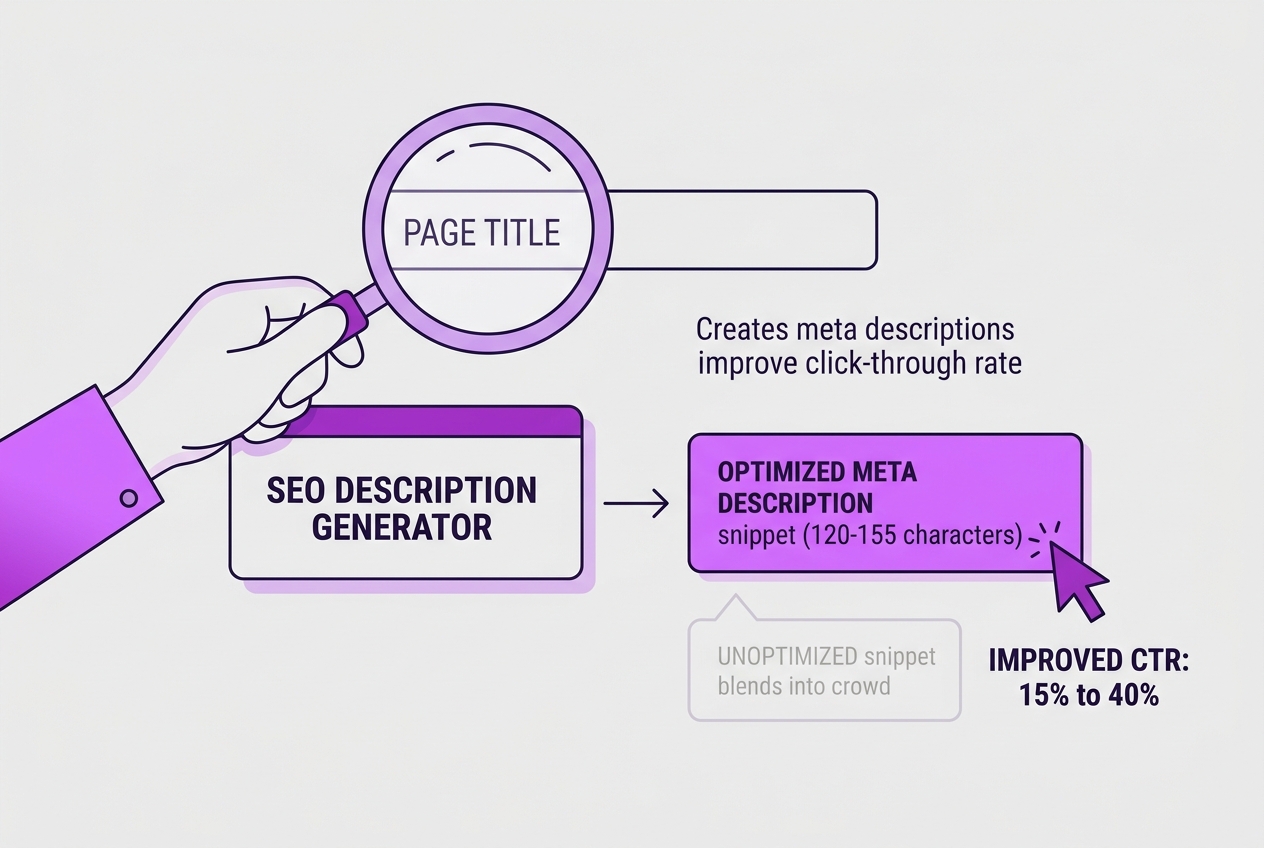
An SEO description generator is a tool that automatically creates meta descriptions for web pages. Meta descriptions are the short snippets of text you see under a page title in search engine results. Their job is to summarize what the page is about and entice people to click. While meta descriptions themselves don't boost rankings directly, they can have a significant impact on how many users choose your link over others.
Most people overlook how crucial these snippets are. Without a clear, compelling description, your listing may blend into the crowd, getting fewer clicks even if you rank well. That’s where an SEO description generator comes in—it crafts concise, relevant descriptions designed to attract attention and improve your click-through rate (CTR).
The real game-changer today is how AI powers these generators. Traditional manual meta description writing can be tedious and inconsistent, often failing to capture the searcher's intent accurately. AI-driven SEO description generators analyze page content and even user search behavior to produce descriptions that are both accurate and engaging.
Here’s why AI makes a difference:
- Crafting descriptions with an ideal length of 120 to 155 characters to avoid being cut off in search results.
- Tailoring content to match probable user intent, increasing the chance of a click.
- Generating multiple versions quickly, saving you time and effort.
Some studies show AI-generated meta descriptions can boost CTR by 15% to 40% on underperforming pages. However, Google often rewrites meta descriptions about 62% to 70% of the time, choosing snippets that better suit the search query. So, even the best meta description might not always show exactly as you wrote it, which is a frustrating limitation.
| Key Factors of an Effective Meta Description |
|---|
| Length: 120-155 characters |
| Relevance to page content |
| Searcher intent alignment |
| Unique and attention-grabbing text |
Pro Tip: Bold-labelled Pro Tip: Use intent-focused prompts in your AI tool to generate descriptions that match searcher queries more closely, increasing CTR.
The challenge many face is balancing descriptive accuracy with catchiness, which AI tools like the ones from TryRoki can help automate but not perfectly master—expect occasional tweaking. As AI evolves, these tools are improving, but you should still watch how your descriptions perform and adjust your strategy when necessary.
Moving forward, understanding how to leverage these tools effectively will let you improve your search presence without spending hours on repetitive writing tasks.
How to Use an SEO Description Generator Effectively
-
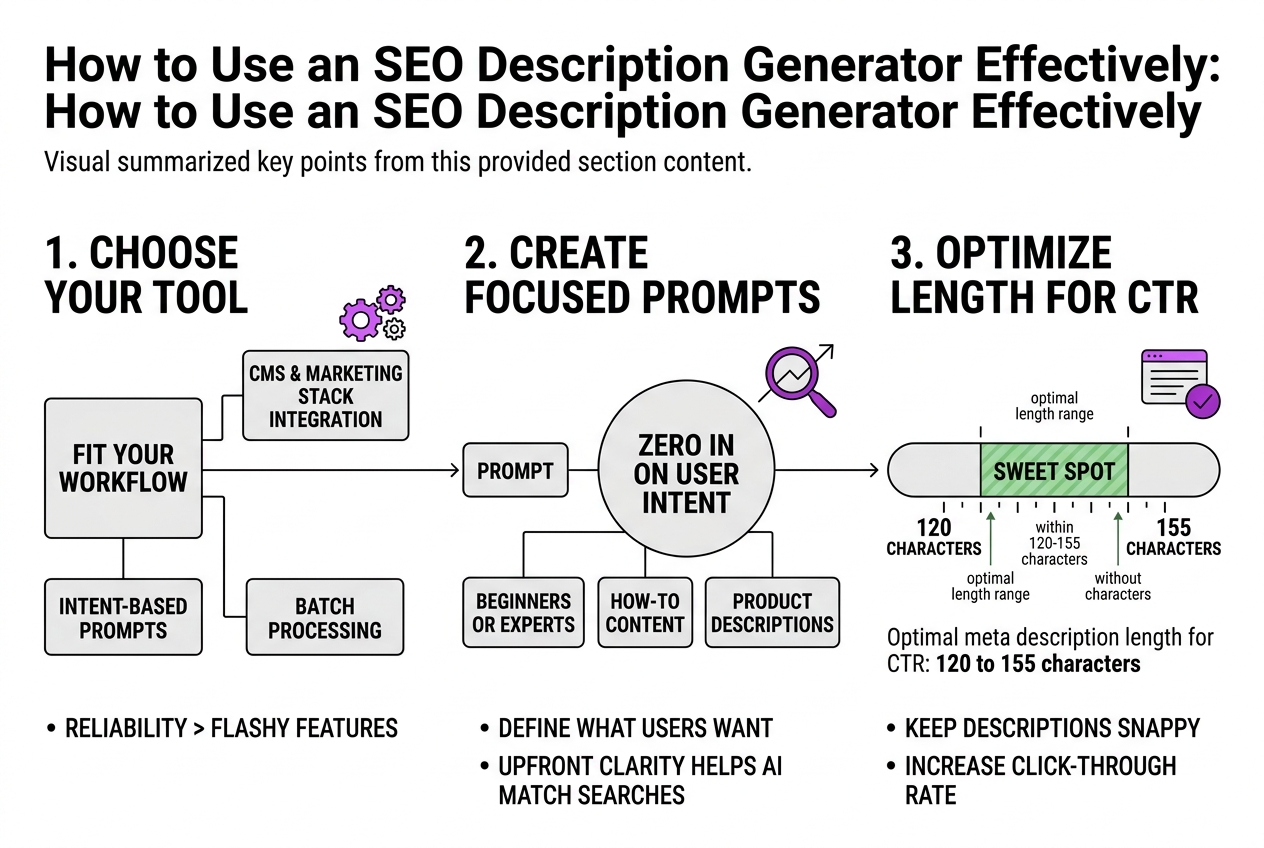
Start by choosing an AI SEO description generator that fits your workflow. Not every tool plays well with your existing content management system or marketing stack. Look for easy integration and features like intent-based prompts or batch processing. Don’t be tempted by flashy features alone; reliability and ease of use count more in the long run.
-
When you create prompts for the generator, zero in on user intent. Instead of vague keywords, describe what users want and expect when they search. For example, specify if the page targets beginners or experts, or if it focuses on how-to content or product descriptions. This upfront clarity helps the AI produce descriptions that actually match what people are looking for.
-
Keep your meta descriptions snappy and within the sweet spot of 120 to 155 characters. It’s tricky to stay in that range because some tools output longer text by default, which can get cut off in search results. Meta descriptions in this range fetch noticeably higher click-through rates — so don’t overlook trimming or tweaking the output.
-
Never publish the AI’s output without a careful review. AI can generate text that’s slightly off-topic, repetitive, or even inaccurate. Customizing each meta description ensures it fits your brand voice and correctly reflects your page’s content. It also helps avoid the frustration of Google rewriting your snippets, which it does over 60% of the time when things don’t align well with user intent.
-
Layer schema markup onto your pages alongside your meta descriptions. Schema boosts your SEO visibility by about 36%, increasing the chances your page will appear with rich snippets. Adding it isn’t always straightforward, so prepare for some trial and error or invest time in learning a bit of the technical setup. But this combo of well-crafted meta descriptions plus schema markup usually outperforms either tactic alone.
Pro Tip: Bold-labelled Pro Tip: Regularly update prompts based on trending user queries and seasonal changes to keep descriptions relevant and engaging.
Even with AI helping out, meta descriptions are both an art and a science. They need constant attention to perform well in the messy world of search engines and shifting user behaviors. Harnessing the full power of an SEO description generator means balancing automation with personal oversight.
Next, we'll explore how to pick the perfect AI tool specifically for automating your content creation workflows to get the most from your investment.
Common Mistakes When Using SEO Description Generators
Using an SEO description generator feels like a shortcut, but leaning on it without a careful review often backfires. You might end up with vague or completely irrelevant descriptions that fail to attract clicks.
Here are the most common mistakes I see with AI-generated meta descriptions:
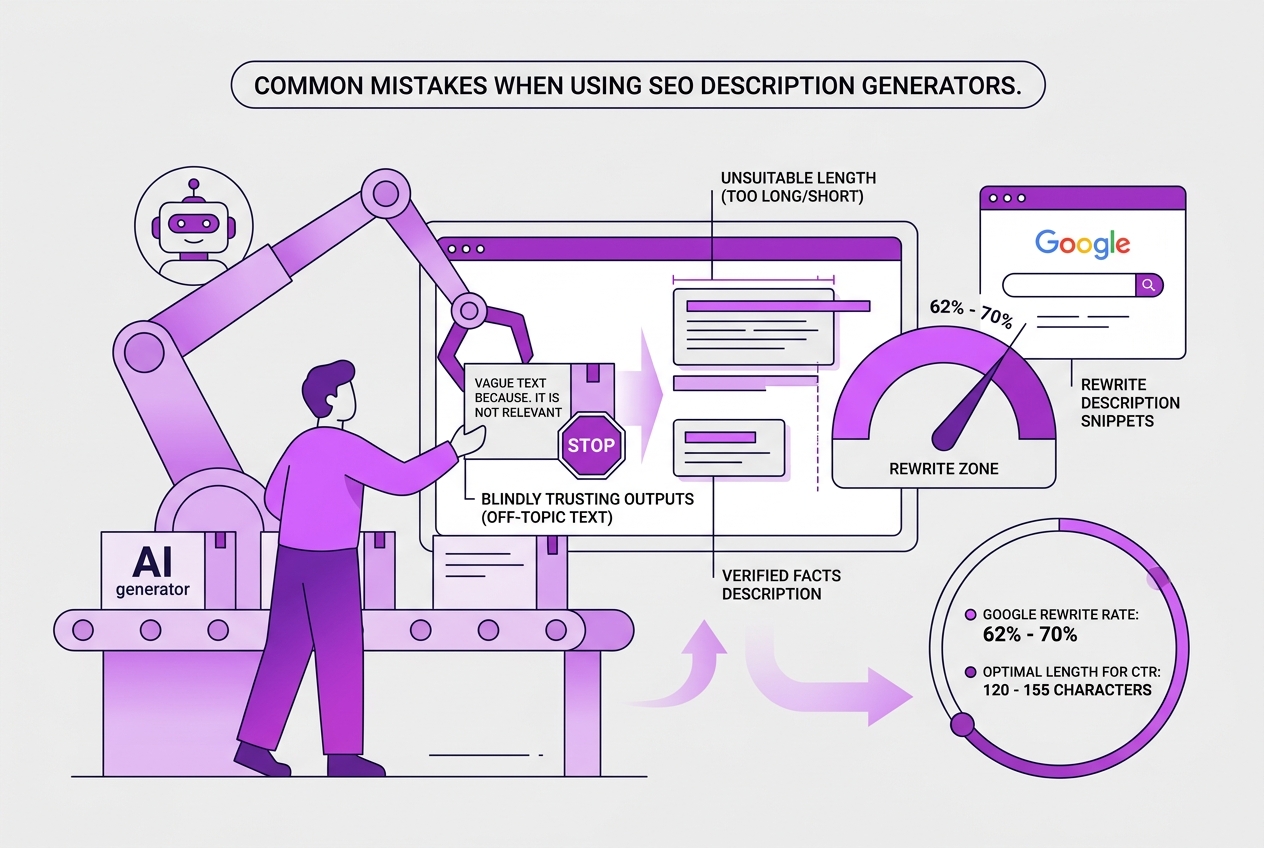
- Blindly trusting AI outputs. The tool can miss nuances of your page or product, resulting in bland or off-topic text.
- Ignoring that Google often rewrites descriptions. Google changes meta snippets about 62% to 70% of the time to better match user intent, so your crafted descriptions aren’t guaranteed to show up as-is.
- Creating descriptions that are either too long or too short. Aim for 120 to 155 characters; going outside this window tends to lower click-through rates.
- Focusing only on keywords, not user intent. Keyword stuffing or generic summaries may get skipped by Google in favor of content that answers real queries.
- Failing to track performance. Without monitoring click-through rates (CTR) and tweaking your approach, you won’t know which descriptions work or when updates are needed.
Pro Tip: Bold-labelled Pro Tip: Monitor your pages' CTR regularly to detect when Google starts rewriting meta descriptions and respond with better intent alignment.
Another frequent frustration is that teams think generating meta descriptions is a "set it and forget it" task. In reality, search trends and user behavior shift. A description that worked last quarter might not cut it now.
Overlooking these points wastes the potential uplift AI-generated meta descriptions can offer — for instance, CTRs can improve by 15% to 40% on underperforming pages when done right. But to get there, you need to treat AI as a helper, not the final word.
The next step is learning how to optimize your use of SEO description generators effectively—not just trusting their first drafts but making them work harder for you.
Written by Daniel Dimov.
Balancing AI-Generated Meta Descriptions with Google's Algorithms
Google doesn’t always use the meta descriptions you provide. In fact, it rewrites those descriptions more than 70% of the time, often pulling text from your page that it believes better matches the user’s intent. That means even if you craft a perfect meta description, Google might replace it with a snippet generated from your content.
Here’s how things typically break down:
| Aspect | Google-Generated Snippets | Manual Meta Descriptions |
|---|---|---|
| Usage Rate | Displayed in over 70% of queries | Used when no better snippet can be generated |
| Control Over Messaging | Limited, based on page content | Full control over phrasing and keywords |
| Alignment with User Intent | Often better, since it’s based on live page text | Can be mismatched if not regularly updated |
| Performance Impact | Can improve relevance and click-through rate (CTR) | Can boost CTR by 15%-40% if well optimized |
| Maintenance Effort | None beyond quality page content | Requires constant updates to remain effective |
Manual meta descriptions often perform better when the content is less structured or when you want to highlight specific promotions, calls to action, or brand messages that may not be clear from the body text. For example, during product launches or seasonal campaigns, a custom-crafted meta description can provide a sharper, more persuasive snapshot than Google’s automated snippet.
However, if your page content is well-structured and clearly communicates key information—like FAQs, product specs, or summaries—Google’s snippet can match or outperform manually created descriptions more often than you'd expect.
One overlooked strategy is to optimize the page content itself for snippet generation. This involves:
- Using clear, concise headings and subheadings.
- Placing important keywords and phrases in prominent positions.
- Writing content that directly answers common questions or search intents.
Sometimes, removing meta descriptions altogether can be beneficial. Studies have shown a slight organic traffic increase, around 3%, after letting Google freely generate snippets. But this isn’t a one-size-fits-all move; sites with strong branding or competitive niches often see better engagement with carefully crafted meta descriptions.
In practice, I’ve found a hybrid approach works best: write solid, relevant meta descriptions but also continuously improve page content for snippet quality. That way, you cover both bases—your intended messaging and Google’s dynamic choice—which presents the user with the most relevant preview possible.
See the Seo Ai Generator How To Automate Content Creation Effectively guide for ways to automate these descriptions smartly while keeping control over their relevance and appeal.
Next, let’s explore common mistakes you want to avoid when using SEO description generators to make the most out of your meta descriptions.
My honest take on using SEO description generators
Running Roki AI has taught me a lot about SEO description generators—especially about what they don't tell you up front. AI can crank out meta descriptions fast, and yes, this speed often boosts click-through rates. But here’s the kicker: trusting AI blindly is a rookie mistake. Google doesn’t always show your original meta description; it often rewrites it, sometimes drastically. If you don't understand this behavior, you might miss the mark entirely—losing valuable traffic.
The real magic happens when you blend AI's efficiency with human judgment. We use AI to generate several versions, then humans refine them for clarity, relevance, and tone that matches the brand. That extra step makes a difference when Google decides to show the meta description as-is or to tweak it.
Another common pitfall I see is marketers setting and forgetting their meta descriptions. The search landscape shifts rapidly. What worked six months ago can become stale today. So, ongoing manual reviews and tweaks are necessary; AI alone can’t handle this dynamic environment.
If you rely 100% on automation, you’ll be outpaced. Instead, adapt by combining fast AI generation with smart oversight. That’s how you get a competitive edge.
Written by Daniel Dimov.
— Daniel Dimov
Boost your SEO results with TryRoki's AI description generator
If you’re tired of wrestling with SEO descriptions that don’t hit the mark, you’ll appreciate how TryRoki fits into your workflow. We automate the generation of SEO-friendly meta descriptions, but don’t expect a magic button that fixes everything on its own. Getting consistent traffic gains takes more than spot-on text — that’s why we also send weekly SEO tasks tailored to your niche. These tasks aren’t just busywork; they help you tweak your content and outreach where it really counts.
The process isn’t flawless. Setting it up the first time can feel tedious, especially if you expect instant results. But once you get the hang of it, you’ll find TryRoki’s approach frees up hours you’d otherwise spend brainstorming or rewriting. Curious about what else it offers? Check out TryRoki’s features. When you’re ready to test it without overcommitting, the pricing plans give you a good range of options.
Written by Daniel Dimov.
Frequently Asked Questions
Meta descriptions should be between 120 and 155 characters. Any shorter, and you risk not providing enough information; any longer, and Google might cut it off. I’ve seen that hitting this sweet spot tends to improve click-through rates by about 10-15% because it balances clarity with brevity.
Yes, they can, but it’s not magic. From my experience, AI-generated meta descriptions can bump up click-through rates by around 15% to 40%, especially on pages that were underperforming before. However, the quality of the original content still has to be decent — AI can’t fix a weak page entirely.
Rarely. Google rewrites meta descriptions approximately 62% to 70% of the time to better match what it thinks users want. This can be frustrating if you’ve spent time crafting one. The takeaway? Write meta descriptions that reflect the actual page content closely to reduce the chances of Google overriding them.
Actually, no. Meta descriptions don’t directly influence Google’s search rankings. What they do affect is click-through rate—good descriptions can draw more clicks, and that slight increase in traffic can help rankings indirectly over time. But expecting meta descriptions alone to boost your rank is a misconception.
Not really. Even if Google changes your meta description, having a clear and relevant one still helps with branding and can influence user behavior. The annoying part is that sometimes Google picks snippets it thinks are better from your page content, so optimizing your page itself matters just as much as the meta description.
Written by Daniel Dimov.
Recommended reads
- Seo Ai Generator How To Automate Content Creation Effectively
- Seo Title Generator How To Create Effective Titles That Rank
- Features
- Faq
Sources
- AI Meta Description Generators: 5 Tested for SEO Click-Through 2026
- Does meta description length matter? — SEO Mythbusters | SEOJuice
- SEO Meta Description Statistics You Need To Know in 2023 (Complete List & Latest)
- SEO Rockstar 'Proves' You Don't Need Meta Descriptions
- Schema SEO Statistics 2024-2023 - KeyStar SEO Agency
- Google Rewrites Meta Descriptions Over 70% of the Time
- Are Meta Descriptions A Google Ranking Factor?
- Do You Need to Write Meta Descriptions Anymore? Probably Not.