Daniel D.
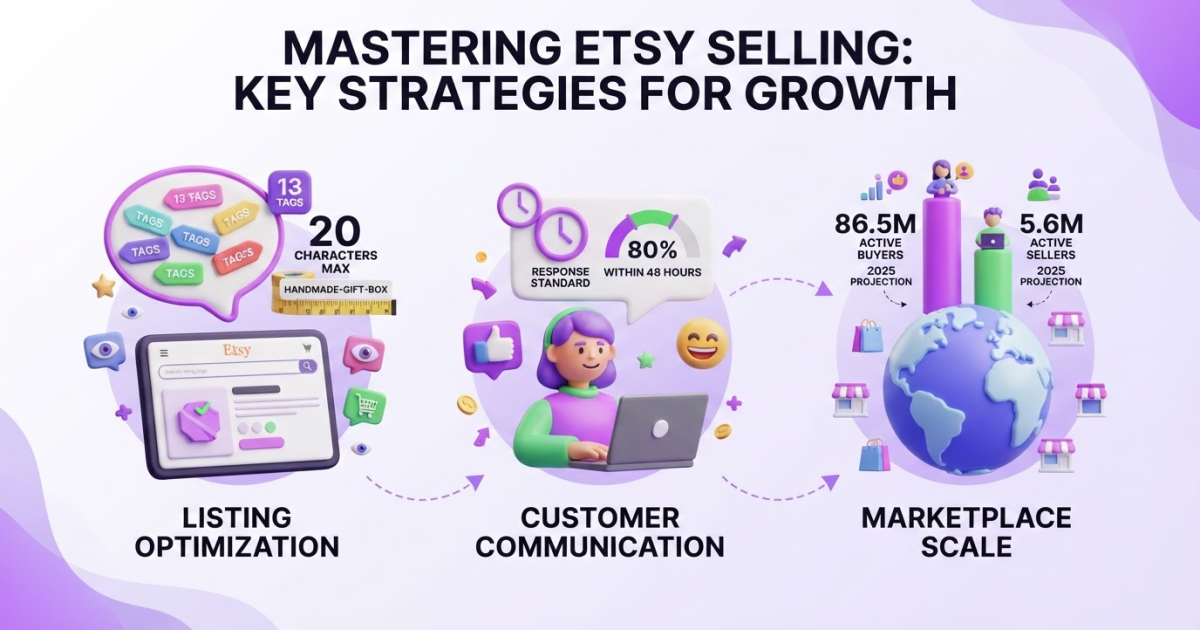
A free Etsy SEO tool helps you find shopper search terms, improve listing titles and tags, and track which keywords bring visitors without paying for extra software. Use it alongside Etsy’s own search guidance, but expect free tools to have limits when you need deeper keyword data, ongoing monitoring, or more than 3–10 SEO tasks each week.
Improving Etsy SEO can feel like doing keyword research after every sale, then guessing whether your tags or titles actually helped. The work gets tedious fast, especially because Etsy search separates matching a shopper’s query from ranking the listings that match it. A free Etsy SEO tool can reduce the guesswork, but it cannot fix vague product positioning or weak listings for you. You need a tool-selection process, a repeatable keyword workflow, and a way to review results without treating every traffic change as proof.
| Point | Details |
|---|---|
| Start With Demand | Use Etsy search suggestions and marketplace language to find phrases shoppers already use before you edit a listing. |
| Use Every Tag | Fill all 13 Etsy tag opportunities, keeping each tag within the 20-character limit. |
| Match Search Intent | Put the strongest phrase in the title, then use related terms, attributes, and descriptions to explain the product clearly. |
| Measure Real Signals | Review Shop Stats for clicks, favorites, carts, and purchases instead of trusting keyword guesses alone. |
| Avoid Tool Dependence | A free tool can support research, but lasting visibility still depends on relevance, listing quality, customer service, and conversion. |
What a Free Etsy SEO Tool Should Actually Do
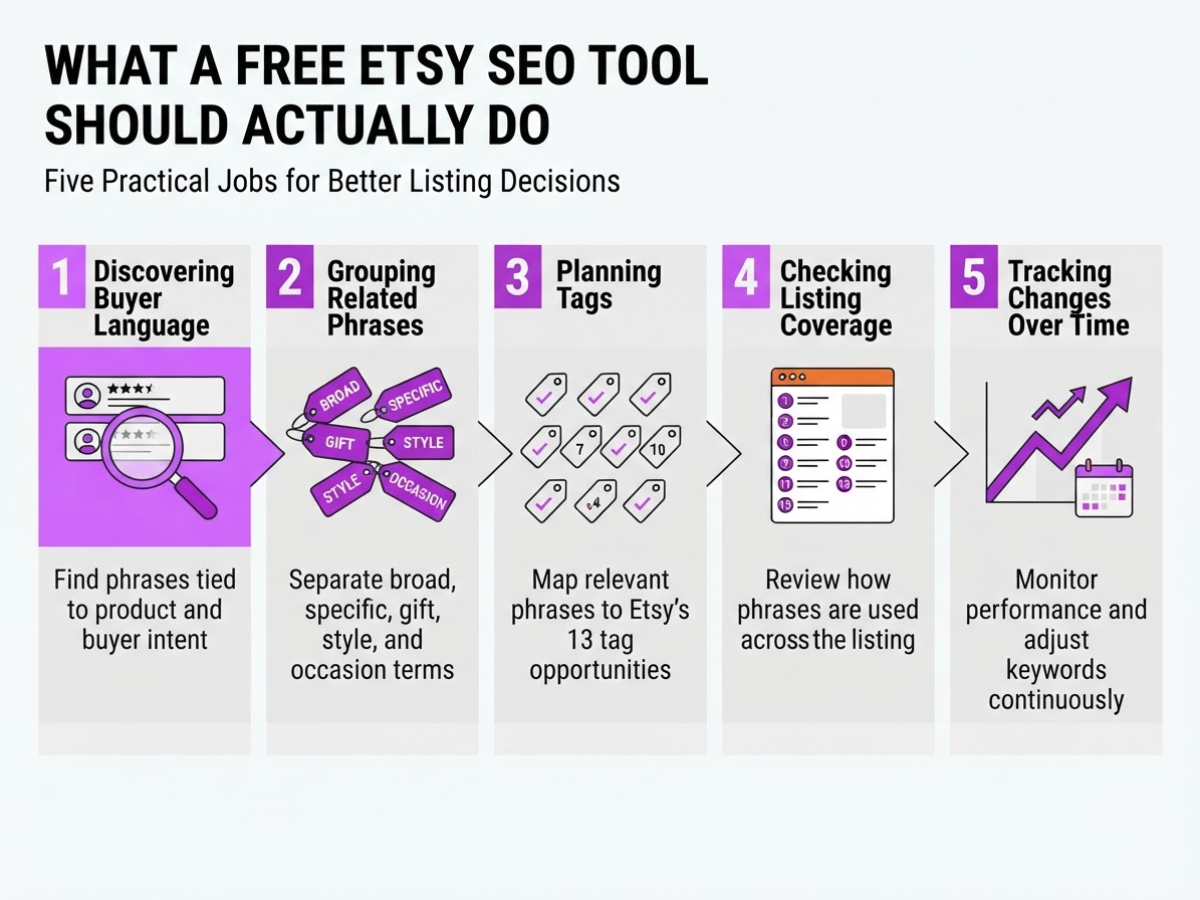
A free Etsy SEO tool should help you make better listing decisions, not simply produce a long spreadsheet of phrases. When I review tools with sellers, I look for five practical jobs: discovering buyer language, grouping related phrases, planning tags, checking listing coverage, and tracking changes over time.
A generic keyword generator often misses the point. Etsy shoppers search with product-specific phrases, and Etsy search works differently from Google search:
| Etsy SEO job | What a useful tool should help you do |
|---|---|
| Keyword discovery | Find phrases tied to a real product and buyer intent |
| Phrase organization | Separate broad, specific, gift, style, and occasion terms |
| Tag planning | Map relevant phrases to Etsy’s 13 tag opportunities |
| Listing review | Spot missing terms, weak titles, and unused attributes |
| Basic tracking | Compare impressions, visits, and search terms over time |
Etsy search first matches listings to a query and then ranks those matches using factors such as shop, customer service, and listing quality. Google SEO focuses more heavily on web pages, links, and broader site signals. Neither system lets a tool promise page-one placement, more favorites, or guaranteed sales. Any tool making that promise is selling confidence, not evidence.
I judge a free Etsy keyword tool against five tests:
- It uses Etsy-relevant language rather than only Google data.
- You can copy or export phrases without rebuilding the list by hand.
- It explains free-plan limits, result sources, and refresh dates.
- It remains useful without forcing you to buy Etsy Ads.
- You can understand the output within a few minutes.
Pro Tip: Judge a tool by the decisions it helps you make, not by how many keyword rows it displays.
Suppose you sell a lavender soy candle. A useful tool might organize “lavender candle,” “relaxation gift,” “housewarming candle,” and “small hostess gift” by intent, then help you choose relevant tags and revise the title. You still check Etsy’s search suggestions and Shop Stats, because those show what shoppers actually type and which terms already bring visits. The tool supports your judgment; it does not replace it.
The practical difference comes down to how a tool turns raw phrases into usable Etsy tags.
A 20-Minute Workflow for Using One on Etsy
Set a timer for 20 minutes and work on one listing only. I use this limit because keyword research expands quickly, and sellers often spend an hour collecting phrases they never use. The goal is a clear listing plan, not a perfect spreadsheet.
-
Define the listing in two minutes. Write down the exact product, intended buyer, use case, style, material, and occasion. For example: “Personalized walnut ring box for an engaged couple, rustic wedding gift.” This keeps a free Etsy SEO tool from mixing broad phrases such as “wood gift” with the specific language a shopper might type.
-
Collect search-bar phrases for five minutes. Type the product into Etsy’s search bar and record useful suggestions, including longer variations. Etsy says these suggestions reflect popular customer search terms, so they give you a better starting point than guessing synonyms from memory. Add phrases tied to buyer intent, such as “wedding ring box,” plus modifiers such as “personalized,” “rustic,” or “walnut.”
-
Sort the list for four minutes. Put each phrase into one of three groups: exact product, buyer intent, or descriptive modifier. Then paste the groups into the free tool to compare wording, combine close variants, and flag phrases that do not fit the item. Do not force every variation into one listing. That creates awkward copy and leaves no room for the phrases that describe how someone shops.
Pro Tip: Create one keyword map per product family, then adapt it for each variation instead of copying the same title and tags across every listing.
-
Draft the listing plan in six minutes. Put the clearest product phrase near the start of the title, then add one or two strong intent or modifier phrases in normal language. Build a 13-tag plan, keeping each tag within Etsy’s 20-character limit and using multi-word phrases where they fit. Etsy recommends using all 13 tag opportunities. Outline the description with the product, buyer, use case, materials, size, personalization details, and shipping expectations. Check every relevant category attribute too, since attributes help Etsy match shopper queries.
-
Record and review in three minutes. Save the old title, tags, description, and attributes before publishing the edits. Note the change date, the phrases you prioritized, and a review date 30 days later. Compare visits, search terms, favorites, carts, and orders. Keep what attracts the right shoppers and replace what does not.
That workflow gives you a controlled starting point. The next decision is whether free limits are costing more time than a paid platform would save.
Free Tools Versus Paid Etsy SEO Platforms
The right choice depends less on the tool’s price than on the cost of making a bad listing decision. I have seen sellers pay for enormous keyword databases, then copy vague phrases into titles without checking buyer intent, competition, or conversion. A larger database does not automatically produce better keywords or better listings.
| Capability | Free Etsy SEO tool | Paid Etsy SEO platform |
|---|---|---|
| Keyword discovery | Good for seed phrases, related terms, and quick idea checks | Broader suggestions, filters, and larger query databases |
| Competitor visibility | Usually limited to visible listings and basic comparisons | More competitor tracking, listing history, and market views |
| Historical data | Often absent or shallow | Trends, saved keywords, and historical comparisons |
| Listing audits | Basic title, tag, or character checks | Deeper audits across many listings at once |
| Rank tracking | Manual spot checks or a small allowance | Scheduled tracking across keywords and listings |
| Exports and limits | Few exports, daily searches, or limited results | Bulk exports, saved projects, and higher usage limits |
For a new shop, a catalog of 1 to 20 listings, or a seasonal test, free is usually enough. You can research a handful of phrases, compare competing listings, update titles and tags, then watch Shop Stats. Etsy recommends reviewing the search terms shoppers used to find your shop and adding relevant terms or synonyms you do not already use. A free Etsy keyword tool guide can help you build that process without adding another monthly bill.
Free tools also suit budget-conscious makers who research once or twice a month. The annoyance is manual work: you need a spreadsheet to save terms, check rankings yourself, and repeat the same audit for every listing.
Pro Tip: Before paying for volume, calculate how many listings you will realistically optimize each month and which missing feature would change your decisions.
Paid platforms become easier to justify with 50 or more listings, multiple shops, agency clients, or weekly experiments. Historical data matters when you test a title for 30 days and need to separate a real trend from a slow week. Rank tracking and bulk audits matter even more when checking 100 listings by hand would take several hours.
Use this rule: stay free when you research fewer than 10 keywords monthly and an incorrect change costs little. Consider paid research when you review 10 to 50 keywords monthly, manage a larger catalog, or one poor optimization could waste a launch, ad budget, or production run. The next section covers the mistakes that make even good keyword data expensive to use.

Five Free-Tool Mistakes That Waste Seller Time
Keyword data is useful only when you apply judgment. I have seen sellers spend an afternoon polishing phrases that looked impressive in a free Etsy SEO tool, then wonder why the listing attracted views but no buyers. These are the mistakes I would stop first:
- Chasing broad volume: “jewelry,” “gift,” or “wall art” may show more searches, but they rarely describe your exact product or the buyer’s intent. A handmade birthstone necklace for a mother has a clearer audience than a generic jewelry listing. Choose specific phrases that match what you sell, even when estimated volume looks smaller.
- Repeating one phrase everywhere: Copying the same keyword into the title, all 13 tags, and every paragraph makes the listing awkward. Use close variations and synonyms instead. Etsy recommends using all 13 tags and reviewing Shop Stats for relevant search terms you have not used yet, which is more useful than forcing one phrase repeatedly.
- Treating a score as Etsy data: A tool’s competition, demand, or opportunity score is an estimate, not an official Etsy ranking signal. A high score cannot guarantee impressions, clicks, or sales. Use it to compare ideas, then check the actual search results and your own Etsy keyword research process.
- Changing everything at once: Do not rewrite the title, replace every tag, swap the photos, and cut the price on the same day. You will not know what helped or hurt. Change one meaningful element, record the date, and give the listing enough time to collect comparable data.
- Ignoring the buying experience: Keywords can earn the visit, but photos, pricing, shipping, replies, and product quality influence the sale. Etsy says listing actions such as clicks, favorites, cart additions, and purchases affect listing quality and that better conversion can support search ranking. Its customer-service standards also expect replies to 80% of first messages within 48 hours and 80% of orders to ship on time.
The free tool is only the starting point. After avoiding these traps, review whether your changes improved qualified traffic or merely inflated the view count.
How to Tell Whether Your Etsy SEO Changes Worked
A keyword change is not a win just because the listing appears in search once. I treat it like a small experiment: record what changed, watch the right numbers, then make one decision instead of rewriting the listing every few days.
Before editing, save the listing’s title, all tags, selected attributes, price, shipping offer, and primary photo. Record impressions, visits, favorites, cart additions, orders, and revenue for the previous period where Etsy provides the data. A spreadsheet is enough. Add the date and note whether the listing was promoted, discounted, or newly published.
Use this review schedule:
- Day 0: Capture the baseline and write down the phrase you plan to test. If you used a free Etsy keyword tool guide, do not assume its suggested phrase caused future traffic. It is a hypothesis, not proof.
- Days 1 to 14: Check for errors, not conclusions. Confirm the title, tags, and attributes saved correctly, but resist changing the listing again. Two quiet days rarely tell you anything useful.
- Days 15 to 30: Compare the same metrics with the baseline. Look at Etsy Shop Stats to find the actual search terms shoppers used to reach your shop. Etsy recommends using those terms to identify relevant additions and synonyms, which is more reliable than guessing that your researched phrase generated every visit.
- After 30 days or a meaningful traffic sample: Choose one next action. Keep a phrase that brings qualified visits, test a close synonym when impressions remain weak, improve photos when visits rise but favorites and carts do not, or revise the offer when shoppers engage but do not buy.
Do not compare a quiet January listing with a holiday-season listing and blame the keywords. Note seasonality, sales, Etsy Ads, new products, stock changes, delivery times, and price changes beside your numbers. Those factors can move revenue even when search visibility stays flat.
The useful distinction is visibility versus conversion. More impressions and visits with no orders usually means the thumbnail, photos, description, price, reviews, or offer needs work, not that you should cram in more keywords. Etsy says listing quality reflects shopper actions such as clicks, favorites, cart additions, and purchases after search discovery, so listing quality and conversion belong in the same review.
Keep each review narrow. Change one major variable, wait long enough to collect comparable data, and write down the next test before closing the spreadsheet. That record gives you a clearer basis for improving the listing’s offer and presentation.
My honest take on free Etsy SEO tools
I think a free Etsy SEO tool is enough for most sellers to build a sensible first workflow. I would start with one product, research the phrases buyers actually use, fill every relevant tag, tighten the listing’s promise, and then review performance before changing anything. That process is less exciting than collecting keyword ideas, but it produces decisions you can defend.
Here’s my contrarian view: most sellers do not need more keyword data. They need fewer, better choices and enough time to measure the result. I would take one carefully researched listing over a subscription that generates 300 loosely related phrases. The common frustration is not a lack of ideas. It is changing titles and tags every few days, then blaming Etsy when the results become impossible to interpret.
Free tools become limiting when you manage a large catalog, run frequent experiments, or need historical rankings and performance records. Even then, I would upgrade only to solve a named operational problem, such as tracking changes across 100 listings. No tool fixes weak photography, unreliable fulfillment, poor product-market fit, or a listing that fails to persuade the right shopper. Research can speed up the work, but it cannot make an unconvincing product desirable.
— Daniel/Aleksandra
Turn Etsy research into a broader search workflow with Roki AI
A free Etsy SEO tool can show you the phrases shoppers use, but it cannot keep your wider search work moving. Once you spot a product theme and the customer language around it, Roki AI helps turn that research into website content and finds relevant Reddit discussions where you can add a genuinely useful answer and mention your site when it fits.
I built Roki AI around the part many shop owners struggle with: consistent follow-through. Each week, it gives you 3 to 10 practical tasks for improving visibility in Google and AI search engines. The trade-off is that you still need to judge which topics and Reddit threads deserve your time. That is intentional. Use Roki’s free SEO tools for marketplace research, then let the weekly task list make execution less easy to postpone.
Frequently Asked Questions
Yes. Many free tools let you research keywords manually without account access, while Etsy Shop Stats shows search terms used to find your listings inside your shop. Before connecting anything, check the tool’s privacy policy and requested permissions, especially if it asks for more than read-only access.
Review keyword performance at least once every 30 days for active listings, and check more often during seasonal launches. Change only a few terms at a time, because replacing all 13 tags and the title together makes it difficult to tell what helped or hurt.
No. Etsy can connect related wording, but clear, relevant multi-word phrases still give its matching system useful context. Use all 13 tags when they fit your product, and avoid stuffing awkward phrases into a title that shoppers would not naturally read.
Views show that shoppers noticed the listing, not that they were ready to buy. Check the photos, price, shipping cost, description, reviews, and competing products before blaming SEO, and compare the listing’s conversion rate over at least 30 days.
They can be, but choose tools that explain their data collection and request only the permissions they need. Treat guaranteed rankings or sales as a red flag, and never share your Etsy password or payment details with a tool that has no clear security information.
Written by Daniel/Aleksandra.
Recommended reads
- Best Free Etsy Keyword Tool 2026 Guide
- Etsy Keyword Tool Free A Practical Seller Guide
- Etsy Analytics Tool How To Use One Well
- Free Seo Tools