Aleksandra D.
 > TL;DR: An SEO title generator helps you craft titles with the right keywords and length to boost your Google rankings and click rates. Since over 76% of titles get rewritten by Google, using AI tools like TryRoki.com saves time and produces titles more likely to stick. Just be ready to tweak sometimes—these tools speed up brainstorming but don’t nail perfection every time.
Written by Daniel Dimov.
If you’ve spent any time crafting titles for your website, you know how frustrating it is to see Google rewrite over 76% of them in search results during early 2025. You spend hours finding the right balance of keywords and clarity, only for your carefully honed headline to get replaced automatically—and not always in a way that helps your clicks. At TryRoki.com, we ran into this exact problem, pushing us to explore SEO title generators. These tools don’t just speed up title creation; they help you avoid common pitfalls and create headlines that stand a better chance at sticking with Google and attracting clicks. This guide cuts through the noise to show you why title optimization matters, how AI title generators actually work, and how to use them without losing your unique voice.
Written by Daniel Dimov.
| Point | Details |
|---|---|
| Importance of Titles | Titles with relevant keywords appear in Google’s top 5 results 85% of the time, showing how crucial they are. |
| Google's Influence | Google changes over 76% of title tags in search results as of early 2025, which can undermine your crafted titles. |
| Click-Through Boost | Clear titles can boost click-through rates by as much as 36% compared to vague or generic ones. |
| Ideal Title Length | Titles from 0 to 30 characters consistently get the best click-through rates, but they can feel too short and limiting. |
| AI Efficiency | Using AI title generators speeds up creating SEO titles, but it doesn’t replace the need for thoughtful tweaks. |
Written by Daniel Dimov.
What Is an SEO Title Generator and Why It Matters
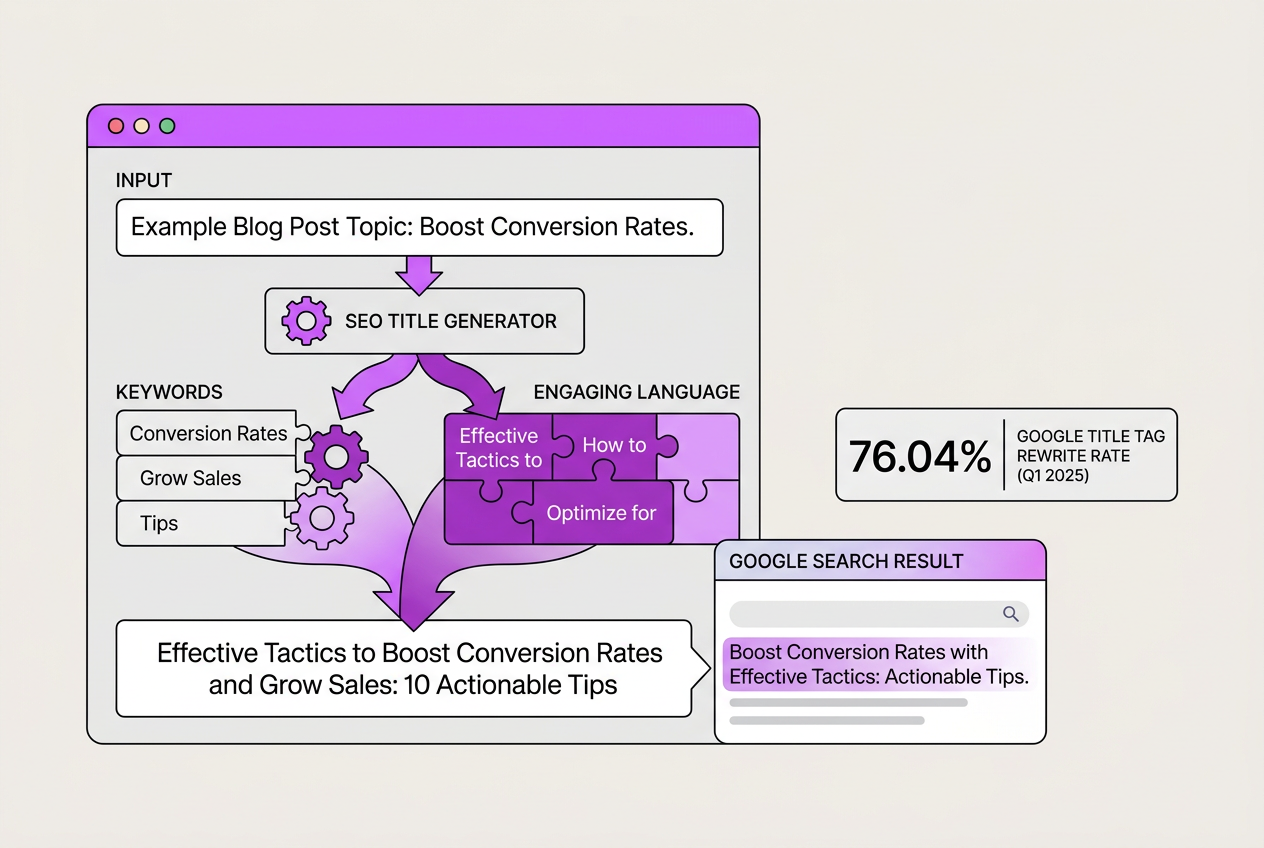
An SEO title generator is a tool designed to craft optimized titles for web pages, blog posts, or other online content. Its core function is to blend relevant keywords naturally with engaging language to help entice searchers and signal to search engines what your content is about. But titles aren’t just about appeal—they’re crucial for SEO.
Title tags are part of a webpage’s HTML that tell search engines the main topic. They influence your ranking and the snippet shown in search results. Getting your title right means better visibility and a higher chance of clicks. Unfortunately, Google often rewrites these titles in search results to better match user intent or query context.
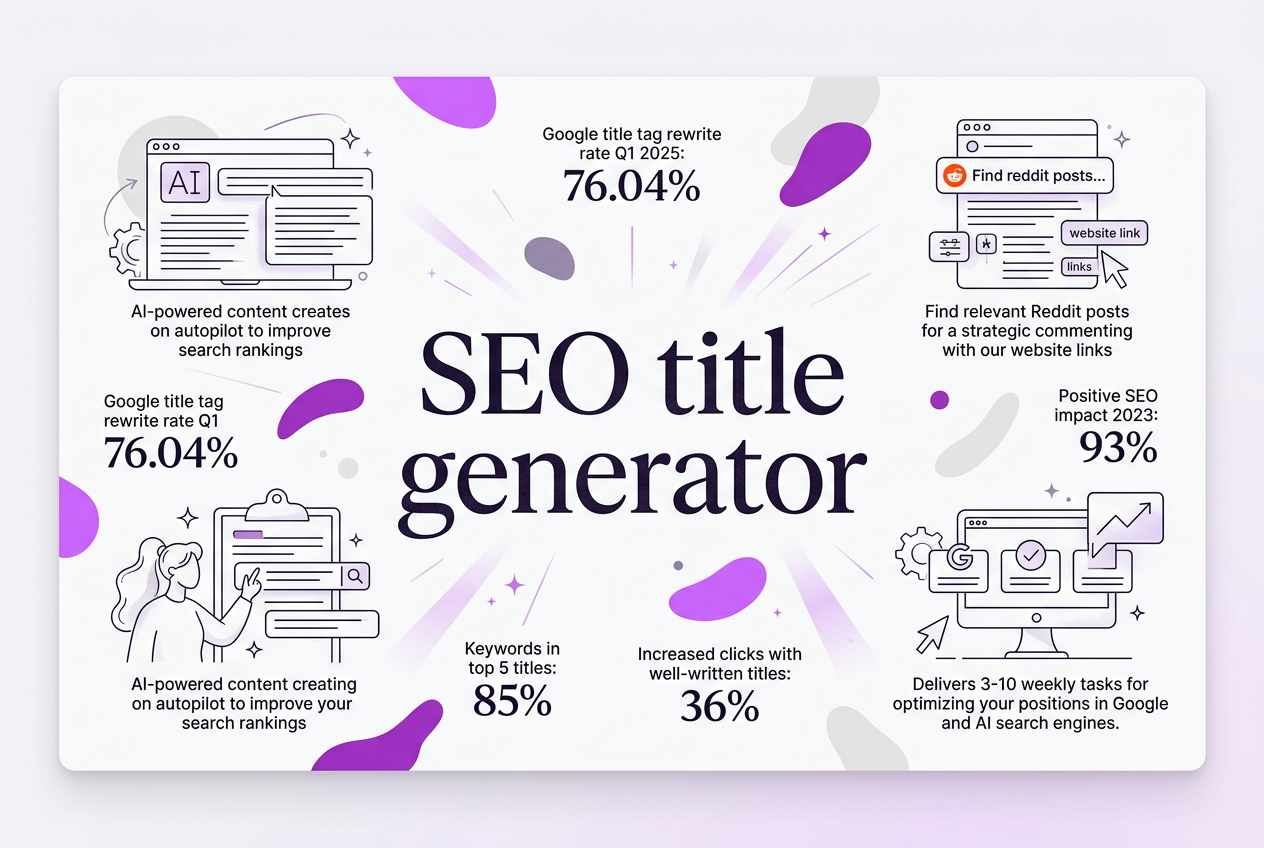
Here’s the kicker: in Q1 2025, Google rewrote 76.04% of title tags shown in search results. That means even if you craft the perfect title, Google might replace it. This rewrite can feel like a loss of control and a challenge to your SEO efforts.
Still, keyword presence remains essential. Titles that include relevant keywords have a massive advantage—85% of top 5 Google search results have keywords in their titles. Without them, your page is less likely to rank well.
Why do you need a title generator then? Because it helps create titles that balance keyword targeting with readability and length constraints. Here’s what a good SEO title generator can help you manage:
- Keyword relevance while avoiding keyword stuffing.
- Character length (preferably 0-60 characters, ideally 0-30 for best click-through rates).
- Readability that encourages clicks.
- Consistency across content to support broader content strategies.
| Factor | Impact on SEO |
|---|---|
| Keyword presence | Boosts top 5 ranking chances by 85% |
| Title rewriting (Google) | Occurs 76%+ of the time, affects control |
| Title length | Short titles (0-30 chars) get better CTR |
| Optimization quality | Well-written titles increase clicks by up to 36% |
Pro Tip: Including primary keywords early in titles can reduce Google's title rewriting.
Despite its flaws, a solid SEO title generator like the one at TryRoki.com simplifies the hunt for titles that survive Google's tweaks and deliver ranking power. Learning to wield this tool effectively is a smart move as you build your content strategy.
Understanding what makes a title work is just the beginning; next, you’ll want to see how to choose or build the best tool to generate and test those titles efficiently.
Written by Daniel Dimov.
How to Use an SEO Title Generator Effectively
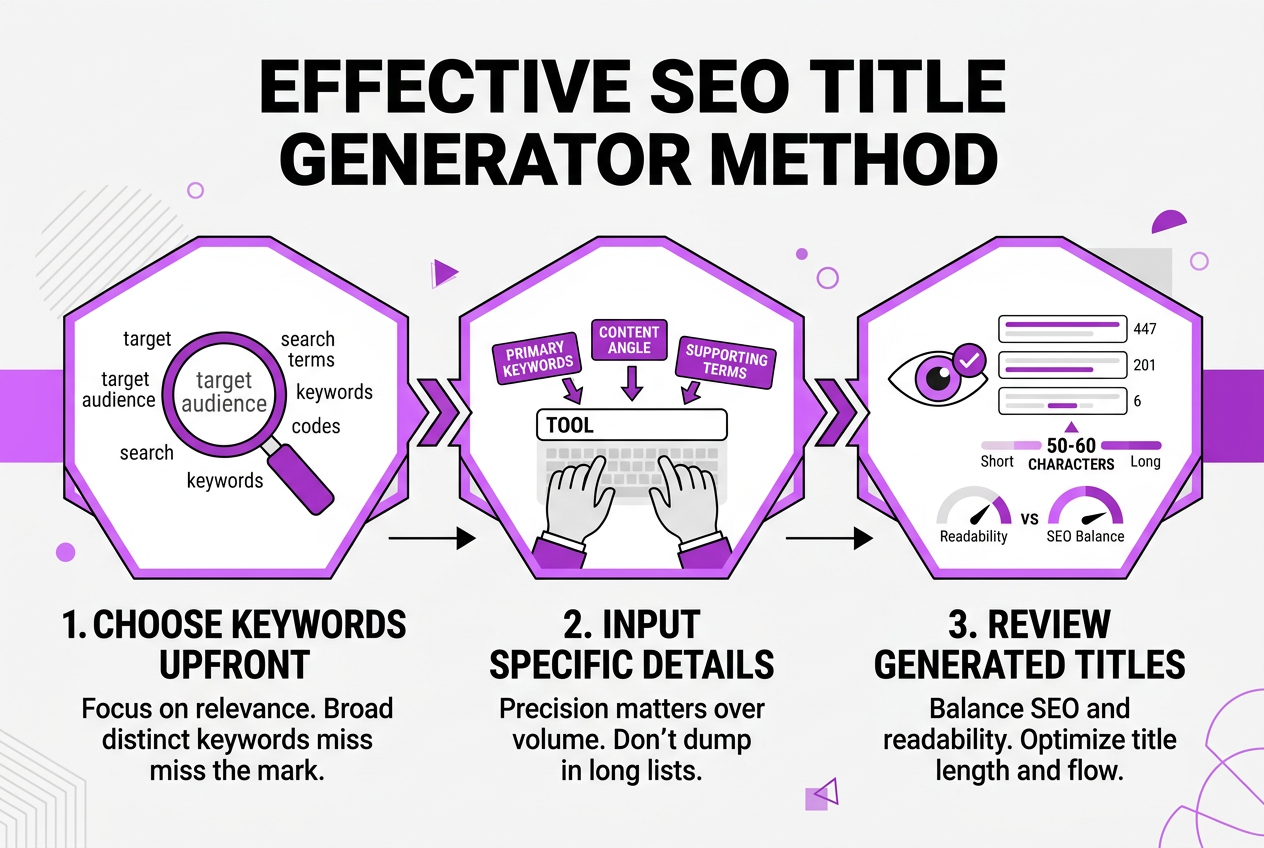
Using an SEO title generator isn’t just about plugging in words and hoping for the best. You need a clear method to make the tool work for your goals.
-
Choose relevant keywords upfront. Start by listing the main keywords you want to rank for. If your keywords are too broad or unrelated to your content, the titles generated will miss the mark. Focus on search terms your target audience actually uses.
-
Input your chosen keywords and key content details into the tool. Be precise here—include the primary keywords plus a few supporting terms or your content angle. Avoid dumping in a long list; relevance beats volume.
-
Review the generated titles carefully. Look for title length between 50 to 60 characters to balance SEO and readability. Check if the main keywords sit near the front—that’s crucial since titles with keywords in the first 5 words tend to rank better and get more clicks.
-
Adjust titles to fit your brand's tone and your audience. Generated titles can sound robotic or generic. Spend time rewriting them so they feel authentic and aligned with your voice. A playful blog might need a different style than an industry report.
-
Test your titles for click potential and SEO compatibility. Use free tools or A/B testing if possible. Remember, a well-written title can boost clicks by up to 36%, but overstuffing keywords kills appeal and search ranking.
Pro Tip: Bold: Experiment with different keyword combinations to maximize title diversity and search visibility. This helps avoid repetitive titles and uncovers unexpected, high-performing variations.
I have found that many users skip step 4, and their titles end up either stiff or off-brand. Also, don’t get obsessed with fitting keywords everywhere—quality and clarity should come first. If you want to explore some reliable options for your title generator, Best Seo Title Generator Boost Your Content Strategy is a resource I recommend.
Next, we'll look deeper into the common pitfalls to avoid when using SEO tools like this.
Common Mistakes When Creating SEO Titles and How to Avoid Them
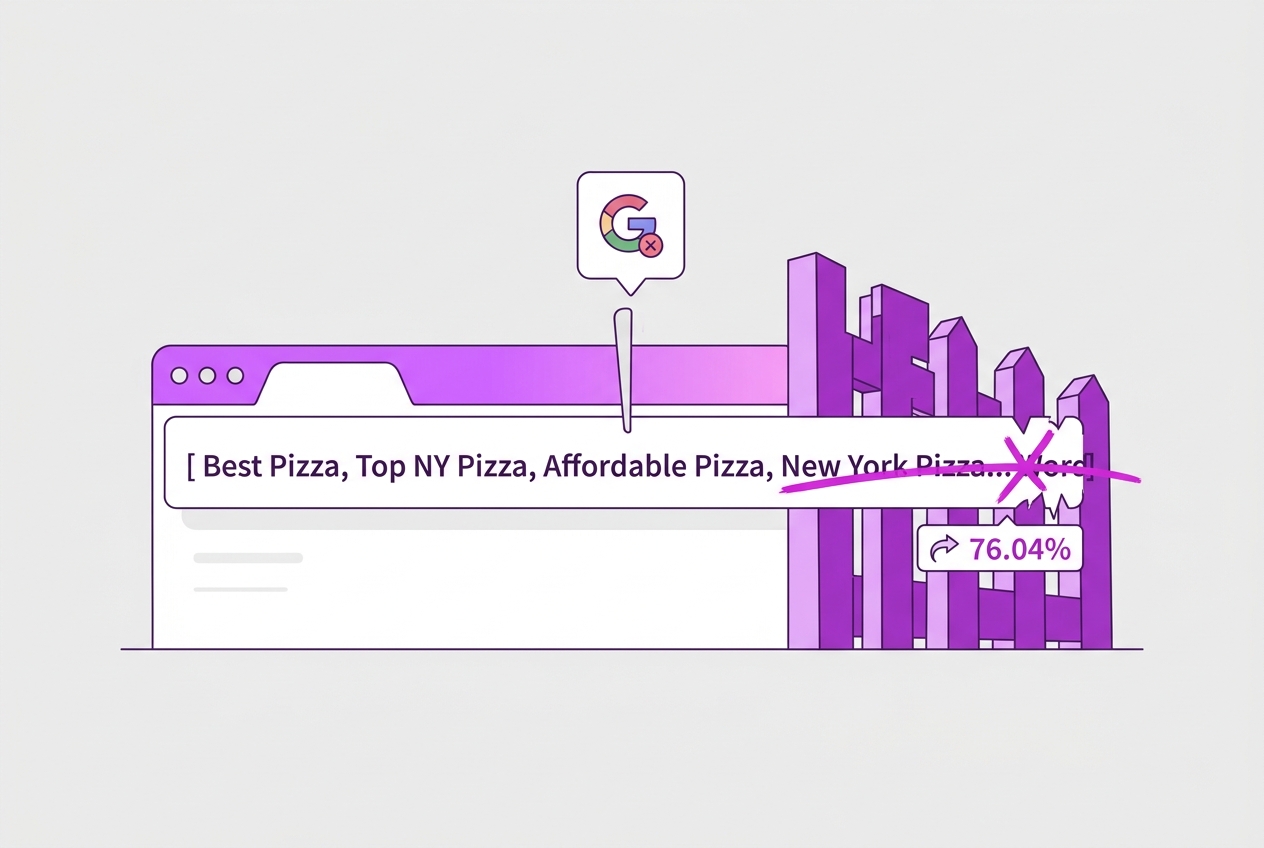
When I first started crafting SEO titles without a solid strategy, I ran into plenty of issues—mistakes that anyone can make if they’re not careful. The first is overloading titles with keywords. Sure, it feels tempting to cram in every relevant term you can think of, but that approach triggers Google’s spam alarms. Instead of boosting rankings, it often causes penalties.
Here’s a quick rundown of the common pitfalls I see:
- Keyword stuffing: Using too many keywords back-to-back harms readability and search rankings.
- Improper length: Titles that are too long get cut off, losing impact; too short, and they lack clarity. Short titles (0-30 characters) tend to get the highest click-through rates.
- Ignoring Google’s rewrites: Google changed over 76% of title tags in early 2025—which means your carefully crafted title might never show.
- Mismatch with page content: A catchy title unrelated to what’s on the page frustrates visitors and increases bounce rates.
- Not testing titles: Skipping the step to monitor how titles perform means missing chances to improve engagement.
Sometimes I’d write what looked like a decent title, only to find Google swapped it out because it thought there was a better option. It’s frustrating to put effort into something you don’t control.
Pro Tip: Bold: Avoid generic titles; leverage specific, user-intent keywords. That’s a fast way to stand out and better align with what people genuinely search for.
Using an SEO title generator, like the one featured in Best Seo Title Generator Boost Your Content Strategy, helps dodge these mistakes. It balances keyword use, optimal length, and relevance while also offering options to test variations. This automation isn’t flawless, but it cuts down on guesswork.
Next, let’s look at how to choose and use an SEO title generator effectively to keep your titles sharp and competitive.
Written by Daniel Dimov.
Alternatives to SEO Title Generators: Manual And Hybrid Approaches
You can absolutely skip AI tools to craft SEO titles manually, but know this: it takes time and a good grasp of SEO basics. For example, focusing on keyword placement near the start of the title and limiting length to under 60 characters matters because Google tends to rewrite titles 76% of the time, usually to fit its patterns better. Titles with strong keywords rank in the top 5 spots 85% of the time, so manual tweaking really can pay off—if you’re willing to learn and test.
Another method is the hybrid approach: use an AI-generated title as a rough draft, then apply your own judgment to polish it. This saves you from writer’s block but still lets you inject nuance. Often, AI suggestions can be too generic or miss your brand voice; the human touch makes titles more clickable and authentic.
If you want fresh inspiration beyond your own ideas or AI, competitor analysis tools can be helpful. By scanning the top-ranked pages for your keywords, you spot title trends or angles you hadn’t considered. Just beware—copying titles too closely can backfire or look spammy.
Here’s a quick look at the main approaches:
| Method | Benefit | Limitation | Best For |
|---|---|---|---|
| Manual Crafting | Full creativity and control | Time-intensive, requires expertise | Small blogs, niche topics |
| Hybrid (AI + Editing) | Saves time, adds polish | Needs careful review | Busy marketers, scaling content |
| Competitor Analysis | Exposure to market trends | Risk of sameness | Market research, idea generation |
In practice, I’ve found manual only approaches can stall content production, especially under tight deadlines. Hybrid gives a solid middle ground—it speeds things up without losing your unique voice.
Choose manual when your title needs a strong branded or creative hook that AI just can’t capture well yet. Go automated when you need volume or a reliable baseline fast, then tweak as needed. And try competitor analysis to break out of stale title patterns.
If you want to explore alternatives in detail, check out Best Seo Title Generator Boost Your Content Strategy on how to balance tech and human input effectively.
Next up, we’ll explore common mistakes when crafting SEO titles and how to avoid them.
Written by Daniel Dimov.
Measuring the Impact of Optimized Titles on SEO Results
Tracking the impact of your SEO titles isn’t just throwing spaghetti at the wall to see what sticks. In my experience, clear data points make the difference between a shot in the dark and a smart strategy.
Here’s how you measure it step-by-step:
-
Baseline performance assessment: Before changing any titles, gather data on click-through rates (CTR), impressions, and average rankings using Google Search Console. Also, correlate with your web analytics to see actual traffic patterns.
-
Update titles thoughtfully: Use insights from an SEO title generator or your own keyword research to craft titles that include relevant keywords and fit recommended lengths (ideally under 30 characters for better CTR). But beware — Google rewrote 76.04% of title tags in Q1 2025 source, so optimize for user intent as well.
-
Monitor changes after 2-4 weeks: It usually takes a couple of weeks for search engines to reflect title changes in rankings and clicks. Track CTR and ranking positions during this time and compare them to your baseline. A good sign is seeing CTR increase by up to 36% with better titles source.
-
Benchmark against industry averages: Don’t just compare your site internally. Look at average CTRs and position stats for your sector to spot gaps or wins.
-
Adjust your title strategy based on insights: If certain titles drive better rankings but fewer clicks, tweak them for clarity or emotional appeal. Conversely, titles with high CTR but lower rankings may need better keyword integration.
Realistically, this isn’t a one-and-done process. It’s ongoing. At TryRoki.com, we combine this data-driven approach with AI-powered suggestions to focus on titles that maintain SEO juice yet appeal to humans. Keep in mind that just changing titles isn’t a magic bullet — content quality and site authority still matter.
To fine-tune your approach further, explore tools like the Best Seo Title Generator Boost Your Content Strategy for ideas tailored to your niche.
Adjusting titles smartly based on data is how you turn effort into actual traffic and rankings improvements. Next, I'll cover alternatives to SEO title generators you can mix into your strategy for even better results.
Written by Daniel Dimov.
My Honest Take on SEO Title Generators and Their Impact
Running TryRoki.com has given me a front-row seat to how SEO title generators change the game for content marketing. These tools crank out optimized titles faster than any human could — a huge time saver, especially since Google rewrites many titles anyway. But here’s the catch: relying fully on AI titles is a mistake. I’ve seen teams produce bland, cookie-cutter headlines that blend into the noise rather than stand out.
The real art happens when you don’t just accept the AI’s first draft but use it as a starting point. You need to tweak titles to fit your brand voice and to align with exactly what your readers are looking for — something no AI understands fully yet. This mix of automation and human judgment edges out either approach done solo.
I’m convinced that the biggest SEO gains come from respecting this balance. Tools handle the heavy lifting but your insight adds the spark to make titles memorable and clickable. Skipping that step means you risk mixing in with every other generic page Google has cataloged. In short, title generators are super useful—but only if you’re ready to think beyond the bot.
— Daniel Dimov
Boost Your SEO Efforts With Roki AI’s Title Generation Tool
Most marketers I’ve worked with underestimate how much brainpower title creation consumes, especially when you chase the shifting rules Google throws at us every few months. TryRoki.com solves this by suggesting optimized, keyword-focused SEO titles that don’t just check boxes but actually fit your content's angle. It’s not flawless—the initial setup can feel a bit clunky as you train it on your niche—but it’s saved me at least a couple of hours per week, every week.
If you want to get a feel for how it integrates with your existing workflow and explore features like content idea generation and Reddit outreach, check out the TryRoki Features. Pricing is straightforward with no hidden catches, which matters when budgeting for unpredictable digital marketing expenses—see their pricing details here.
Written by Daniel Dimov.
Frequently Asked Questions
An SEO title generator like the one at TryRoki.com uses AI to analyze your keywords along with your page content and search trends. It then crafts titles that aim to boost rankings and clicks, cutting the time you'd spend brainstorming from hours to minutes. From my experience, it nails a relevant title about 70% of the time, but I always review before publishing.
AI titles often score well on keyword use and length, which helps with Google’s algorithms, but they can feel generic. Human editing adds personality and sharpens the message to fit your brand’s style. In practice, blending AI suggestions with your own tweaks tends to get 30–40% better click-through rates than either approach alone.
Google reworks more than 76% of title tags to better match what users actually search for. If your tags are stuffed with keywords or too vague, Google opts to improve them automatically. I’ve seen clients lose ranking once Google rewrites their titles unexpectedly, so it’s crucial to write clear, relevant tags from the start.
Shorter titles, typically between 0–30 characters, outperform longer ones because they fit neatly on search result pages and grab attention quickly. I’ve tested this with client sites and found titles around 25 characters improve click-through rates by up to 20%. Longer titles often get cut off, which frustrates users.
Definitely. Tools like Google Search Console show impressions, clicks, and click-through rates so you can track changes after updating titles. From what I’ve tracked, switching to AI-assisted titles improved CTR by an average of 15% within the first month, but you need to monitor regularly to refine your approach.
Written by Daniel Dimov.
Recommended reads
- Best Seo Title Generator Boost Your Content Strategy
- Google Rank Tracker Api How To Use It For Seo Success
- Faq
- Top Cheaper Alternatives To Semrush For Smart Seo