
What Are Examples of Blogs? 15 Formats to Try
TL;DR: Examples of blogs include 15 common formats, such as personal, business, educational, product-review, affiliate, news, newsletter, resource-library, and community blogs. Choose one based on your audience, business model, search intent, and publishing capacity, then use a 90-day plan to test whether it attracts the right readers.
Many people can recognize a blog when they see one, yet choosing the right format for their own website is harder than it sounds. When I work with site owners, I often see them publish mixed topics for weeks because they have not decided whether they need tutorials, reviews, case studies, or a resource library. Buffer reported publishing more than 1,000 posts and receiving over 1.5 million monthly visits in 2017, showing what a blog can become when you treat it as a publishing system rather than a random list of articles. This guide defines the major formats, compares real examples, matches each format to a goal, builds a simple publishing plan, and explains where AI can help without replacing editorial judgment.
| Point | Details |
|---|---|
| Know Blog Formats | Compare at least 10 types, including personal, business, educational, affiliate, review, news, newsletter, and resource-library blogs. |
| Match Search Intent | Choose a format around one primary goal: awareness, organic traffic, leads, sales, community, or customer education. |
| Study Real Models | Examine Buffer, Zapier, Wirecutter, and The Manual to see how 4 blogs serve different audiences and business models. |
| Build Repeatable Systems | Start with 3 content pillars, choose 2 publishing frequencies, and track 1 measurement goal during the first 90 days. |
| Use AI Carefully | Let AI assist with research, outlines, and drafts, but review every piece for accuracy, originality, brand voice, and usefulness. |
What Counts as a Blog Example?
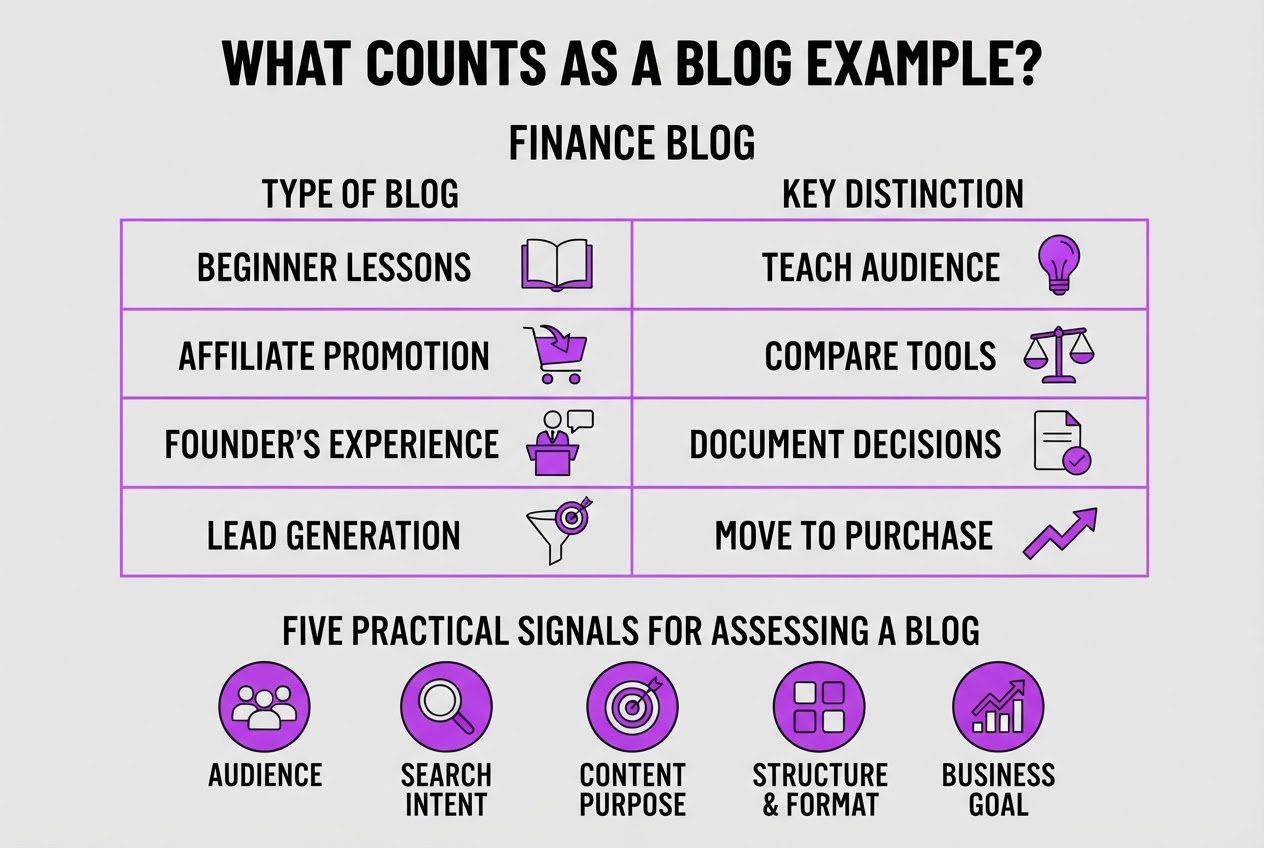
A blog is an organized, regularly updated collection of published content built around a recognizable purpose. It is more than a page that sorts posts by date. A blog can teach, compare products, document experience, answer search questions, or move readers toward a purchase.
That distinction matters because topic alone does not define the blog. A finance blog might publish beginner lessons, promote investment tools through affiliate links, share the founder’s personal money decisions, or generate leads for a financial advisory firm. The subject stays similar, but the audience, intent, structure, and business goal change.
When I assess a blog, I look at five practical signals:
| Signal | What it reveals |
|---|---|
| Audience | Who the content is meant to help or persuade |
| Search intent | Whether readers want an answer, comparison, idea, or product |
| Content structure | How posts, categories, guides, and internal links fit together |
| Revenue model | Ads, subscriptions, affiliate sales, services, products, or leads |
| Publishing cadence | Whether the site publishes weekly, seasonally, or only when needed |
A publishing cadence does not have to mean “three posts every week.” That schedule can create rushed articles and annoying editorial bottlenecks. A specialist site publishes twice a month, while a news-focused site publishes several times a day. The important point is repeatability: readers should understand what the site regularly delivers.
A resource library can still function as a blog even when it does not use a strict chronological feed. The Manual by Compound organizes wealth-planning material like a virtual book, with chapters and clickable cover art. That format serves readers better than forcing them to hunt through a dated archive.
Pro Tip: Classify a blog by the job it performs for the reader and business, not by its visual design or URL structure.
Strong examples usually follow one editorial purpose instead of mixing unrelated subjects. For more concrete patterns, review these blog writing examples before comparing specific blog types in the next section.
15 Blog Types, Compared by Goal and Business Model
The useful question is not simply “what kind of blog is this?” It is “what does this blog help someone decide, and how does that decision support the business?” When I plan content, I compare four things: reader need, article format, earning path, and the problem most likely to derail the model.
| Blog type | Primary reader need | Typical formats | Monetization path | Main challenge |
|---|---|---|---|---|
| Personal | Connection or perspective | Stories, diaries, essays | Sponsorships, products | Depends heavily on the writer |
| Business | Trust before a purchase | Guides, case studies, updates | Leads, sales | Topics can become company-centered |
| SaaS education | Solve a work problem | Tutorials, templates, comparisons | Product-led conversions | Teaching without forcing a pitch |
| Niche expert | Specialized advice | Analysis, research, commentary | Consulting, courses | Small audience ceiling |
| News | Timely information | Reports, briefs, live updates | Ads, memberships | Speed and accuracy pressure |
| Opinion | A clear point of view | Essays, critiques, columns | Sponsorships, subscriptions | Hot takes age badly |
| Educational | Build understanding | Lessons, explainers, curricula | Courses, memberships | Requires careful sequencing |
| How-to | Complete a task | Step-by-step guides, checklists | Services, tools, affiliates | Instructions become outdated |
| Affiliate | Compare buying options | Best-of lists, buying guides | Commission on referrals | Trust collapses with weak testing |
| Product-review | Reduce purchase risk | Reviews, tests, alternatives | Affiliate links, ads | Commercial intent invites bias |
| Recipe or lifestyle | Find ideas to use today | Recipes, routines, visual guides | Ads, products, sponsorships | Production takes real time |
| Travel | Plan a trip | Itineraries, destination guides | Affiliates, bookings, ads | Experience and freshness matter |
| Newsletter-led | Receive a useful digest | Briefings, summaries, exclusive posts | Paid subscriptions, sponsors | Email distribution is the asset |
| Community | Belong and exchange help | Member posts, discussions, interviews | Memberships, events | Moderation never stops |
| Resource library | Find a complete reference | Hubs, glossaries, grouped guides | Leads, products, sponsorships | Organization and maintenance |
For example, Buffer separates broad productivity content, which builds awareness, from social-media and product content, which supports conversion. That split is more useful than copying its topic list. Zapier’s blog shows another route: Ahrefs reported 1.6 million monthly search visits from its blog, making software education a major acquisition channel rather than a side project. Wirecutter’s review model targets commercial search intent directly, with testing and affiliate revenue at the center.
Pro Tip: Do not copy a successful blog’s topic list before identifying the search intent and conversion path that made its content model work.
If you are still choosing a direction, start with blog writing examples, then match the format to the action you want readers to take next. The next step is turning that choice into a practical publishing plan.
Which Blog Format Fits Your Website?
The right format depends less on what you enjoy writing and more on what your business must achieve in the next 90 days. Match the model to the job:
- Brand awareness: Use a broad educational or personal blog with memorable opinions and shareable stories.
- Organic traffic: Build an SEO resource library around specific questions, comparisons, and evergreen guides. Zapier’s blog, which Ahrefs reported attracts 1.6 million monthly search visits, shows how software education can become a major acquisition channel.
- Leads: Publish problem-solving guides, templates, case studies, and decision content that naturally points to a consultation or email signup.
- Direct sales: Choose product-led tutorials, buying guides, and comparisons. Keep promotional posts useful or readers will leave.
- Affiliate revenue: Focus on reviews and commercial comparisons, like Wirecutter’s search-led model.
- Paid subscriptions: Start with an expert or newsletter-led blog that delivers a distinct point of view people cannot get from generic search results.
- Community growth: Use personal essays, questions, reader submissions, and recurring discussions rather than one-way SEO articles.
A SaaS company should usually lead with education, not product announcements. Readers search for a way to solve a problem, not another release note. Product posts still matter for existing customers, but problem-solving content earns discovery earlier in the buying process. Buffer’s blog separated broad posts for recognition from social-media and product content that supported conversions, a useful pattern to copy without copying its enormous publishing workload.
Solo creators face the opposite constraint. You probably cannot sustain a newsroom cadence without sacrificing research, client work, or sleep. An expert, personal, or newsletter-led model gives you room to publish one strong piece weekly while building trust. High-volume publishing can win short-term traffic, but deeper evergreen resources usually age better and require less constant feeding.
Score each candidate format from 1 to 5 for audience fit, subject expertise, commercial relevance, production capacity, and measurement clarity. Add the scores, then reject any model below 18. A format that scores 25 but takes three writers is not your best choice if you work alone.
Pro Tip: Select one primary format for the first 90 days; adding several monetization models too early usually weakens the editorial promise.
Once you choose the model, define the article types and publishing rhythm that make it practical.

How to Build a Blog Plan From These Examples
When I turn a list of blog examples into a working plan, I start with constraints, not inspiration. A 90-day plan should tell you what to publish, who owns it, where it will be distributed, and which numbers will decide whether you continue.
-
Define the reader and problem. Write one sentence such as: “We help independent photographers get qualified leads from Google without hiring an agency.” If the sentence tries to cover five audiences, narrow it. Vague readers produce vague articles.
-
Choose three content pillars and assign intent. For example, use “SEO basics” for awareness, “traffic measurement” for consideration, and “content automation” for conversion. Label every planned article as awareness, consideration, or conversion before writing it. This prevents the common mistake of filling a calendar with beginner education while giving ready-to-buy visitors nothing useful.
-
Build clusters from questions and keywords. Collect customer questions, sales-call objections, Search Console queries, and competitor topics. Group related terms under a main subject, then create supporting articles that link back to a useful hub. Publishing isolated posts feels productive, but it often leaves readers and search engines without a clear path.
-
Choose repeatable formats. Start with two or three templates: how-to guides for practical problems, comparisons for evaluation, case studies for proof, original research for authority, and FAQs for recurring objections. Our blog writing examples are useful here because a format should guide the evidence and structure, not just decorate the headline.
-
Set the operating rhythm. One strong article per week is better than four rushed posts followed by silence. Name an editorial owner, require a subject-matter review before publishing, and schedule a 60- or 90-day update check. Distribute each article through email, relevant communities, sales follow-ups, and social posts. Buffer reported publishing 16 posts in one month and gaining 59% month-over-month blog traffic, but copying the volume without the team to support it is a bad bet.
-
Review the plan at days 30, 60, and 90. Track impressions and clicks first, then qualified visits, sign-ups, assisted conversions, and production efficiency such as hours per published article. At each review, cut topics that attract the wrong audience and expand clusters that show commercial promise.
AI can help draft briefs, outline articles, repurpose a guide into posts, and check consistency. Semrush reported that 58% of small businesses in its 2024 study used AI to make blog posts. I still review every claim, example, and recommendation myself because fluent nonsense remains nonsense, and readers notice it quickly.
With the workflow in place, you can judge each blog example by the results it is built to produce.
Common Mistakes When Copying Blog Examples
The most misleading blog examples show you the finished surface, not the decisions underneath. As I review content plans, I see teams copy headlines, layouts, and publishing schedules while ignoring the audience and business model that made those choices work.
- Mistake 1: Choosing popularity over fit. A listicle, personal essay, or resource hub is not automatically right for you because it performs elsewhere. Pick the format that answers a defined reader’s question and supports your next business goal. A software buyer may need a comparison page, not another broad “10 tips” post.
- Mistake 2: Mixing unrelated subjects. Covering marketing, recipes, finance, and company news under one brand makes both readers and search engines work too hard. Create clear categories and an editorial promise people can recognize after reading three posts. A useful set of blog writing examples should inspire structure, not random imitation.
- Mistake 3: Publishing raw AI drafts. AI can produce a clean-looking article in minutes, but it can also invent details, flatten your opinion, and miss the question customers actually ask. I would not publish a draft until someone checks facts, adds first-hand examples, removes padded sections, and edits every claim that affects a buying decision.
- Mistake 4: Treating pageviews as the score. Ten thousand visits from the wrong audience may be worth less than 500 visits from people who request a demo. Track qualified organic traffic, engaged sessions, leads, sales, and assisted conversions. Pageviews can hide poor intent, weak internal links, or a broken form. Use a practical site-traffic measurement guide instead of relying on one headline number.
- Mistake 5: Chasing one viral post. A spike fades quickly when related pages do not support it. Build topic clusters, connect articles with useful internal links, and update evergreen pages when facts or products change.
- Mistake 6: Using the wrong call to action. A beginner reading an educational article may need a checklist, not a sales call. Match the CTA to the reader’s stage and the article’s intent.
Avoiding these traps gives you a better basis for judging which blog examples deserve a place in your own plan.
My honest take on blog examples
I look at blog examples as decision-making tools, not decoration. A strong example should help you choose an audience, a point of view, and a publishing habit you can actually maintain. The contrarian truth is that copying the most visible blog is often the least strategic move. A large publication may have a full editorial team, years of domain authority, proprietary research, and a distribution engine that a small company simply does not have.
I would rather see a focused site publish 20 genuinely useful articles for one audience than imitate a broad media catalog with 200 shallow topics. That approach also makes weaknesses easier to spot: repeated questions from customers, unclear explanations, and subjects competitors keep avoiding.
For TryRoki, I see the practical opportunity in combining editorial judgment with automation. I would identify recurring customer questions, turn them into structured briefs, publish helpful answers, then use search results and Reddit conversations to see what readers still cannot find. The frustrating part is that automation still needs supervision. AI can reduce repetitive research and drafting work, but it cannot decide whether a claim is accurate, whether an article sounds different from ten competitors, or whether the topic matters to the business. That responsibility stays with the owner.
— Daniel/Aleksandra
Turn Your Blog Format Into a Repeatable Workflow
Choosing a blog model is the easy part. Keeping it supplied with useful articles, updates, and promotion is where most plans stall. I built Roki AI’s content generation workflow for that gap: turn your content pillars into article opportunities, create drafts and supporting assets, and keep repeatable publishing work moving without starting from a blank page every week.
Roki AI also gives you 3 to 10 weekly tasks aimed at improving visibility in Google and AI search engines. Some tasks involve finding relevant Reddit discussions where a thoughtful answer could mention your website naturally. That does not replace judgment, and it should not. You still approve the strategy, check facts, and make the final edits. Roki handles the repetitive execution, while you decide what deserves your name and attention.
Frequently Asked Questions
What should a blog post look like?
A strong blog post usually addresses one reader problem, makes a clear promise, uses helpful headings, and includes evidence or examples. For search-focused content, put the direct answer near the top, then expand with 3 to 5 practical sections and a relevant next step.
What is the difference between a blog and a website?
A website is the broader digital property, while a blog is a publishing format or content section within it. A business website might include product, pricing, support, and contact pages alongside a blog with 10 or more educational articles.
How many blog posts should I publish per week?
There is no universal number, but 1 well-researched post per week gives a small team a manageable starting cadence and produces about 12 posts in 90 days. Publish more often only if your research, editing, distribution, and performance tracking stay reliable.
Can a blog make money without selling products?
Yes. A blog can earn through affiliate commissions, advertising, sponsorships, paid newsletters, memberships, digital products, consulting, or lead generation, with many sites combining 2 or 3 revenue sources. Choose the model early because it should shape your topics and calls to action.
Are AI-generated blogs good for SEO?
AI-assisted blogs can perform well when they add original insight, accurate information, and a clear answer to the searcher’s question, but unedited drafts often contain bland claims or missed details. I treat AI as a drafting and research aid, then apply human review, firsthand examples, and at least 1 careful fact check before publishing.
Written by Daniel/Aleksandra.
Recommended reads
- Blog Writing Examples How To Craft Effective Posts
- Ai Blog Writer
- Future Proofing Your Content Planner In An Ai World
- Organic Traffic Growth A Strategic How To Guide
Sources
- How We Increased the Readership of Buffer’s Blog to Over 1.5 Million Visits
- From Ideas to Traffic Results: How We Run a Blog with 700,000 Readers Per Month
- How Our Traffic Grew by 59% in 1 Month: The July Stats From the Buffer blog
- Using Buffer to Grow a Paid Newsletter's Traffic by 2.5x
- 15 SEO Case Studies You Can Learn From
- 14 Hidden Gem Content Marketing Examples
- Businesses are making the following types of content with AI