Daniel D.
The strongest approach to Balancing Human Touch and AI in SEO Writing pairs AI’s speed for research, outlines, first drafts, and workflow support with human judgment, firsthand experience, audience empathy, and careful editing. Keep people responsible for accuracy, original insight, useful examples, and the final publishing decision, even when tools such as Roki AI provide 3–10 weekly SEO tasks to guide your work.
You can get an AI draft on screen before your coffee goes cold, then spend twice as long removing bland claims, missing context, and sentences no customer would trust. I have seen teams publish quickly and still lose time fixing weak examples, vague expertise, and content that sounds identical to every competitor. Google’s people-first guidance puts user purpose ahead of chasing rankings, while BCG found that consultants using GPT-4 performed 40% better on measured tasks. The practical workflow below splits work between people and AI, checks drafts for originality and real experience, sets quality controls, and uses Roki AI for repeatable SEO tasks without handing over accountability.
| Point | Details |
|---|---|
| Assign Clear Roles | Let AI handle research, structure, and repetitive production while humans own judgment, expertise, and final approval. |
| Protect Firsthand Insight | Add customer experiences, original examples, and at least 1 piece of evidence that AI could not reliably infer. |
| Edit for Usefulness | Run every draft through a 5-part checklist covering accuracy, search intent, originality, tone, and practical value before publishing. |
| Avoid Scaled Sameness | Do not publish dozens of lightly edited pages, because each page should address 1 distinct user need and add meaningful value. |
| Measure Reader Outcomes | Review engagement, conversions, assisted searches, and qualified traffic after at least 30 days instead of judging success by rankings alone. |
What the Human–AI Balance Really Means in SEO Writing
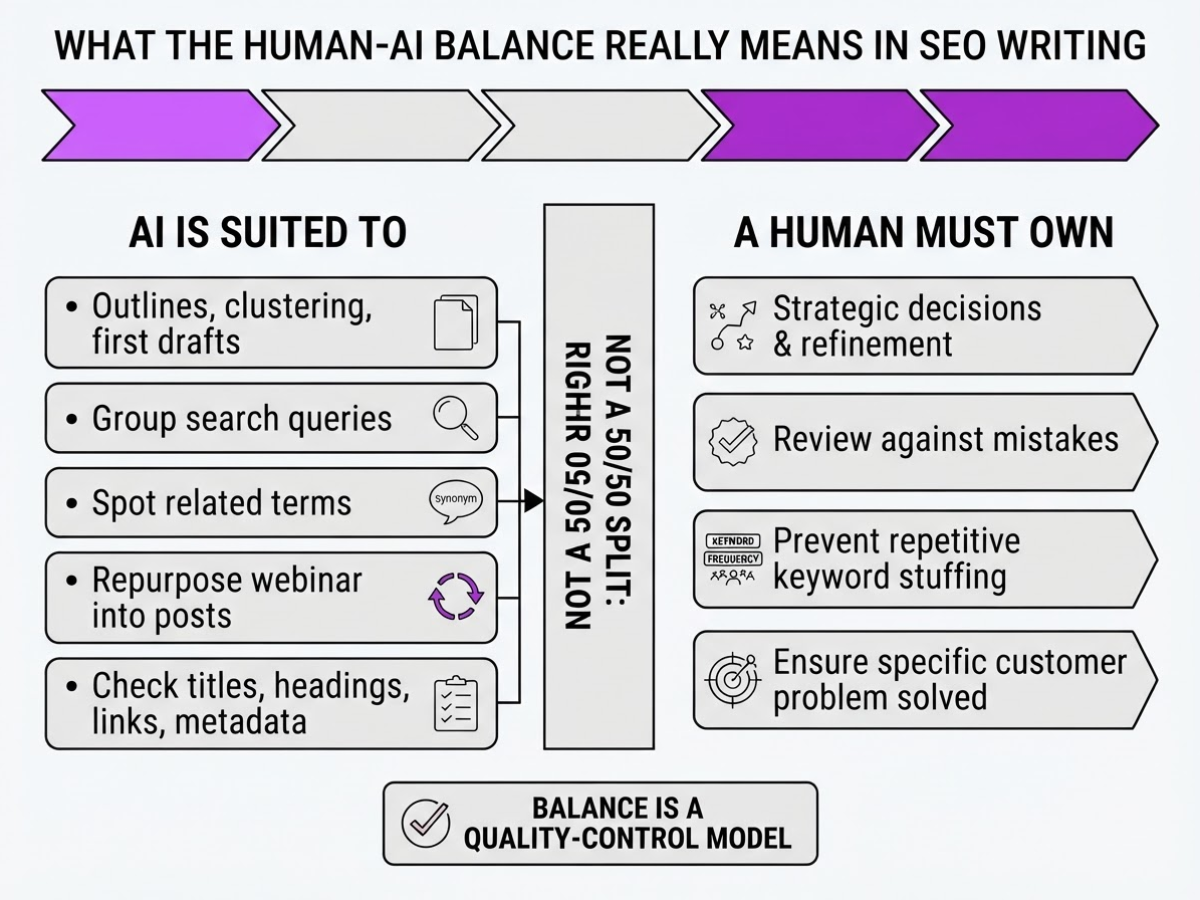
When I review an SEO draft, I do not ask whether AI wrote 30% or 70% of it. That percentage is usually a distraction. The useful question is whether each task has the right owner, because balance is a quality-control model, not an equal 50/50 split.
AI is good at work that is fast, repetitive, and pattern-based. It can group search queries, suggest an outline, spot related terms, repurpose a webinar into several posts, and check titles, headings, links, and metadata. At TryRoki, we use that assistance to remove blank-page friction and repetitive SEO housekeeping. It still makes annoying mistakes, such as repeating a keyword too often or turning a specific customer problem into bland advice.
| AI is suited to | A human must own |
|---|---|
| Outlines, clustering, and first drafts | Strategy, positioning, and the final angle |
| Repurposing and formatting | Lived experience and original examples |
| Pattern checks and repetitive SEO tasks | Accuracy, empathy, accountability, and risk |
| Variant titles and meta descriptions | Claims that could affect money, health, safety, or trust |
That division separates AI-assisted writing from fully automated publishing. In an assisted workflow, a person chooses the audience, supplies evidence, challenges weak suggestions, adds firsthand detail, checks facts, and approves publication. Fully automated publishing skips those decisions and often produces pages that sound plausible but do not solve a real problem. Google warns that generating many pages without adding value may fall under its scaled content abuse policy, so volume is a poor substitute for judgment.
Pro Tip: Set the human share of the workflow by risk level: low-risk formatting can be mostly automated, while expert or sensitive claims require human ownership.
Here is my simplest test: would this page still help someone if search engines did not exist? If the answer is no, you probably wrote for a crawler instead of a reader. Google’s people-first content guidance points in the same direction, while its E-E-A-T guidance recognizes that first-hand experience can matter most for some topics.
That is also why tools such as AI workflow automation for agencies should support decisions rather than quietly make them. A practical human and AI SEO workflow leaves humans responsible for meaning, trust, and risk, while machines handle the chores.
The next step is turning that principle into a repeatable writing workflow.
Build a Human-in-the-Loop SEO Content Workflow
I use a six-step workflow because AI is fastest when a human decides what deserves to be written. Skip that judgment and you get polished pages that sound plausible but do not help a specific reader or move a real business goal.
-
Set the brief before opening an AI tool. Write down the audience, primary search intent, business goal, target keyword, and page angle. “SEO tips” is not a brief. “Help freelance designers choose 3 affordable ways to track leads, then invite them to request an audit” is. Include the reader’s current problem and the action you want after the page.
-
Use AI to sort the research, not replace it. Feed it search-result notes, customer questions, competitor headings, and relevant source material. Ask it to cluster subtopics, suggest an outline, compare coverage, and flag gaps such as pricing, examples, limitations, or next steps. I still open the sources myself. AI can miss a qualification in one paragraph and turn an old statistic into a confident mistake.
-
Add knowledge no public tool can invent. Supply customer wording from sales calls, support tickets, product demos, and interviews. Add your own examples, case evidence, test results, and expert opinions. This is usually the difference between a page that resembles 10 competitors and one that could only have come from your company. Google’s guidance also warns that mass-producing pages without added user value can fall under scaled content abuse.
-
Generate the draft with constraints. Tell AI the audience, tone, structure, approximate length, reading level, sources it may use, claims it must avoid, and where examples belong. Ask it to mark uncertain statements instead of filling gaps. I often create the first draft in Roki AI, then edit the sections that depend on our product knowledge rather than accepting its wording unchanged.
Pro Tip: Create 2 prompts for every important article: 1 for drafting and 1 for adversarial review that looks for unsupported claims, generic language, and missing user questions.
-
Run separate human reviews. Do 1 pass for factual accuracy and citations, another for originality and customer usefulness, and a third for SEO clarity. Check intent, headings, keyword coverage, internal links, introductions, and calls to action. Combining these reviews usually takes longer than expected, but 1 rushed pass lets awkward claims survive.
-
Approve the whole publication package. Before publishing, check the title, slug, meta description, images, internal links, author information, and CTA. Add Article structured data and author markup where appropriate, as Google recommends. For recurring production, Roki AI can help draft content and surface 3 to 10 weekly SEO tasks, while you decide which tasks fit the week’s priorities. Its workflow is useful, but it will not know that a product launch changed your audience’s needs unless you tell it.
That process keeps AI doing repetitive preparation while human judgment controls what earns publication. The review standard matters just as much as the workflow itself.
Where AI Helps—and Where It Should Stop
The boundary is not “AI or no AI.” It is who carries the consequence when a page is wrong. I use AI for repeatable production work, but I keep judgment, evidence, and promises under human ownership.
| Ownership | Suitable tasks and limits |
|---|---|
| AI-led | Generate headline variations, outline options, keyword groupings, content briefs, summaries, and basic formatting. These tasks are useful because they are easy to inspect and revise. AI can produce 10 headline options in seconds, but it cannot know which promise your customers will believe. |
| Shared | Review competitors, interpret search intent, suggest internal links, and plan content refreshes. AI can spot patterns across pages, but a person must decide whether those patterns reflect genuine user needs or thin competitors copying one another. |
| Human-led | Write original opinions, customer stories, expert claims, legal or medical nuance, brand positioning, and the final fact-check. These depend on experience, accountability, and context that a prompt cannot supply. |
Treat every AI response as a draft or recommendation, never as an authority. Google says generative AI can support research and structure, but mass-producing pages without user value may violate its scaled-content-abuse policy. People-first content still has to satisfy the reader’s purpose, not merely include the right phrases.
I also see teams overrate competitor analysis. An AI can summarize 10 ranking pages, then confidently recommend the same bland points everyone else uses. Keep a human in the loop to ask what customers are still confused about, what your company can prove, and where your experience adds something unavailable elsewhere.
The risk rises with the topic. A weak formatting decision wastes minutes; an invented dosage, unsupported financial claim, or false customer result can create legal exposure and damage trust for years. That is why a small local-business update may need 1 editor, while medical, legal, financial, and high-value purchase content deserves a named subject-matter reviewer and documented sources.
Pro Tip: If a sentence could materially change a customer’s decision, route it through a named human reviewer even when AI produced the wording.
For routine production, a tool such as a free online SEO title generator can save time, but do not confuse speed with approval. At TryRoki, we use automation to reduce the dull work, then make a person answer for the page’s claims, tone, and usefulness.
That ownership model becomes especially important when you turn the boundary into a repeatable publishing workflow.

Five Quality Controls That Keep AI-Assisted Content Useful
I use 5 quality controls before an AI-assisted page reaches a client site. They catch problems that grammar tools miss, especially when a draft sounds polished but gives the reader no reason to trust it.
1. Cut the empty opening and the recycled ending. Read the first 100 words aloud. Remove generic introductions, repeated phrasing, empty claims such as “businesses need a strong online presence,” and conclusions that simply repeat every heading. If the answer does not appear quickly, rewrite the opening around the target query.
2. Verify every detail that could embarrass you. Check statistics, dates, prices, product features, quotations, links, companies, and named people against the original source. I have seen AI turn a discontinued feature into a current recommendation and attribute a quote to the wrong executive. Keep a source beside each important claim until the editor signs it off.
3. Test the query and the next question. Search the target phrase, then compare the draft with the questions appearing in related searches, forums, and customer calls. The page should answer the main query in its first useful section and anticipate what the reader asks next. For practical SEO work, I also check whether the page has a clear title and intent rather than forcing extra keywords into every paragraph.
4. Add evidence only your team can provide. Include a customer interview, internal performance data, a documented experiment, a screenshot, or a practitioner observation. First-hand details make a page harder to copy and more useful than a rewritten summary. Combining human creativity and AI for SEO success explains this division of work, but your own evidence still has to carry the argument.
5. Review the page as its actual reader. Check voice, inclusivity, readability, examples, and terminology against the audience you serve. Then search your own site for near-duplicates and ask whether this page has a distinct purpose. A mass-produced set of pages often competes with itself, wastes editorial time, and weakens trust. Google warns that generating many pages without adding user value may violate its scaled content abuse policy.
Use this mistake list during the final review:
- The introduction delays the answer.
- Claims have no source or first-hand proof.
- Examples describe an imaginary audience.
- Several pages target the same intent.
- The conclusion adds no decision or action.
Fixing these faults gives the page a reason to exist. The next review should focus on whether the finished article still sounds like a person who has done the work.
How to Measure Whether the Balance Is Working
A ranking report can look healthy while your content operation quietly wastes time and loses leads. I measure the system from 4 angles: editorial quality, business results, search visibility, and the hours required to produce each publishable page.
Start with a baseline before changing the workflow. Record average production time per article, publishing frequency, qualified organic sessions, conversions, and the number of editorial rework hours. Also note how many fact-check corrections, rewrites, and approval rounds each page needs. Without those figures, “AI made us faster” usually means someone else absorbed the cleanup.
I track the early signals weekly:
- Brief stage: Measure time from topic selection to an approved brief, including research and source collection.
- Draft stage: Record time to first draft, then count factual corrections, missing examples, and structural changes.
- Approval stage: Track approval cycles and the percentage of pages published without a second major rewrite.
- Search stage: Review impressions, clicks, indexed pages, query coverage, and non-branded visibility in Search Console. Rankings matter, but they are only 1 output. Google’s people-first guidance is a better quality test: does the page satisfy the visitor’s purpose?
- Audience stage: Check engaged visits, return visits, email signups, demo requests, and assisted conversions. A page that attracts fewer visitors but helps close 3 qualified deals may deserve more attention than a high-traffic glossary page.
Use a fixed review rhythm instead of reacting to daily movement. At 30 days, check indexing, early query coverage, factual issues, and engagement. At 60 days, refresh weak sections, improve internal links, and compare assisted conversions. At 90 days, keep, consolidate, redirect, or fully rewrite pages that still show thin demand or overlapping intent.
Roki AI’s recurring tasks help keep this work from disappearing under client calls and publishing deadlines. The platform can surface weekly actions, including content and Reddit opportunities, but it does not decide which page deserves investment. I review the evidence, reject busywork, and assign priorities based on business value. That human judgment is also central to a disciplined human-plus-AI content workflow.
The next step is turning these measurements into a repeatable editorial scorecard your team will actually use.
My honest take on balancing humans and AI
I do not believe the winning model is “AI writes, humans approve.” That arrangement still outsources the important work first, then asks a person to act as a safety filter at the end. In my experience building TryRoki, the better division is simpler: humans decide what deserves to exist, and AI helps execute that decision consistently.
AI is genuinely useful when I need to get past a blank page, sort a messy topic, compare several angles, or keep a publishing schedule from quietly collapsing. It is much less dependable at recognizing which customer detail matters, spotting a claim that needs evidence, or choosing the opinion a company should defend. Those decisions require context, and generic prompts rarely supply enough of it. The first draft can also sound polished while missing the 1 uncomfortable fact a buyer actually needs.
My contrarian view is that more AI can make human judgment more valuable, not less. As generic content becomes cheaper, firsthand knowledge and accountable editorial choices become clearer differentiators. At TryRoki, our long-term aim is to automate repetitive work while helping businesses publish 3 to 10 useful tasks each week, including relevant Reddit conversations, without lowering the standard. Every page still needs a real problem, a clear point of view, and a named person willing to stand behind it.
— Daniel/Aleksandra
Put the human-plus-AI workflow into practice with Roki AI
If you want to balance human judgment with AI output, use Roki AI as the execution layer, not the decision-maker. I built the workflow around a practical problem: good SEO plans often stall when nobody owns the next task. Roki AI can draft website content on autopilot, organize ongoing SEO work, and surface Reddit posts where a genuinely useful comment could mention your site.
Each week, it delivers 3 to 10 tasks, which gives your team a manageable list instead of another oversized content calendar. The setup still takes attention, and weak prompts or rushed reviews can produce work you should reject. Start with 1 content workflow, set clear human review checkpoints, and track quality, leads, and relevant search visibility before expanding. You can see how Roki AI fits into an SEO content workflow or start building a consistent task routine.
Frequently Asked Questions
Yes, AI can help you produce content that ranks, but the draft still needs human research, editing, and firsthand insight. Before publishing, check at least 5 things: search intent, factual accuracy, originality, authority, and whether the page solves the reader’s actual problem.
Feed the draft real customer phrases, specific examples, original opinions, and observations from your team instead of relying on broad prompts. I also recommend a human edit that removes repeated wording, checks the tone against your brand, and adds 2 or 3 details an outsider would not know.
Google does not penalize a page simply because AI helped create it, but publishing dozens of low-value pages can create serious search problems. Give every page a clear owner, verify its claims, and add enough original insight that a reader would notice if your company disappeared from the article.
Keep strategic positioning, sensitive claims, expert commentary, customer evidence, and final publication approval under human control. Automation works better for repetitive jobs such as organizing keywords, formatting drafts, preparing outlines, and creating weekly workflow reminders, but I would not let a tool make the final call on a claim that could affect trust.
Review every page before publication, then check its performance at 30, 60, and 90 days. Refresh it sooner when a product changes, a fact becomes outdated, search intent shifts, or customers start asking a different question.
Written by Daniel/Aleksandra.
Recommended reads
- Creating High Quality Seo Content With Roki Ai
- How Roki Ai Streamlines Your Seo Content Workflow
- Seo Ai Generator How To Automate Content Creation Effectively
- Free Seo Tools
Sources
- Google Search's Guidance on Generative AI Content on Your Website | Google Search Central
- Creating Helpful, Reliable, People-First Content | Google Search Central
- Our latest update to the quality rater guidelines: E-A-T gets an extra E for Experience | Google Search Central Blog
- Generative AI at Work
- How People Create and Destroy Value with Generative AI | BCG
- AI at Work Is Here. Now Comes the Hard Part
- B2B Content Marketing: 2025 Benchmarks & Trends
- AI in content marketing: How creators and marketers are using AI to speed up & succeed [data]
- 2024 Edelman-LinkedIn B2B Thought Leadership Impact Report | Edelman
- Learn About Article Schema Markup | Google Search Central | Documentation | Google for Developers
- Tivius