Daniel D.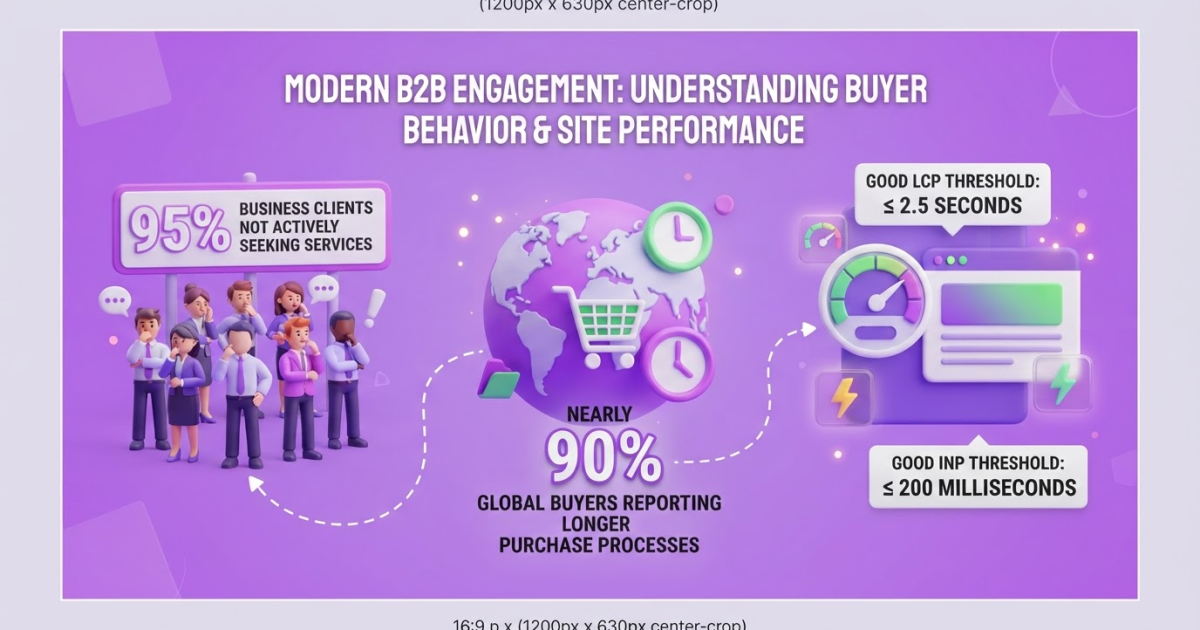
Creating high-quality SEO content with Roki AI means using automation for research, outlining, drafting, publishing, and finding relevant Reddit discussions, while you remain responsible for accuracy, originality, usefulness, and brand voice. Roki AI assigns 3–10 improvement tasks each week to help you build a repeatable workflow, reduce search-manipulation risks, strengthen visibility in Google and AI search, and improve results through measurement and iteration.
Publishing consistently is easy to prioritize and surprisingly hard to do well. I have seen automation increase output while quietly lowering the standard: drafts miss customer context, recycle thin advice, and give reviewers too much cleanup. That matters before a buyer is ready, because 95% of business clients were not actively seeking goods or services at any given time, so useful content has to earn attention first. With Roki AI from TryRoki, I’ll show you a practical workflow for choosing topics, building briefs, drafting, reviewing with human judgment, handling on-page SEO and internal links, participating on Reddit without spamming, then publishing and measuring what works.
| Point | Details |
|---|---|
| Start With Intent | Define the reader’s problem, desired outcome, and awareness stage before creating a brief or draft. |
| Keep Humans Accountable | Review 100% of factual claims, recommendations, examples, and brand statements before publication. |
| Optimize Foundations | Prioritize clear titles, crawlable links, useful structure, and strong page experience instead of chasing unproven AI-search tricks. |
| Use Reddit Carefully | Contribute authentic answers in relevant communities and avoid repeated or unsolicited business-link promotion. |
| Improve With Evidence | Review performance every 4 weeks and update pages using engagement, rankings, conversions, and user feedback. |
What High-Quality SEO Content Actually Means
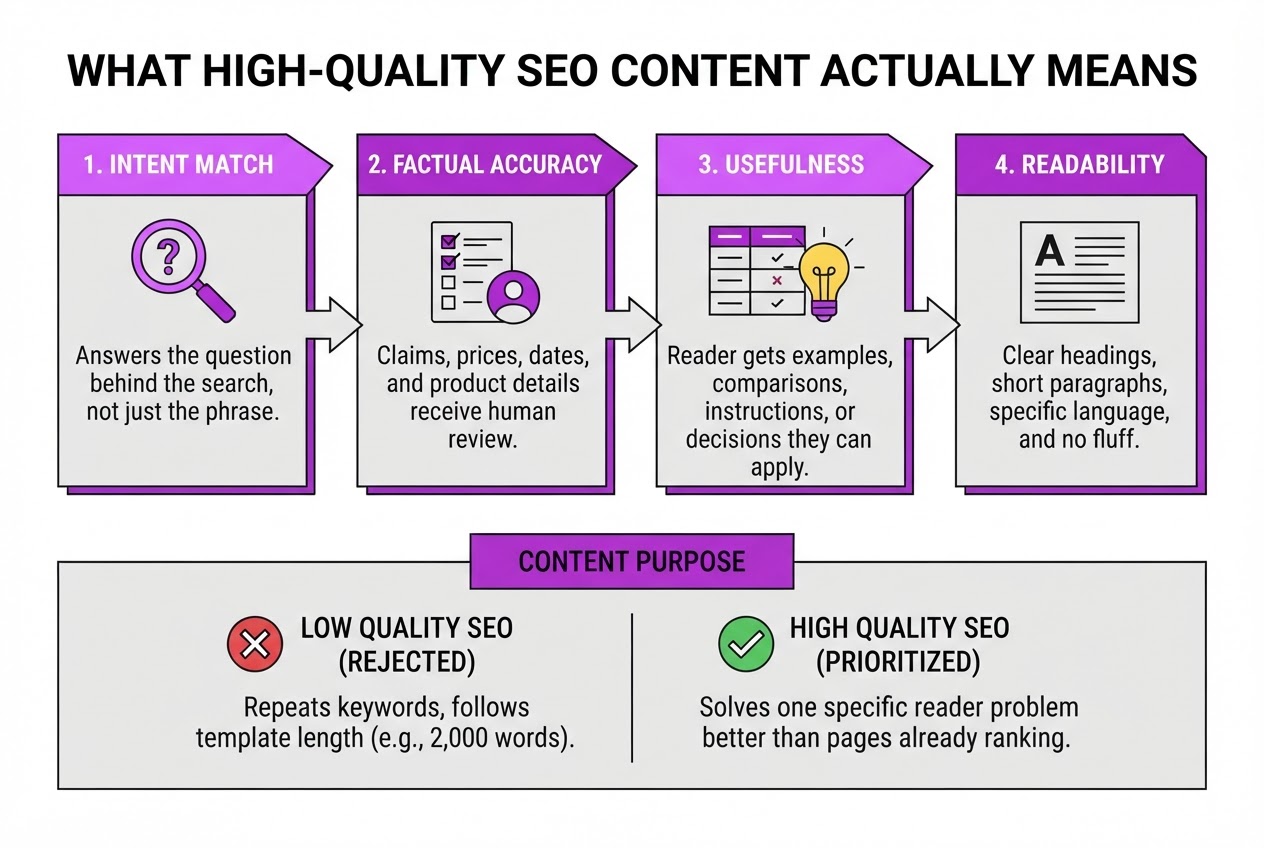
High-quality SEO content solves one specific reader problem better than the pages already ranking. It does not simply repeat keywords or produce 2,000 words because a template said so. If someone searches “how to choose accounting software for a small business,” your page should help them compare options, understand trade-offs, and decide what to do next.
When we review content for TryRoki, we look for six practical signals:
- Intent match: The page answers the question behind the search, not just the phrase itself.
- Factual accuracy: Claims, prices, dates, and product details receive a human review.
- Usefulness: The reader gets examples, comparisons, instructions, or decisions they can apply.
- Readability: Clear headings, short paragraphs, specific language, and no padding.
- Originality: The article includes firsthand observations, original analysis, or a perspective competitors cannot copy.
- Next-step clarity: The reader knows what to check, calculate, download, or do after finishing.
Quality also depends on trustworthy sourcing and a recognizable brand point of view. Link to primary sources when a claim needs proof, explain uncertainty instead of hiding it, and use examples from your customers or internal experience. Generic advice is easy to generate and hard to remember. A sharp opinion, such as explaining why a popular SEO tactic is overrated for local businesses, gives the page a reason to exist.
Pro Tip: Pro Tip: Add one concrete observation from customer conversations or support tickets to every strategic article; it gives AI-assisted content a perspective competitors cannot copy.
Roki AI can speed up research, outlines, drafts, and recurring production. We built it to reduce the blank-page work, not to remove editorial judgment. The business publishing the article remains responsible for every claim, recommendation, statistic, and example. AI may confidently invent a detail, miss a recent change, or flatten a nuanced customer problem, so publishing without review is careless.
Google’s position is equally clear: using automation primarily to manipulate search rankings violates its spam policies. Responsible AI assistance supports a useful editorial process; low-value automated publishing creates pages mainly to capture traffic. Our SEO content workflow works best when a person sets the angle, checks the evidence, and makes the final call.
That quality standard leads naturally to the production process: how you turn a search intent into a useful, reviewable article.
The Roki AI Workflow: From Topic to Publish-Ready Page
A reliable Roki AI page starts before you open the generator. I have seen teams waste a week polishing articles that had no clear reader, offer, or reason to exist. Use this workflow instead:
-
Choose a problem, not a random keyword. Start with a customer question, a commercial priority, or a gap in the pages already ranking. For example, “how to compare local SEO agencies” may support a service decision, while a disconnected keyword list usually produces shallow traffic. Check existing pages, sales questions, support tickets, and competitor coverage before you commit.
-
Write the brief before drafting. Record the primary search intent, audience, angle, supporting questions, evidence requirements, internal-link targets, and conversion goal. Add the action you want the reader to take, such as booking a call, comparing plans, or downloading a checklist. If the brief cannot explain why this page should exist, stop there.
-
Give Roki AI useful constraints. Feed it the approved brief, your brand voice, preferred terminology, banned claims, examples of good writing, and the required evidence. Use Roki AI to organize research, group related questions, build an outline, and produce a first draft. Its SEO content workflow is most useful when you direct the work instead of accepting the first output.
-
Review the draft as an editor, not a button-pusher. Check every factual claim, statistic, date, product detail, and quotation. Remove outdated advice, unsupported numbers, generic phrasing, and sentences that sound copied from another page. Search distinctive phrases from the draft to catch accidental duplication. AI can save hours on structure, but it cannot take responsibility for a wrong promise made to your customer.
Pro Tip: Pro Tip: Separate the approval gates: approve the topic and brief first, then the draft, then the final SEO and conversion details. This prevents polishing an article that should never have been written.
-
Run the on-page check. Confirm that the title is unique, clear, concise, and accurate, as Google recommends. Check the headings, readable URL, introduction, meta description, descriptive internal links, useful media, calls to action, canonical tag, sitemap coverage, and indexing settings. Google also uses crawlable links to discover pages, so do not hide important navigation behind scripts or vague “click here” text.
-
Perform the reader test before publishing. Ask someone unfamiliar with the project to read the page and take the intended next step. Can they understand the context, trust the evidence, and act without searching for missing definitions? If they hesitate, fix the page rather than publishing it and blaming rankings later.
Once this page passes those gates, you can move from production to the measurement and improvement work that follows.
Five Quality Risks to Catch Before You Publish
The draft is not ready because Roki AI produced it. I have seen good outlines turn into risky pages when nobody owns the final fact check. Use AI for speed, but keep a human accountable for every claim that could affect a purchase, health decision, legal choice, or reputation.
Common mistakes I ask the team to catch are:
- Publishing confidence instead of evidence. An unedited draft may state a price, feature, statistic, or result as fact when the source is outdated or missing. Stop the page if you cannot verify a material claim, then assign the check to the subject-matter owner, not the person who pressed “generate.”
- Missing search intent. A keyword can signal a definition, comparison, solution, or transaction. If someone searching “SEO content workflow” needs a process but your page opens with a product pitch, the copy may rank for the wrong reason and disappoint the visitor.
- Copying the category. Repeating competitor talking points creates a page with no reason to trust you. Add a customer example, a real limitation, a tested number, or a clear opinion. Otherwise, you are publishing a rearranged summary.
- Forcing SEO into every sentence. Keyword stuffing, excessive internal links, and identical templated headings make reading feel mechanical. Link where the reader needs the next explanation, such as this guide to streamlining an SEO content workflow, not every time a phrase appears.
- Treating Reddit as a link-drop channel. Roki AI may surface three to ten Reddit tasks each week, but a task is not permission to paste your URL. Reddit’s spam guidance warns against repeated or unsolicited engagement and contributions built mainly around links to a business you benefit from. Answer the actual question first, and omit the link when it adds nothing.
- Ignoring the page itself. Slow loading, awkward mobile layouts, inaccessible controls, and unclear navigation can ruin useful content. Check Core Web Vitals at the 75th percentile, including LCP at 2.5 seconds or less, INP at 200 milliseconds or less, and CLS at 0.1 or less.
Pro Tip: Pro Tip: If a sentence would require a subject-matter expert to defend it in a sales call, route it for expert review instead of asking AI to make it sound more certain.
Before approval, the writer owns citations and originality, the SEO lead owns intent, links, and indexing, and the site owner owns mobile and technical checks. Stop publication when any one of those owners marks a red flag, and record the final approval in your content brief. That small pause costs less than repairing a page that loses trust after launch.
With those risks controlled, the next step is to judge whether the finished page earns attention beyond its keyword.

Roki AI, Manual Writing, or a Hybrid Workflow?
The right choice depends on what happens when a page is wrong. In my work with content teams, manual writing produced the strongest opinions and examples, but it also turned publishing into a queue. One writer handling research, briefs, drafts, edits, and uploads can become the bottleneck long before traffic becomes the problem.
Fully automated publishing fixes the queue and creates a worse risk. If the brief contains a weak assumption, the system can repeat it across 50 pages before anyone notices. Google treats automation used mainly to manipulate search rankings as a spam-policy violation, so “publish everything” is not a serious content strategy.
| Approach | Speed | Consistency | Cost | Originality | Review burden | Publishing capacity |
|---|---|---|---|---|---|---|
| Manual writing | Low | Depends on writer | High per page | Usually high | Medium | Limited |
| Fully automated | Very high | High in format, uneven in judgment | Low per page | Often thin | High after mistakes | High |
| Human-led Roki AI | High | High with clear standards | Moderate | Strong when experts add insight | Focused | High |
The hybrid model is the one I recommend to most businesses. People choose the audience, search intent, evidence standards, and brand boundaries. Roki AI handles repeatable work such as topic expansion, first drafts, formatting, and parts of the content workflow. Your team then checks claims, examples, links, and whether the page says anything worth reading. The setup takes discipline, and the first few drafts may need more correction than expected. That is still cheaper than cleaning up an entire weak content library.
Use deeper expert review for health, finance, legal advice, product claims, and first-person customer evidence. A subject-matter reviewer should confirm medical or financial statements, legal wording, performance promises, and any quote or case-study detail. Roki AI can organize the material, but it should not invent authority or personal experience. Our Roki AI workflow guide covers the production handoffs that make this division practical.
| Your situation | Sensible default |
|---|---|
| Solo founder | Roki AI draft, personal fact-check, selective publishing |
| Small marketing team | Shared standards, Roki AI production, editor approval |
| Agency | Reusable briefs, client-specific checks, human final sign-off |
| Business with subject-matter reviewers | Roki AI prepares pages, experts approve sensitive claims |
Once you choose the workflow, your next decision is how much expert review each page actually needs.
How to Measure Whether Your Content Is Working
Numbers only become useful when you record them before you expect improvement. Before publishing, save the page’s indexed status, impressions, clicks, average rankings, organic sessions, conversions, and assisted conversions if your analytics setup supports them. Without that snapshot, a later traffic increase may feel promising while hiding a drop in qualified leads.
I also track leading indicators because business results often lag. Watch query coverage, click-through rate, engaged visits, scroll behavior, and actions such as email sign-ups, demo views, product-page clicks, or contact-form starts. A page ranking in position six but attracting the right visitors can be more valuable than a position-two page that produces no useful action.
My team uses this review rhythm:
-
At 30 days, check discovery and relevance. Confirm that Google indexed the intended URL and that impressions are appearing for the questions you targeted. If impressions remain near zero, inspect indexing, canonical signals, internal links, and intent match before rewriting every paragraph. Roki AI’s content workflow helps keep those publishing and review steps visible, although you still need to verify the page yourself.
-
At 60 days, check interaction quality. Compare click-through rate, engaged sessions, scroll depth, and qualified actions with the baseline. High impressions and weak clicks usually point to a vague title or promise; clicks followed by shallow visits often mean the introduction does not answer the query quickly enough. Google recommends unique, clear, concise, accurate titles, so improve the title based on the actual queries earning impressions rather than chasing clever wording. That guidance is more useful than blindly copying a competitor’s headline.
-
At 90 days, decide what deserves more work. Refresh weak sections, add firsthand evidence, strengthen relevant internal links, revise the title, or consolidate pages when several URLs serve the same intent. Review citations, brand mentions, and useful referral visits too. Do not buy or manufacture links for a reporting win; a handful of relevant referrals beats a noisy backlink count, and Google says AI features still depend on ordinary Search eligibility and foundational SEO practices.
Roki AI assigns three to ten tasks each week, which gives you a practical improvement queue instead of a vague “optimize later” reminder. I rank each task by expected impact and confidence, then test one meaningful change at a time. That discipline matters because rankings alone are a lagging signal, not a definition of success.
With the measurement loop in place, you can decide which pages need refinement and which content decisions deserve closer human judgment.
My Honest Take on Creating SEO Content with AI
As the owner of TryRoki, I see AI’s best role differently from many content teams. It should remove repetitive work that keeps good people from publishing consistently, not replace the editorial judgment that makes a page worth reading. Roki AI can help move a team from an idea to a usable draft, while the team remains responsible for every promise made to the reader.
My contrarian view is that more content is often the wrong SEO goal. A smaller library of pages built around real customer questions, reviewed by someone accountable, can outperform 30 thin drafts aimed at vaguely related keywords. More pages also create more maintenance work, more internal-linking problems, and more chances to publish claims nobody can defend.
I would rather see a business publish three genuinely useful pages, then improve them from search performance and customer feedback, than release three dozen interchangeable articles and abandon them. Roki’s weekly tasks, including finding relevant Reddit discussions, are useful only when they lead to thoughtful actions rather than box-ticking.
The durable advantage is a disciplined routine: clear briefs, uncomfortable but honest review, sensible internal links, genuine community participation, and one weekly session to study what readers and search engines actually reward. AI speeds up that routine. It cannot take ownership of it.
— Daniel/Aleksandra
Turn a Responsible SEO Workflow into a Weekly Habit
I built Roki AI for teams that want steady SEO progress without turning publishing into a race for word count. It helps you create high-quality website content on autopilot, organize the next production tasks, and keep research moving while you decide what deserves your name and final review.
The workflow is not magic. You still need to set a clear priority, check facts, and reject drafts that miss your standards. The first setup can also feel tedious, especially when you are defining topics and approval rules. That trade-off is deliberate: strategy stays human, while repeatable work becomes easier to execute each week.
Roki AI also surfaces relevant Reddit conversations for thoughtful contributions, not a license to drop promotional comments everywhere. Start with one content priority, use the resulting tasks to build a reliable rhythm, and let that rhythm improve your site over time. That is the practical growth system we are building at TryRoki.
Frequently Asked Questions
Yes. AI-assisted content can rank when it gives readers accurate, original, genuinely useful information instead of trying to manipulate rankings. Before publishing, I review every important claim, check whether the page matches the search intent, and add practical details that a generic draft usually misses.
Give the system a defined audience, customer wording, real examples, brand principles, and a clear point of view. I also add at least 1 piece of firsthand evidence or expert review, because asking AI to “sound more human” usually produces polished but forgettable copy.
Review important pages at least quarterly, and check them sooner when facts, products, regulations, or search intent change. For a new page, a 30-, 60-, and 90-day review cycle helps you catch weak titles, missing sections, and answers that do not match what visitors actually need.
No. AI assistance alone is not the deciding quality issue, but content created mainly to manipulate rankings or content that fails to help readers can create problems. I use AI for production support, then keep human responsibility for accuracy, originality, and usefulness on every published page.
Join communities where you have a genuine interest, answer the question first, follow each community’s rules, and disclose a business connection when it matters. Avoid dropping the same link 3 times across unrelated discussions, especially when the comment would be useless without the link, because moderators usually notice that pattern quickly.
Written by Daniel/Aleksandra.
Recommended reads
- How Roki Ai Generates High Quality Blogs On Autopilot
- How Roki Ai Streamlines Your Seo Content Workflow
- Seo Ai Generator How To Automate Content Creation Effectively
- Best Ai Content Optimization Platforms 2026 A Strategic Guide
Sources
- Creating helpful, reliable, people-first content - Google Search Central
- AI Features and Your Website - Google Search Central
- SEO Starter Guide: The Basics - Google Search Central
- SEO Link Best Practices for Google - Google Search Central
- Spam - Reddit Help
- Reddit Rules
- Web Vitals - web.dev
- 2024 B2B Thought Leadership Impact Report
- Changes to HowTo and FAQ rich results - Google Search Central Blog