Aleksandra D.
Cheap SEO works when you fix technical basics, target specific queries, publish useful pages, and promote them carefully instead of paying for every platform or agency. Set aside 3–10 focused tasks per week, then measure impressions, clicks, indexed pages, and leads over 3–6 months.
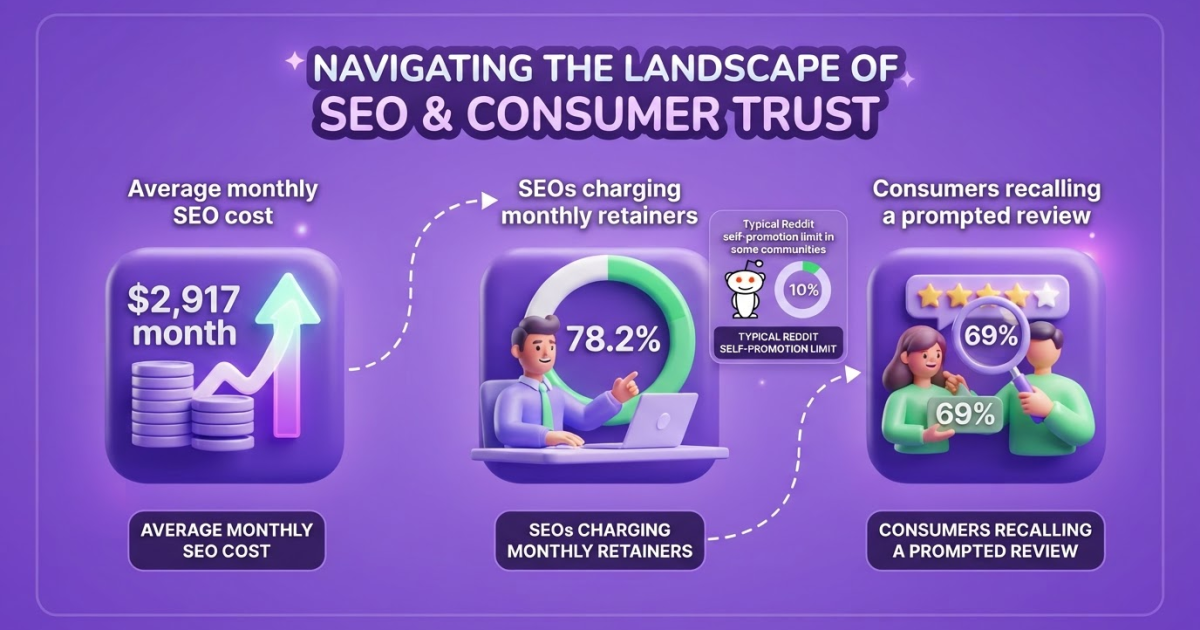
You want more customers from Google, but an agency retainer or another software subscription can put SEO out of reach. I have seen small businesses pay for reports while basic pages, useful answers, and local visibility stay neglected. Effective SEO does not require a large budget, although Ahrefs found that the average monthly SEO fee was $2,917 and 78.2% of SEOs used monthly retainers. The practical alternative is to spend limited cash and time on work that improves a real page for a real customer.
Contents
- What Cheap SEO Actually Means
- Free SEO vs. Paid SEO: Where Should You Spend?
- How to Build a Cheap SEO Workflow in 7 Steps
- Cheap SEO Mistakes That Become Expensive
- Low-Cost Alternatives to Hiring an SEO Agency
- My honest take on cheap SEO
- Make cheap SEO consistent with Roki AI
- Frequently Asked Questions
| Point | Details |
|---|---|
| Fix Fundamentals First | Use free tools to resolve indexing, title, internal-link, and page-clarity issues before paying for advanced software. |
| Choose Realistic Keywords | Prioritize specific, lower-competition queries that match your audience and your site’s current authority. |
| Create Useful Content | Make every page solve one clear customer problem and add original value. |
| Promote With Context | Join relevant communities and contribute helpful comments before mentioning your business. |
| Measure Real Signals | Review impressions, clicks, queries, indexed pages, and leads at least every 30 days. |
What Cheap SEO Actually Means
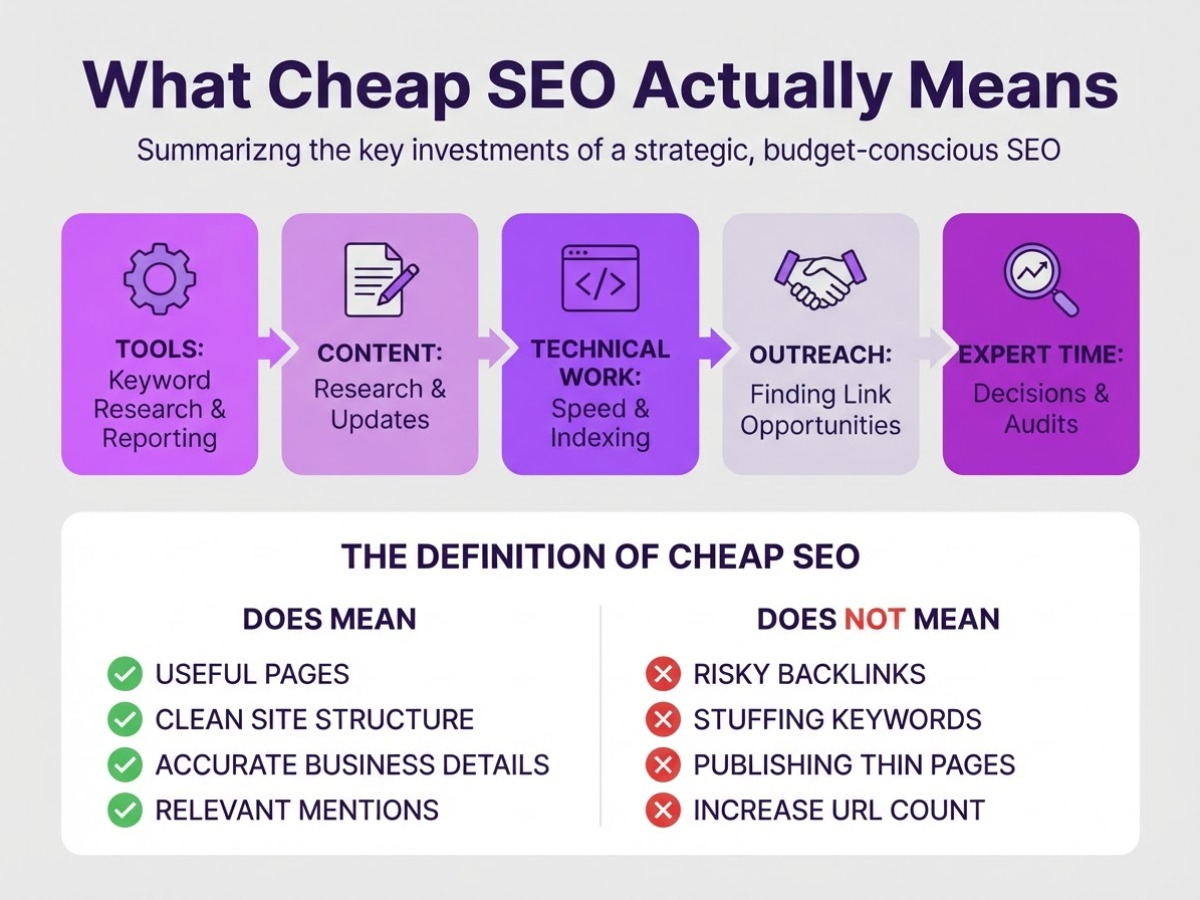
Cheap SEO does not mean careless SEO. As a company owner, I define it as putting limited money and attention behind useful pages, clean site structure, accurate business details, and relevant mentions. It does not mean buying risky backlinks, stuffing keywords, or publishing thin pages to increase your URL count.
You are mainly paying for five things:
| Cost category | What the money or time covers |
|---|---|
| Tools | Keyword research, crawling, rank tracking, and reporting |
| Content | Research, writing, editing, images, and updates |
| Technical work | Speed, indexing, redirects, templates, and fixes |
| Outreach | Relevant sites, partnerships, and link opportunities |
| Expert time | Audits, prioritization, decisions, and quality control |
You can reduce cash spend by doing research and implementation yourself, then using automation for repetitive work. Start with free SEO tools and upgrade only when a paid feature saves enough time to justify its cost. A dashboard will not fix a weak offer or a page nobody needs.
Ahrefs reported an average monthly SEO fee of $2,917, while 78.2% of surveyed SEOs used monthly retainers. That benchmark reflects agency and consultant work, not a minimum entry price. A solo business can spend less cash, but it replaces the retainer with its own hours. That trade-off is easy to miss when technical fixes become tedious or content research takes longer than expected.
Pro Tip: Set a monthly ceiling before choosing tools; unused subscriptions waste more money than a small software gap.
A practical budget has three layers:
- Free foundation: Search Console, basic fixes, keyword research, and two or three useful pages.
- Focused paid support: One tool, editor, developer, or specialist for the bottleneck you cannot handle well.
- Reinvestment: Put part of new revenue into content, technical work, or outreach after you see qualified traffic or leads.
Rankings rarely change overnight. Give consistent work several weeks to produce early signals, then judge meaningful growth over a few months. Next, decide which jobs deserve your first limited hours and dollars.
Free SEO vs. Paid SEO: Where Should You Spend?
I would not buy an SEO platform on day one. Start with Google Search Console, which shows whether Google can find your pages, where impressions come from, and which queries produce clicks. Its performance report includes queries, pages, countries, devices, and search appearance data.
The gap appears when you need market context or repeated monitoring. Use this comparison to decide what deserves money:
| SEO job | Free option | Paid option worth testing | Spend when |
|---|---|---|---|
| Find opportunities | Search Console and Google results | Keyword database with volume and difficulty data | You need to choose among dozens of topics |
| Watch competitors | Manual searches and page reviews | Competitor gap and backlink reports | Competitors publish often or outrank you across many terms |
| Track rankings | Search Console trend data | Daily or weekly rank tracking by location | You need to measure a specific campaign |
| Fix technical issues | Search Console indexing reports | Crawl software or an experienced consultant | Errors repeat, affect many URLs, or confuse your developer |
My spending order is firm: remove technical blockers first, improve content second, fix conversion problems third, and pay for scale last. A $300 technical fix that restores indexation can beat a $100 monthly keyword subscription. Rewriting a service page with 1,000 impressions and few clicks may matter more than finding 500 new keywords.
Pro Tip: Pay for the bottleneck, not the dashboard: if you cannot publish consistently, a content workflow may create more value than another keyword database.
Software can flag thin pages or show that a competitor ranks for “emergency plumber,” but it cannot decide whether your customers mean same-day repair, after-hours service, or a local problem. I have seen owners collect impressive reports and make no publishing or pricing decision. That is wasted spend.
For a small business, test one paid capability for 30 days. Pick one question, such as “Which five pages should we update?” Export the baseline, make the changes, and review impressions, clicks, leads, or sales at the end. Keep the subscription only if it changed a decision you could not make efficiently with free SEO tools.
Do not count features. Count useful decisions. Apply that rule to the first SEO tasks worth doing on a limited budget.
How to Build a Cheap SEO Workflow in 7 Steps
Start with the parts of SEO you can inspect yourself. A cheap SEO workflow works best when each task has an owner, a page, and a reason.
-
Check the site in Google Search Console. Verification costs nothing, and Google Search Console shows indexing errors, excluded URLs, security issues, queries, and links. Open Page indexing first, then inspect important pages individually.
-
Match one problem to each page. Write down the audience question each target page should answer, then choose a query you can realistically compete for. “Accounting software for freelance designers” gives a small firm a clearer job than “accounting software.”
-
Fix the title and opening. Give every page a concise, unique title that says what the visitor gets. Google recommends descriptive, concise titles without unnecessary keyword repetition. Follow it with an introduction that names the problem and answer.
-
Publish something worth keeping. Use clear headings, short sections, internal links, original examples, and one relevant next step. I would rather publish one useful page than five thin pages made to hit a quota. Google prioritizes helpful, reliable, people-first information, not writing that exists mainly to manipulate rankings.
Pro Tip: Create a backlog with columns for query, page, effort, business value, and next action; it keeps cheap SEO from becoming random SEO.
-
Use Roki AI for repetitive work. Roki AI can turn a query and audience problem into an outline, draft, or content task. Review every claim, example, and recommendation yourself. The first draft can miss industry nuances or invent a plausible detail, so use Roki AI’s SEO content workflow as assistance, not approval.
-
Promote the page where the audience gathers. Share it with relevant communities, partners, customers, email subscribers, or people who contributed useful examples. Do not drop the same link into ten forums. That creates annoyance and moderation trouble.
-
Review results once a month. Record impressions, clicks, queries, ranking movement, and conversion signals. High impressions with few clicks suggests a title or introduction problem; clicks without enquiries point to a weak next step. Let those findings choose next month’s work.
Once the workflow is running, protect the budget by avoiding shortcuts that create cleanup work.

Cheap SEO Mistakes That Become Expensive
The cheapest SEO work becomes expensive when you have to undo it. I have seen owners publish dozens of pages, buy questionable links, and spend more fixing the site than they would have spent planning it properly.
Common mistakes include:
- Publishing pages at scale without a useful purpose. Swapping city names or product terms can create 100 nearly identical pages. Google defines this as scaled content abuse when the main aim is manipulating rankings.
- Stuffing keywords into weak copy. Repeating “cheap SEO” in every heading makes the page awkward and inexperienced. Copied paragraphs and vague titles weaken trust.
- Automating backlinks without checking relevance. Random directories, forum comments, and paid placements rarely create useful authority. Reddit promotion fails when every comment points to your site. Reddit prohibits spam and may remove content or suspend accounts, so contribute a specific answer first.
- Measuring output instead of progress. Twenty articles are not progress if Google has not indexed them, visitors leave immediately, and nobody requests a quote or buys.
I use a quality gate for every page: clear search intent, first-hand evidence, original detail, plain language, useful internal links, and human review. A free SEO title generator can suggest ideas, but it cannot decide whether the page deserves to exist.
The safe shortcuts are now clear. The next question is whether you should handle the work yourself or buy focused help.
Low-Cost Alternatives to Hiring an SEO Agency
The right alternative depends on your time, technical confidence, and tolerance for trial and error. Agency retainers average $2,917 per month, as shown in Ahrefs’ pricing survey, so many small businesses should not begin there.
| Operating model | What you handle | Where it breaks down |
|---|---|---|
| Fully DIY | Research, titles, updates, internal links, and performance checks | Technical errors, inconsistent publishing, and limited time |
| Tool-assisted | You set priorities while software finds keywords, drafts content, and tracks changes | Bland or inaccurate work without review |
| Freelance specialist | A specialist handles an audit, technical fix, local SEO, or content batch | Quality varies, and one contractor rarely owns the whole strategy |
| Focused agency project | An expert handles one defined problem, such as a migration or penalty recovery | The project can quietly become an expensive retainer |
Writing service pages, improving titles, adding internal links, claiming your Google Business Profile, and checking clicks in Google Search Console are reasonable owner tasks. Pay for help when you face JavaScript indexing issues, a site migration, a messy backlink profile, international SEO, or a competitive market where a wrong six-month bet costs more than an expert.
Automation should remove repetition, not judgment. With Roki AI, you can receive 3 to 10 recurring tasks each week, including content and SEO work, then choose what deserves attention. I still expect the owner to check facts, add first-hand detail, approve the target page, and reject generic work. Google prioritizes helpful, people-first information, not pages made only to fill a calendar.
My preferred starting point is narrow: one website, one audience, and one measurable objective, such as 20% more qualified organic visits in six months. Use affordable SEO tools to support that plan, then add help when a specific bottleneck justifies the cost.
My honest take on cheap SEO
I believe cheap SEO works when you treat it as an operating discipline, not a bargain version of agency SEO. In my experience building TryRoki, small businesses rarely need six platforms or daily reports. They need a defined audience, a realistic publishing rhythm, accurate measurement, and time to improve pages after customer questions expose their weaknesses.
Here is the contrarian point: doing SEO yourself is not automatically the cheapest option. If you spend 10 hours fixing technical issues you barely understand or rewriting generic AI drafts, your time can cost more than focused specialist help. I use automation for repetitive work, but I keep the owner responsible for priorities, claims, examples, and the final standard. Automated suggestions still need judgment.
At TryRoki, we turn that discipline into three to 10 weekly tasks, including content opportunities and relevant Reddit discussions where a useful comment can mention your site. I would rather see a business publish five helpful pages than 50 thin ones that create cleanup work. Cheap SEO should reduce waste, not lower the bar.
— Daniel/Aleksandra
Make cheap SEO consistent with Roki AI
Cheap SEO usually fails because the work becomes a pile of disconnected tools and half-finished ideas. I built Roki AI to act as the execution layer for a lean SEO strategy, giving you 3–10 practical tasks each week: draft website content, identify relevant Reddit discussions where a useful mention fits, and keep visibility work moving across Google and AI search engines.
It will not replace your judgment. You still need to review drafts, reject weak suggestions, choose priorities, and add the experience that makes your business worth citing. Reddit opportunities can be irrelevant, and some drafts need more editing than expected. Start with one site and a small weekly commitment, then compare the time saved with your current mix of spreadsheets and tools. The useful question is whether you execute better week after week.
Frequently Asked Questions
Yes. Start with Google Search Console, analytics, manual search checks, content updates, and ethical promotion without paying for software. Give yourself 2 to 3 hours each week to review queries, fix page problems, and decide whether a paid tool saves enough time.
Many sites need 3 to 6 months to see meaningful organic growth, although technical fixes can improve visibility within a few weeks. Your timeline depends on competition, site history, content quality, authority, and consistent implementation.
Fix indexability and page clarity first, then publish useful answers to specific audience questions and add relevant internal links. These changes can cost $0 in software, but they still require focused work and a review every 30 days.
AI assistance is not automatically bad, but unreviewed, repetitive, or misleading pages create quality and spam risks. Use AI for research, outlining, and drafting, then add expertise, verify claims, and edit until the page genuinely helps a reader.
Yes, Reddit can support discovery and referral traffic when you answer relevant questions and mention your site only when it adds clear value. Follow community rules, avoid repeated promotion, and build a helpful contribution history before sharing a link.
Written by Daniel/Aleksandra.
Recommended reads
- Cheap Seo Tools Affordable Solutions For Effective Seo
- Free Seo Tools
- How Roki Ai Streamlines Your Seo Content Workflow
- Avoiding Common Ai Content Mistakes For Better Seo
Sources
- SEO Pricing: How Much Does SEO Cost? 439 People Polled
- About Search Console - Search Console Help
- How are you performing on Google? - Search Console Help
- Influencing Title Links in Google Search | Google Search Central | Google for Developers
- Spam Policies for Google Web Search | Google Search Central | Documentation | Google for Developers
- How do I keep spam out of my community? – Reddit Help
- Local Consumer Review Survey 2024: Trends, Behaviors, and Platforms Explored
- Add or claim your Business Profile - Google Business Profile Help
- Creating Helpful, Reliable, People-First Content | Google Search Central
- SEO Starter Guide: The Basics | Google Search Central | Documentation | Google for Developers