Daniel D.
There is no universal number of backlinks you need to rank. The right target depends on competition, relevance, link quality, referring-domain diversity, and the pages already ranking. Compare the top 10 results, use their median referring-domain count as a benchmark, and review progress after 8 to 12 weeks instead of chasing a fixed total.
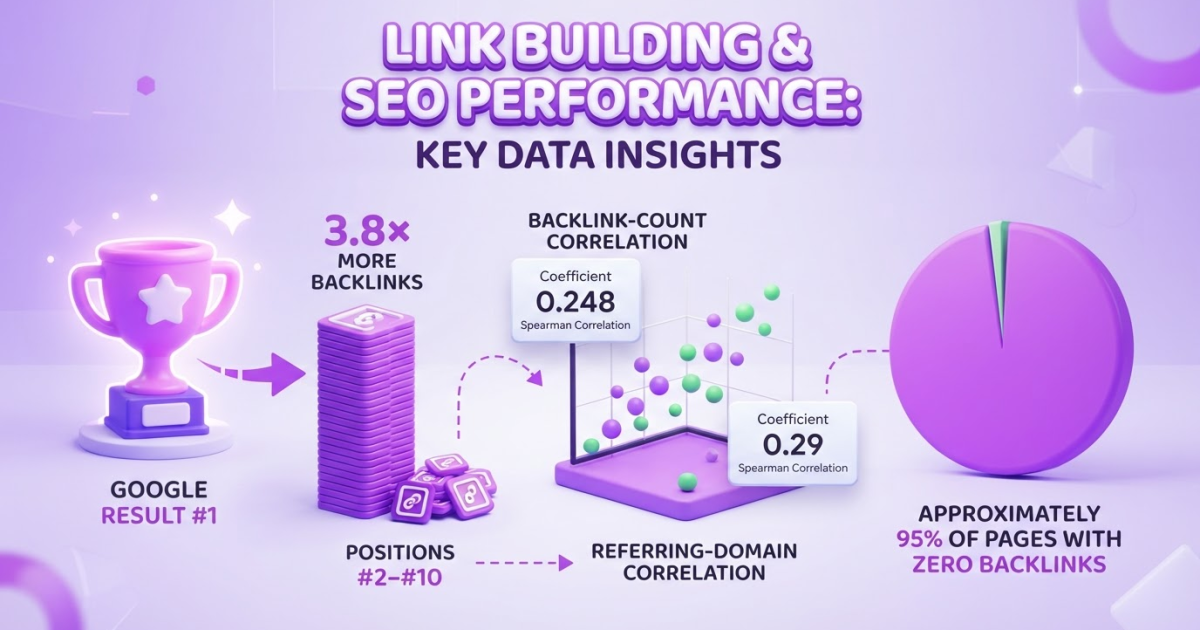
You may be staring at competitors’ backlink counts and wondering whether your page needs 20 links, 200, or 2,000 before Google takes it seriously. That uncertainty is frustrating, especially when weak outreach wastes time and money. In Backlinko’s analysis of 11.8 million Google results, the #1 result had an average of 3.8 times more backlinks than results in positions 2–10, but that correlation does not prove backlinks alone caused the higher rankings. A useful benchmark starts with competing pages, not a universal quota.
| Point | Details |
|---|---|
| No Magic Number | Your backlink needs depend on keyword difficulty, competition, page quality, search intent, and the current SERP. |
| Benchmark Competitors | Review the top 10 results and compare referring domains. Forty unique domains can matter more than 400 links from a few sites. |
| Prioritize Diversity | One hundred links from 100 relevant domains can be more useful than 100 links from 10 domains. |
| Quality Beats Volume | A thousand weak or irrelevant links can add little value and create compliance risks. |
| Track The Outcome | Measure rankings, referring domains, organic traffic, and qualified conversions for 8 to 12 weeks. |
The backlink number is a benchmark, not a rule
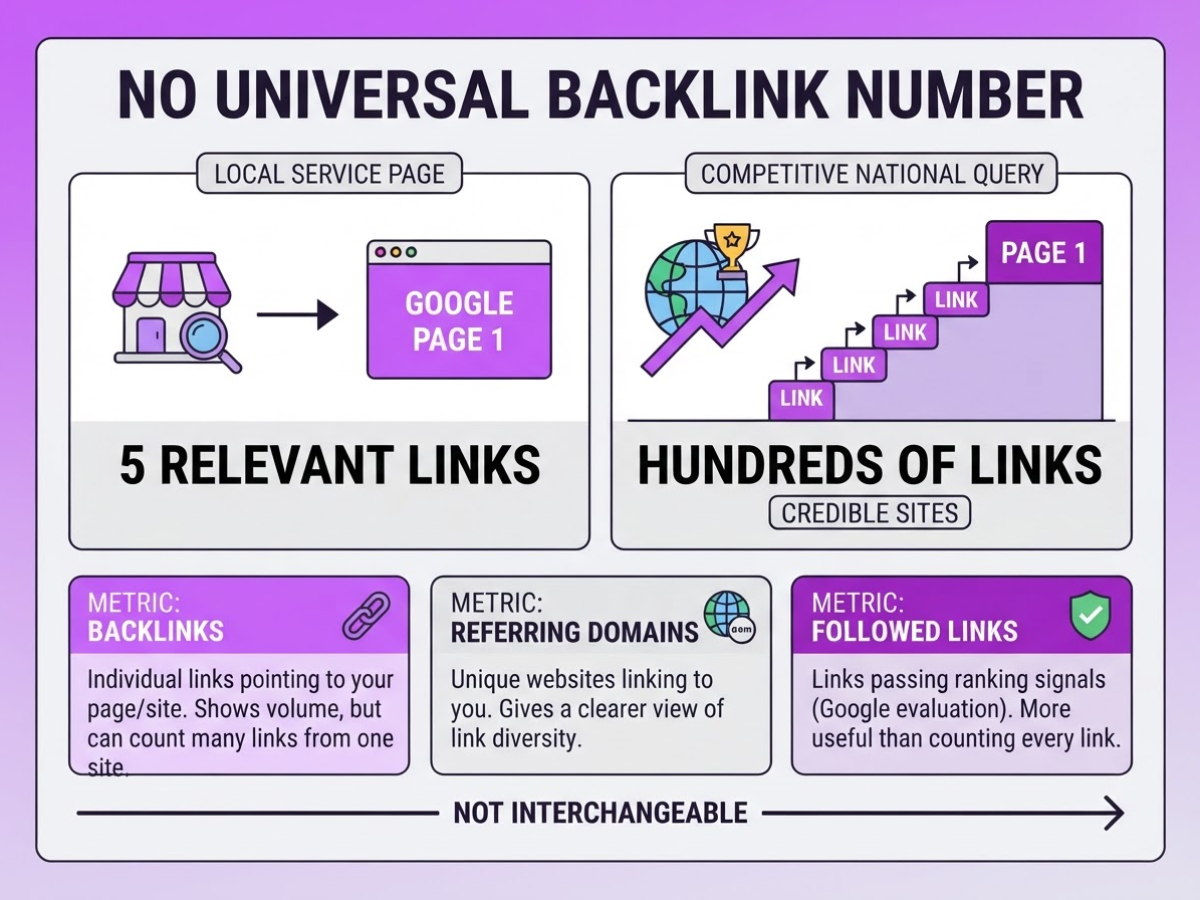
Backlink counts can help you set a target, but they cannot answer the question alone. A local service page might reach page one with five relevant links, while a competitive national query can require hundreds of links from credible sites.
Start by separating the metrics. They are not interchangeable:
| Metric | What it measures | Why it matters |
|---|---|---|
| Backlinks | Individual links pointing to your page or site | Shows total volume, but can count many links from one site |
| Referring domains | Unique websites linking to you | Gives a clearer view of link diversity |
| Followed links | Links that can pass ranking signals, subject to Google’s evaluation | More useful than counting every link, though quality still matters |
| Page-level links | Links pointing to the specific page you want to rank | Usually more relevant to that page’s authority |
| Domain-level links | Links pointing elsewhere on your website | May support the site without strengthening your target page equally |
Ahrefs reported a 0.248 correlation between backlink count and ranking position across the top 20 results for one million high-volume U.S. keywords. Referring domains showed a stronger 0.29 correlation. That is correlation, not proof that links alone caused rankings. A link profile can also reflect brand age, useful content, publicity, and authority.
Google says links help it discover pages and act as a relevance signal, but links remain one part of ranking. Content fit, search intent, technical accessibility, reputation, and user satisfaction also shape results. Most teams overrate raw link totals and underrate whether the linking page makes sense.
Pro Tip: Use referring domains as your primary comparison metric, then inspect individual links for relevance and editorial context.
For a practical benchmark, search the exact keyword in the target location and record the page-one results. Compare referring domains, followed links, page-level links, content depth, and intent match. Do not copy the largest number. If the top results answer a simple question with 15 relevant domains, building 200 weak links is wasted effort and can create spam concerns. Review how to use backlink software safely before collecting data or planning outreach.
That SERP comparison gives you a defensible range. Next, turn it into a page-specific target.
How to calculate a realistic backlink target
Start with the SERP you want to win, not a broad keyword report. I use the exact query, country, language, device, and search intent before opening a backlink tool. “How many backlinks do I need?” produces a different benchmark on mobile in the United States than on desktop in the United Kingdom. An informational page should not be compared with product pages.
-
Lock the search conditions. Record the keyword, location, device, and date. Classify intent as informational, commercial, navigational, or transactional. Save the current top 10 URLs. Results shift, so a competitor list from six months ago can create a false target.
-
Build one comparison table. For every ranking URL, record total backlinks and referring domains from the same tool and database. Do not mix Ahrefs data for one page with Semrush data for another. Their crawlers and definitions produce different totals.
| Position | Ranking URL | Total backlinks | Referring domains | Page type |
|---|---|---|---|---|
| 1 | Competitor URL | |||
| 2 | Competitor URL | |||
| 3–10 | Competitor URLs |
- Use the middle, not the outlier. Calculate the median for backlinks and referring domains, then note the lowest and highest values. If the top 10 have 20 to 180 referring domains, targeting 180 because one competitor has it is usually wasteful. Referring-domain diversity deserves more attention than repeated links from the same few sites, as Semrush’s 2024 study measured it among ranking factors.
Pro Tip: If the top 10 pages have very different link profiles, segment them by intent and content type before calculating a benchmark.
-
Separate page authority from site authority. Check links pointing directly to the ranking URL, then inspect the domain’s homepage and sitewide profile separately. A strong publication can rank a new article with few page-level links because its domain has earned trust over years. Copying its total backlink count will mislead you.
-
Inspect the strongest links manually. Review topical relevance, anchor-text naturalness, placement, followed status, and the linking site’s estimated authority. Ten relevant editorial links can matter more than 500 profile or footer links. Google’s policies treat links created mainly to manipulate rankings as spam, so buying volume is a bad shortcut.
-
Set a working target and review date. Start near the median of comparable pages, adjusted for quality and your current authority. Set a review date 8 to 12 weeks after meaningful content improvements and legitimate link acquisition. Recheck the SERP, rankings, and link profile then. The number is a planning signal, not a guarantee.
Backlinks versus referring domains: what should you chase?
A backlink count treats every link as if it carries the same weight. It does not. For outreach, I care first about how many distinct, relevant websites choose to reference you, then about where each link appears and whether it helps a reader.
| Profile | What it looks like | Practical interpretation |
|---|---|---|
| Concentrated links | 100 backlinks from 10 domains | Useful for referral traffic and brand exposure, but limited domain diversity |
| Diverse links | 100 backlinks from 100 domains | Stronger evidence that independent sites find the page worth citing |
The second profile is usually the better starting point. Research on ranking factors has found that the number of linking domains correlates with rankings, and its analysis suggests backlink diversity matters more than collecting links from the same websites.
Repeated links from one site still have a place. A relevant article link can send qualified visitors, while a sitewide footer link can help discovery across several pages. The tenth link from the same low-value page type rarely deserves the effort of a first link from a respected, closely related publication. Learn more about evaluating premium backlinks for SEO before treating a large placement list as progress.
Context changes the assessment. A link from a cybersecurity journal to your security guide, placed beside a technical claim, is more useful than a directory link from an unrelated business site. Relevance, editorial judgment, page visibility, anchor wording, and real click potential all matter.
Pro Tip: When two competitors have similar referring-domain counts, compare the topical closeness and editorial prominence of their best links before assuming they are equally strong.
Use referring domains as a reporting filter, not a ranking formula. Review each new domain for topic fit, quality, placement, and likely traffic. Prioritize relevant new domains and avoid duplicate placements created only to inflate totals. Vanity growth can create risk instead of durable progress.
That measurement approach keeps outreach tied to sustainable SEO. The next question is whether extra links can actually improve the page.

Why more backlinks may not improve your ranking
A sudden pile of backlinks can look impressive in a report and still do nothing for rankings. It can also make a site look like it is trying to manipulate search results. When I review link campaigns, the pattern matters more than the headline number.
Watch for these common mistakes:
- Buying irrelevant links from sites with no connection to your topic
- Using automated systems that place links across low-quality blogs, comments, or directories
- Accepting sitewide footer or sidebar links that appear on hundreds of pages
- Repeating the same exact-match anchor text, such as “best accounting software,” at an unnatural rate
- Paying for links that pass ranking credit without clear disclosure or editorial value
Google defines link spam as creating links to or from a site mainly to manipulate rankings. Its spam policies warn that manipulative link creation can cause pages to lose search features, rankings, or visibility. A cheap batch of 500 links is not a bargain if cleanup takes six months.
Automation needs extra caution. Tools can help you find opportunities, but blindly publishing links is different. If you use software, read how to use automated backlinks software safely and effectively before allowing it to create anything for you.
Link building cannot repair a weak page. Fix search-intent mismatches, indexing errors, thin content, slow templates, and poor internal linking first. A page answering the wrong question will not become useful because another website mentions it. Domain Authority and Domain Rating can help compare prospects, but Google does not use them as guarantees.
I prefer links earned from original data, expert contributions, digital PR, relevant partnerships, and resources people genuinely need to cite. The pattern is usually slower and uneven: two relevant links this month, five next month, then none for a while. That is more defensible than hundreds of nearly identical placements and keeps the budget focused on assets that can earn attention twice.
Before increasing your target, check whether the page gives searchers a reason to stay and share it.
What results should you expect from a backlink campaign?
A backlink campaign rarely produces a clean jump from page 40 to page 5. Ranking movement depends on content quality, results-page competition, crawl and indexing timing, site history, and link quality. A relevant link from a trusted site can matter more than 50 weak placements, which makes a raw target a poor success metric.
Links affect two different stages. Google uses links to discover new pages, and most new pages it finds each day are discovered through links. Discovery or indexing can happen before rankings move. I have seen a newly linked page enter the index quickly, then sit still for weeks while Google tests its relevance and user response.
Do not assume every page needs a large backlink profile. Approximately 95% of pages in one large analysis had zero backlinks, so specific queries and low-competition topics can rank with few or no external links. That does not make links irrelevant. It means the page, site history, search intent, and competing pages still set the difficulty.
Use an 8 to 12-week review cycle:
- Weeks 1–4: Confirm that Google crawled and indexed the page. Record keyword position, impressions, clicks, organic traffic, referring domains, and conversions before judging the campaign.
- Weeks 5–8: Check whether impressions and average position are moving, even if clicks remain small. Review whether new domains are relevant and whether links point to the page that needs authority.
- Weeks 9–12: Choose a direction. Improve the content and continue if impressions, rankings, or conversions are rising. Refine the keyword and outreach if the page attracts visibility but misses the right audience. Stop if the likely traffic cannot justify the cost.
I have wasted time extending campaigns for keywords that could never produce enough sales. Build the minimum credible authority needed to compete, not the maximum possible link count. That principle leads to a better budget decision.
My honest take on how many backlinks you need
I do not believe responsible SEO starts with a universal backlink quota. The strongest competitor’s link count can send you in the wrong direction. A smaller site can win by matching intent more precisely, publishing a better resource, and earning five relevant editorial mentions instead of chasing 50 weak ones.
I use competitor data as a boundary, not a promise. First, I check the median referring-domain count among credible pages ranking for the target query. Then I inspect those domains: are they relevant, editorially earned, and linking to content that resembles the page I want to rank? A spreadsheet full of irrelevant directory links can make a SERP look harder than it is.
If the gap is large, I decide whether the keyword justifies the outreach, content, and time required. That decision is often more valuable than launching a campaign and discovering three months later that the economics never worked. Link counts are easy to report; relevance and placement quality take real inspection.
At TryRoki, I use Roki to keep that work moving. It helps create useful content, surfaces Reddit discussions where we can contribute honestly, and turns weekly SEO work into three to ten concrete tasks. The goal is not to manufacture links. It is to build enough authority and relevance that the page deserves to be cited.
— Daniel/Aleksandra
Turn your backlink benchmark into a weekly SEO workflow
Once you set a page-specific backlink target, execution becomes the difficult part. Teams often chase a bigger number, then lose weeks researching prospects, drafting resources, and deciding which opportunities deserve attention. I built Roki AI to keep that work visible without pretending it can guarantee rankings.
Roki creates content on autopilot and gives you 3–10 weekly tasks for ongoing SEO work. Tasks can include finding relevant Reddit posts where you can leave a useful comment and mention your website only when it fits. You still need to review suggestions before publishing or commenting, and that trade-off matters.
Roki works best as a system for consistent work: publish stronger resources, find practical opportunities, and track progress instead of buying links blindly. Try it after choosing your target, then use the weekly tasks to follow through.
Frequently Asked Questions
Yes. A page can rank with zero backlinks when it closely matches a specific query, especially in a low-competition niche, although links can still help Google discover and trust it over time.
Give Google roughly 8 to 12 weeks to discover, crawl, and evaluate new links in context. Check trends across that full period because a ranking jump after 3 days is usually noise, not proof that the link worked.
Not necessarily. One thousand low-quality links from repeated or unrelated sources can be less useful than 10 relevant links from distinct websites, so compare referring-domain quality rather than counting links alone.
Social links can bring visitors and help people discover your content, but their direct ranking impact varies by platform and link treatment. Use social promotion to reach readers and potential publishers, not as a guaranteed replacement for editorial links.
No, not when the main purpose is to manipulate rankings. One paid link can create policy and quality risks, so I prefer useful content, genuine partnerships, expert contributions, and editorial mentions, even though those routes take longer.
Written by Daniel/Aleksandra.
Recommended reads
- Seo Backlinks Software How To Use Tools To Boost Your Rankings
- Premium Backlinks How To Acquire High Quality Links For Seo Success
- Automated Backlinks Software How To Use It Safely And Effectively
- How Roki Ai Streamlines Your Seo Content Workflow
Sources
- Google Says "Links Matter Less"—We Looked at 1,000,000 SERPs to See if It's True
- We Analyzed 11.8 Million Google Search Results. Here’s What We Learned About SEO
- Google Ranking Factors and How to Optimize for Them
- We Analyzed 11.8 Million Google Search Results. Here’s What We Learned About SEO
- Link best practices for Google
- SEO Starter Guide: The Basics
- Backlink metrics
- Spam Policies for Google Web Search | Google Search Central
- Links and Brand as Ranking Factors: 2021 Correlation Study - Moz