Aleksandra D.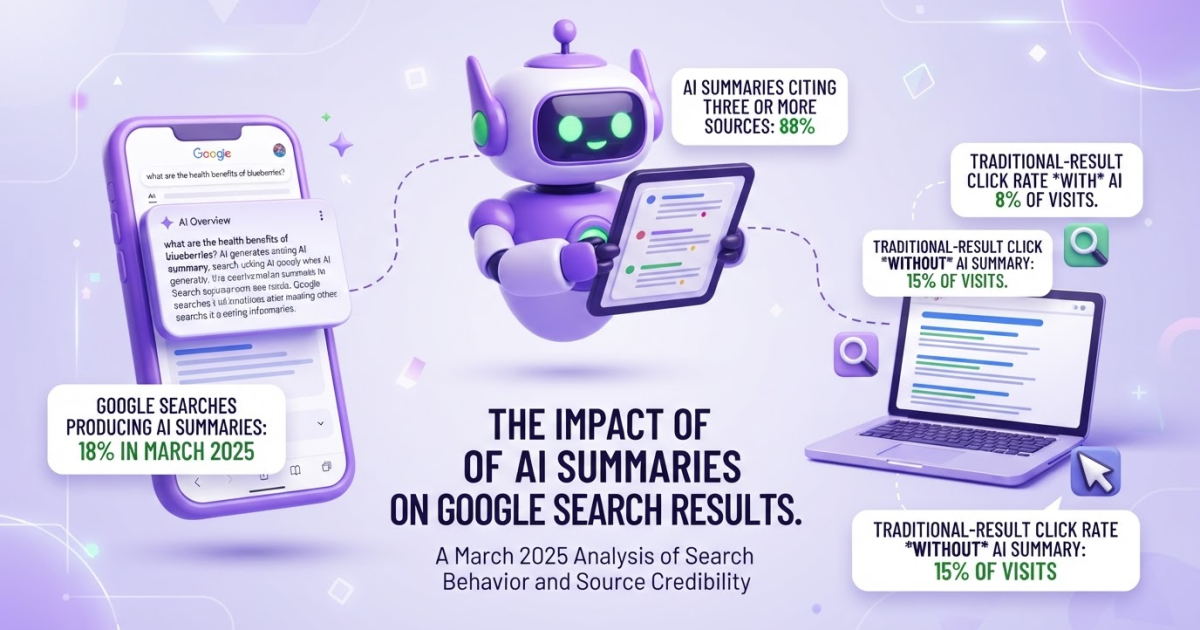
Avoiding Common AI Content Mistakes for Better SEO starts with original value, accurate claims, and a human review before publication. Audit all 6 failure points: scaled low-value pages, factual errors, duplicated metadata, weak internal links, search-engine-first writing, and misleading structured data.
You can publish AI-assisted articles faster and still watch organic visibility stay flat. That is frustrating, especially when a draft looks polished until a weak fact, recycled angle, or generic recommendation gives readers no reason to trust it. Pew Research Center found that 18% of Google searches produced an AI-generated summary in March 2025, so your content must satisfy traditional results while providing useful, distinctive signals for AI search experiences. I’ll show you how to spot common AI content mistakes, audit drafts before publication, strengthen originality and trust, and measure impressions, clicks, and meaningful engagement.
| Point | Details |
|---|---|
| Prioritize usefulness | Make every AI-assisted page answer a real audience question with original information, examples, or perspective that improves on the top results. |
| Review every claim | Have a human verify 5 essentials before publication: statistics, names, dates, recommendations, and citations. |
| Avoid scaled abuse | Do not publish hundreds of low-value pages. Search policy risk applies to automated, human-produced, and hybrid content alike. |
| Optimize the whole page | Check the title, meta description, crawlable links, headings, and relevant internal connections instead of treating body copy as the entire SEO job. |
| Measure business value | Track impressions, clicks, conversions, and engagement for at least 4 to 8 weeks before judging content by output volume. |
What AI Content Mistakes Actually Hurt SEO?
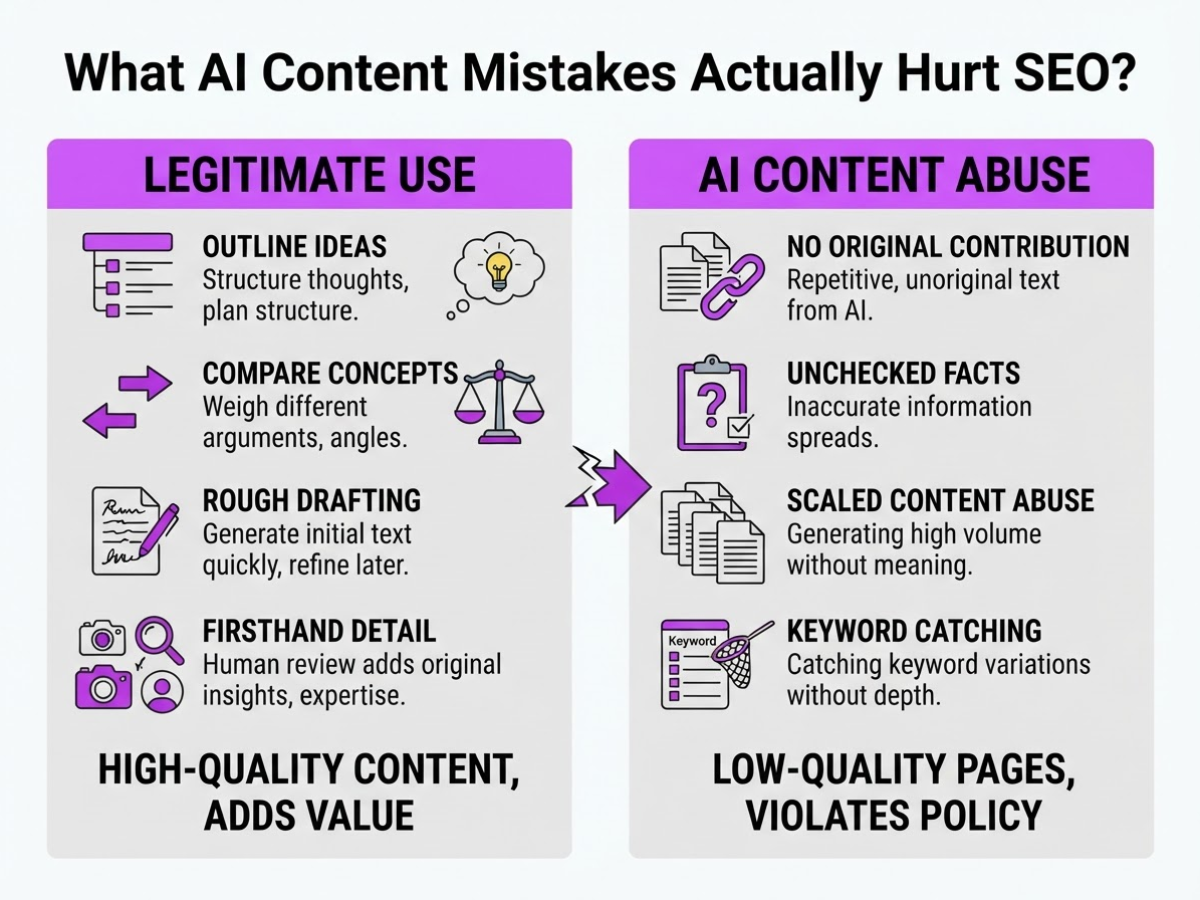
AI is not the SEO problem by itself. I use it to outline, compare ideas, and get a rough draft moving, but I would never treat the first output as publishable. The real damage starts when a team publishes text with no original contribution, unchecked facts, or clear responsibility for the result.
Google’s policy focuses on the outcome, not the software. Generating many pages with generative AI without adding value may violate its scaled content abuse policy. Volume is not the test. Meaningful usefulness is. Fifty pages that answer distinct questions with firsthand detail can be legitimate; fifty near-identical pages built to catch keyword variations are a liability.
The warning signs become obvious once you stop judging a draft by word count:
- A generic introduction that could fit any company or industry
- The same claim repeated in three sections
- Expertise stated without evidence, examples, authorship, or review
- Keywords forced into headings and sentences where they sound unnatural
- A page with no unique purpose beyond targeting a slightly different phrase
I have seen teams spend hours polishing these pages while missing the bigger problem: nobody can explain why the page should exist. That is a poor use of AI and an even poorer editorial process. A human and AI content workflow only works when a person still makes the important calls.
Use this standard before publishing each page:
| Requirement | Question to answer |
|---|---|
| Audience | Who specifically needs this information? |
| Search intent | What decision or task brought them here? |
| Original contribution | What example, data, judgment, or experience is new? |
| Accountable reviewer | Who checked the claims and approved publication? |
Pro Tip: Before asking AI to draft, write the page’s unique contribution in one sentence. If that sentence is vague, the finished page will probably be interchangeable.
This standard also matters for AI search visibility. Concise, trustworthy, source-supported answers are easier for systems to understand and reuse than padded prose. Google’s scaled-content policy applies to automation, human work, or both, so adding a human name after mass production does not solve a thin-content problem. The next step is a review process that catches the mistakes AI drafts routinely hide.
Run a 7-Point Pre-Publish AI Content Audit
Before publishing an AI-assisted draft, I assign one person to own the audit and record every fix. A checklist prevents the familiar rush where a polished page goes live with the wrong audience, an invented statistic, or a broken link.
-
Confirm the job of the page. Write down the search intent, target reader, page purpose, and action you want the reader to take. If a beginner’s guide suddenly pushes a sales demo, revise the brief before editing sentences.
-
Verify every factual claim. Check each number, quote, product detail, date, medical or financial statement, and named source against a primary reference. “The AI probably meant…” is not an answer. If you cannot verify a claim, remove it or label the uncertainty.
-
Add evidence of real experience. Replace broad advice such as “optimize your workflow” with a process detail, original example, comparison, customer situation, or observation from your team. Generic paragraphs usually signal that the draft needs a human who has done the work.
Pro Tip: Use two separate review passes: a factual pass with sources open and a reader pass without the original prompt. The second pass makes generic or awkward sections easier to spot.
-
Test the structure aloud. Make sure the opening answers the main question, headings follow a sensible order, lists help, and formatting supports scanning. Cut repeated definitions and throat-clearing; readers notice repetition faster than editors do.
-
Check on-page SEO without forcing it. Review the title, meta description, headings, image alt text, canonical signal, and keyword placement. Google primarily builds snippets from page content, but can use the meta description when it gives a better summary, so write a specific description rather than stuffing keywords. For a practical canonical review, use this canonical link check guide.
-
Inspect internal links manually. Each link should lead to a relevant next page, use clear anchor text, and work in rendered HTML. Google explains that crawlable links need an anchor element with an href attribute, so a JavaScript click handler alone is not enough.
-
Give the page a final human edit. The owner or subject expert should check tone, clarity, legal and brand risk, unsupported promises, and whether the page would still help someone who never arrived through search. Publish only when that person can defend the page’s advice and sources.
After the audit, you have a safer draft to measure, improve, and maintain. The next review is easier when you know which recurring defects to find first.
The Five Failure Patterns to Remove From AI Drafts
The fastest way to improve an AI draft is to name the failure before polishing sentences. At TryRoki, I look for these patterns first because clean writing can hide weak research and near-duplicate pages.
- Thin expansion: One narrow idea becomes five URLs, each repeating the same advice with new headings. Keep one page when search intent is the same. Create another only when it adds original evidence, a different audience, a distinct process, or a genuinely different question. Generating many pages without user value can violate Google’s scaled content abuse policy, even when a human edits the final copy.
- Confident inaccuracies: Plausible wording is not proof. Check dates, prices, regulations, product details, and statistics against primary sources; label assumptions as assumptions. Delete a claim when you cannot verify it. A fluent error still damages trust.
- Template repetition: Identical introductions, conclusions, examples, headings, and calls to action make every page feel disposable. Change the structure only when the reader’s problem changes, not to disguise duplication. Creating high-quality SEO content with Roki AI can help with drafting, but editorial judgment still has to separate pages.
- Search-engine-first writing: Keyword stuffing, awkward exact matches, and long preambles mean the draft answers Google instead of the visitor. Put the direct answer near the top, use the phrase where it reads naturally, and remove filler. Google’s guidance favors people-first content and originality, not pages built mainly to manipulate rankings.
- Unsubstantiated experience: Never imply that you tested a product, achieved customer results, hold credentials, or used a method firsthand when none of that happened. Replace invented authority with a sourced statement, a clear limitation, or a real example from your records.
- Duplicate page elements: Give every page a specific title and meta description that reflect its actual promise. Google says similar descriptions across a site are not helpful and recommends page-specific copy. This small edit also prevents editors from confusing one service page with another.
- Misleading markup: Structured data must describe content visible on the page. Do not add review, FAQ, or product markup simply because you want a richer result. A violation can remove rich-result eligibility without improving ordinary rankings, so validate the markup and remove anything the page cannot support.
Pro Tip: Search your own site for repeated three- to five-word phrases in introductions and conclusions. Repetition at that level often reveals a deeper lack of page-level differentiation.
Once these defects are removed, compare the human-led process with publishing the raw output.

AI-Assisted Writing Versus AI-Only Publishing
At TryRoki, I have seen the difference between using AI as a junior assistant and treating it as an unsupervised publisher. AI-only publishing sends a prompt straight to a live page. It is quick, but nobody reliably checks whether the claim is true, the example fits the audience, or the promise matches what the business can deliver.
AI-assisted publishing keeps decisions with people. You define search intent, supply subject knowledge, review evidence, and edit the draft before approval. AI can handle tedious parts, but it cannot take responsibility for a medical warning, pricing promise, customer story, or opinion presented as firsthand experience.
| Area | AI-only publishing | AI-assisted publishing |
|---|---|---|
| Speed | Produces pages quickly from a prompt | Speeds up drafts while keeping review time visible |
| Best uses | High-volume generation, often with uneven quality | Briefs, first drafts, outlines, formatting, refresh checklists, and repurposing |
| Main strength | Consistency of output format | Human expertise, originality, judgment, and trust |
| Main risk | Invented claims, generic advice, and unowned errors | Slower approvals and the need to resolve disagreements |
| Final decision | The system effectively decides what goes live | A named editor approves every publication |
My rule is simple: automate structure, not accountability. Roki AI can help create content and manage recurring SEO tasks, but it does not replace the person who verifies a statistic, confirms a product detail, or removes a promise the company cannot support. That division matters because Google says trust is the most important part of E-E-A-T, even though E-E-A-T itself is not a ranking factor.
A documented brief helps when several writers or reviewers touch the same site. Record the audience, search intent, primary claim, required sources, internal links, forbidden promises, author, and approval owner. Then use a short checklist: verify claims, inspect citations, add genuine examples, check customer language, review title and description, and record the final approver. The paperwork feels annoying on small assignments, but it prevents five contributors from making five different assumptions.
I explain the practical version of this setup in how Roki AI streamlines your SEO content workflow. Measurement is the next test: a careful workflow still needs evidence that its changes helped.
How to Prove Your Fixes Improved SEO
I measure SEO fixes against business outcomes, not the number of articles published. Before changing an AI-assisted workflow, I record 28 days of impressions, clicks, click-through rate, average rankings, indexed pages, conversions, and engagement. I also note qualified visits, return visits, and assisted conversions. Without that baseline, a traffic increase can look impressive while attracting people who never become customers.
I split pages into useful cohorts instead of comparing the whole site at once. Group them by topic, publication date, content process, and search intent, then compare revised pages with similar pages that did not change. That sounds tedious because it is. Mixing a new product page with an old informational article produces a neat report and a weak conclusion.
- Week 0: Export the baseline from Search Console, analytics, and your rank tracker. Record the page URL, target intent, current queries, indexed status, and conversion events.
- Weeks 1 to 2: Publish or revise the selected cohort. Log changes to research, factual review, internal links, titles, and consolidation decisions in your weekly task list. A repeatable SEO content workflow prevents small fixes from disappearing in chat threads.
- Weeks 4 to 8: Compare impressions, clicks, CTR, rankings, qualified visits, conversions, return visits, branded searches, and useful query coverage. Competitive queries and new domains often need several more months, so do not declare failure after one quiet week.
Look beyond rankings. A page at position 12 that brings qualified prospects and assists conversions can matter more than a position-five page attracting irrelevant clicks. Refresh pages that receive impressions but fail the query, and consolidate overlapping pages that compete with each other.
Treat AI-search visibility as directional evidence, not a promise of inclusion in generated summaries. Pew found that 18% of Google searches in March 2025 showed an AI summary, while traditional-result clicks fell to 8% when one appeared, compared with 15% without one. Track mentions, cited pages, and query coverage, but keep conversions as the harder test.
These measurements create a practical decision rule, but they also expose a common strategic mistake: publishing more pages is not always progress.
My honest take on avoiding AI content mistakes
I have seen teams make the same wrong assumption in two directions: they treat AI content as automatically risky, or they expect it to run without supervision. Neither view survives real publishing. At TryRoki, I use AI for research support, first drafts, page organization, and recurring tasks, but I keep ownership of the angle, factual standard, and final edit.
My contrarian view is that publishing less can be the fastest route to better SEO. A site with 30 genuinely different pages can be stronger than one with 300 near-duplicates targeting every slight keyword variation. More content is not automatically more coverage; sometimes it makes a site harder to understand and gives you more pages to maintain when rankings slip.
The frustrating work still matters. I set a clear purpose for each page, check claims against reliable sources, add customer context that AI cannot invent, and review performance after publication. AI can make decisions more consistent, but it should not remove decisions from the process. The technology is not the strategy. Disciplined judgment is, and no automation tool can supply it on your behalf.
— Daniel/Aleksandra
Build a safer AI content workflow with Roki AI
I built Roki AI’s SEO workflow for the gap between spotting content mistakes and consistently fixing them. It can create website content on autopilot and surface Reddit posts where a thoughtful, relevant comment may mention your site. That does not make every draft publishable or every comment worthwhile. You still need to check claims, search intent, tone, and whether joining a Reddit thread genuinely helps readers.
Each week, Roki AI delivers 3 to 10 tasks across research, content creation, visibility work, and improvement. That steady list keeps SEO moving without taking final decisions away from you, although the first setup can feel tedious and some tasks need judgment. Use it alongside the audit: let Roki AI speed up the work, then review before publishing or commenting. See how the workflow fits together and decide whether it suits your current process.
Frequently Asked Questions
Yes. AI-assisted content can rank when it is accurate, useful, original, and written for people rather than produced only to manipulate search visibility. The tool matters less than whether a human added real expertise, checked the claims, and made the page worth reading.
Verify every important claim against at least 1 primary or authoritative source, especially statistics, dates, prices, legal guidance, medical information, and product details. Keep a human reviewer responsible for approving the final draft because an AI detector cannot confirm whether an answer is true.
Google does not apply a special penalty simply because you used 1 writing tool. Problems arise when a site publishes scaled, unoriginal, misleading, or low-quality pages, regardless of whether humans, automation, or both produced them.
Start with search intent and a clear brief, then use AI for research support and drafting before adding human expertise and original evidence. Before publishing, check at least 5 areas: facts, links, metadata, usefulness, and whether the page genuinely answers the query.
Review every draft before publication, then reassess newly published pages every 4 to 8 weeks for accuracy, traffic, and search intent. Update sooner if a product, price, policy, statistic, or other important fact changes.
Written by Daniel/Aleksandra.
Recommended reads
- Creating High Quality Seo Content With Roki Ai
- Balancing Human Touch And Ai In Seo Writing
- How Roki Ai Streamlines Your Seo Content Workflow
- Maximizing Google Rankings Using Ai Generated Content
Sources
- Google Search's Guidance on Generative AI Content on Your Website | Google Search Central | Documentation | Google for Developers
- What web creators should know about our March 2024 core update and new spam policies | Google Search Central Blog | Google for Developers
- Creating Helpful, Reliable, People-First Content | Google Search Central | Documentation | Google for Developers
- Creating Helpful, Reliable, People-First Content | Google Search Central | Documentation | Google for Developers
- Google users are less likely to click on links when an AI summary appears in the results
- How to Write Meta Descriptions | Google Search Central | Documentation | Google for Developers
- SEO Link Best Practices for Google | Google Search Central | Documentation | Google for Developers
- General Structured Data Guidelines | Google Search Central | Documentation | Google for Developers