Aleksandra D.
Competitive keywords are tough nuts to crack because tons of businesses fight for the same spots, but nailing them can double your site’s organic traffic. Expect to spend significant time analyzing keyword difficulty and planning content that actually stands out. Treat these keywords like a long game—half-hearted or rushed attempts almost always fail.
Trying to rank for competitive keywords can feel like wrestling in a crowded ring. With nearly a third of keywords scoring above 70 in difficulty this year, carving out a visible spot in search engine results isn't just tough – it demands precise strategy and persistence. I’ve seen countless businesses chase after high-volume terms, only to get stuck in a traffic stalemate because they overlooked how fierce the competition really is. Don’t expect quick wins; the reality is it can take many months just to get traction when targeting these keywords. This guide from TryRoki breaks down how to identify competitive keywords, measure their real challenge, and build content strategies that stand a chance against the heavy hitters of SEO.
| Point | Details |
|---|---|
| Definition | Competitive keywords usually have difficulty scores above 70 out of 100, making them hard to rank for. |
| Difficulty Metrics | On average, difficulty scores in 2026 hover around 48, but roughly 30% of keywords exceed 70, showing strong competition. |
| Traffic Impact | Over half of website visits—53%—come from organic search, so focusing on competitive keywords matters for growth. |
| Ranking Time | Ranking on Google's first page for tough keywords typically takes 6 to 12 months, which can test your patience. |
| AI Influence | Around 34% of search queries now feature AI Overviews, shaking up how people interact with results for competitive terms. |
What Are Competitive Keywords and Why They Matter
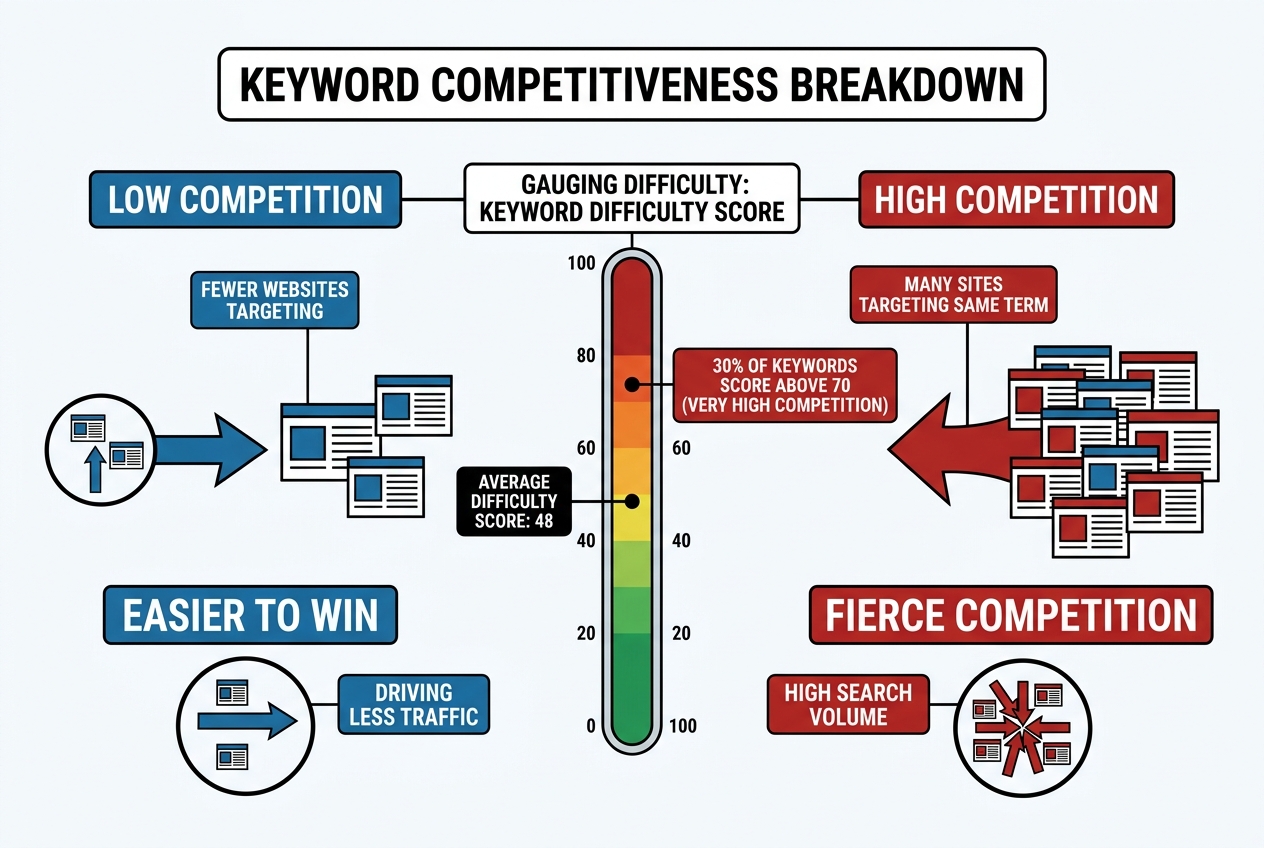
Competitive keywords are search terms that attract a lot of interest from websites trying to rank for them. These keywords usually have high search volume but also fierce competition, meaning many sites are targeting the same term. On the other hand, low competition keywords have fewer websites trying to rank, making them easier to win but usually driving less traffic.
A common way to gauge keyword competitiveness is the keyword difficulty score. This score ranges typically from 0 to 100 and estimates how hard it is to rank on the first page of Google for that term. For example, an average difficulty score is around 48, but 30% of keywords score above 70, indicating very high competition.
Here’s a breakdown to clarify:
| Keyword Type | Difficulty Score Range | Competition Level | Traffic Potential |
|---|---|---|---|
| Low Competition | 0-30 | Low | Lower, niche |
| Moderate Competition | 31-70 | Medium | Moderate, steady |
| High Competition | 71-100 | High | High, valuable |
Ranking for competitive keywords can bring a significant boost in traffic since these terms are often highly searched and relevant. Given that Google dominates 89.3% of the search market and organic search drives 53% of all web traffic, securing spots for these keywords is a strategic way to increase visibility and user acquisition.
Pro Tip: Pro Tip: Don’t chase every competitive keyword; focus on those aligned with your audience and business goals for better ROI.
But targeting competitive keywords isn’t without its challenges. The race is tough, and it often takes 6 to 12 months to climb to the first page, so patience and strategic planning matter. That’s why understanding these keywords deeply can shape your content strategy to prioritize efforts that actually pay off.
Next, we’ll examine how to evaluate keyword difficulty scores effectively and use that insight to pick the right keywords for your SEO goals.
How to Identify and Evaluate Competitive Keywords Effectively
Identifying competitive keywords is more than plugging terms into an SEO tool. You need a system to find them accurately and evaluate them strategically. Here’s how I approach it:
-
Use Multiple SEO Tools to Discover Keywords Start by feeding your seed keywords into platforms like Google Keyword Planner, Ahrefs, or SEMrush. These tools show you related terms, search volumes, and competition metrics. Don’t rely on just one source; each tool indexes data differently.
-
Interpret Keyword Difficulty and Search Volume Metrics Thoughtfully Keyword difficulty scores tell you how hard it is to rank for a term, usually on a 0-100 scale. The average in 2026 is around 48, with about 30% of keywords scoring above 70, signaling very tough competition. High search volume means more traffic but usually higher difficulty. Balance is key—targeting only the hardest keywords often leads to wasted effort.
-
Dive Deeper Than the Scores: Examine the SERP Landscape Look beyond numbers. Analyze the first page itself: who ranks there? Are they authoritative sites or infrequent bloggers? Do features like snippets, videos, or ads dominate the results? Such nuances reveal if you have a practical chance to break in or if the keyword is monopolized.
-
Leverage AI-Powered Insights for Emerging Trends AI Overviews appear in 34% of queries now, reshaping how people search. AI tools can highlight rising topics before they saturate the market. They also help you understand shifting user intent and zero-click trends, which are critical for adjusting your keyword strategy in real time.
-
Streamline Your Process Using TryRoki’s Suite I find TryRoki’s combined tools perfect for both discovering competitive keywords and analyzing their difficulty and SERP context. Its AI-integrated features help surface emerging keyword trends and offer a more nuanced view of competitiveness. This can save hours of manual research.
Pro Tip: Use a combination of manual SERP reviews and AI-powered tools to get a fuller picture of keyword competitiveness.
Competitive keyword research isn’t static. It requires ongoing attention and the right tools. After you nail these evaluation techniques, the next step is crafting content that can realistically lift your rankings in that competitive landscape.
Next up, we’ll explore strategies for creating content that targets these keywords without getting lost in the noise.
Crafting Content Strategies to Compete for High-Difficulty Keywords
Competing for high-difficulty keywords demands clear strategy and smart resource allocation. These keywords often have an average difficulty score above 70, meaning you’re up against well-established players. Here’s how you can navigate this challenge:
-
Tailor Content to User Intent
Start by truly understanding why people search those keywords. Are they looking for quick answers, detailed guides, or product comparisons? Content that directly matches search intent outperforms generic pages, even when competing against heavier budgets. -
Use AI to Scale and Sustain Quality
AI content tools can help maintain a steady output without sacrificing quality—a major hurdle in competitive niches. However, don’t rely solely on AI-generated text; human edits ensure it stays relevant and trustworthy. I’ve seen projects where AI provided a strong first draft, but the human touch cut down unnecessary fluff and improved clarity. -
Build Comprehensive, Authoritative Content
You need to go deeper than competitors. That means covering subtopics thoroughly, citing credible sources, and answering related questions. Your content has to become the one-stop reference for that keyword. This depth often translates into longer time on page, reduced bounce rates, and better rankings. -
Optimize Meta Tags and Schema Markup
Make your content stand out in search results by optimizing your title tags and meta descriptions with clear, concise phrasing that’s aligned with the keyword intent. Adding schema markup can enhance your snippet with ratings, FAQs, or other elements, increasing click-through rates despite intense competition. -
Adapt for Mobile Search Trends
Since over 62% of global traffic is mobile, your content must load fast and be easy to navigate on phones. If your competitor’s site looks great on desktop but fails on mobile, that’s your opening. I recommend testing your pages regularly on mobile and prioritizing mobile user experience in your optimizations.
Pro Tip: Pro Tip: Regularly update competitive keyword content to maintain rankings amid evolving AI search landscapes.
Managing high-difficulty keywords is tough. It forces you to combine thorough user understanding, tactical AI use, and relentless content refinement. This approach gives you the best shot at breaking through the noise.
Next, we’ll explore how to measure keyword difficulty effectively to fine-tune your SEO priorities.

Common Mistakes When Targeting Competitive Keywords
Targeting competitive keywords without a clear plan often leads to wasted time and resources. I’ve seen many businesses jump in too fast without understanding the full challenge. Here are the most common traps I recommend avoiding:
-
Ignoring keyword difficulty: Many folks look only at search volume and skip checking how tough the competition is. With 30% of keywords scoring above 70 on difficulty, pushing for hard keywords blindly results in slim chances of ranking.
-
Failing to differentiate content: When every site is hitting the same angles on a saturated topic, your page won’t stand out. Competitors have likely covered basics well, so your content must offer a unique perspective or deeper insight.
-
Neglecting AI Overviews and zero-click trends: AI Overviews show up in over a third of searches now, and 60% of queries end without any clicks. This means even ranking top might not bring traffic if you don’t optimize for these new search behaviors.
-
Overlooking mobile user experience and site speed: With nearly 63% of traffic coming from mobile devices, slow loading pages or hard-to-navigate mobile sites kill your rankings faster than you’d expect.
-
Not measuring or adapting strategy: SEO isn’t set-it-and-forget-it. If you don’t regularly check performance data and refine your approach, you’ll keep spinning wheels against competitors who do.
Each of these mistakes creates serious roadblocks. For instance, ignoring keyword difficulty wastes budget on content that just isn’t competitive. Meanwhile, missing the shift in how users interact with AI-driven search means your pages won’t attract clicks even if they rank.
You can defend your target terms better by understanding these pitfalls clearly and adjusting tactics before you commit a full campaign. This groundwork will make your next moves smarter and more effective.
Next, let’s explore how to craft content strategies that truly set your website apart against those tough competitive keywords.
Boosting SEO ROI by Winning Competitive Keywords Over Time
Winning competitive keywords is a marathon, not a sprint. On average, it takes between 6 to 12 months to see your site land on page one of Google for these tough search terms. This timeline demands patience and persistence; most businesses give up too soon before real results start to show.
Here’s a rough timeline of what to expect:
- Months 1-3: Foundations and initial optimization — auditing your site, updating content, and building authority.
- Months 4-6: Increased indexation and steady ranking improvements. Traffic grows, but not dramatically.
- Months 7-9: Noticeable ranking breakthroughs, especially on secondary keywords linked to your core terms.
- Months 10-12: Solid placement on page one, sustained organic traffic, and conversions start to pick up meaningfully.
When you manage this process well, the payoff is huge. In 2026, SEO strategies targeting competitive keywords deliver an average return on investment (ROI) of 748%. That’s nearly an eightfold return for every dollar you put into content creation, link-building, and technical SEO.
But the journey isn’t without challenges. Ranking for high-difficulty keywords means constant adaptation. Search engines update algorithms regularly, and AI-driven search features now affect how users find content. I’ve found relying heavily on AI and automation tools helps scale efforts without burning out the team. Tools like TryRoki’s AI-powered content generation and reddit posting automation take some heavy lifting off your plate, enabling ongoing optimization.
Finally, don’t let your SEO strategy stagnate. Regularly revisit your ranking targets and tweak your content. Keep an eye on how AI overviews and zero-click searches evolve because these trends reshape organic traffic behavior every year.
This disciplined approach results in consistent traffic growth and a strong digital presence that pays off long term. Now, let’s look at some common mistakes that can derail your competitive keyword targeting efforts.
My honest take on competing for competitive keywords
Competing for highly competitive keywords isn’t just tough—it’s often misunderstood. Many marketers see high keyword difficulty as a stop sign and pivot to low-competition alternatives, thinking it’s less effort. From running TryRoki for years, I’ve found that this mindset misses the bigger picture. Keyword difficulty scores are a blunt instrument. Success hinges more on understanding user intent, weaving AI insights into content, and crafting quality that genuinely meets reader needs.
Here’s the rub: chasing competitive keywords demands patience and precision. It’s far from a quick win. You might pour hours into research, content tweaks, and AI-driven optimization without seeing immediate payoff. But the long-term return is worth the headache. Competitive keywords draw sustained traffic that grows your brand’s authority and reach—something low-competition keywords simply can’t replicate.
One pitfall is obsessing over these scores or chasing shortcuts that compromise quality. AI helps, but it’s not a magic fix if your strategy is shallow or reactive. You have to treat AI tools as partners, not replacements, and commit to steady, iterative improvement. That’s how you unlock lasting growth.
If you’re aiming for the top spots, the biggest mistake is avoidance. Embrace complexity with the right tools and mindset. It’s tough, yes, but that’s exactly why it pays off.
— Daniel
Elevate Your SEO with TryRoki’s AI-Powered Keyword Tools
Managing competitive keywords today is trickier than it looks. From my experience running TryRoki, simply finding keywords isn’t enough—you need to dig into ones that others often overlook or misjudge. Our platform doesn’t just list competitive keywords; it helps you prioritize those that fit your site's specific strengths.
Sure, the setup isn’t flawless—navigating through AI-driven content suggestions and figuring out how to best use Reddit for engagement takes some trial and error. But once you fine-tune your approach, it’s a game-changer. TryRoki's keyword analysis features help me zero in on opportunities that matter instead of chasing overly saturated terms.
If you’re thinking about where to invest your content effort next, exploring TryRoki could offer actionable insights without overwhelming your daily workflow. It’s about working smarter with your SEO, not just harder.
Frequently Asked Questions
A keyword becomes competitive when its difficulty score rises above 70 on a scale of 100, as it does in 2026. This score means hundreds or even thousands of sites aggressively target it, which makes climbing to the top search results tough. It’s tempting to go after these, but the effort doesn’t always match the payoff immediately.
Ranking on Google’s first page for competitive keywords often takes between 6 and 12 months—sometimes longer if your content or backlink profile isn’t strong. You need to invest steadily in quality content and backlinks before you see meaningful progress. So, don’t expect overnight results here.
They definitely can, but watch out for over-reliance. AI tools analyze mountains of data on search trends, user behavior, and competitor weaknesses in seconds, pinpointing strong competitive keywords you might miss. That said, they’re only as good as how you interpret and apply their insights.
Because about 60% of searches end with no clicks anymore, especially due to AI-powered answer snippets showing at the top. Ignoring these zero-click results means losing out on huge visibility, even if you rank highly. So, it’s crucial to aim for featured snippets and quick answers along with classic ranking.
Both matter, but it depends on your goals. Low competition keywords offer quicker wins and bring initial traffic boosts—sometimes within weeks—while competitive keywords build stronger long-term authority and bigger audiences over many months or years. Mixing both is usually the smartest move.
Written by Daniel.
Recommended reads
- Low Competition Keywords How To Find And Use Them Effectively
- Check Keyword Difficulty How To Evaluate And Use It Strategically
- Ai Blog Writer
- How To Get Organic Traffic Proven Strategies For Growth