Daniel D.
An SEO roadmap template turns vague goals into ordered tasks with owners, deadlines, and measurable outcomes. Use a 90-day plan to establish your baseline, fix technical issues, prioritize content, build authority, and review results without confusing publishing volume with progress.
Your team probably has more SEO ideas than it can execute. Without an agreed order, owner, or definition of success, writers publish what feels urgent, developers fix the loudest issue, and nobody can connect activity to growth. The Content Marketing Institute found that 54% of B2B marketers reported moderate content marketing success, while 21% felt minimally or not at all successful in its 2025 benchmark. That is a useful warning against measuring output alone. Use the 90-day plan below to set a Search Console baseline, prioritize technical and content work, build authority responsibly, and review progress weekly.
| Point | Details |
|---|---|
| Establish Baselines | Record clicks, impressions, CTR, average position, indexed pages, and conversions before changing the site. |
| Rank By Impact | Score each task from 1 to 3 using expected impact, effort, and dependencies instead of publishing order. |
| Use 90 Days | Divide your roadmap into three 30-day phases: diagnose, execute, and improve. |
| Judge With Data | Review performance weekly, but wait 28 to 90 days before judging most SEO changes. |
| Protect Page Quality | Use AI to speed up production, but give every page a useful purpose, original value, and human review. |
What an SEO roadmap template should include
An SEO roadmap turns business priorities into assigned, dated decisions. It is not a second audit or a prettier task list.
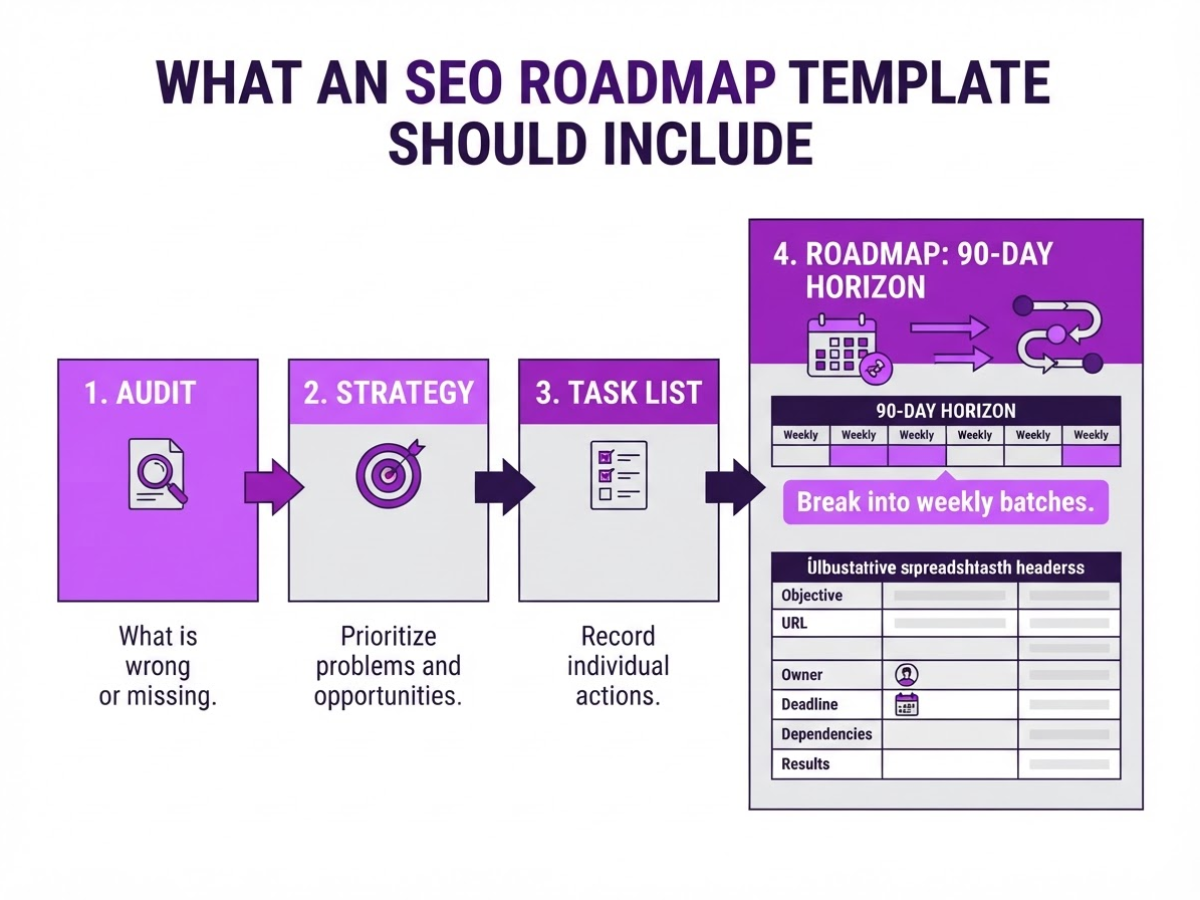
An audit identifies what is wrong or missing. A strategy decides which problems and opportunities matter most. A task list records individual actions. The roadmap connects those actions to owners, deadlines, dependencies, and results. Confusing these documents is how teams spend three weeks fixing minor title tags while important conversion pages sit untouched.
Start with a 90-day horizon and break it into weekly batches. Your spreadsheet or project board should include these columns:
| Objective | URL or topic | Task | Owner | Priority | Dependency | Due date | Status | KPI | Review date |
|---|---|---|---|---|---|---|---|---|---|
| Improve qualified leads | /pricing | Fix blocked canonical tag | Developer | High | CMS access | Week 1 | Not started | Indexed URL, demo leads | Week 4 |
| Grow product sign-ups | “SEO roadmap template” | Write and publish content brief | Content lead | Medium | Keyword research | Week 3 | Drafting | Organic clicks, sign-ups | Week 8 |
| Increase local visibility | Google Business Profile | Review performance and calls | Marketing owner | High | Tracking configured | Week 12 | Planned | Calls, direction requests | Week 13 |
Group rows into six workstreams: technical SEO, content, internal linking, authority, conversion, and measurement. Tie every task to a business outcome such as qualified leads, sales, sign-ups, or local visibility. A ranking increase matters less if it attracts people who never contact you.
Pro Tip: Add a dependency column before assigning deadlines. Fixing indexation or templates can unlock dozens of later content tasks.
Use Search Console clicks, impressions, average CTR, and average position alongside conversions in your analytics system. I also keep a small toolkit, including free SEO tools, but tools do not replace a review decision. Set milestones and review them instead of treating publication as progress.
The next step is turning this structure into a prioritized 90-day plan.
Build the baseline before choosing SEO priorities
Before assigning a priority, establish what is already happening. In week one, I want one shared baseline that connects search visibility, technical risk, and revenue. Otherwise, a team can spend a month fixing low-impact metadata while a broken template keeps important pages out of Google.
-
Export the last three months from Search Console. Save clicks, impressions, average CTR, and average position. Google’s report supports filters for queries, pages, countries, devices, search appearance, and dates, so export useful segments rather than relying on the default total. Keep the date range visible. Search demand shifts quickly, and an unexplained month-over-month change is difficult to investigate later.
-
Add business outcomes to the search data. Record organic and assisted conversions by landing page, country, device, and month where those dimensions exist. A page with 1,000 visits and no qualified action deserves less attention than a page with 80 visits that produces demo requests. Assisted-conversion tracking is annoying because channel definitions rarely align perfectly, but ignoring it makes SEO look weaker than it is. Use this practical guide to integrating SEO if your reporting still lives in separate tools.
-
Classify every important page. Put URLs into five groups: winners, near-winners, declining pages, underperformers, and pages with no strategic role. Define groups with numbers, such as top-three rankings for winners, positions 4 to 20 for near-winners, and a 20% traffic decline over three months for declining pages. Mark thin, duplicated, outdated, or orphaned pages instead of pretending every URL deserves an update.
Pro Tip: Create an “evidence” field in the roadmap and attach the query, page, report, or screenshot that justified each task.
-
Inspect the site’s technical baseline. Check index coverage, sitemap status, canonical signals, robots directives, page templates, and internal-link depth. Open representative URLs from each template because a clean homepage report can hide a product or article template that blocks crawling. Record whether each issue affects one URL, a template, or the whole site.
-
Capture experience and write the opportunity. Record current Core Web Vitals by template. Google’s good thresholds are LCP within 2.5 seconds, INP below 200 milliseconds, and CLS below 0.1. Turn each observation into a statement such as: “Product pages load slowly on mobile, reducing organic conversion potential; reduce image payloads and retest within 30 days.” That format gives the roadmap an owner, an action, and a business outcome.
With this evidence in place, rank opportunities by impact, effort, and urgency rather than by whoever speaks first in the planning meeting.
Turn the baseline into a prioritized 90-day SEO plan
A 90-day roadmap should reflect what your site can support, not what an SEO checklist says you ought to do. I usually rank each task from 1 to 5 for expected impact and effort, then divide impact by effort. A prerequisite moves up even when its score looks mediocre. Publishing 20 articles has little value if indexing, templates, or analytics are broken.
| Month | What to prioritize | Typical outputs |
|---|---|---|
| 1 | Remove blockers and set direction | Crawl fixes, measurement, page improvements |
| 2 | Match content to demand | New or refreshed pages, clusters, internal links |
| 3 | Expand proven winners | Snippet tests, conversion updates, mentions, lessons |
Pro Tip: Reserve 15–20% of each month for unexpected technical issues and promising opportunities found in fresh performance data.
In month one, fix accidental noindex tags, broken redirects, duplicate URLs, unusable templates, missing conversions, and pages that never enter the index. Set up Search Console, analytics, conversion events, and a baseline for clicks, impressions, rankings, and leads. Google’s Core Web Vitals targets are LCP within 2.5 seconds, INP below 200 milliseconds, and CLS below 0.1. Improve important existing pages before commissioning a large batch of new ones. Free SEO tools can help with early checks, but they cannot replace judgment when a template creates hundreds of weak URLs.
Month two is for clear search intent. Choose between a new page, a refresh, consolidation, deletion, or a conversion improvement. Do not turn every keyword into another article. Build or repair a topic cluster, then add contextual links from relevant pages using descriptive anchors. A new service page may need links from three useful guides, while two overlapping blog posts may deserve one stronger consolidated page.
Month three should follow evidence. Expand pages gaining impressions, rewrite titles with high impressions but weak CTR, improve calls to action on pages attracting qualified visits, and pursue relevant mentions from partners, associations, or specialist publications. Document what changed and what failed. That record prevents the team from repeating the same experiment six months later.
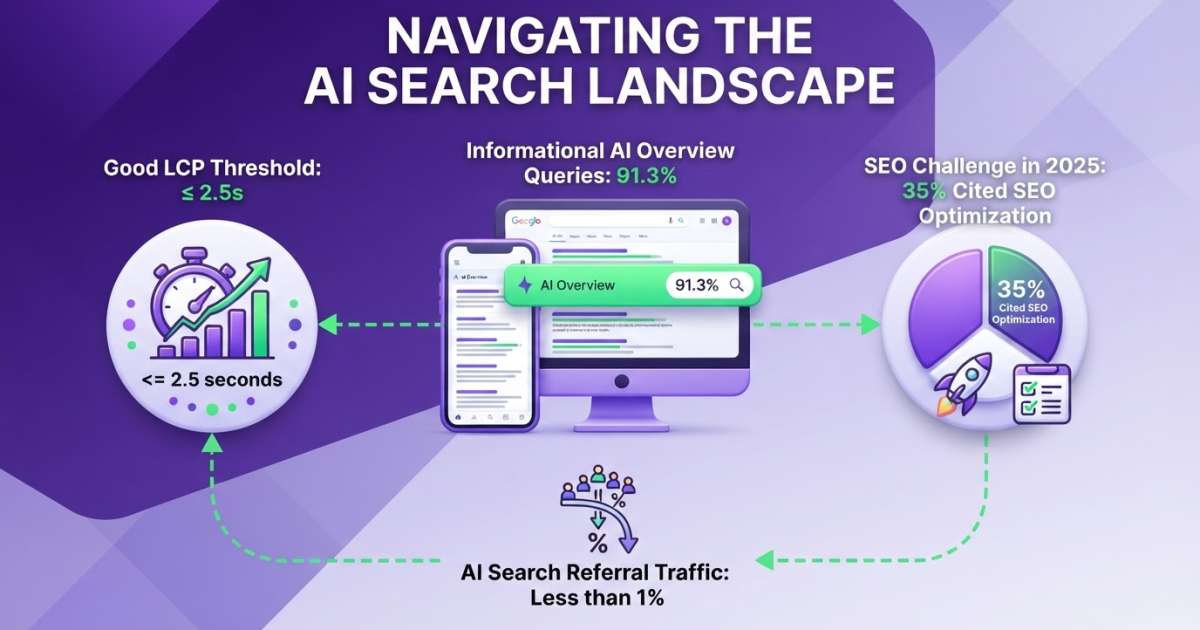
Keep two tracks in the spreadsheet. Track Google rankings, clicks, crawl health, and conversions separately from AI-search visibility, where clear definitions, original evidence, and direct answers matter. Semrush found that 91.3% of queries triggering AI Overviews were informational in January 2025, while BrightEdge reported AI search drove less than 1% of referral traffic in its January to August 2025 study. Keep conventional SEO primary and add helpful AI-readable answers without producing thin pages at scale.
These priorities now need owners, deadlines, and measurable milestones.

Execute technical SEO tasks without creating new problems
Deployment is where a tidy SEO roadmap can become a liability. I have seen a harmless template change create hundreds of duplicate URLs, and a robots.txt edit quietly block an entire product directory. Treat every technical task as a change to a live system, not a box to tick.
Before marking a task complete, test canonicalization, redirects, indexation, XML sitemaps, structured data, mobile rendering, and Core Web Vitals. Google uses canonicalization to select the representative URL from duplicate or near-duplicate pages, so verify that the canonical points to the version you want indexed. A canonical link check can help, but inspect the implementation yourself.
Do not change URLs, templates, canonicals, or robots directives in isolation. Check affected page types, internal links, pagination, hreflang if you use it, analytics tags, and redirect dependencies. A redirect that works in a browser can still send an important parameter variant to the wrong destination. Mobile rendering deserves the same scrutiny because broken phone layouts can undermine a correct desktop template.
Common mistakes to catch before sign-off:
- Publishing a sitemap with a
lastmoddate that changes daily even when the page did not receive a meaningful update. - Assuming valid structured data guarantees a rich result. It makes a page eligible, not entitled, to enhanced search treatment.
- Checking only the homepage instead of representative product, category, article, filtered, and error URLs.
- Inspecting raw source but not rendered HTML, where JavaScript can alter links, canonicals, content, or schema.
- Skipping rollback notes because the deployment looked small. Record the previous template, directive, redirect map, and owner before release.
After launch, monitor Search Console’s Performance report for clicks, impressions, CTR, and average position, then watch indexing and enhancement reports for several weeks. Technical SEO is recurring maintenance, not an audit milestone you finish once. Tie each item to an owner, verification date, and rollback path.
Create a weekly review loop that compounds results
I run the roadmap through a short review loop, not a dramatic monthly meeting. Every week, block 30 minutes to check whether the work moved forward and whether the evidence still supports the plan.
- Review delivery first. Mark completed work, blocked tasks, technical errors, and new issues. A task blocked for two weeks is no longer a priority unless someone owns the fix and has a completion date.
- Check search movement. Compare clicks, impressions, CTR, average position, indexation, and conversions with the previous week and the same period last year when seasonal demand matters. Search Console’s Performance report lets you filter these metrics by page, query, device, country, and date.
- Separate signal types. Treat impressions, indexation, rankings, and meaningful engagement as leading indicators. Leads, opportunities, and revenue are lagging indicators. A new page can gain impressions for six weeks before producing a qualified enquiry, while a ranking jump for an irrelevant query produces nothing.
- Investigate before reacting. Use page-level and query-level comparisons together. A click decline can reflect lower brand demand, seasonality, an algorithm change, a tracking problem, or a competitor’s new result. Check analytics, annotations, index coverage, and recent deployments before rewriting content.
- Apply a decision rule. Expand a page when rankings and qualified conversions rise together. Refresh it when impressions remain healthy but CTR or engagement falls. Consolidate overlapping pages, pause work with no credible business link, and investigate sudden technical or traffic changes before assigning more production tasks.
Write down what changed, when it changed, the expected effect, and the earliest sensible review date. That record stops teams from judging a page two days after launch or forgetting which template change caused a gain.
At month-end, hold a 45-minute retrospective. Rebalance the next 30 days around leads and revenue, then remove tasks that no longer support the business goal. The roadmap should get narrower as evidence improves, not grow into an endless SEO wishlist.
The next planning cycle can now focus on the strongest evidence.
My honest take on SEO roadmap templates
I treat an SEO roadmap as a decision record, not a project-management prop. Its job is to show why a task matters, who owns it, what “done” means, and when you will review the result. If those details are missing, the roadmap creates a comforting appearance of progress while traffic, leads, and revenue stay flat.
My contrarian view is simple: a shorter roadmap is usually stronger. Ten well-evidenced tasks with named owners and review dates will usually beat a 100-item backlog that encourages shallow publishing. I would rather see a team fix one important service page, connect it to three relevant internal pages, and measure qualified enquiries over 60 days than publish 20 articles nobody maintains.
I also would not replace conventional SEO with AI-search optimization yet. Referral patterns are still developing, so I would keep improving useful pages, site structure, and distribution while watching where visitors actually come from. Roki AI can help create a repeatable weekly cadence, including content tasks and relevant Reddit discussions, but it cannot own the judgment. Someone at the business must decide which topics deserve attention, what quality means, and whether the traffic is commercially useful. That human review is the part most teams try to automate too early.
- Keep the roadmap short enough to review every week.
- Test AI-assisted production on a small batch before increasing volume.
- Judge progress by qualified actions, not activity alone.
— Daniel/Aleksandra
Turn your SEO roadmap into a weekly operating rhythm
A roadmap earns its place when someone completes the next useful task, not when it sits in another planning document. When I review SEO workflows with teams, the recurring problem is a backlog full of vague tasks, missing owners, and priorities that change every week.
Start with Roki’s free SEO tools and check one site against your own Search Console data, technical findings, and editorial judgment. Roki AI can help create content and surface 3 to 10 weekly tasks aimed at improving visibility in Google and AI-influenced search. The suggestions still need your review, and setup feels repetitive at first. That trade-off is worthwhile if you begin with one priority and one review cycle. When that rhythm works, see how Roki AI turns SEO backlogs into recurring actions.
Frequently Asked Questions
Start with business goals, audience, site structure, keyword opportunities, technical requirements, and measurement setup, then turn them into a 90-day plan. Spend month one on indexation and technical issues, month two on high-intent pages, and month three on internal links and content gaps, with a 30-minute review every week.
Your strategy explains the direction and reasoning, such as which customers, topics, and search journeys matter most. Your roadmap turns that thinking into assigned tasks, deadlines, dependencies, and KPIs for the next 30 or 90 days.
Review it once a week for progress, blockers, and new evidence, but do not rewrite priorities every time one page moves in Google. Re-prioritize monthly, then run a deeper quarterly reset when goals, seasonal demand, major site changes, or search behavior shift.
Track impressions, clicks, click-through rate, average position, indexed pages, organic conversions, qualified leads, and revenue when you can connect it reliably. Give every metric a baseline and a decision rule, such as investigating pages below a 2% CTR after 1,000 impressions instead of reacting to daily changes.
Yes, but publish it only after a human checks the facts, adds first-hand detail, and confirms that it answers the search intent better than existing pages. At TryRoki, we would test a small batch of 10 pages first, measure useful traffic and conversions, and stop if the content adds volume without giving readers a reason to stay.
Written by Daniel/Aleksandra.
Recommended reads
- Integrating Seo A Practical Guide
- Competitive Keywords A Strategic Guide To Win In Seo
- How Roki Ai Streamlines Your Seo Content Workflow
- Free Seo Tools
Sources
- Understanding Core Web Vitals and Google search results
- Performance report (Search results): Overview and basic setup
- Build and Submit a Sitemap
- What is URL Canonicalization
- General Structured Data Guidelines
- Spam Policies for Google Web Search
- B2B Content Marketing: 2025 Benchmarks & Trends
- Semrush Report: AI Overviews’ Impact on Search in 2025
- BrightEdge Data Finds AI Accounts for Less Than 1% Search, Organic Traffic Continues to Dominate