
Google Search Competitors: Practical SEO Guide
TL;DR: Google still leads search, but Bing, Brave Search, DuckDuckGo, Ecosia, and AI search platforms reach different audiences and discovery paths, so you should not optimize for Google alone. Compare where your customers search, then build a focused plan for those channels, using Roki AI’s 3 to 10 weekly tasks to improve your visibility across Google and AI search.
If you are comparing Google search competitors, you are probably tired of watching one algorithm change dictate your traffic, leads, and budget. It is frustrating to know your audience may be searching elsewhere while your team keeps producing content for the same crowded results page. Google accounted for 91.1% of worldwide search-engine market share in August 2026, compared with 4.5% for Bing and 0.7% for DuckDuckGo, but that dominance does not make Google your only strategic bet. This guide defines the main competitors, matches each to its user segment, compares visibility opportunities, and lays out a 30-day monitoring and content workflow with Roki AI without treating every platform alike.
| Point | Details |
|---|---|
| Map audience behavior | Choose competitors based on where your customers search, not on brand popularity alone. |
| Prioritize selectively | Start with 1–2 secondary search engines instead of splitting effort across every platform. |
| Compare discovery systems | Evaluate 5 factors: index quality, privacy, audience fit, referral potential, and optimization controls. |
| Reuse strong foundations | Technical SEO, useful content, clear entities, and trustworthy references support visibility across multiple platforms. |
| Monitor weekly | Review rankings, referrals, indexed pages, and emerging AI-search mentions every 7 days. |
What Counts as a Google Search Competitor?
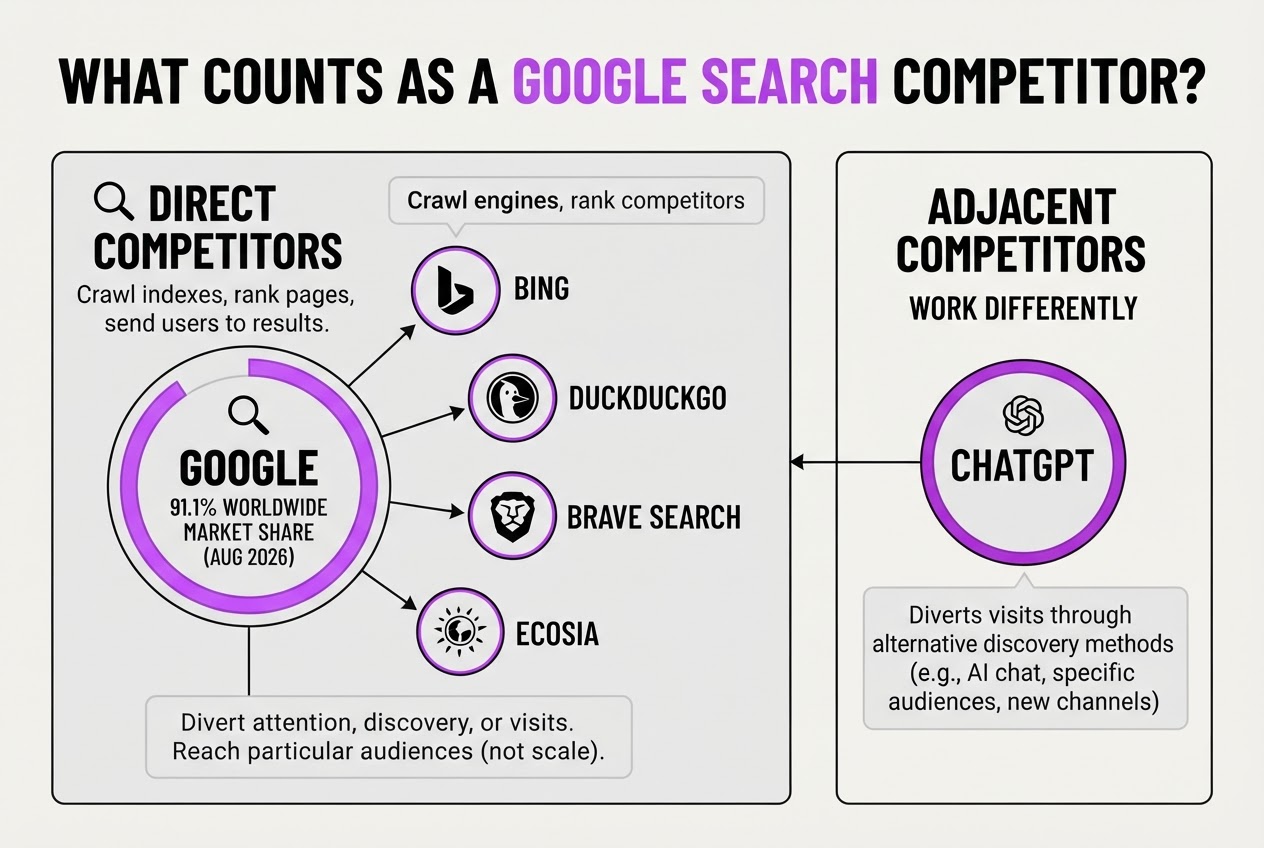
A Google search competitor is any channel that can divert attention, discovery, or visits from a Google result. That definition is wider than “another search engine.” In my work with website owners, this distinction prevents a common mistake: treating every alternative as if it were trying to replace Google outright.
Direct competitors include Bing, DuckDuckGo, Brave Search, and Ecosia. They crawl or receive web indexes, rank pages for typed queries, and send users to results. Google still dominates by a wide margin: it held 91.1% of worldwide search-engine market share in August 2026, compared with 4.5% for Bing and 0.7% for DuckDuckGo. Smaller engines matter because they reach particular audiences, not because they match Google’s scale.
Adjacent competitors work differently. ChatGPT, Perplexity, Gemini, and Copilot may answer a question directly, cite a page, or recommend a brand without showing ten blue links. Reddit, YouTube, TikTok, and shopping marketplaces can also compete for discovery while sending little or no traditional organic traffic. AI platforms sent 1.3 billion referral visits to a sample of the top 1,000 websites in May 2025, so dismissing them as a fad is already a poor planning decision.
I evaluate a competitor across six practical measures:
- Market reach: How many relevant users can it actually expose you to?
- User intent: Are people researching, comparing, buying, or asking for a recommendation?
- Index independence: Does the platform maintain its own crawl and ranking system, or mostly reuse another index?
- Privacy: Does its audience choose it to avoid profiling or personalized search?
- Commercial value: Can visibility produce a sale, lead, subscription, or credible referral?
- Measurement access: Can you see rankings, citations, clicks, and conversions reliably?
These channels compete for different outcomes: queries, referrals, indexed visibility, or brand mentions. They are opportunities to add to your acquisition mix, not automatic Google replacements. For a closer comparison of alternatives, see this practical guide to search engines better than Google.
Pro Tip: Separate “where users search” from “where users discover brands”; AI referrals and search-result visibility may require different content signals.
The useful next question is which competitors deserve your attention first.
Which Competitor Fits Your Audience?
Audience fit matters more than raw market share. When we review search competitors with customers, we start with who already buys, which devices they use, and what they expect from a search experience. The right secondary engine can send fewer visits than Google but produce more qualified leads.
Bing deserves attention if your customers use Windows, Microsoft Edge, Microsoft 365, or workplace devices managed by Microsoft. It also tends to be useful for commercial searches, where product comparisons and purchase research matter. Bing reported approximately 124 million average monthly active users in the European Union between August 2023 and June 2024. Do not treat that figure as your audience, though. Check your own country and device data first.
DuckDuckGo fits privacy-conscious visitors who dislike behavioral profiling. Its privacy model changes your assumptions: results and ads are not built around a persistent personal search history in the same way. DuckDuckGo says it does not share information that personally ties users to their searches, chats, visits, or individual search history. That can limit personalization, so content built around returning-user targeting can perform differently.
Brave Search attracts people who want an independent index rather than another search layer dependent on a dominant provider. It is worth testing for technical, privacy-focused, and media audiences, although its smaller reach means you need clean measurement. Ecosia makes more sense when sustainability is part of the buying decision or your brand already serves environmentally minded customers. Its tree-planting mission is appealing, but values alone will not compensate for poor regional coverage or weak conversion intent.
Start with customer research, then validate it against analytics, surveys, and referral data. We usually score each engine like this:
| Engine | Audience fit | Visibility potential | Conversion quality | Effort |
|---|---|---|---|---|
| Bing | 1–5 | 1–5 | 1–5 | 1–5 |
| DuckDuckGo | 1–5 | 1–5 | 1–5 | 1–5 |
| Brave Search | 1–5 | 1–5 | 1–5 | 1–5 |
| Ecosia | 1–5 | 1–5 | 1–5 | 1–5 |
Weight conversion quality and audience fit twice if sales matter more than reach. Review other search engines beyond Google before choosing a test set.
Pro Tip: Review server logs and referral analytics before choosing a target engine; a small existing audience with strong conversion can be more valuable than a large theoretical market.
After you choose one secondary engine, match its audience expectations to the content and technical work you will measure next.
Google vs. Bing, Brave, DuckDuckGo, and Ecosia
When I review search competitors for a customer, I start with five real queries, not a market-share chart. Google usually offers the broadest index, strongest local intent, mature shopping features, and the deepest integrations with Maps, Merchant Center, Search Console, and Analytics. That convenience also creates the most personalization, which can make two people see different competitors.
Bing is the practical second engine for Microsoft-heavy teams, B2B searches, and some local and shopping queries. Its reporting is more accessible than most alternatives, but its smaller audience means you should not copy Google targets blindly. Brave Search is different: its documentation describes an independent index that crawls and indexes billions of pages, rather than simply repackaging Google results.
DuckDuckGo reduces user-level personalization and says it does not share information that links individuals to their searches. That helps privacy-led products, but it limits remarketing audiences, profile-based targeting, and some audience measurement. Ecosia has a similar privacy-leaning appeal, with a clear sustainability position, though its local depth, shopping coverage, integrations, and reporting can vary by market.
Pro Tip: Compare the same five target queries across each engine manually before committing; record result types, competitor domains, freshness, and answer features.
| Audience | Strength | Limitation | Optimization priority | Measurement method |
|---|---|---|---|---|
| B2B buyers | Google and Bing cover technical research and Microsoft workflows | Long sales cycles hide engine-level conversions | Build topic depth, clear authorship, and comparison pages | Search Console, Bing Webmaster Tools, CRM source data |
| Local services | Google usually leads on Maps, reviews, and nearby intent | Personalization and location can distort rank checks | Business Profile, service-area pages, reviews | Calls, direction requests, UTM-tagged leads |
| Ecommerce | Google and Bing support product discovery and shopping features | Feed rules and commercial competition are demanding | Product feeds, structured data, price and availability | Merchant reports, analytics, revenue by landing page |
| Publishers | Google offers broad discovery and news visibility | Algorithm changes can cause sharp traffic drops | Freshness, internal links, original reporting | Analytics, referral logs, returning readers |
| Privacy-led products | Brave and DuckDuckGo fit users who reject profiling | Smaller reach and thinner audience reports | Useful content, direct demand, privacy messaging | Server logs, first-party analytics, assisted conversions |
| Sustainability brands | Ecosia gives the mission a natural audience fit | Limited integrations and uneven query coverage | Explain measurable environmental impact | Tagged campaigns, direct traffic, customer surveys |
Do not treat privacy as a minor ranking variable. Less personalization can produce cleaner comparisons, but it also makes remarketing and demographic modeling less precise. For measurement, combine engine-specific tools with first-party analytics and sales data; this practical guide to other search engines can help you build the initial shortlist.
The right choice depends on intent: optimize Google first for reach, add Bing for B2B coverage, test Brave or DuckDuckGo for privacy-sensitive audiences, and use Ecosia when sustainability is part of the buying decision. The next move is turning that comparison into a competitor research workflow.

How to Build a Multi-Search Visibility Plan
I use one repeatable workflow instead of chasing every new search product. The goal is not to rank everywhere at once. It is to become visible where a specific audience already looks for answers, products, and recommendations.
-
Choose one audience segment and 10–20 priority queries. Start with a defined group, such as independent retailers or B2B marketing managers, then list the questions they ask before buying. Mix informational, comparison, local, and product-led searches. I prefer 10 focused queries over 200 vague keywords because a small set exposes patterns you can actually act on.
-
Capture the current search landscape. Search each query on Google and the other engines that fit your audience. Record organic rankings, featured snippets, AI answers, local packs, product results, videos, competitor pages, and repeated brands. Save the date, location, device, and query wording because results can change noticeably between a desktop search in New York and a mobile search elsewhere. A practical guide to other search engines can help you decide which platforms deserve this comparison.
-
Audit the site before rewriting content. Check crawlability, indexation, redirects, page experience, structured data, authorship signals, and internal links. A brilliant article cannot compete if Googlebot cannot reach it or if the important URL stays out of the index. I also check whether internal links describe the destination clearly, rather than using ten instances of “click here.”
-
Improve the page for people and machines. Put a direct answer near the top, define important entities plainly, cite original research or first-hand evidence, and add details that competing pages skip. Do not pad a 700-word answer into 2,000 words. That usually creates friction for readers and gives reviewers more unsupported claims to remove.
-
Distribute it where the audience participates. Earn reputable mentions, answer relevant community questions, and keep your brand name, authors, and descriptions consistent across profiles. Do not spray links into forums. That tactic annoys moderators and rarely builds trust. Adobe reported a 1,200% rise in U.S. retail traffic from generative-AI sources during its measured period, with those visitors showing 8% higher engagement, so distribution now includes sources beyond traditional results.
-
Measure weekly, then reprioritize. Track impressions where platforms expose them, organic sessions, referral conversions, indexed URLs, rankings, and mentions in AI answers. Roki AI helps my team turn those signals into 3–10 weekly tasks and supports content production, but human review remains mandatory for facts, tone, citations, and brand risk. Automation can draft a weak claim very quickly; it cannot take responsibility for publishing it.
Once these baselines are in place, you can judge which search competitors deserve more effort and which ones only create reporting noise.
What to Measure After You Expand Beyond Google
The first mistake I see after expanding beyond Google is celebrating impressions as if they were revenue. Rankings, indexed pages, crawl coverage, and search visibility help diagnose the work, but qualified visits, leads, sales, and assisted conversions determine whether the channel deserves more budget. A page indexed on Bing or Brave is not a win if it attracts people who never reach a product page.
Before changing titles or publishing new pages, record a baseline for each engine. Save impressions, clicks, visits, engagement, conversion rate, revenue, assisted conversions, indexed URLs, and the exact queries you target. I also record brand mentions and referral links from AI platforms, where traditional rank tracking often fails. Similarweb measured 1.3 billion AI-platform referral visits to a sample of the top 1,000 websites in May 2025, so ignoring those referrals leaves a real gap in attribution.
Use this review schedule:
- At 30 days: Check crawling, indexing, impressions, query matching, and landing-page relevance. Do not expect a flood of sales yet. A technical access problem can make months of content look ineffective.
- At 60 days: Compare qualified visits and conversion rates by engine. A channel sending 200 visits with a 4% conversion rate can beat Google traffic that sends 2,000 visitors at 0.2%. Volume alone is a lazy verdict.
- At 90 days: Review leads, sales, assisted conversions, branded mentions, and referral links. Separate new demand from people who already knew your company and simply used another route to find it.
Results often lag because the target queries have little volume, bots cannot access key pages, the content answers the wrong searches, or the site lacks enough authority to be cited. Fixing redirects and crawl problems matters more than publishing another thin article. I use other search engines beyond Google as a planning prompt, not as proof that every channel deserves equal effort.
At each quarterly review, choose one decision for every secondary channel: scale it, maintain a smaller test, or stop the work. That discipline keeps search competitors tied to business value rather than novelty, and it sets up the next step: choosing where your effort should go.
My honest take on Google search competitors
I do not think most companies should optimize equally for Google, Bing, Brave Search, ChatGPT referrals, and every new discovery channel at the same time. That sounds diversified, but for a small team it usually creates thin content, scattered reporting, and a long list of half-finished technical fixes. My contrarian advice is to prove audience fit and conversion quality on one secondary channel first. If it sends the right visitors and produces leads or sales, then expand the effort.
Google still has the scale that makes it impossible to ignore. At the same time, independent indexes, privacy-focused search, and AI referrals give you useful insurance when rankings shift or one platform changes how it displays results. I pay attention to those sources because they can introduce a company to people who would never find it through a standard Google result, but I do not treat every impression as a win. A referral that never becomes a qualified visit is mostly noise.
That is how I think about Roki. Weekly improvements, useful content, technical hygiene, and measurable tasks beat chasing every algorithm announcement. The work is not glamorous, and the first setup can feel fiddly, especially when you are fixing old pages instead of publishing something new. But consistent progress gives a growing business a clearer signal than frantic optimization across every search engine.
My operating rules are simple:
- Test one secondary channel before adding another.
- Judge qualified conversions, not impressions alone.
- Keep human review in the publishing loop.
— Daniel/Aleksandra
Turn Search Competitor Research Into Weekly SEO Tasks
Once you choose the right Google search competitors, the difficult part is keeping the work moving. I built Roki AI’s execution layer for that gap: each week, it gives you 3 to 10 practical tasks focused on visibility in Google and AI search engines. It can also find relevant Reddit discussions where mentioning your site makes sense, although you still need to judge the conversation. Forced promotion usually backfires.
Use Roki’s website content writer to turn those priorities into drafts, then edit them with your audience in mind. The system will not guarantee rankings, and it should not replace your judgment. Start by reviewing who you want to reach, choose one secondary search engine to test, and use the weekly tasks to build a repeatable workflow. Consistency matters more than chasing every new competitor or platform.
Frequently Asked Questions
What search engine is better than Google?
There is no universal winner, but you have at least 4 credible alternatives: Bing for Microsoft-focused audiences, DuckDuckGo for privacy-conscious users, Brave Search for an independent index, and Ecosia for sustainability-minded users. Pick the engine that delivers the right visitors and conversions, not simply the one with the largest market share.
Is Bing a good alternative to Google for SEO?
Yes, particularly if your audience uses Microsoft products or lives in a market where Bing has meaningful reach. Test 10 to 20 priority queries first, then compare qualified visits and conversions before committing more time or budget.
Does DuckDuckGo track your searches?
DuckDuckGo says it does not share information that can personally connect you with your searches, chats, website visits, or individual search history. That privacy model removes one common targeting signal, so marketers should judge performance through content relevance, referral data, and aggregate conversions instead.
Why do people use Brave Search?
People choose Brave Search mainly because they prefer stronger search privacy and an independent web index rather than relying entirely on Google or Bing. Brave reports more than 2.4 billion searches per month, which makes it a meaningful niche discovery channel even though its audience is much smaller than Google’s.
How can I get my website found on alternative search engines?
Fix crawlability, publish useful pages, earn credible mentions, and track referrals from the engines your audience actually uses. Start with 1 or 2 platforms, review visits and conversions after 30 days, and expand only when the numbers justify the extra work.
Written by Daniel/Aleksandra.
Recommended reads
- What Search Engine Is Better Than Google
- Other Search Engines Better Than Google A Practical Guide
- Competitive Keywords A Strategic Guide To Win In Seo
- Ai Seo Agent
Sources
- All & Worldwide Search Engine Market Share Worldwide | Statcounter Global Stats
- Bing overview
- About Brave | Brave
- Brave Search - API
- DuckDuckGo Privacy Policy
- Ecosia - the search engine that plants trees
- Adobe Analytics: Traffic to U.S. Retail Websites from Generative AI Sources Jumps 1,200 Percent
- BrightEdge AI Market Pulse
- The Top 50 Sites Getting Traffic from AI Chatbots