
Other Search Engines Better Than Google: A Practical Guide
 > TL;DR:
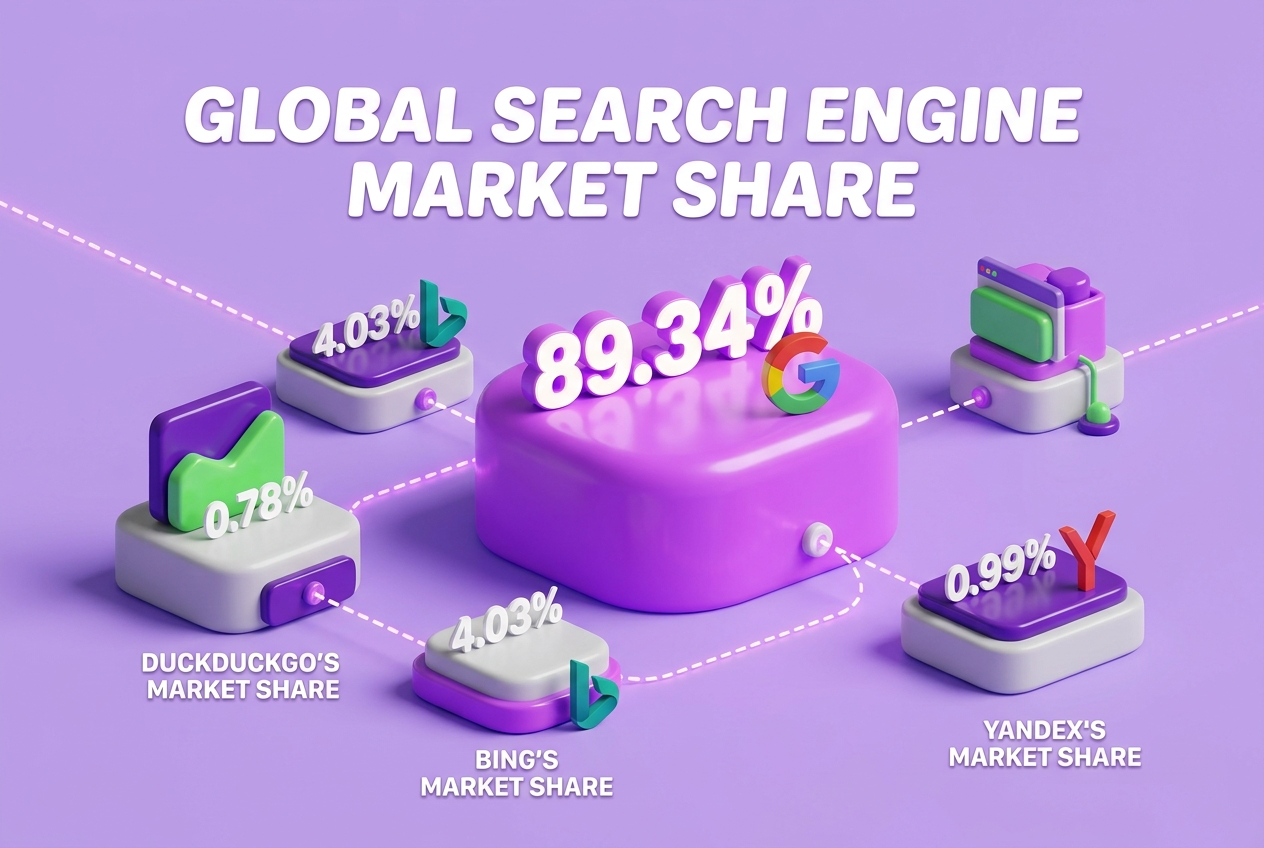
Google still rules search with nearly 90% market share, but you're missing out if you don't try alternatives. Bing and DuckDuckGo give you solid privacy or integration perks, while Yandex and Baidu shine in regional relevance. Some users even report satisfaction levels close to Google's, depending on what you care about most.
You’ve probably felt that Google isn’t always the perfect fit for your searches. It’s quick and familiar but sometimes leaves gaps—whether that’s in privacy, regional results, or just plain relevance. Google’s grip on the search market has slipped below 90%, according to recent data from Tom’s Hardware, signaling more users are exploring alternatives. This guide breaks down what other search engines offer and why some might serve your specific needs better than Google right now, with clear insights on market share, user satisfaction, and how to make the switch work for you.
| Point | Details |
|---|---|
| Google Market Share | Google controls 89.7% of the search market as of late 2024, though it's slowly losing ground. |
| Bing’s Position | Bing holds 4.03% market share and earned a user satisfaction score of 77 in 2024. |
| Privacy Focus | DuckDuckGo commands 0.78% share with a strong satisfaction rating of 79, highlighting privacy. |
| Regional Players | Yandex and Baidu cover 0.99% and 0.53% market shares respectively, both with satisfaction at 77. |
| Choosing Alternatives | Your choice depends on what you value most: privacy, language support, regional relevance, or features. |
Understanding Alternatives to Google Search
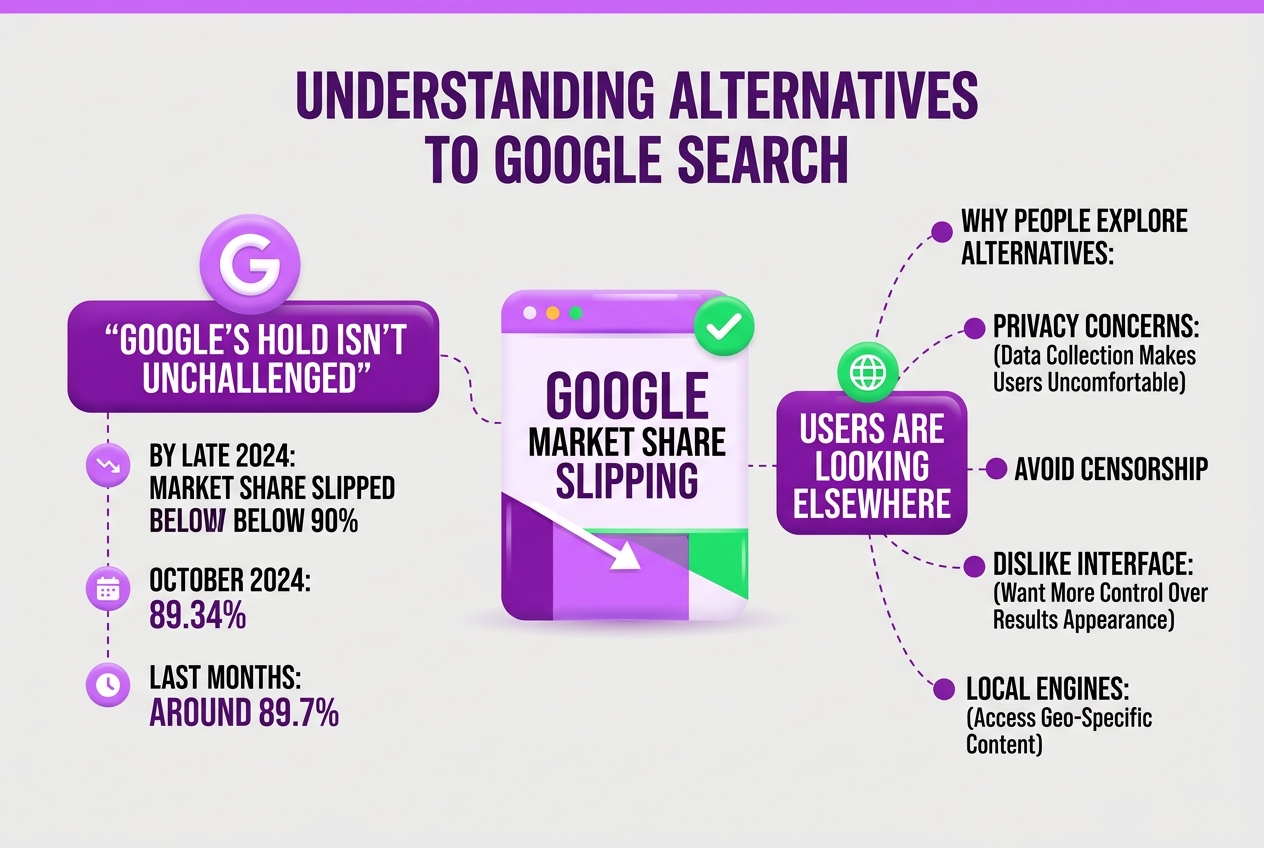
Google's hold on the search engine market has been famously strong, but it’s no longer as unchallenged as it once was. By late 2024, its global market share slipped just below 90%, reaching figures like 89.34% in October and around 89.7% in the last months of the year. That might sound minor, but for an empire built on dominance, even a small crack signals users are looking elsewhere.
Why are people exploring alternatives? The reasons aren’t just technical but deeply personal. Privacy concerns top many lists: Google’s data collection practices make some users uncomfortable. Others want to avoid censorship or simply dislike Google’s interface and want more control over how results appear. For instance, users in certain countries might turn to local engines to access geo-specific content or avoid search filtering.
Many major players have stepped up as alternatives to Google, each targeting specific user frustrations or regional preferences. Here are the key contenders:
- Bing: Microsoft’s offering, with a 4.03% market share in December 2025, is the second-largest and often praised for integrating with Windows and Office.
- DuckDuckGo: Focused heavily on privacy, this search engine captured 0.78% of the market by December 2025 and scored 79 out of 100 in user satisfaction, the highest among peers.
- Yandex: Dominant in Russia, Yandex held 0.99% market share in May 2026 and matches Bing and Baidu with a 77 satisfaction score.
- Baidu: Leading in China, Baidu took 0.53% share in May 2026, also scoring 77 in satisfaction.
Here’s a quick snapshot of their market presence and satisfaction:
| Search Engine | Market Share (Late 2025/ Early 2026) | User Satisfaction (out of 100) |
|---|---|---|
| ~89.7% | N/A (dominant market leader) | |
| Bing | 4.03% | 77 |
| DuckDuckGo | 0.78% | 79 |
| Yandex | 0.99% | 77 |
| Baidu | 0.53% | 77 |
User satisfaction scores reveal that despite its smaller share, DuckDuckGo is winning hearts thanks to its privacy-first approach. Bing, Yandex, and Baidu maintain steady followings, especially where Google’s reach is limited or less favored.
Switching from Google isn’t always seamless. Each alternative has quirks: Bing’s integration can feel Microsoft-heavy, DuckDuckGo can miss some local results, and Yandex or Baidu mainly serve their native languages and regions. Still, this growing ecosystem challenges Google’s monopoly and offers you choices suited to your values and search habits.
Understanding what these alternatives deliver sets the stage for evaluating their specific features and how they stack up against Google’s offerings. We’ll get into that next to help you decide if it’s time to try a new search engine.
Why Some Search Engines Are Better than Google for Privacy and User Control
Privacy is becoming a decisive factor for many when choosing a search engine. Google collects a vast amount of personal data to tailor ads and improve services, but that comes at the cost of persistent tracking. Some users simply don’t want every query logged, every click analyzed.
DuckDuckGo stands apart with its strict no-tracking policy. It doesn’t store your search history, doesn’t profile you, and blocks trackers from other sites. This leaves you with a cleaner, less invasive experience — and that discipline shows in user trust.
Bing, Microsoft's search engine, also collects data but implements controls that users might find less intrusive than Google's. However, Bing's data collection still contributes to personalized advertising, a trade-off some users accept but others reject outright.
Here's a comparison of privacy features and user satisfaction for 2024 among these engines:
| Search Engine | Data Tracking Approach | User Satisfaction Score (2024) |
|---|---|---|
| DuckDuckGo | No tracking, no profiling | 79/100 |
| Bing | Moderate tracking, some control | 77/100 |
| Extensive tracking, profiling | N/A (lower than competitors) |
User satisfaction scores reflect more than just search accuracy; privacy clearly weighs heavily. DuckDuckGo’s lead at 79 points underlines that people value privacy in their search experience.
Pro Tip: Bold-labelled: Always review the privacy policy updates of any search engine regularly as policies can shift.
Privacy isn’t just about data security; it shapes how comfortable users feel and how willing they are to use a service long-term. An intrusive search experience feels invasive and discouraging, whereas privacy-respecting engines build trust over time.
Switching to a search engine like DuckDuckGo can address privacy concerns without sacrificing quality. For those frustrated by Google’s extensive data mining, this can feel like a breath of fresh air.
Next, we’ll break down how these differences in privacy and control translate into actual search performance and user experience nuances in 2024.
Comparing Market Share and Satisfaction: Bing, Yandex, and Baidu Vs. Google
When you look beyond Google's dominant presence in the search engine market, the alternatives each tell a distinct story shaped by region and user preference. Google still claims just under 90% of the global market share, but competitors like Bing, Yandex, and Baidu hold smaller, yet meaningful slices with loyal user bases.
Here's how these search engines stack up by market share and user satisfaction scores:
| Search Engine | Market Share (2025-2026) | User Satisfaction Score (out of 100) | Primary Regions of Use |
|---|---|---|---|
| ~89.7% | 78 | Worldwide | |
| Bing | 4.03% | 77 | North America, some Europe |
| Yandex | 0.99% | 77 | Russia and neighboring countries |
| Baidu | 0.53% | 77 | China and parts of Asia |
Bing, owned by Microsoft, holds over 4% of the global market share with a solid satisfaction rating of 77. This reflects a steady user base, especially in the US and parts of Europe. While Bing’s interface and integration with Microsoft products are touted as advantages, some users find search result relevance inconsistent compared to Google.
Yandex is the go-to search engine for Russia and nearby areas. Its market share of about 1% globally is modest but represents the majority in its home region. User satisfaction remains steady at 77, suggesting reliability and familiarity outweigh the lack of global reach.
Baidu dominates Chinese-language search but only accounts for about half a percent globally. Its satisfaction score matches Bing and Yandex, but its use is largely confined to China due to language and regulatory barriers.
Google’s overwhelming dominance is a double-edged sword; while it offers comprehensive global results and overall solid satisfaction just under 80, some users seek alternatives for privacy, niche regional content, or integration with specific ecosystems like Microsoft’s.
Regional differences strongly influence which search engine users prefer. For example, a user in the US is likely to stick with Google or Bing, whereas someone in Russia would gravitate naturally toward Yandex, and in China, Baidu is often the default.
In short, choosing between these search engines depends on your location and what you prioritize: market presence, satisfaction, or local relevance. The variety ensures Google’s grip isn’t unbreakable.
Next, we’ll explore how privacy-focused alternatives compare to these mainstream players.

How To Switch and Utilize Alternative Search Engines Effectively
Switching from Google to an alternative search engine isn’t just about clicking a new homepage. You’ll want to make the change stick by setting your new engine as the default in your browser. Here's how to do that, along with tips to squeeze the most out of your options.
-
Set Your Default Search Engine:
- In Chrome, go to Settings > Search engine > Manage search engines. Click “Add” if your preferred engine isn't listed, then set it as default.
- Firefox users can go to Preferences > Search, then pick or add a new default engine.
- On Edge, find Settings > Privacy, Search, and Services > Address bar and search, and change the default there.
-
Optimize Bing or DuckDuckGo Settings:
- Bing offers customizable search results filtering and integration with Microsoft Rewards, which can be rewarding but also a distraction.
- DuckDuckGo is great for privacy. Tweak its settings to block trackers, force encrypted connections, and choose region-specific search results.
-
Try Regional Alternatives—Yandex and Baidu:
- Yandex handles Cyrillic scripts and local results better if you need Russia-centric content.
- Baidu dominates Chinese-language content but is quite limited outside that scope and enforces censorship.
-
Integrate Alternative Engines with AI and Workflow Tools:
- Use browser extensions or APIs that let you pull search results into your favorite AI tools or apps. For instance, you can plug Bing or DuckDuckGo results into writing assistants or research dashboards.
- If your daily workflow involves complex queries, adjust search shortcuts or custom search engines in your browser for faster access.
-
Measure Satisfaction and Adapt:
- After a week or two, evaluate what’s missing from your new search engine. Are results less relevant? Is privacy improved? Adjust your habits or try a hybrid approach—using Google for some queries and an alternate engine for others.
Pro Tip: Bold-labelled: Test multiple search engines side-by-side for a week to discover your personal best fit before committing to one.
Switching search engines can challenge your routine, and none are perfect replacements for Google in every category. But with a bit of trial and customization, you’ll find a setup that fits your priorities better.
Next, let’s explore what makes some search engines better than Google for privacy and user control.
Mistakes to Avoid When Switching from Google to Other Search Engines
Switching away from Google is more complex than just picking a new search box. Many users fall into avoidable traps that make the change frustrating or less effective.
Common mistakes I see people make include:
- Relying solely on market share as a quality measure: Google's near 90% market share might feel like the best benchmark, but smaller players like DuckDuckGo and Bing, with less than 5% each, often deliver excellent quality tuned to specific needs.
- Ignoring regional relevance or language support: Search engines like Yandex or Baidu serve strong regional user bases, while generic engines might struggle with local language nuances or region-specific content.
- Underestimating the learning curve with new interfaces: Familiarity with Google's layout makes switching jarring. The settings, filters, and even results presentation vary widely and take time to master.
- Failing to customize search preferences and privacy settings: Early neglect of preferences can leave you vulnerable or with poorer search results. Customizing safe search, ad preferences, and privacy options is essential for a good experience.
- Not backing up bookmarks and search histories before switching: Your saved links and search history are valuable and usually tied to your Google account. Without a backup plan, you risk losing that data.
Paying attention to these points will save a lot of headaches. It’s about more than just switching engines — it’s about adapting your whole search habit. Next, we’ll cover how to get the most out of your new search engine experience.
My honest take on Other Search Engines Better Than Google
I’ve been watching Google’s grip on search soften just a bit, and honestly, I don’t see it as a problem. At TryRoki, we view this shift as a chance to rethink how we discover content online. Google’s algorithm is still sharp, no doubt. But alternatives like Bing and DuckDuckGo each bring things Google just can’t offer — for example, better regional relevance or a real shot at protecting your privacy.
That said, the buzz around DuckDuckGo often makes it sound like a perfect privacy shield. It’s not. You’ll trade off some convenience and integration that Google nails. Sometimes the search results feel less tailored or lag behind on industry updates because the scale just isn’t there.
What works better, in my experience, is using a mix — not putting all your eggs in one search basket. Depending on what you’re after, a specialized engine can deliver fresher, or more private, or more local results. Marketers and users who diversify their tools get a clearer picture of the web and don’t miss out on niche or emerging content.
So instead of chasing a “better than Google” contender, aim for a smarter search strategy. The web’s too big and too varied to rely on any single giant.
— Daniel
Boost Your Website Visibility Beyond Google with Roki AI
Choosing other search engines beyond Google is smart, but it often means juggling different optimization demands that many tools don’t handle well. I remember when we first tried to push content on emerging platforms; it quickly became a mess managing updates and keyword shifts. That's where Roki AI helped us. It doesn’t just focus on Google’s quirks but automates SEO tasks tailored for multiple search engines, letting you avoid wasting hours on manual tweaks.
On top of that, simply having great content isn’t enough—you need relevant exposure. Our integration with Reddit communities streams tasks straight to your dashboard, guiding you to places where your audience already hangs out. This isn’t about spamming but smart engagement that actually drives traffic outside Google’s sphere.
If you’re serious about tapping into diverse online ecosystems, trying out our AI SEO agent and the Reddit poster tool could make the difference between hope and real results.
Frequently Asked Questions
Which search engines offer better privacy than Google?
DuckDuckGo stands out as a solid choice for anyone worried about privacy. It refuses to track your searches and holds a user satisfaction score of 79 out of 100 in 2024. That’s a decent jump compared to Google, where privacy concerns often top the complaints.
Is Bing a viable alternative to Google for everyday use?
Bing isn’t just a backup plan; it commands over 4% of the search market share and sports a user satisfaction rating of 77. It integrates well with Microsoft services, making it a practical choice if you use those products regularly. Still, some users find it clunkier than Google when it comes to search result accuracy.
How do Yandex and Baidu compare to Google globally?
Yandex and Baidu focus heavily on their home markets—Russia and China, respectively. They each capture less than 1% of the global user base but pull a steady user satisfaction score around 77. If you’re searching in these regions or languages, they often deliver more relevant, localized results than Google does.
Can I set a non-Google search engine as default easily?
Yes, switching default search engines is generally straightforward across major browsers. It typically takes just a few clicks in the settings to swap Google for DuckDuckGo, Bing, or another option. However, some browsers nudge you to stick with Google by making the change less obvious.
What mistakes should I avoid when switching from Google?
Many jump to conclusions based purely on market share—big mistake. Also, ignore regional relevance at your own risk; what works well in one country might fall flat in another. Don’t skip learning a new interface either, or you’ll waste time. Lastly, back up your important data and saved searches before making the switch to avoid lose.
Written by Daniel.
Recommended reads
- Organic Traffic Google How To Boost Your Website Visitors
- Search Or Enter A Website Your Step By Step Guide
- Page With Redirect Google Search Console How To Fix Optimize
- What Is Automated Seo A Strategic Guide For 2024