
How to Write a Perfect Article: 7 Steps
TL;DR: To write a perfect article, answer one specific reader question with a clear goal, useful evidence, and a structure people can scan. Use this 7-step workflow: define intent, research, outline, draft, edit, optimize, publish, then review results at 30, 60, and 90 days.
You may publish consistently and still wonder why your articles do not help readers choose, trust, or act. The frustrating part is that even strong ideas get buried when a page asks too much of a distracted reader: users may read only 28% of the words on a typical web page. As the owner of TryRoki, I have seen AI speed up production while also making weak research and vague thinking easier to hide. You still own the usefulness, accuracy, and judgment. This guide gives you a practical seven-step workflow for intent, research, outlining, drafting, editing, SEO, publishing, and measuring results.
| Point | Details |
|---|---|
| Start With Intent | Define 1 reader, 1 problem, and 1 desired action before writing a single paragraph. |
| Build Before Drafting | Follow a 7-part workflow covering research, outlining, writing, editing, optimization, publishing, and measurement. |
| Make It Scannable | Use headings, short paragraphs, lists, examples, and direct answers because readers often process only 28% of page words. |
| Optimize For People | Use keywords naturally and follow Google’s people-first guidance instead of writing mainly to manipulate rankings. |
| Measure Outcomes | Review visibility, engagement, conversions, and assisted revenue after 30, 60, and 90 days. |
What Makes an Article “Perfect” for Its Reader?
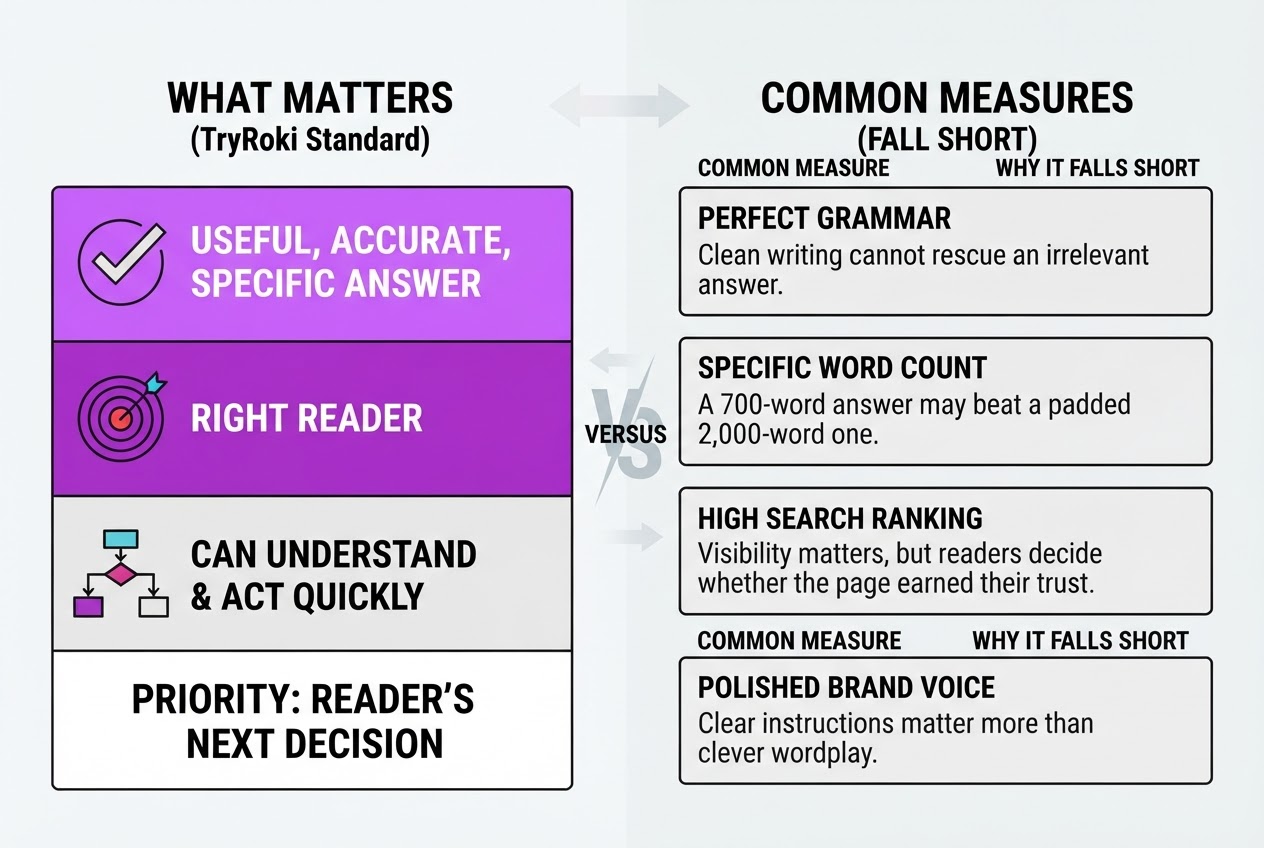
A “perfect” article is not flawless prose. It is an article that gives the right reader a useful, accurate, specific answer in a form they can understand and act on without wasting time. When I review content for TryRoki, I care less about elegant sentences than whether a reader can make the next sensible decision after finishing the page.
That standard is different from several popular definitions of perfection:
| Common measure | Why it falls short |
|---|---|
| Perfect grammar | Clean writing cannot rescue an irrelevant answer. |
| A specific word count | A 700-word answer may beat a padded 2,000-word one. |
| A high search ranking | Visibility matters, but readers decide whether the page earned their trust. |
| A polished brand voice | Clear instructions matter more than clever wording. |
Before you draft, define four things:
- Audience: Who needs this answer, and what do they already know?
- Problem: What specific frustration brought them to the search box?
- Awareness stage: Are they learning the basics, comparing options, or ready to buy?
- Desired action: Should they try a method, choose a product, request help, or continue researching?
For example, “how to write a perfect article” could attract a student, a freelance writer, or a business owner planning a content program. Those readers need different examples and different next steps. Writing for all three usually produces vague advice that satisfies nobody. A step-by-step article-writing guide can help with the process, but you still need to choose whose problem you are solving first.
Your opening, headings, examples, and conclusion should support one central promise. If the promise is “you will plan and draft a useful article in one afternoon,” do not spend half the page on advanced backlink tactics. That detour may sound impressive, but it breaks the reader’s expectation.
Pro Tip: Write the article’s promised transformation in one sentence and delete any section that does not help deliver it.
Put the highest-value information near the top. Users may have time to read at most 28% of the words on a typical web page, so burying the answer behind background, throat-clearing, or generic claims is a practical mistake. Give readers the core answer early, then add evidence, examples, and nuance for those who need them.
With that definition in place, you can build an article around the reader’s intent rather than an arbitrary idea of perfection.
The Seven-Step Article-Writing Workflow
A publishable article starts before you write the first paragraph. I use the workflow below because skipping research or editing usually creates expensive rework later, especially when a topic sounds clear to the writer but vague to the reader.
-
Turn the topic into a reader question. Replace “how to write a perfect article” with a question such as, “How can a first-time writer plan, draft, and improve an article that readers finish?” Then define one success metric: qualified organic visits, email sign-ups, product demos, or completed downloads. A page cannot succeed against five competing goals.
-
Inspect the territory before taking a position. Search the topic, study the competing pages, and note what readers still need. Pull wording from customer calls, support tickets, reviews, and sales conversations. Check credible source material, not just the first few results. This takes longer than copying headings, but copied structure usually produces a forgettable article.
-
Build the outline before drafting. Arrange the answer in the order a reader needs it. Assign a clear job to each H2, then mark where you need evidence, a practical example, a definition, or a warning. Add the conclusion now, even if it contains only three bullets. A useful article-writing guide can help you test whether the outline actually moves from problem to decision.
-
Draft quickly around that outline. Write direct sentences and explain each idea with a concrete situation. Do not stop every three lines to polish an introduction or hunt for the perfect adjective. That habit feels careful, but it turns a 90-minute draft into an all-day chore.
Pro Tip: Separate drafting from editing by at least one review pass; trying to invent and judge every sentence simultaneously usually produces slower, weaker work.
-
Edit in separate passes. Check facts and calculations first. Then review structure, clarity, tone, and unsupported or unnecessary claims in separate passes. Read the article aloud once. You will catch missing words, inflated promises, and paragraphs that looked fine on screen but sound awkward.
-
Apply ethical SEO. Put the main idea in the title, relevant headings, description, URL, links, and media text where it genuinely helps. Do not repeat a keyword until the prose sounds mechanical. Google recommends helpful, reliable, people-first content, not pages written mainly to manipulate rankings.
-
Publish, distribute, and review. Share the article through the channels your audience already uses, connect it to relevant pages, and record its baseline impressions, clicks, rankings, and conversions. Schedule reviews after 30, 60, and 90 days. Publication is a checkpoint, not the finish line, and the performance data should shape your next article.
How to Make Every Section Earn Its Place
The fastest quality check I use at TryRoki is simple: can a reader explain the section’s point after one pass? If not, the section probably has two jobs competing for attention. Give each section one question to answer, one takeaway to deliver, and one clear reason to continue.
Lead with the useful answer. If someone asks how to write a perfect article, do not begin with the history of blogging or a definition of content quality. State the recommendation, then add context, evidence, and exceptions. Readers often scan rather than read every word, so concise, scannable writing improved measured usability by 58%.
I review important sections in this order:
- First pass: Write the answer in the opening sentence and remove throat-clearing.
- Evidence pass: Add one example, comparison, mini-checklist, data point, or expert judgment that helps the reader decide what to do.
- Structure pass: Break dense text with descriptive subheadings, bullets, bold emphasis, and short paragraphs. Do not add formatting just to make the page look busy.
- Action pass: Give the reader a next step that fits their stage. A beginner may need a worksheet; a buyer may need a product comparison; an existing customer may need a setup instruction.
- Measurement pass: Track scroll depth, engaged sessions, sign-ups, assisted conversions, and qualified leads, not rankings alone.
Pro Tip: During the final review, read only the headings and first sentence of each section. If the article’s argument is unclear, the structure needs work before the prose does.
The last step is where many content teams lose the plot. A polished article can still be commercially useless if nobody decided whether it should generate demand, support sales conversations, answer customer questions, or attract qualified search traffic. In CMI’s 2025 research, 42% of underperforming B2B strategies cited a lack of clear goals as a reason for weak performance.
Set the goal before publication, then monitor website traffic against a realistic baseline. A ranking may bring visibility, but a qualified lead or assisted conversion tells you whether the article helped the business. Once the section structure is doing its job, the final review can focus on accuracy, proof, and reader trust.

Common Article-Writing Mistakes to Remove Before Publishing
A draft can be grammatically clean and still fail its reader. I have seen articles attract impressions but produce no enquiries because the writer solved the wrong problem, buried the answer, or gave readers no reason to trust the advice.
Watch for these publishing mistakes:
- Starting too broadly: “How to write an article” is a topic, not a brief. Define the audience, their situation, and the search intent before outlining. A beginner looking for a template needs a different article from a content manager comparing editorial processes.
- Taking too long to answer: A six-paragraph introduction frustrates readers who came for a practical answer. State the promise early, then earn attention with useful detail.
- Padding the word count: Repeating the same advice under different headings makes a long article feel thin. If two sections produce the same takeaway, combine them.
- Making claims without support: Delete unsupported statistics, vague phrases such as “many businesses,” outdated examples, and jargon your reader would not use. Link evidence to the claim, not to a random sources list.
- Writing for an algorithm instead of a person: Keyword repetition, forced internal links, and copied competitor headings make the article awkward. Use the keyword naturally and add a viewpoint, example, test, or limitation competitors missed. Google’s people-first content guidance is a better standard than copying the current top result.
- Publishing an untouched AI draft: AI can give you structure, but it can also invent facts, flatten your opinion, and miss important context. Fact-check every claim, edit the rhythm, and add what you have actually observed with customers.
- Stopping without a job for the reader: End with a clear conclusion, next action, or measurement plan. “Track rankings” is weak; name the metric, baseline, and review date.
Before publishing, check accuracy, originality, readable headings, descriptive image text, keyboard-friendly links, and a mobile-friendly layout. Verify every link, title tag, meta description, and canonical URL. Then ask one commercial question: does this article guide the right reader toward the next useful step, or does it only chase traffic? A practical article-writing workflow helps turn that final review into a repeatable habit.
With the obvious defects removed, you can judge whether the finished piece is ready to earn attention and action.
How AI Fits Into a High-Quality Writing Process
I treat AI as a fast assistant, not a co-author with editorial authority. As TryRoki’s owner, I have seen the same failure repeatedly: a draft arrives quickly, but its sources are weak, its examples feel interchangeable, and nobody can explain why a recommendation belongs in the article.
| Writing task | Manual-first approach | AI-assisted approach | What you still own |
|---|---|---|---|
| Research and ideas | Search the audience’s questions, competitors, forums, and trusted sources | Expand angles, surface content gaps, and suggest questions to investigate | Source selection, evidence, and whether the topic matters |
| Planning | Build the brief and section order from the reader’s goal | Generate outline options, titles, and briefs for comparison | Search intent, scope, voice, and the promise you make |
| Drafting | Write every paragraph from scratch | Produce variations, rewrites, examples, and concise alternatives | Original insight, accuracy, nuance, and useful recommendations |
| Quality control | Edit for logic, facts, repetition, and brand fit | Flag unclear passages, missing topics, and inconsistent wording | Final fact check, citations, originality, and publish-or-reject judgment |
The line is simple: use AI to expand possibilities, not to invent evidence. It can propose five titles, expose a missing subtopic, or rewrite a dense paragraph for a beginner. It cannot confirm that a statistic is current, understand a customer’s unstated concern, or decide whether a recommendation could damage your reputation.
I also prefer a content platform when it supports a visible workflow rather than hiding production behind one button. TryRoki can help you create briefs and drafts consistently, but I still review sources, remove generic filler, check claims, and make the final article sound like the business behind it. The annoying part is that review does not disappear. It becomes more important when output increases.
For structure, I use a recurring loop: create, review, publish, monitor, and improve. After publication, check traffic and search performance instead of assuming a finished page will keep working. Our step-by-step article-writing guide covers the craft, while a practical website traffic guide helps you inspect what readers actually do.
That discipline matters because 51% of businesses that publish blogs report how-to guides as a strong-performing format, not because every how-to article will succeed. Your review process decides whether the format delivers a clear answer or merely produces more generic pages. The next step is turning that judgment into a repeatable publishing standard.
My honest take on writing a perfect article
I have learned that a “perfect” article is not a literary trophy. It is an operational standard: the page understands a real question, answers it faster than competing pages, earns trust, and gives the reader a useful next step. If someone reaches the answer only after three screens of background, the article has already failed, no matter how elegant the prose sounds.
Here is the contrarian part: more research, more words, and more SEO fields do not automatically improve an article. They often make it slower and less useful. I would rather publish a focused 1,200-word guide with clear evidence than a 3,000-word page that buries one practical answer under definitions and keyword variations.
At TryRoki, I see where AI helps and where it should stop. Roki AI can remove repetitive production work, such as drafting outlines, preparing content, and finding relevant Reddit discussions. But the company still owns the audience judgment, factual responsibility, and point of view. AI cannot decide whether a claim is fair to your customer or whether your advice reflects what you actually believe.
Quality comes from a repeatable publishing and measurement system, not one heroic writing session. Track whether readers find the answer, take the next step, and return. Then fix the weak parts and publish again.
— Daniel/Aleksandra
Turn a Better Article Process Into a Consistent Publishing System
A perfect article still needs a repeatable publishing process. If your team understands research, structure, editing, and internal linking but keeps losing hours to blank documents and scattered spreadsheets, TryRoki can handle part of that routine. AI Blog Writer helps you draft website content, while AI SEO Agent supports ongoing optimization and visibility work.
Each week, Roki AI assigns 3–10 practical tasks, such as publishing a post, improving an existing page, or finding relevant Reddit conversations where your website adds value. That workload is manageable, but it still needs judgment. Review every draft for accuracy, tone, and claims before it goes live, and do not expect guaranteed rankings. If repetitive work is slowing your content plan, explore TryRoki as a way to maintain momentum without treating automation as a replacement for expertise.
Frequently Asked Questions
How long should a perfect article be?
There is no universal ideal length, so write as much as needed to answer the reader’s question without repetition. Start with the essential points, then cut any sentence that does not support the article’s main promise.
How do you start writing an article for beginners?
Write 1 sentence that names the reader, their problem, and the result they want. Then review 3 to 5 credible sources, note the questions readers ask, and build an outline before drafting.
What makes an article interesting to read?
Specific examples, clear opinions, useful evidence, varied pacing, and a strong connection to the reader’s situation keep an article engaging. Give readers at least 1 concrete takeaway in each major section instead of relying on broad claims.
Can AI write an article that ranks on Google?
AI can help organize research, create an outline, draft passages, and suggest edits, but no tool can guarantee rankings. Before publishing, complete at least 1 human review for accuracy, original value, and alignment with Google’s people-first guidance.
How often should a business publish new articles?
Choose a schedule your team can maintain after accounting for research, editing, and approval time rather than chasing a fixed daily number. Review each article at 30, 60, and 90 days so your publishing plan reflects actual performance.
Written by Daniel/Aleksandra.
Recommended reads
- How To Write A Great Article A Step By Step Guide
- Blog Writing Examples How To Craft Effective Posts
- Ai Blog Writer
- Organic Traffic Growth A Strategic How To Guide
Sources
- Website Reading: It (Sometimes) Does Happen
- Concise, SCANNABLE, and Objective: How to Write for the Web
- Creating Helpful, Reliable, People-First Content | Google Search Central | Documentation | Google for Developers
- HubSpot's 2025 State of Blogging Report [Data from 500+ Global Marketers]
- B2B Content Marketing: 2025 Benchmarks & Trends
- The 2025 State of Marketing & Trends Report: Data from 1700+ Global Marketers
- 2026 Marketing Statistics, Trends, & Data