Daniel D.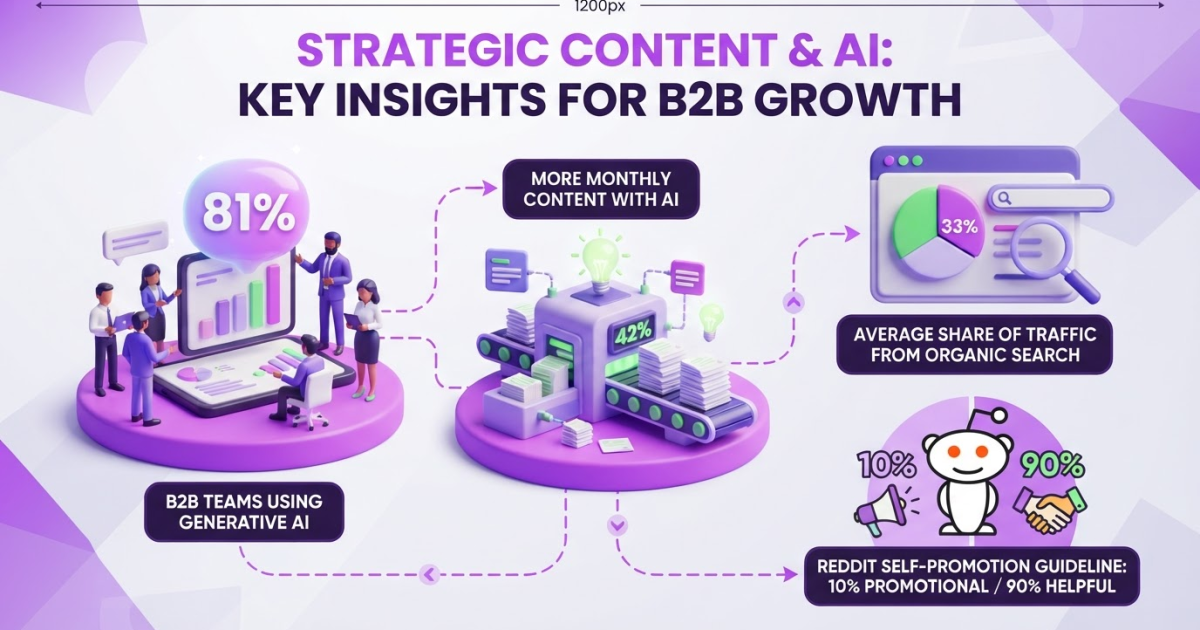
Maximize website traffic with AI by using it to find valuable topics, produce genuinely useful content, optimize pages for search and AI discovery, and promote them thoughtfully, while keeping human review and measurement in the loop. A practical system should improve through consistent iteration, with tools such as Roki AI surfacing 3–10 weekly tasks for content and visibility instead of flooding your site with generic AI text.
Publishing more often does not guarantee more visitors. AI can help you draft articles faster, but your traffic still depends on whether each piece matches a real search, earns trust, and reaches people beyond your own site. That pressure is real: organic search generated an average of 33% of website traffic across seven industries. I built TryRoki to turn the repetitive work into a practical weekly routine, not a pile of unfinished AI drafts. This guide covers opportunity research, AI-assisted production, SEO and AI-search optimization, useful Reddit participation, quality checks, and performance measurement through a focused 3 to 10 task workflow.
| Point | Details |
|---|---|
| Start With Opportunities | Prioritize topics with clear audience demand, realistic ranking potential, and a direct connection to your offer before generating content. |
| Keep Humans Involved | Ahrefs found that 80% of surveyed marketers manually reviewed AI-generated content for accuracy, so assign a human review before publishing. |
| Optimize For Discovery | Build each page around search intent, useful structure, internal links, and answer-ready information for both search engines and AI systems. |
| Promote With Context | If a Reddit community follows a 10% self-promotion guideline, make at least 9 out of 10 contributions genuinely helpful rather than promotional. |
| Measure Business Impact | Track organic sessions, impressions, rankings, conversions, assisted conversions, and content output together instead of judging success by traffic alone. |
What AI-Powered Traffic Growth Really Involves
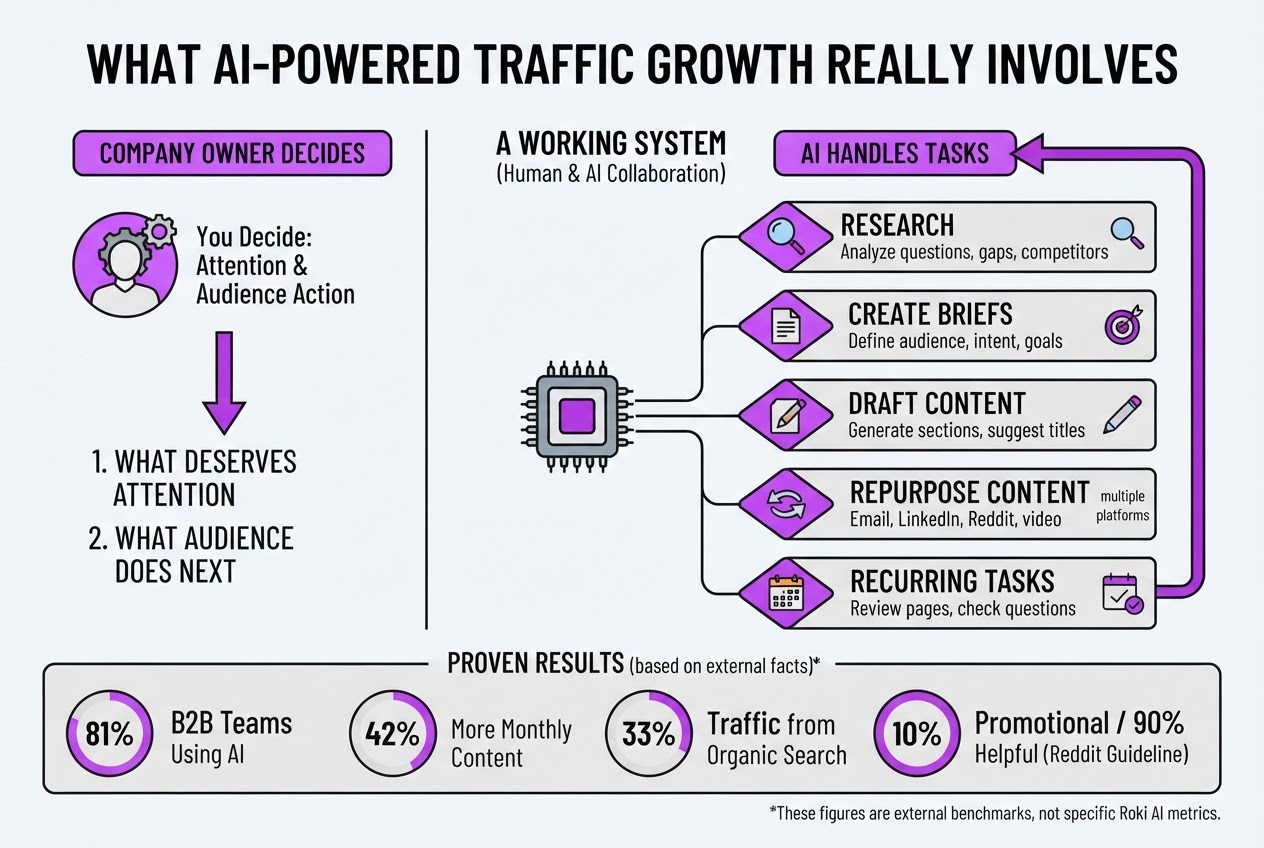
AI-powered traffic growth is not a command to publish 100 articles and hope Google notices. As a company owner, I see it as a working system where AI handles repetitive decisions and production tasks, while you decide what deserves attention and what your audience should do next.
AI can help you:
- Research customer questions, competitor pages, search results, and topic gaps.
- Turn that research into briefs with an audience, search intent, angle, evidence, and conversion goal.
- Draft sections, suggest titles, improve internal links, and flag missing subtopics.
- Repurpose a useful article into an email, LinkedIn post, Reddit response, or short video script.
- Maintain recurring tasks, such as reviewing declining pages or checking new questions each week.
The irritating part is that AI often produces a confident draft before it understands your customers. It can also recommend a keyword with traffic but no buying intent. I would rather publish two accurate pages for a clear audience than twenty polished pages nobody trusts.
Traffic growth only works when these parts agree:
| Part | What you need to confirm |
|---|---|
| Audience need | The problem matters to a real person |
| Search intent | Your page answers the reason behind the query |
| Quality | The advice is accurate, useful, and distinct |
| Distribution | People can find it through search, AI answers, referrals, or communities |
| Conversion path | The visit leads to a meaningful next action |
Those channels also measure different things. Search visibility means appearing in traditional results. AI-search visibility means being cited or surfaced in generated answers. Referral traffic comes from another site, while a qualified website visit comes from someone likely to become a subscriber, lead, or customer. A traffic dashboard can show the difference; raw sessions alone cannot.
The opportunity is operational leverage, not editorial surrender. CMI’s 2025 research found that 81% of B2B marketers use generative AI, yet only 4% reported high trust in its outputs. That gap matches what I see: AI speeds decisions and drafts, but experts still need to prioritize, fact-check, add experience, and reject weak angles.
Pro Tip: Pro Tip: Define one meaningful conversion before increasing publishing volume; otherwise, AI can optimize the wrong traffic stream at a much lower cost.
Next, the practical question is how to turn this definition into a repeatable workflow without creating a pile of disposable content.
A Six-Step Workflow for Turning AI Into More Visitors
I use this workflow when a content idea needs to earn attention and support a business goal. AI can shorten the work, but it cannot decide whom you serve or whether a topic deserves your reputation.
-
Set the target before opening an AI tool. Write down your audience, offer, conversion goal, and current traffic sources. For example, you might help ecommerce owners choose analytics software, aim for demo requests, and currently receive 60% of visits from organic search. Record baseline visits, leads, and conversion rate so a traffic spike does not distract you from weak results.
-
Collect signals, then score the opportunities. Pull keywords from search data, competitor pages, sales calls, support tickets, customer questions, Reddit discussions, and your site search. Score each idea from 1 to 5 for relevance, demand, difficulty, and business value. I would rather publish one answer to a painful customer question than chase a broad keyword with thousands of weak competitors.
-
Build a brief before requesting prose. Specify search intent, the original angle, evidence requirements, outline, internal-link targets, and the CTA. Include the reader’s likely objection and the action you want after the final paragraph. A vague prompt produces a polished version of what already exists, which is usually the least interesting result.
-
Give AI your actual knowledge. Ask it to draft or expand sections using customer examples, product limitations, pricing details, test results, and your preferred tone. Add clear constraints such as “do not invent statistics” or “flag claims that need a source.” AI helps most with structure and variations; it struggles when you give it nothing but a keyword.
-
Review every line with a human standard. Check facts, originality, usefulness, tone, citations, headings, links, metadata, and the path from article to conversion. Ahrefs found that 80% of surveyed marketers manually reviewed AI-generated content for accuracy, and that matches my experience: the first draft often sounds confident where it should sound careful. Before publishing, verify every number and remove examples your company cannot defend.
Pro Tip: Pro Tip: Ask AI to identify unsupported claims and missing user questions before asking it to polish the draft; quality control works better when it starts before publication.
- Distribute it deliberately and log the next task. Add relevant internal links, send the piece to your email list, adapt it for social posts, and join community discussions without dropping the same link everywhere. Check how to monitor website traffic weekly, then record one next improvement, such as refreshing a weak section, testing a CTA, or answering a new question. Reddit’s 10% self-promotion guidance is a useful guardrail; repeated link dropping burns trust quickly.
This process turns AI from a content shortcut into a controlled traffic experiment, which gives you a clearer basis for choosing the right promotion channels next.
Where AI Fits Best: SEO, AI Search, or Community Promotion?
I choose the channel based on how a person discovers the answer, not on which platform is fashionable. A buyer comparing software, a researcher asking an AI assistant, and a Reddit user describing a frustrating problem may need the same insight, but they will reject different versions of it.
| Channel | Audience intent and time horizon | What AI-assisted content must do | Primary KPI |
|---|---|---|---|
| Organic search | Deliberate research; results usually build over months | Use crawlable headings, clear answers, topical coverage, internal links, and evidence | Impressions and qualified clicks |
| AI search | Fast answer-seeking; visibility can change as systems update | Give concise definitions, direct answers, clear entities, original insights, and trustworthy sources | Citations and branded demand |
| Community referrals | A live problem, opinion, or recommendation; impact can be immediate but uneven | Add useful context, respond like a person, and earn relevance before mentioning your site | Engaged referral sessions |
SEO pages are still the durable base. Search engines need to understand the page without guessing: descriptive headings, short answer sections, related pages connected through internal links, and evidence behind claims. I have seen AI drafts produce fluent paragraphs while missing the one comparison, statistic, or product limitation that makes a page worth ranking. Organic search generated an average of 33% of website traffic across seven industries, so ignoring this foundation is an expensive mistake.
AI-search-ready content is not simply shorter SEO content. Define the subject early, answer the likely follow-up, name the people, products, and organizations precisely, then add an observation that generic summaries do not contain. AI Overviews appeared for approximately 16% of analyzed queries after growth stabilized in 2025, which makes citation tracking and branded searches more useful than obsessing over one ranking position.
Reddit works differently. Copy-pasting a link or automating comments usually feels like advertising, because it is. Reddit’s guidance notes that some communities use a 10% self-promotion rule and flags repeated similar comments as spam. Answer the actual question first, disclose your connection when relevant, and link only when the page genuinely saves the reader work. The annoying part is that good participation takes human judgment, and a thread may produce no click at all.
Pro Tip: Pro Tip: Do not force one article to serve every channel equally; create a core page, then adapt its useful insight to the specific context of each distribution channel.
My preferred portfolio combines durable search assets, answer-oriented updates, and selective human-led community participation. Track those results separately in a practical website traffic monitoring guide, because blended totals hide whether content earned attention, citations, or genuine referral visits. The next step is turning this channel choice into a repeatable publishing workflow.

Five AI Content Mistakes That Quietly Limit Traffic
I have watched teams publish dozens of AI-assisted articles and still attract the wrong visitors. The problem is rarely the writing speed. It is usually one of these five mistakes:
-
Publishing a generic draft: An AI article without customer examples, first-party data, a clear opinion, or a distinct reason to exist looks interchangeable. Add what you have learned from support calls, sales conversations, product use, or failed experiments. Otherwise, you are adding another page to a crowded search result.
-
Confusing volume with coverage: More posts do not fix overlapping topics, keyword cannibalization, outdated pages, or weak internal links. Before creating a new article, check whether an existing page already answers the query. I would rather improve one page that earns impressions but no qualified action than publish five near-duplicates. A weekly review using a practical website traffic monitoring guide can expose that waste.
-
Treating AI output as fact: Models can invent statistics, citations, product capabilities, and confident advice. Only 4% of B2B marketers reported high trust in generative AI outputs in CMI’s 2025 research. Review every number, source, product claim, and recommendation, especially in health, finance, legal, and technical content.
-
Writing for a crawler instead of a person: Repeating a keyword in headings and awkward sentences makes an answer harder to read. Start with the reader’s actual question, then use the language that explains it naturally. Search intent matters more than forcing an exact phrase into every paragraph.
-
Automating promotion and ignoring the next step: Repeated Reddit comments, copied messages, and irrelevant links can make your brand look like spam. Reddit explicitly identifies repeated similar comments and promotional bots as spam behavior. Even useful traffic is wasted when the page has no relevant signup, demo, comparison, or purchase path.
I also remove or rewrite pages that earn impressions but produce no qualified action after a fair test. The next section shows how to measure those decisions without mistaking raw visits for growth.
How to Measure Whether AI Is Actually Growing Traffic
Before changing your publishing workflow, freeze a baseline. Record the previous 90 days of organic sessions, impressions, clicks, average rankings, referral visits, engagement rate, leads, pipeline, and revenue. Save the same figures for each important page and topic cluster. Without that snapshot, a traffic increase can look impressive while qualified visits and sales quietly fall.
I also track AI-assisted work separately from existing content. Tag new or substantially revised URLs, promotion campaigns, and referral sources in analytics. A practical website traffic monitoring guide can help you confirm the tracking setup before you trust the report. Setup is rarely the exciting part, but a missing conversion event can waste an entire quarter of analysis.
Use two reporting views. Page-level reporting shows which URLs are growing, stagnating, declining, or attracting visitors who leave without taking a relevant action. Topic-level reporting shows whether a broader subject is earning demand, even when traffic shifts between several pages. Compare impressions and indexed pages with sign-ups, demo requests, sales, and assisted conversions. Impressions are an early signal, not proof that the content is helping the business.
I review the data on this schedule:
- Days 1 to 7: Check indexing, crawl errors, canonical tags, redirects, tracking, and page delivery. Do not judge conversions yet. A new page may need time to appear, and technical errors can make every later comparison useless.
- Weeks 2 to 4: Inspect impressions, clicks, rankings, engagement, referral traffic, and query changes. Look for pages gaining visibility but drawing the wrong audience, then adjust intent, titles, internal links, or calls to action.
- Every month: Compare topic groups, branded searches, direct traffic, and returning visitors. Review AI-search mentions or referral data where available, because discovery may happen without a measurable click. Semrush and Datos found zero-click searches fell from 33.75% to 31.53% after AI Overviews appeared, so clicks alone do not tell the whole story.
- After 60 to 90 days: Judge sign-ups, demos, sales, assisted conversions, and revenue. Keep a page that creates qualified pipeline even if it has fewer visits than a high-volume article.
Each week, I inspect the dashboard, choose three to ten improvement tasks, complete the highest-impact work, and record what changed. That discipline matters more than publishing volume. CMI’s research found that 81% of B2B marketers use generative AI, but only 4% report high trust in its outputs, which is a good reason to measure human-reviewed results rather than assume AI caused growth.
With the measurement loop in place, the next decision is which content signals deserve action first.
My honest take on maximizing traffic with AI
I have watched teams use AI to publish dozens of pages, then wonder why traffic barely moves. My contrarian advice is simple: many companies should publish less before they publish more. A tighter group of topics, chosen around real customer questions and reviewed by someone who knows the business, usually beats an archive of interchangeable drafts.
At TryRoki, I see AI as an operating system for content work, not a page factory. It can surface topic opportunities, speed up first drafts, find relevant Reddit discussions, and turn improvement into recurring tasks. Our weekly task list typically gives you 3 to 10 practical actions, but automation cannot tell you whether a claim is naïve, a comparison is unfair, or a topic has no commercial value. That judgment still belongs to you.
The frustrating part is that AI makes weak assumptions look finished. Editors then spend time fixing tone, missing evidence, and generic advice that should never have been published. I would rather see one genuinely useful article, supported by original knowledge and responsible promotion, than ten polished pages nobody trusts. The companies that win will measure qualified leads, sales conversations, and useful visibility in Google and AI search, not just publication volume.
— Daniel
Turn AI Traffic Growth Into a Weekly System with Roki AI
If your traffic plan still lives in a spreadsheet nobody updates, the problem may be consistency rather than ideas. I built Roki AI for that gap: it can draft website content on autopilot, surface relevant Reddit discussions where a genuinely useful answer could mention your site, and give you three to ten weekly tasks tied to visibility in Google and AI search engines.
It is not a magic rankings button. You still need to edit weak drafts, avoid dropping links into conversations where they do not belong, and decide which tasks deserve your time. That friction is useful because careless publishing creates more cleanup than traffic. Start by reviewing your current process and choosing one measurable goal, such as qualified visits to a service page. Then explore Roki AI’s workflow features to make research, production, promotion, and iteration easier to repeat.
Frequently Asked Questions
Yes, it can, when you use it to answer real search questions, add original expertise, and review every draft before publishing. In practice, AI may cut research and drafting time by 30% to 50%, but it cannot guarantee rankings or attract qualified visitors by itself.
Use AI to find topic opportunities, create a brief, outline the article, surface unanswered questions, and suggest practical on-page improvements. Before publishing, verify important claims, add at least 2 first-party examples, check search intent, and connect the page to relevant internal links and a clear conversion path.
AI assistance is not automatically harmful, but inaccurate, repetitive, or search-engine-first pages can perform badly and weaken trust. Treat the draft as production material, then complete an editorial review, run an originality check, and monitor results for at least 8 to 12 weeks after publication.
There is no universal schedule, and publishing 5 weak posts each week is usually worse than publishing 2 useful ones you can properly review and update. Choose a cadence your team can sustain while matching topic demand, available expertise, and the time needed to fact-check each article.
Read each community’s rules, answer questions before sharing a link, disclose relevant affiliations, and avoid posting the same comment across multiple threads. Some communities mention a 10% self-promotion guideline, but moderators may apply stricter limits, so make your contribution useful even if the link is removed.
Written by Daniel/Aleksandra.
Recommended reads
- How To Monitor Website Traffic Practical Guide
- Future Proofing Your Content Planner In An Ai World
- Seo Ai Generator How To Automate Content Creation Effectively
- Organic Traffic Growth A Strategic How To Guide