
SEO Company Manchester: A Practical Growth Guide
TL;DR: A good SEO company in Manchester should combine local SEO, technically sound content, authority building, and transparent reporting tied to leads rather than vanity rankings. Expect useful signals within 3 to 6 months, and use tools such as Roki AI carefully: it provides 3 to 10 weekly tasks for improving visibility in Google and AI search.
Winning work in Manchester is harder when competitors target the same “near me” searches, publish similar service pages, and appear before you do. As an owner, you can waste months chasing rankings that bring clicks but no enquiries, especially when an agency reports traffic without tying it to signed jobs. Manchester had 22,895 enterprises in 2024, so standing out requires more than adding “Manchester” to every page. This guide explains what a Manchester SEO company should deliver, when outsourcing makes commercial sense, how to compare providers, and how to build an ethical workflow for Google and AI visibility while tracking leads, calls, and revenue.
| Point | Details |
|---|---|
| Start With Local Intent | Prioritise service, location, and problem-based searches that can turn Manchester traffic into qualified enquiries instead of chasing broad rankings. |
| Audit Before Scaling | Review technical health, Google Business Profile signals, competitors, content gaps, and conversion tracking before commissioning a large campaign. |
| Measure Commercial Outcomes | Track calls, forms, booked consultations, qualified leads, revenue, rankings, and organic sessions across at least 6 meaningful metrics. |
| Demand Useful Content | Make every page add at least 1 clear local insight, first-hand expertise point, or decision-making detail rather than repeating generic SEO copy. |
| Use AI With Oversight | Use AI for research and production, but give every important page human editing, fact-checking, originality checks, and local review before publishing. |
What should a Manchester SEO company actually do?
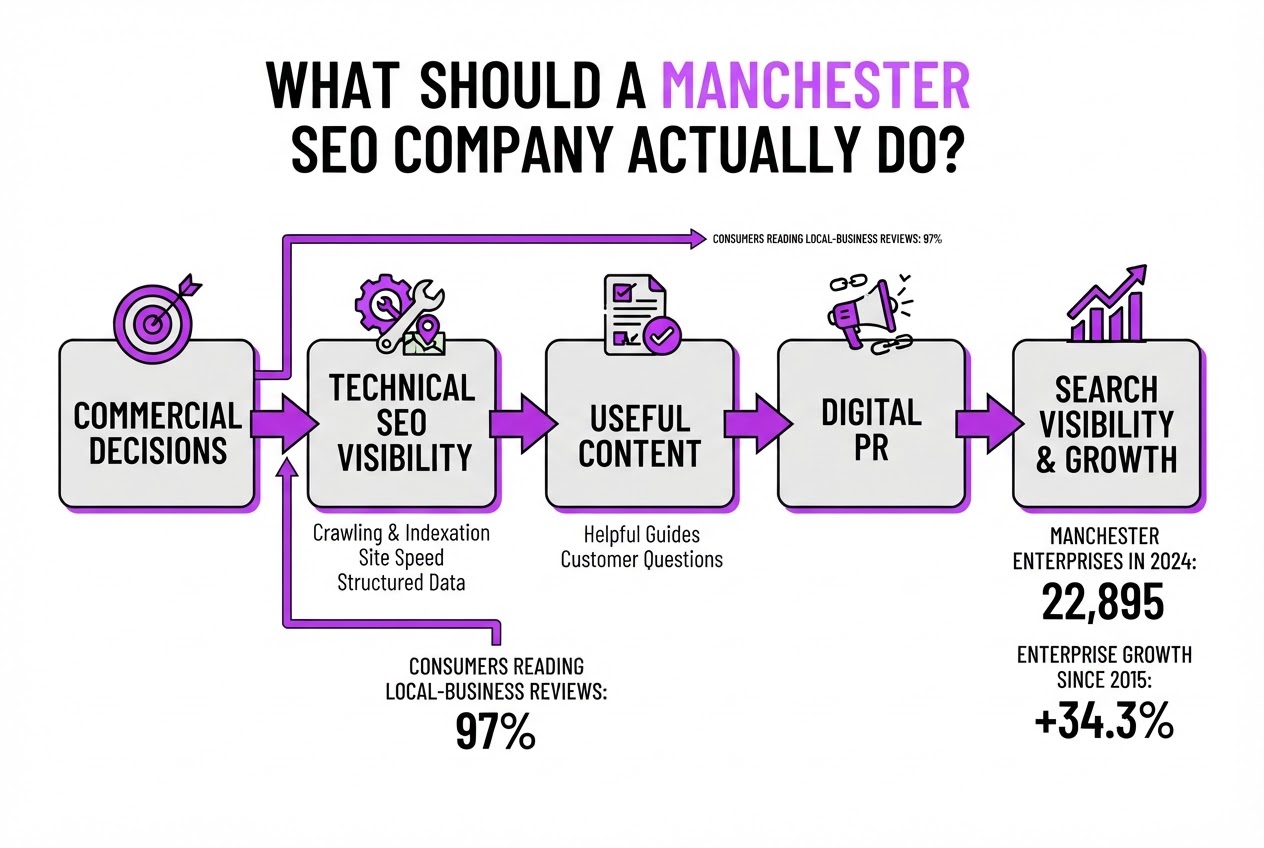
A credible Manchester SEO company should connect search visibility to commercial decisions, not sell you a stack of disconnected deliverables. A blog post, a backlink, or a monthly ranking report means little if nobody knows which service, location, or customer problem it is meant to support.
The work usually spans five connected areas:
- Technical SEO: crawling, indexation, site speed, internal linking, structured data, and fixing pages that block search engines or frustrate visitors.
- Local visibility: Google Business Profile, location pages, reviews, local citations, and consistent business details.
- Useful content: service pages and genuinely helpful guides based on customer questions, not thin pages written only to include “Manchester”.
- Digital PR: earning relevant coverage, mentions, and links that reinforce reputation. Buying random backlinks is usually the quickest way to waste a budget.
- Conversion optimisation: clearer calls to action, stronger proof, better forms, and landing pages that turn visits into calls, enquiries, or purchases.
Manchester SEO might target the city as a whole, neighbourhoods such as Didsbury or Ancoats, a wider service area across Greater Manchester, or national-intent searches. A city-centre solicitor and a Stockport plumber should not receive the same keyword map. The Google Search Competitors practical SEO guide can help you see why the competitive landscape matters before anyone promises rankings.
For local work, Google’s guidance identifies relevance, distance, and prominence as the main factors. That means accurate service information, proximity to the searcher, reviews, recognised expertise, and credible references all matter. No agency can remove distance from the equation.
At minimum, the operating system should look like this:
- Discover the business, customers, competitors, and assets.
- Measure rankings, traffic, leads, calls, and technical issues.
- Prioritise a roadmap by likely commercial impact.
- Implement changes, then test pages and conversion paths.
- Report what changed, what moved, and what happens next.
Expect useful signals within 3 to 6 months, with harder competitive gains taking longer. You should retain ownership of your website, Google Business Profile, analytics, content, and links. Agree a monthly strategy call, clear task owners, and evidence beyond rankings.
Pro Tip: Ask an agency to show the exact business decision each proposed activity supports. This quickly exposes activity reports disconnected from revenue.
The next question is how to judge those promises before signing a contract.
Is hiring an SEO company in Manchester right for your business?
The right setup depends less on your postcode than on what must happen after the strategy is delivered. Manchester had 23,385 VAT-registered businesses in 2023, so “we need SEO” is not a useful brief on its own.
| Business type | Usually the sensible starting point |
|---|---|
| Local service business | Freelancer or small agency if Google Business Profile, reviews, location pages, or technical fixes are being neglected |
| Retailer | Hybrid: internal product knowledge with external SEO and ecommerce technical support |
| Professional firm | Specialist freelancer or agency with experience in regulated, trust-led searches |
| Ecommerce company | Agency when category competition, feeds, templates, and analytics exceed internal capacity |
| Business serving customers beyond Manchester | Internal owner plus specialist support for national content, links, and technical work |
Outsourcing makes sense when publishing happens in bursts, technical warnings remain unresolved, local visibility is weak, or nobody can explain which searches produce enquiries. It also helps when your marketing lead has only 2 hours a week for SEO. I would rather see a focused freelancer fix those bottlenecks than watch a large agency produce another generic monthly report.
An agency is premature if your offer is unclear, your contact forms or checkout lose prospects, customer research is thin, or no one has time to implement recommendations. SEO cannot repair a confusing service, a slow sales response, or a product people do not want. Fix those faults first.
Your buying options have different risks:
- Fixed retainer: predictable access, but weak providers can fill the month with low-value tasks.
- Project audit: useful for a defined technical or content problem, though you must fund implementation separately.
- Performance-led arrangement: sounds attractive, but define “performance,” attribution, leads, and control before signing.
- Internal ownership: best for deep business knowledge, but one employee may lack technical and editorial range.
Before choosing, ask who gets access to Search Console, analytics, CMS, and the Google Business Profile; what the report will show; who owns the strategy and work; the minimum commitment; and what happens when results fall short. Use free SEO tools to inspect the basics before paying for an audit.
Pro Tip: Before comparing monthly fees, calculate the value of one qualified customer and the number of additional customers required to make the programme worthwhile.
With that decision made, you can judge what a Manchester SEO company should actually deliver each month.
How to build a Manchester SEO plan in six steps
I start with the commercial decisions, not a keyword list. A Manchester campaign becomes easier to manage when every target has an owner, a budget, and a defined business outcome.
-
Set the commercial priorities. List your most profitable services, target locations, ideal customers, typical margins, and the action that counts as a conversion. That action might be a booked survey, a phone call lasting more than 60 seconds, a quote request, or an online purchase. Do not target “Manchester” broadly if you only serve Didsbury, Salford, or Trafford.
-
Audit the foundations. Check crawling, indexation, canonical tags, internal links, mobile page experience, Core Web Vitals, and broken templates. Then inspect your Google Business Profile, citations, review process, call tracking, analytics, and Search Console. I regularly find businesses celebrating ranking gains while form submissions are broken or calls never reach the sales team.
-
Map intent and competitors. Group searches into booking-ready, comparison, problem-solving, and local discovery terms. Compare results across Manchester, nearby neighbourhoods, and relevant national searches, because a page ranking in Ancoats can behave differently from one targeting the whole region. Record what competitors actually offer, prove, and omit, rather than copying their headings.
-
Build the page roadmap. Assign one clear purpose to each service, location, comparison, and supporting article page. Add genuinely local evidence such as project details, travel areas, regulations, pricing context, customer questions, staff expertise, and original photographs. Google recommends unique, helpful, people-first content, not pages that repeat generic advice with a neighbourhood name swapped in. Give every page one obvious next action.
Pro Tip: Create one evidence bank containing customer language, local regulations, case results, service-area details, and expert opinions. Reuse it to make every page more distinctive.
-
Earn local prominence. Build legitimate relationships with trade bodies, suppliers, charities, community groups, and relevant Manchester publications. Offer useful references, contribute expertise, and ask satisfied customers for honest reviews. Avoid bulk link packages. They create a reporting line, not a reputation, and can leave you cleaning up questionable links later.
-
Review performance monthly. Track rankings by location, impressions, clicks, calls, qualified leads, booked work, assisted conversions, and lead quality. Traffic alone is a vanity metric if it brings students, job seekers, or people outside your service area. Keep a change log so you can connect a content, technical, or authority action with what happened next.
An AI-assisted workflow can turn research into briefs and prioritised tasks. Tools such as Roki’s AI SEO Agent can speed up that first pass, but you still need to check facts, remove bland suggestions, add first-hand evidence, and approve every recommendation. Google warns that mass-produced AI pages without added value can breach its scaled-content-abuse policy, so use AI to organise work, not to manufacture expertise.
With the plan documented, the next decision is how much of this work your team should handle internally.

How to compare SEO companies in Manchester without guessing
I would put every shortlisted agency through the same scorecard before discussing price. A polished pitch can hide thin delivery, so score each area from 1 to 5 and ask for evidence behind every mark.
| Area | What to test | Evidence worth seeing |
|---|---|---|
| Local SEO | Google Business Profile, reviews, location intent and Manchester-level competition | A local visibility audit and service-area plan |
| Technical depth | Indexing, templates, speed, schema, canonicals and migrations | Prior fixes, not just an automated audit export |
| Content quality | Research, expertise, useful service pages and editorial review | Sample briefs and published work in your sector |
| Authority building | Relevant digital PR and sensible link acquisition | Named methods, targets and quality controls |
| Measurement | Leads, calls, enquiries, sales quality and revenue | GA4, Search Console and CRM reporting |
| Implementation support | Developer access, tickets, testing and ownership | A clear delivery workflow |
| Sector experience | Familiarity with your buyers, regulation and sales cycle | A comparable client example |
A strong proposal should diagnose your current site before prescribing monthly activities. It should size the opportunity, rank priorities, state deliverables, identify dependencies such as developer time or approvals, and explain what happens in months 1, 3, and 6. I also want reporting dates, named owners, and a review process that allows the plan to change when the data disagrees with the original assumptions.
Reporting needs to answer commercial questions. “Organic sessions increased 18%” is incomplete if those visitors never contact you. Useful reporting shows which landing page produced qualified enquiries, whether calls became booked work, and what action the agency took after spotting the pattern. For competitor research, a guide such as Google Search Competitors: A Practical SEO Guide can help you challenge vague claims about who supposedly outranks you and why.
Be wary of guaranteed rankings, unexplained link packages, copied location pages, long lock-ins, and unclear ownership of content or accounts. No agency should restrict your access to Google Analytics, Search Console, your website, or the work it creates. Those arrangements create dependency, not value.
Finally, interrogate case studies. Check the timeframe, starting baseline, methodology, commercial result, and whether the business resembles yours. A 379% traffic increase over 12 months sounds impressive, but it tells you little without knowing the starting traffic, lead quality, and work involved. Use those answers to choose the agency whose process fits your constraints, then examine what a sensible contract should contain.
Five Manchester SEO mistakes that waste budget
The fastest way to waste an SEO budget is to publish activity that looks busy but gives Manchester customers no better reason to choose you. I have seen small firms spend months repairing these shortcuts after an automated campaign created more cleanup than enquiries.
-
City-swap pages: Replacing “Liverpool” with “Manchester” across near-identical pages does not create local relevance. Add real project examples, service-area limits, pricing context, transport details, or customer questions from Manchester; if several pages say the same thing, consolidate them. Thin pages are usually a temporary visibility weakness, but hundreds of doorway-style pages can become a spam risk.
-
A Google Business Profile treated as the whole strategy: Posts and photos can attract a click, but they cannot replace useful service pages, proof, clear contact details, or a working call and form path. Rebuild the website journey and test it on a phone. A quiet profile is a fixable weakness; sending visitors to a broken or misleading destination damages trust and wastes every local visit.
-
Cheap links, review manipulation, and irrelevant directories: A dozen low-quality directory listings will not compensate for missing local credibility. Remove obvious junk, stop incentivised or fabricated reviews, and earn references through suppliers, trade bodies, local publications, and genuinely useful partnerships. Bad citations are a temporary clean-up job; paid link schemes or fake reviews can create serious search and reputation risk.
-
Unedited AI page production: Automation can draft quickly, but it cannot verify a Manchester customer story, legal claim, or service promise without supervision. Give each page an owner, first-hand evidence, and a clear job before publishing. Google warns that mass AI pages without added value may violate its scaled content abuse policy. A few weak drafts need editing; a large pattern of them can trigger spam concerns.
-
Rankings and traffic as the scoreboard: Track calls, qualified forms, sales acceptance, close rate, and customer lifetime value alongside visibility. Recover by adding source tracking and asking sales to reject poor-fit leads explicitly. A ranking dip is often temporary; hiding weak lead quality behind traffic reports is a serious commercial and reporting risk.
A disciplined Manchester SEO company should fix these foundations before adding more automation or content volume.
My honest take on hiring a Manchester SEO company
I do not think the best Manchester SEO partner is the one promising the fastest ranking jump. I would rather work with the team that first asks what you sell, who buys it, how leads become customers, and how much work your staff can realistically absorb. Without those answers, an SEO plan is usually busywork wearing a smart label.
Here is the contrarian part: many businesses should delay a large SEO retainer. If your positioning is fuzzy, your enquiry path is awkward, or your site has no convincing proof, more traffic may only produce more wasted clicks. Fixing those issues first can feel less exciting than publishing articles, but it is usually the better commercial decision.
An agency earns its fee when it creates consistent execution, challenges my assumptions, connects local search with useful content and authority, and keeps measurement honest. Dashboards do not impress me if nobody can explain which enquiries came from the work or why a page should rank in Manchester.
AI can reduce the friction of research and content production. It cannot replace judgement, local evidence, or accountability. At TryRoki, I care more about practical progress each week than a grand monthly report: one clearer page, one useful task completed, and one better decision based on what customers actually do.
— Daniel/Aleksandra
Turn your SEO plan into consistent weekly action
If you run a business in Manchester, the difficult part is rarely knowing that SEO matters. It is keeping the work moving after the strategy meeting, especially when content, local signals, and AI search visibility compete with client delivery. I built TryRoki for that gap. Its AI SEO Agent can help draft website content, surface relevant Reddit discussions where a genuinely useful contribution may fit, and assign 3–10 weekly tasks around Google and AI search visibility.
It will not replace a Manchester SEO strategy, local knowledge, or your editorial judgement. The Reddit suggestions still need a human check, and some tasks will be a poor fit. That is useful friction, not a promise of automatic rankings. Review TryRoki and start with a focused set of tasks you can actually complete each week.
Frequently Asked Questions
How much does SEO cost for a small business in Manchester?
The price depends on competition, the work required, and whether your provider handles implementation, so one market-wide figure would be misleading. Ask for a prioritised roadmap, then compare the investment with the value and number of qualified customers you need to break even, such as 10 new customers per month.
How long does it take for a Manchester SEO campaign to work?
Technical fixes and local improvements can produce early signs within a few weeks, but meaningful organic growth usually needs several months of consistent work. Set a 90-day review point for rankings, impressions, and enquiries, then judge commercial results over a longer period.
Can a business outside Manchester hire a Manchester SEO agency?
Yes, and location is less important than relevant experience in your target market and sector. Before signing, ask the agency to show how it would build location-specific evidence for at least 3 target areas and support execution remotely.
What should I look for in a local SEO report?
A useful report links completed work to qualified calls, enquiries, booked appointments, conversion rates, and priority search visibility. It should also list completed actions, discovered issues, next priorities, and data limitations, with at least 1 clear explanation of what you should do next.
Do Manchester businesses still need SEO for AI search results?
Yes. Google says its AI features use core Search systems and indexed pages to find relevant information, so technical SEO, useful content, and clear evidence still matter across at least 2 search environments: traditional results and AI-generated answers.
Written by Daniel/Aleksandra.
Recommended reads
- Ai Seo Agent
- Google Search Competitors Practical Seo Guide
- Competitive Keywords A Strategic Guide To Win In Seo
- What Is Automated Seo A Strategic Guide For 2024
Sources
- Annual Monitoring Report 2018
- Manchester Employment Land Review 2025
- Manchester Employment Land Review 2025
- Tips to improve your local ranking on Google
- Google's Guide to Optimizing for Generative AI Features on Google Search
- Google Search's Guidance on Generative AI Content on Your Website
- From apps to AI search: how the UK goes online in 2025
- Local Consumer Review Survey 2026: Star Ratings Keep Rising, Old Reviews Don’t Cut It
- Latitude Law SEO Case Study | +179% Organic Traffic