Aleksandra D.
An ai seo content generator can speed up keyword research, briefs, drafting, optimization, and publishing, but you should not publish its output without human editing and fact-checking. Use it in five steps: define search intent, build a useful brief, generate and improve the draft, verify every important claim, then measure performance in Google and AI search.
You need more SEO content, but producing it quickly can leave you with thin drafts, unchecked claims, and pages that never earn trust. Speed helps only when every article answers a real question better than the pages already ranking. Pew Research found that 18% of Google searches in its March 2025 dataset produced an AI-generated summary, which makes useful, distinctive content harder to fake. This guide shows you how to choose topics, brief an AI SEO content generator, add original value, check claims and metadata, publish responsibly, and improve results over time, including how TryRoki’s automated content and weekly SEO tasks fit a supervised workflow.
| Point | Details |
|---|---|
| Start With Intent | Choose the searcher’s goal and expected content type before asking an AI tool to draft. |
| Build Better Briefs | Give the generator the audience, primary keyword, 3 to 5 supporting terms, angle, evidence, and conversion goal. |
| Add Original Value | Include first-hand experience, concrete examples, original data, opinions, or a process that a generic draft cannot provide. |
| Review Every Claim | Use a human checklist to verify facts, links, titles, metadata, structured data, and image alt text before publishing. |
| Measure And Improve | Review rankings, impressions, clicks, conversions, and AI-search visibility after 30 days instead of judging a page by word count. |
What an AI SEO Content Generator Actually Does
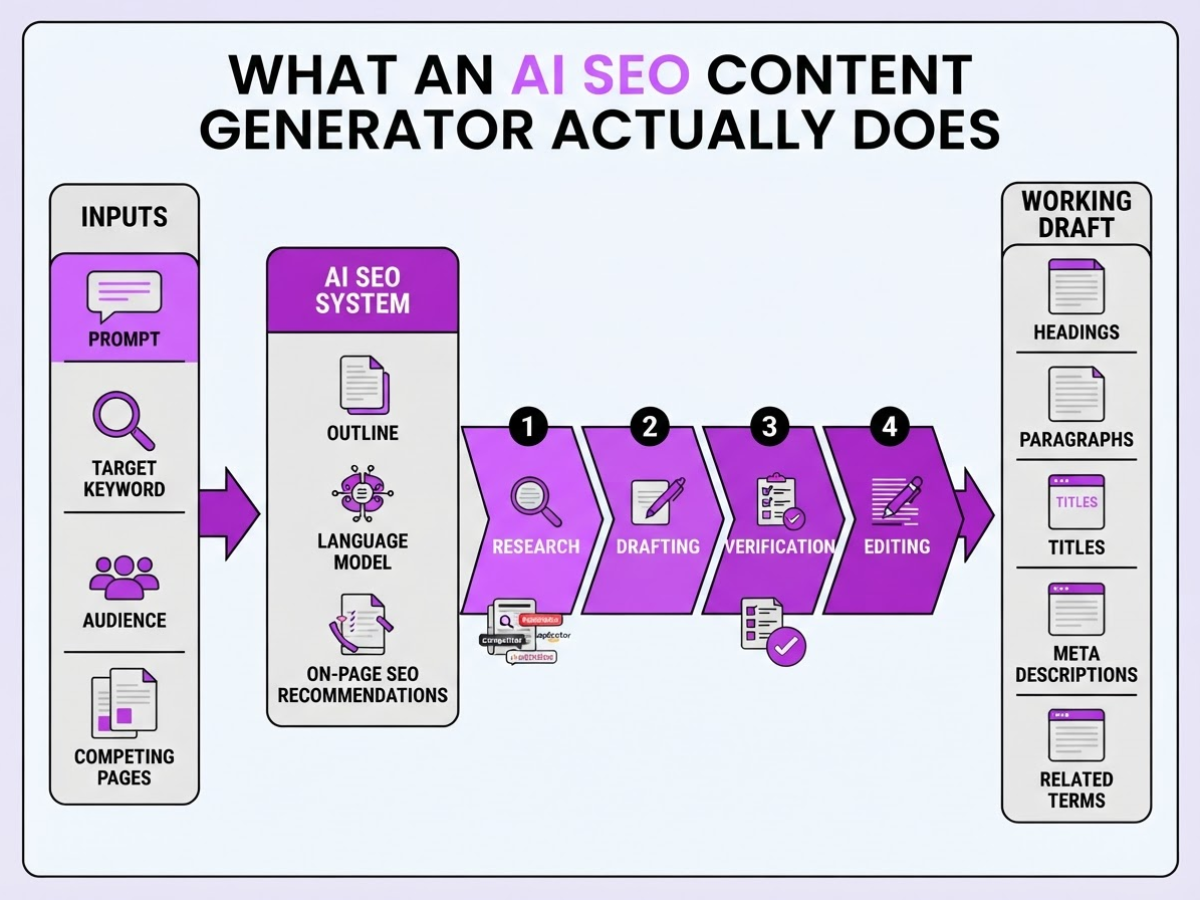
An AI SEO content generator turns a search brief into a working draft. You give it a prompt, target keyword, audience, and sometimes competing pages. The system combines those inputs with an outline, a language model, and on-page SEO recommendations to produce headings, paragraphs, titles, meta descriptions, and related terms.
That sounds broader than it is. Content generation covers the writing stage, not the entire SEO job. In practice, the workflow still includes several separate tasks:
- Research: checking search intent, competitors, customer questions, and content gaps.
- Drafting: turning the brief and outline into readable copy.
- Verification: reviewing claims, sources, prices, statistics, and product details.
- Editing: fixing awkward phrasing, repetition, brand voice, and unsupported confidence.
- Publishing: adding images, links, schema, metadata, and the page to your website.
- Measurement: watching rankings, clicks, conversions, and updates needed after publication.
A generator can help with much of the first two tasks and suggest actions for the rest. It cannot know that your pricing changed yesterday or that a competitor’s statistic is misleading unless you check it. I have seen teams publish polished drafts with one wrong product detail, then spend more time repairing trust than they saved by automating the writing.
Roki AI creates website content on autopilot, then gives you 3 to 10 SEO improvement tasks each week. Those tasks can include finding Reddit posts where you can contribute a useful comment that mentions your website, rather than treating publishing as the finish line. Our guide to automating content creation with SEO AI explains that workflow in more detail.
More pages do not automatically mean more relevance, trust, or rankings. Google warns that generating many pages without adding value can violate its scaled content abuse policy. The fastest way to produce 100 thin pages is also the fastest way to create 100 cleanup jobs.
Pro Tip: Judge a generator by the quality of its review and improvement workflow, not just by how quickly it produces a first draft.
You still own five decisions: choose the right intent, review sources, require original insight, protect your brand voice, and approve every page before it goes live. That ownership shapes the brief in the next section.
Before You Generate: Turn a Keyword Into a Content Brief
A blank prompt gives an AI tool too much room to guess. Before I put a keyword into Roki AI, I turn it into a brief that tells the system what the page must accomplish and what it must not invent.
-
Classify the query. Decide whether the search is informational, commercial, navigational, or transactional. “What is an AI SEO content generator?” needs explanation, while “best AI SEO content generator” suggests comparison and “Roki AI login” is navigational. If the intent is mixed, choose the dominant intent and state it in the brief.
-
Read the current results. Open the top 10 results and record recurring formats, such as tutorials, comparison pages, product pages, or templates. Note repeated questions, missing examples, outdated advice, weak evidence, and points nobody explains clearly. A content gap review is more useful than copying the headings of three competitors.
-
Set the page target. Write down the primary keyword, related terms, audience, funnel stage, desired action, and success metric. For example: “Target operations managers comparing tools; move them from consideration to a demo; measure qualified organic clicks and demo starts.” Do not confuse a traffic goal with a business goal.
Pro Tip: Write the page’s one-sentence promise before writing the prompt; if the promise is vague, the generated outline will usually be vague too.
-
Add the editorial guardrails. Specify the page’s point of view, the proof it needs, acceptable sources, internal links, and claims that require review. If you promise a cost comparison, provide current prices or tell the writer to flag missing data. Google recommends a people-first approach to AI-assisted content, which rules out padding a page with generic paragraphs.
-
Use a repeatable template. Include the headline direction, objective for every section, likely FAQs, title and meta description requirements, audience language, preferred examples, reading level, word range, and editorial restrictions. I also add “do not fabricate statistics, customer results, quotes, or product features.” That line prevents more cleanup than another clever prompt.
-
Run the brief through the workflow, not instead of strategy. Use Roki AI to turn the approved brief into an outline and draft, then review the output against your wider SEO roadmap: topic clusters, publishing sequence, existing pages, links, and conversion priorities. Roki’s content workflow reduces repetitive setup, but it cannot decide which search opportunity deserves your next month of work. With the brief approved, generation becomes much easier to judge.
A Five-Step Workflow for Generating Better SEO Content
A good workflow keeps the AI in the production seat, not the editor’s chair. I use it to remove repetitive work, then keep every decision that affects accuracy, usefulness, and trust with a human.
-
Write the brief before you write the prompt. Include the target keyword, audience, search intent, tone, article length, heading structure, conversion goal, and source requirements. Add details the model cannot safely guess, such as your product limits, customer objections, pricing, and preferred examples. A vague instruction like “write an SEO article” usually produces vague work.
-
Request an outline first. Check whether the proposed sections answer the actual query, match the reader’s stage, and cover important subtopics your competitors missed. Challenge thin or repeated sections before asking for prose.
Pro Tip: Generate the outline first and approve it before drafting; this catches wrong intent earlier than editing a complete article.
-
Revise the draft with evidence from your business. Replace generic examples with customer questions, test results, screenshots, workflows, or first-hand observations. Explain technical points in plain language and remove repeated keyword phrases that sound written for a crawler. I also check every claim that could affect a purchase or decision. Google recommends manually fact-checking AI-generated content, including titles, metadata, structured data, and alt text, because generative models can invent details.
-
Handle the on-page work after the substance is right. Tighten the title and headings, write a specific meta description, add useful internal and external links, validate relevant schema, compress and name images, and write descriptive alt text. A title generator can give you options, but it cannot know which promise your page can actually keep. I often use Roki AI’s SEO content workflow to reduce copying, formatting, and revision tasks, but I still reject awkward headings and irrelevant links.
-
Run a human check, publish, and record the baseline. Confirm facts, examples, links, canonical settings, mobile layout, accessibility, and the call to action. Record the publication date, impressions, clicks, click-through rate, ranking for the target query, conversions, and indexed status. Review those numbers after 7, 28, and 90 days instead of guessing whether the page worked.
Roki AI can also surface 3 to 10 weekly tasks, including content improvements and relevant Reddit discussions. Participate only when you can answer the question usefully; dropping a link into unrelated threads is spam and can damage trust. This workflow gives you a clean baseline before the next round of improvements.

How to Add the Value Generic AI Drafts Miss
The draft usually gives itself away within the first few paragraphs. It sounds tidy, but it could belong to any company in the market. As the owner of TryRoki, I have seen this happen when a team publishes the first AI output instead of adding what only the business can know.
Watch for these warning signs:
- Unsupported claims with no study, customer evidence, or named source
- Recycled introductions such as “in today’s digital landscape”
- Vague advice that never tells the reader what to do next
- Repeated keywords forced into headings and sentences
- A polished tone that does not sound like your customers or team
- Invented examples, statistics, features, or customer results
Fix the draft with material the model cannot safely invent. Add a support question from last week, a product screenshot, your testing notes, a pricing limitation, or a short comment from someone who works in the field. If you cite research, link the claim to the original source and label your interpretation. Google recommends manually fact-checking AI-assisted content because models can produce inaccurate information, and its guidance warns against creating many pages without adding user value.
Replace “choose the right tool” with decision criteria: compare setup time, integrations, export options, cost, and the skill required to maintain each choice. Show one example, then state where it fails. That small admission often makes the advice more useful than another paragraph of confident generalities. A practical guide to finding content gaps can help you spot missing questions, but your customer conversations should decide which gaps matter.
Use an AI SEO content generator for comparison, expansion, editing, and gap finding. Do not ask it to make the subject-matter decisions for you. I would rather publish 900 words with a real test and a clear limitation than 2,000 words that merely repeat the search results.
Reddit needs the same discipline. Answer the community’s actual question first, using useful detail or a relevant experience. Dropping a TryRoki mention or website link into an unrelated reply adds noise, annoys moderators, and rarely earns trust.
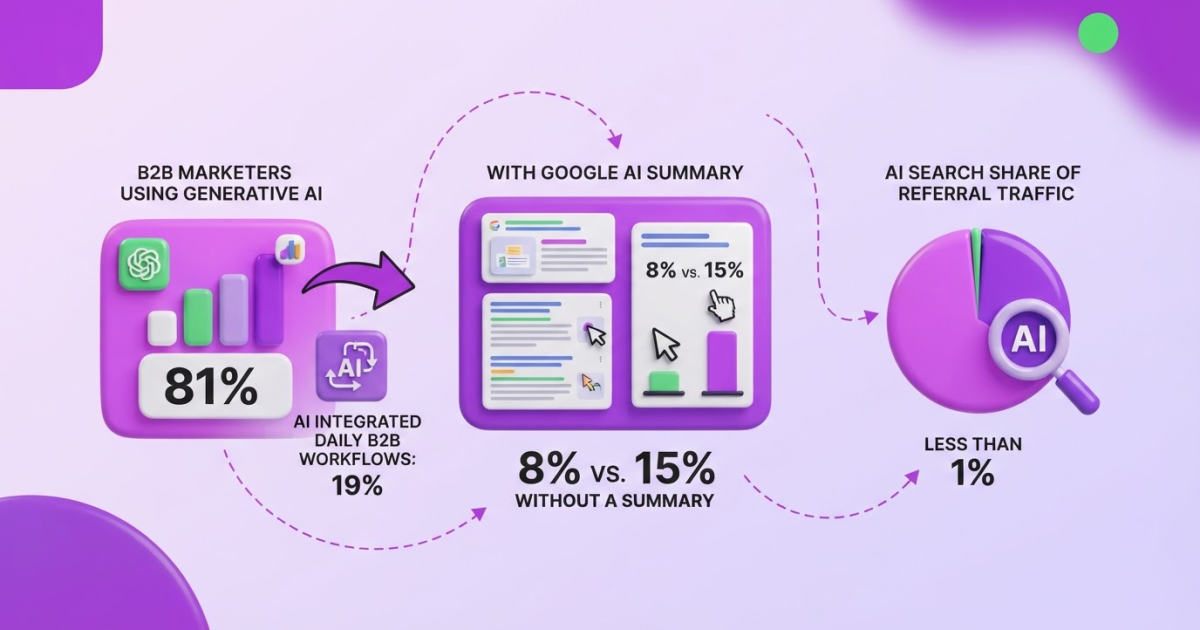
This work matters beyond conventional rankings. Pew Research found that traditional-result clicks fell from 15% to 8% when a Google AI summary appeared, so your claims must be clear enough for both readers and summarization systems to understand. Use that standard in the measurement cycle that follows.
Measure Whether the Generator Is Improving SEO
Traffic alone will not tell you whether an AI SEO content generator is doing useful work. I review indexed pages, impressions, clicks, click-through rate, ranking movement, conversions, assisted conversions, and qualified engagement such as engaged sessions, scroll depth, demo starts, or email signups. Output volume is the easiest metric to inflate and the least useful one.
Start with a baseline. Compare the pages created through your workflow with older pages or a matched group covering similar topics, search intent, and business value. If every new page gets judged against the whole site, seasonality and brand demand can hide what changed. Keep the comparison imperfect but consistent.
Use this review cycle:
- At 30 days, check discovery. Confirm which URLs Google indexed, whether impressions are appearing, and which queries bring visibility. Do not call a page a failure because it has no clicks after one week. Indexing delays and low initial search demand are common, and early ranking data can swing sharply.
- At 60 days, diagnose movement. Look at page-level and query-level data. A page with impressions but a weak CTR needs a clearer title or snippet. A page ranking between positions 8 and 20 needs expanded sections, stronger internal links, better evidence, or a narrower answer. Our SEO title generator guide covers the title problem, but changing a title will not rescue thin content.
- At 90 days, judge business value. Compare organic conversions, assisted conversions, and qualified engagement with the baseline. Consolidate pages that compete for the same intent, and keep investing in pages that attract the right visitors even when their traffic looks modest.
I also record mentions or citations in AI search results as a directional signal, not the scoreboard. BrightEdge found AI search referrals below 1% in its January to August 2025 analysis, while organic search drove most conversions, so traffic and revenue still deserve priority. Roki AI’s weekly 3 to 10 task model turns these findings into a recurring loop: review the data, choose the next fixes, publish or update, then measure again. That rhythm beats a one-time publishing sprint, though it still requires judgment when the numbers disagree.
The data tells you where to focus human attention next.
My honest take on AI SEO content generators
I see an AI SEO content generator as extra capacity, not an autonomous publishing strategy. After watching teams use these tools in real workflows, I have found that the fastest team is rarely the one that publishes the most pages. It is the team that learns fastest from search intent, customer questions, and page-level performance. That is the contrarian point many content plans miss: page volume can hide slow learning.
AI does a good job turning a clear brief into a usable first draft, exposing structural gaps, and removing repetitive work. It also creates new problems. A generated article can sound polished while getting a product detail wrong, repeating what already ranks, or giving readers no reason to trust it. Someone must own the accuracy, originality, positioning, and business result.
My standard is simple:
- Every generated page needs a reason to exist.
- Readers should feel a human contribution in the examples, evidence, or judgment.
- The page needs a measurable purpose beyond word count.
At TryRoki, we are building around that principle by combining automated content production with recurring SEO tasks, including 3 to 10 weekly tasks that help you improve in Google and AI search. Autopilot should mean a dependable operating rhythm, not a blind release button. Use the time saved for better research, sharper editing, and continuous improvement.
— Daniel/Aleksandra
Put your AI SEO content workflow on autopilot with Roki AI
If you want to use an AI SEO content generator without handing over editorial judgment, Roki AI gives you a practical operating rhythm. It helps create website content, organizes the work, and sends 3 to 10 weekly tasks aimed at improving visibility in Google and AI search engines.
I built it for teams that lose momentum between keyword research, drafting, optimization, and distribution. The setup still needs your review, and the first task list can feel broader than your priorities. That is a useful constraint, not a reason to publish blindly. You can combine content creation with actionable optimization and relevant Reddit opportunities, but every contribution must genuinely help the discussion and fit the community.
Test the workflow on one focused topic cluster, review each output, and measure the result before expanding. See how Roki fits into an SEO content workflow. It creates discipline around SEO, not instant rankings.
Frequently Asked Questions
An AI SEO content generator is software that uses artificial intelligence to help you plan, draft, and improve content around a search query. The better tools support at least 3 parts of the workflow: research, writing, and optimization. You still need to check accuracy, usefulness, and brand fit before publishing.
It can support SEO when the content is accurate, original, and written for people rather than search engines alone. I recommend 3 reviews before publishing: check search intent, verify factual claims, and inspect the page’s on-page quality.
The bigger risk is not whether AI helped write the page, but whether the result is inaccurate, repetitive, or published at scale without adding value. Review every article for 3 things: original insight, trustworthy sources, and a clear reason it helps the reader.
Give the tool the audience, search intent, primary keyword, supporting topics, structure, tone, sources, internal links, and desired action. Ask for an outline first, then request the draft with at least 1 explicit instruction not to invent facts or citations.
No. Unedited content can expose factual errors, repetitive wording, weak advice, or incorrect metadata, so use a human approval checklist with at least 2 checks: verify important claims and review the page as a real reader would.
Written by Daniel/Aleksandra.
Recommended reads
- Seo Ai Generator How To Automate Content Creation Effectively
- Creating High Quality Seo Content With Roki Ai
- Avoiding Common Ai Content Mistakes For Better Seo
- Seo For Llms A Practical Optimization Guide
Sources
- Google Search's Guidance on Generative AI Content on Your Website | Google Search Central | Google for Developers
- Creating Helpful, Reliable, People-First Content | Google Search Central | Documentation | Google for Developers
- Do people click on links in Google AI summaries? | Pew Research Center
- BrightEdge Research
- B2B Content Marketing: 2025 Benchmarks & Trends
- AI in content marketing: How creators and marketers are using AI to speed up & succeed [data]