Aleksandra D.
An SEO title is the page title that tells search engines and readers what your page covers. Put the main topic near the beginning, show the benefit or answer, and test a concise 40–60-character version while treating that range as a guideline, not a strict limit.
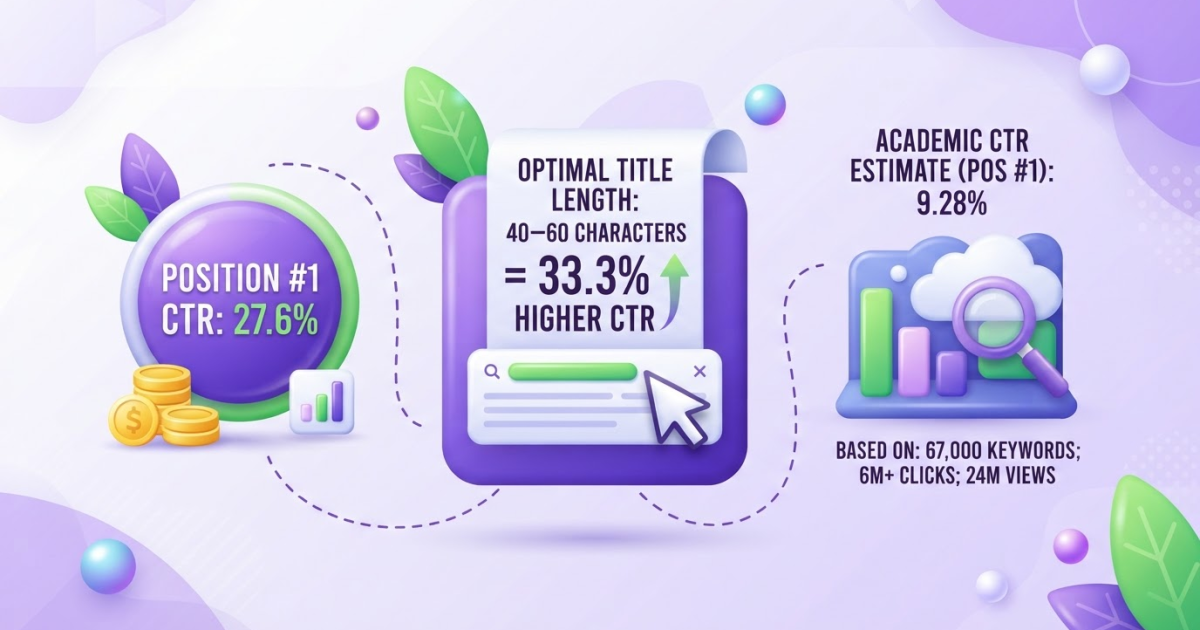
You can spend hours improving a page, then watch it lose clicks because its SEO title is vague, stuffed with keywords, or disconnected from what the page actually delivers. That frustration is common, especially because Google can rewrite what searchers see. In one Backlinko analysis, title tags between 40 and 60 characters had a 33.3% higher click-through rate than titles outside that range, but treat that as an observed association, not a Google rule. This guide shows you how to match search intent, structure an SEO title, improve its appeal, check it in HTML and previews, and repeat the process across multiple pages.
| Point | Details |
|---|---|
| Match search intent | Choose wording that fits the searcher’s goal, whether they want a definition, comparison, tutorial, product, or solution. |
| Lead with relevance | Put the core topic near the beginning when it reads naturally and accurately describes the page. |
| Test 40–60 characters | Treat 40–60 characters as a practical testing range, not a fixed Google limit. |
| Write for clicks | Pair the topic with a specific benefit, audience, angle, or outcome instead of repeating keywords. |
| Check rendered results | Review the HTML title, visible H1, mobile preview, and page content because Google can draw title links from 4 different sources. |
What an SEO Title Actually Does
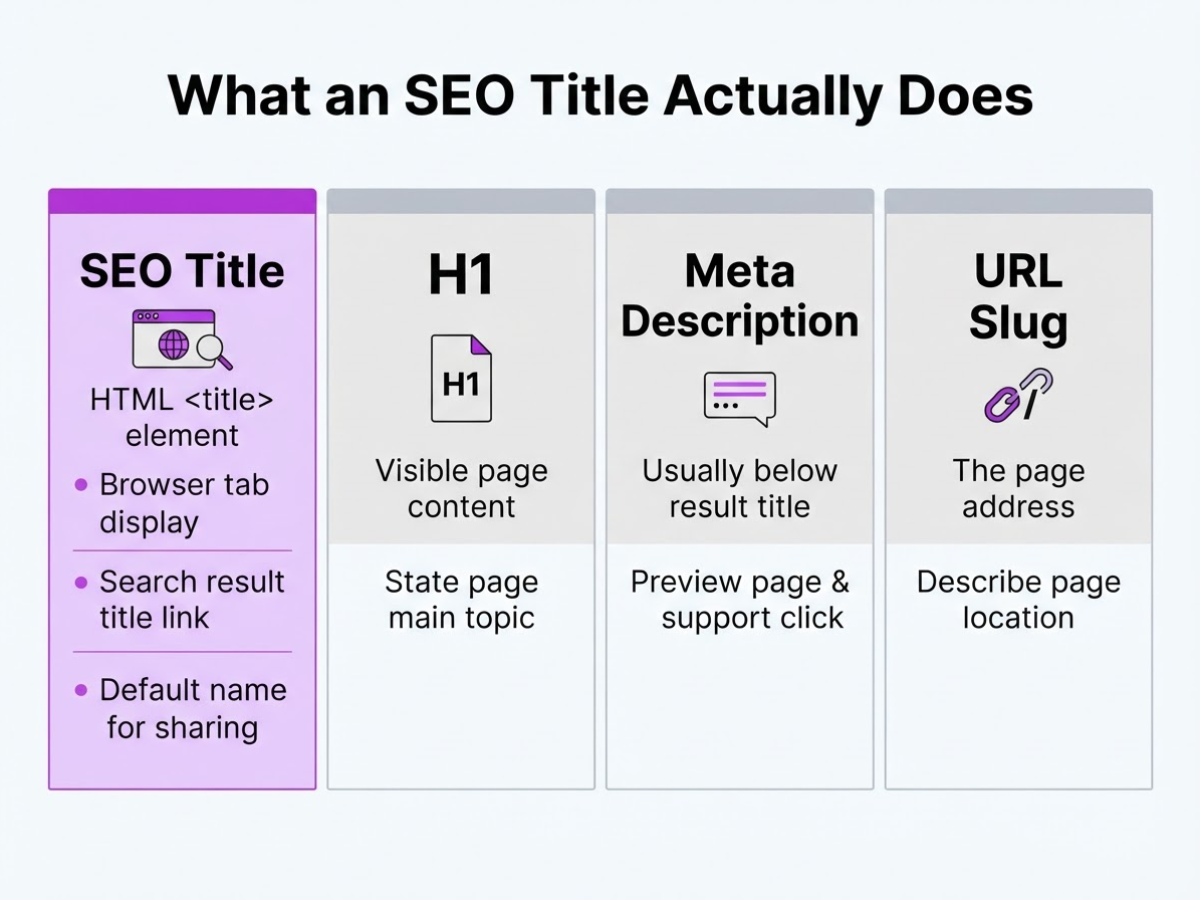
An SEO title is the page’s HTML <title> element. It tells browsers what to display in a tab, gives search engines a strong starting point for the search-result title link, and often supplies the default name when someone shares or saves the page. When I review a site, missing or vague titles are still among the easiest problems to find.
An SEO title is not the same thing as the other labels on a page:
| Element | Where people see it | Main job |
|---|---|---|
| SEO title | Browser tab, search results, shared links | Identify the page and set an expectation |
| H1 | Visible page content | State the page’s main topic for visitors |
| Meta description | Usually below the result title | Preview the page and support the click |
| URL slug | The page address | Describe the page location in a readable way |
Google recommends specifying a title in the HTML <title> element for every page. That does not guarantee Google will display your wording exactly. It can use the H1, prominent text, links, or other page signals when it thinks the supplied title is inaccurate, repetitive, or unhelpful.
Accuracy matters because the title is a promise made before the visit. “Home” tells a searcher almost nothing. “Emergency Plumbing Services in Austin | ClearFlow Plumbing” identifies the service, location, and business. A title such as “Our Services” is only slightly better if the page actually covers drain cleaning, water heaters, and leak repairs.
The same mismatch causes friction in sharing workflows. A colleague copying a browser tab or posting the page may pass along a title that sounds generic, even when the page contains useful information. A clear title also gives your H1 and meta description a direction instead of forcing each element to make a different promise.
Pro Tip: Write the title after the page angle is clear, but before drafting the introduction, so the article stays focused on one promise.
For practical drafting help, you can use a free online SEO title generator, then edit the result to match the page exactly. Next, the focus shifts from definition to the parts that make a title useful in search.
A Five-Step Process for Writing an SEO Title
When I draft an SEO title, I start with the page brief, not a character counter. A title that fits neatly in search but promises the wrong thing still loses trust. Use this five-step workflow instead.
-
Start with the query and the searcher’s job. Write down the primary query exactly as you understand it, then ask what the searcher wants to do. Someone searching “seo title generator” may want a tool immediately, while someone searching “how to write an SEO title” wants instructions. That distinction changes the verb, format, and promise.
-
Pick a useful structure. Choose one clear frame: topic plus benefit, topic plus audience, or topic plus current angle. For example, “SEO Titles: Write Better Search Snippets,” “SEO Titles for Ecommerce Product Pages,” or “SEO Title Best Practices for 2026.” Do not force a year into an evergreen page just to look current. It becomes awkward the moment the content stops matching it.
-
Put the subject where it helps clarity. Place the central topic near the beginning when readers need to identify the page quickly. You do not need to shove the exact keyword into position one every time. Search engines can use the title, H1, prominent text, and other signals when generating a title link, as Google explains in its title-link documentation. Clarity beats a stiff keyword variant such as “SEO Title Best Write.”
-
Add one honest differentiator. Give the reader a reason to choose your result: a specific outcome, audience, format, timeframe, or proof point. “SEO Titles: 7 Examples for Service Businesses” tells more than “SEO Titles: Complete Guide.” Then cut filler, repeated modifiers, unsupported claims, and promises the page cannot prove. “Guaranteed rankings” is not a differentiator if your article cannot deliver that result.
Pro Tip: Draft one title that is search-led, one that is benefit-led, and one that is audience-led; comparing the three usually reveals the clearest angle.
- Compare, then verify. Write 3 to 5 alternatives before choosing one. I often spot the strongest version only after the first draft exposes what sounds forced. A free online SEO title generator can speed up variations, but treat its suggestions as raw material, not a final decision. Check the winner against the H1, opening paragraph, headings, and call to action. If the title promises templates but the page sells consulting, revise the title or the page.
Before publishing, read the title aloud and check whether its main idea survives without the keyword. That small test catches most clumsy titles before they reach search results. Next, apply the same discipline to title length and search-result display.
SEO Title Formulas: Which Angle Fits the Page?
The right formula depends on what the searcher needs to do next. A tutorial reader wants a clear outcome, while a buyer wants evidence that the page fits their situation. I use the page’s intent as the starting point, then add the keyword naturally.
| Page type | Useful title pattern | Example |
|---|---|---|
| Blog guide | How to [achieve outcome] or [Topic]: A Practical Guide | How to Write an SEO Title That Gets Clicks |
| Product page | [Product] for [audience] plus a benefit or use case | SEO Title Generator for Small Business Websites |
| Category page | [Category] for [use case] or [Category] From [price] | Running Shoes for Trail Beginners From $80 |
| Local service page | [Service] in [location] plus a trust or outcome signal | Emergency Roof Repair in Austin, Same-Day Visits |
For informational pages, “How to” works when the article teaches a process and the reader expects actionable steps. “[Topic]: A Practical Guide” fits a broader reference page, but it becomes dull when every article uses it. I use a number only when the page genuinely contains that many options, tools, or steps. “7 SEO Title Mistakes” should not lead to a three-point article padded with filler.
Commercial titles need a stronger buying signal. Audience, use case, comparison, price, and a specific benefit can each help, but only when the page supports the claim. “Best CRM for Freelancers” sets a comparison expectation. “Affordable CRM Plans From $12/Month” needs current pricing. “Guaranteed First-Page Rankings” is not a persuasive formula; it is an unsupported promise that can damage trust.
Year markers also have a cost. They help for changing subjects such as pricing, software features, or regulations, but an old year makes a neglected page obvious.
Pro Tip: Use a year only when the page will receive a scheduled review; an outdated year can reduce trust faster than it increases relevance.
Avoid repeating the exact keyword just to satisfy a formula. A large Backlinko analysis found that exact keyword presence showed essentially zero correlation with higher first-page rankings, while natural title wording still helps users understand the result. For more variations, compare your draft with this free SEO title generator, then edit the output like a human.
With the page angle chosen, the next section turns that choice into a repeatable drafting process.

The SEO Title Quality-Control Checklist
Before I publish a page, I read its SEO title without looking at the URL or keyword brief. If I cannot tell the page’s primary subject and search intent in a few seconds, the title is not ready. A guide, product page, category page, and comparison page should not all sound interchangeable.
Use this quick mistake check:
- Keyword stuffing: Remove repeated phrases such as “SEO Title | SEO Titles | Best SEO Title.” Include the main topic once where it fits naturally.
- Vague claims: Cut words like “amazing,” “ultimate,” and “game-changing” unless the page proves a specific benefit.
- Misleading promises: Do not call a basic overview a complete course, or claim “free” when the key feature requires payment.
- Unnecessary branding: Keep the company name when it supports recognition, but remove it if it pushes the useful subject out of view.
- Duplicate wording: Compare nearby pages, product variants, location pages, and template titles. “Blue Running Shoes” and “Running Shoes in Blue” may still create needless confusion.
- Sloppy details: Check punctuation, capitalization, spelling, city and country names, product models, trademarked names, and dates. A stale “2025” title in November 2026 makes the page look neglected.
I also compare the title with the H1, Open Graph title, first prominent paragraph, and internal anchor text pointing to the page. They do not need identical wording, but they should describe the same offer or topic. If the title says “Shopify SEO Tools” while the H1 says “Our Agency Packages,” you have an alignment problem, not a minor copy difference.
For a practical second opinion, run the draft through a free SEO title generator, then edit the suggestion yourself. Tools often produce tidy but bland titles, and they cannot know when a product name or local spelling matters.
Preview the result on a narrow phone screen and a wide desktop screen. Google has no fixed character limit for the HTML <title>, but it can truncate the displayed title link to fit the device. After publishing, inspect the rendered HTML and confirm that the intended <title> reached the browser, rather than trusting a CMS preview.
Google can also build or rewrite the title link from the title element, H1, main visual title, og:title, prominent copy, anchor text, links pointing to the page, and WebSite structured data, as Google documents here. That is why consistency across the page matters.
With those checks complete, you can judge whether the title earns the click without making promises the page cannot keep.
How to Improve SEO Titles Over Time
I treat an SEO title as a working hypothesis, not a permanent label. Before changing one, I export the page’s last 28 to 90 days from Search Console and record impressions, clicks, CTR, average position, and the queries generating those impressions. The query set matters because a title can attract clicks for the wrong promise while looking healthy in aggregate.
Use this review cycle:
- Day 0: establish the baseline. Save the current title, date, URL, query groups, and landing-page conversions. Pages with meaningful impressions and weak CTR get priority. Changing every title at once creates noise and makes the results nearly useless.
- Day 1: choose one major variable. Test a clearer benefit, a different angle, more specificity, or simpler wording. Do not change the title, page structure, internal links, and meta description together unless you enjoy guessing. I usually keep the keyword concept stable and change only the promise.
- Days 14 to 28: check for an early signal. Record impressions and average position again, but do not declare victory after a handful of clicks. Search demand fluctuates, and Google can rewrite the visible title. Google explains that it can build title links from the
<title>element, headings, prominent text, and other sources, so keep those elements aligned with the new wording. Google’s title-link guidance is worth keeping beside your editorial checklist. - Days 28 to 90: judge the business result. Compare CTR with qualified engagement, leads, purchases, or sign-ups. A higher CTR that sends visitors who leave immediately is not a win. For context, a Backlinko analysis found a 27.6% average CTR for the number-one organic result, but your page’s position and intent still set the realistic benchmark.
Refresh the title when the offer, audience, product, year, or search intent changes. I use an editorial workflow, sometimes with a free SEO title generator, to produce several options, then approve the final wording myself. Automation creates useful variations, but it cannot decide whether the promise matches the page. The next section turns these observations into a repeatable publishing workflow.
My Honest Take on SEO Titles
I treat an SEO title as a strategic promise, not a storage box for every keyword variation. When I review pages at TryRoki, I ask one practical question first: can the right searcher tell what they will get from this page? If the answer is unclear, adding another keyword usually makes the title worse, not better.
Here is my contrarian view: teams spend too much time counting characters. A sensible length range helps keep a title readable in search results, but a perfectly measured title with a weak angle will lose to a slightly longer title that makes the audience and outcome obvious. I would rather publish “How to Write Product Descriptions That Convert for Etsy” than force an awkward exact-match phrase into a shorter line.
The frustrating part is that title work rarely produces instant certainty. You can make a careful choice and still need impressions, clicks, and qualified visits before you know whether the promise matches reality. At TryRoki, I prefer generating several options, checking each against search intent and page quality, then publishing deliberately. Automation can speed up the drafts, but the person responsible for the page must own the promise. No tool can repair a misleading title or a thin article behind it.
- What I would not expect: a better SEO title cannot compensate for weak content, poor page experience, or an offer that does not fit the query.
- What I would do next: compare 3 alternatives, publish one deliberate promise, and review qualified traffic after 28 to 90 days.
— Daniel/Aleksandra
Build a More Consistent SEO Title Workflow with Roki AI
A strong SEO title rarely comes from staring at a blank document. I built Roki AI to help turn that decision into a repeatable publishing habit, with title options, supporting website content, and 3–10 practical tasks each week aimed at improving visibility in Google and AI search engines. You can use Roki AI to keep your SEO publishing organized instead of letting promising ideas sit in a spreadsheet.
The workflow is not magic. You still need to reject weak titles, check search intent, and edit anything that sounds generic. Roki AI can also surface relevant Reddit discussions where a genuinely useful comment may include your website, but forced promotion will usually backfire. For a closer look at how it fits into content production, see how Roki AI streamlines SEO content work.
Frequently Asked Questions
Google does not set one fixed character limit for an HTML title element, and search-result titles can be cut off based on screen width. As a practical starting point, test titles between 40 and 60 characters, but prioritize a clear promise over hitting an arbitrary count.
The SEO title commonly supplies the clickable title in search results, while the meta description gives users supporting context about the page. Keep them connected but distinct, and do not repeat the same sentence in both fields.
Your SEO title does not need to match the H1 word for word, but both should describe the same main topic and user promise. If they differ sharply, Google has more reason to replace your title link with text from another page element.
Start with the target query and search intent, then add a concrete benefit, audience, format, or outcome. Write at least 3 versions, cut filler, and check that the final title accurately describes the article instead of promising something the page does not deliver.
Google can build the title link from your H1, visible page text, headings, og:title, anchor text, links, and other signals. Compare those elements for inconsistent wording, vague claims, or outdated details before changing the HTML title, because a single revision may not fix a conflict across 5 or more page signals.
Written by Daniel/Aleksandra.
Recommended reads
- Free Online Seo Title Generator
- Seo Title Generator How To Create Effective Titles That Rank
- Best Seo Title Generator Boost Your Content Strategy
- Meta Description Generator Write Better Seo Snippets
Sources
- Influencing Title Links in Google Search | Google Search Central | Documentation | Google for Developers
- We Analyzed 4 Million Google Search Results. Here's What We Learned About Organic CTR
- We Analyzed 4 Million Google Search Results. Here's What We Learned About Organic CTR
- Device-dependent click-through rate estimation in Google organic search results based on clicks and impressions data
- We Analyzed 11.8 Million Google Search Results. Here’s What We Learned About SEO
- Beyond Rankings: Exploring the Impact of SERP Features on Organic Click-through Rates