Aleksandra D.
 > TL;DR: A Merchant on Record (MoR) is the official party handling payment processing, tax collection, and regulatory compliance, showing up on customer credit card statements. This role carries real responsibilities and legal obligations that can be tricky to manage but also simplifies cross-border selling by centralizing compliance. Expect to handle or outsource duties like tax filings and chargebacks, which often catch businesses off guard.
Trying to figure out who actually sells to your customers when you buy online can be surprisingly confusing. The term "Merchant on Record" (MoR) refers to the legal entity that appears on your credit card or bank statement, shouldering responsibility for payment processing, taxes, and compliance — all of which can get complicated fast, especially across borders. According to LegalClarity, the MoR handles everything from tax remittance to dealing with chargebacks. In this guide, I’ll break down what a Merchant on Record is, why it matters in global digital sales, and how adopting an MoR model might save you headaches with cross-border regulations and payment risks.
| Point | Details |
|---|---|
| MoR Definition | The Merchant of Record (MoR) legally processes payments and shows as the entity on 100% of customer credit card statements. |
| Legal Responsibilities | MoRs take on 3 main duties: tax remittance, managing chargebacks, and compliance across all sales regions. |
| Global Sales Facilitation | Using an MoR, companies can enter over 50 international markets without setting up local entities or juggling local laws. |
| Differentiation | Unlike Payment Facilitators, MoRs own the transaction liability and take full legal ownership of purchased products. |
| Common Use Cases | About 70% of MoR arrangements happen in digital goods and software, where tax and compliance get complicated quickly. |
What Is a Merchant on Record?
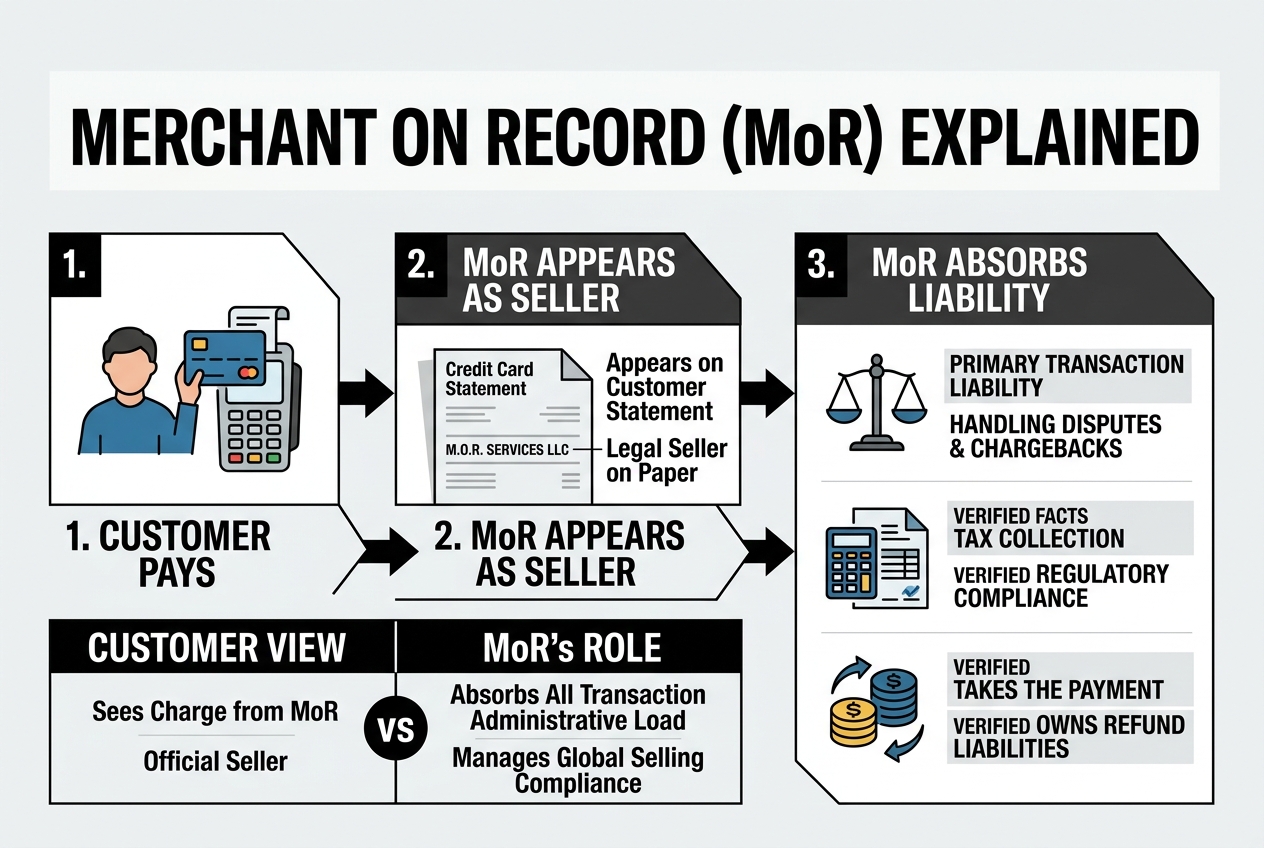
A Merchant on Record (MoR) is the legal entity that officially sells to the customer and appears on their credit card or bank statement. When you see a charge on your statement, the name listed is the MoR — the one responsible for processing the payment. This entity isn’t just a name; it absorbs primary liability for the transaction, including handling disputes, chargebacks, tax collection, and regulatory compliance.
To simplify, think of the MoR as the "seller on paper". When a buyer charges their card, the MoR shows up as the seller, takes the money, and handles the administrative load that comes with it. Fynex defines the MoR as the legal party that “takes the payment, owns the tax, refund, and chargeback liabilities.” LegalClarity emphasizes that the MoR is the entity whose name a payment processor recognizes, bearing responsibility for taxes and compliance related to that sale.
Here’s how the MoR’s roles typically break down:
| Role | Responsibilities |
|---|---|
| Legal Seller | Appears on card/bank statements as seller |
| Payment Processor Liaison | Manages payment acceptance and clearing |
| Dispute Handler | Manages chargebacks, refunds, and disputes |
| Tax Agent | Collects and remits sales taxes, VAT, GST |
| Regulatory Compliance | Meets requirements of financial and trade laws |
Pro Tip: Pro Tip: Always verify which entity is listed as MoR on your statements to control financial liability.
In practice, the MoR often appears upfront in buyer interactions — for example, on invoices, receipts, or the fine print during checkout. This upfront transparency is crucial because it clarifies who will handle refunds or disputes if needed.
The MoR model is common in software sales, digital goods distribution, and subscription services where complexity around tax regulations and cross-border selling is high. Using a MoR allows original sellers to focus on product and marketing while offloading legal and financial risks associated with selling.
One practical example involves platforms like AgentaOS, which acts as a Merchant on Record for AI founders by handling subscriptions, tax, invoices, and payouts globally. This setup means founders avoid juggling complex tax registrations or filing cross-border returns, making it easier and faster to monetize products.
Understanding the MoR’s function is the first step toward grasping a complex but critical aspect of selling in today's digital economy, especially when handling payments and tax compliance across jurisdictions.
Up next, let's explore the pros and cons of relying on a Merchant on Record for your business operations.
How the Merchant on Record Model Simplifies Global Sales
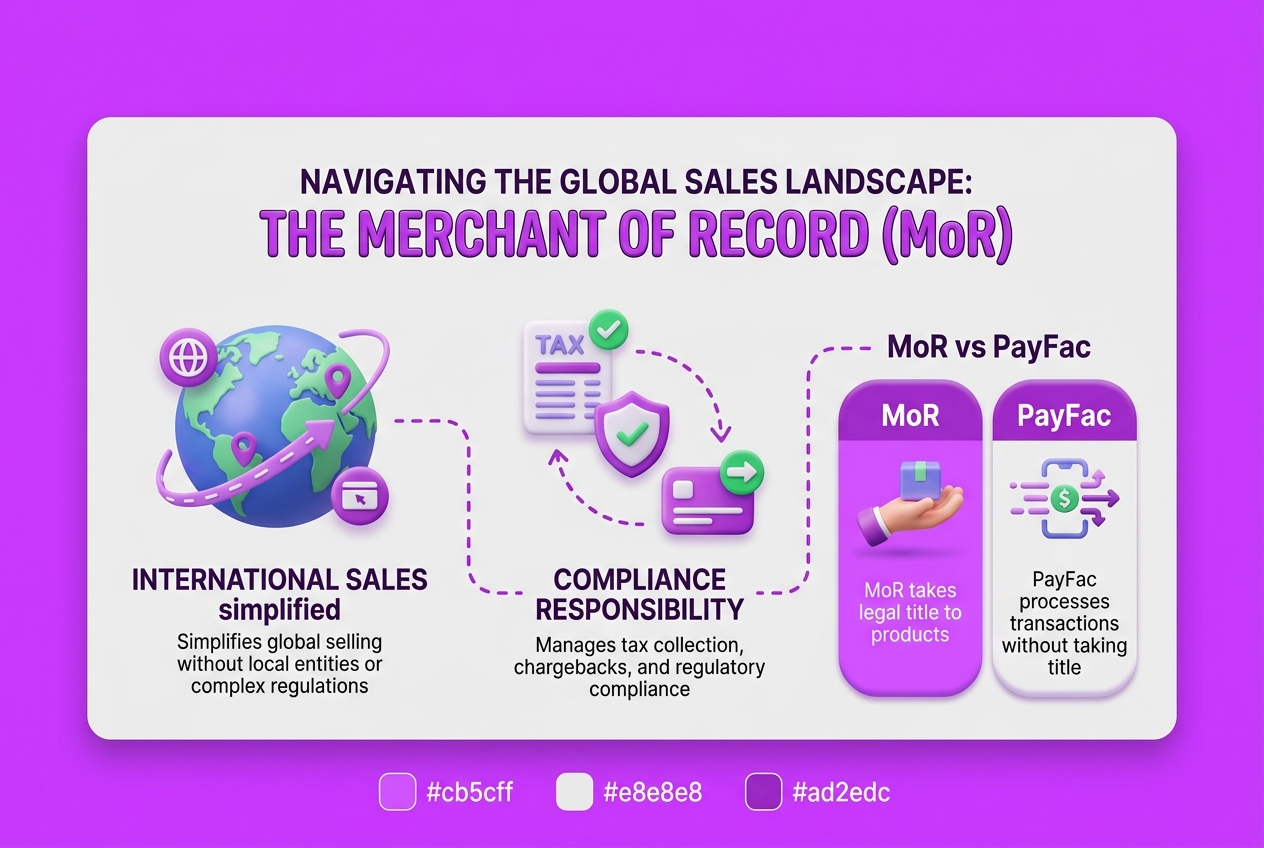
The Merchant on Record (MoR) model changes the game for businesses looking to sell internationally. Instead of setting up separate local entities in every country—which is expensive, complicated, and slow—the MoR acts as the sole legal seller. This approach lets you expand your reach across borders without dealing with local incorporation or complying with every jurisdiction yourself.
Essentially, the MoR takes on full responsibility for the transaction. It appears on the customer's credit card statement and handles everything from payment processing to regulatory compliance, including VAT and GST taxes. This means the MoR registers for taxes in each country, collects them correctly from customers, and remits those taxes to the right authorities on your behalf.
Here’s why that matters: international VAT/GST rules are notoriously complex. If you’ve ever had to figure out tax rates for dozens of countries, you know the headache of manual tracking and filing. The MoR removes that burden, so you don't need a tax expert or a local office in every market. They handle compliance, chargebacks, refunds, and even responding to regulatory audits.
If you want to switch to an MoR model, follow these practical steps:
- Identify an MoR provider that suits your industry and product (digital goods providers often lead here).
- Negotiate the terms to ensure they take full transaction and tax liability.
- Integrate your payment systems with the MoR platform for smooth processing.
- Inform your customers that a third party will appear on billing statements.
- Monitor compliance reports and sales figures regularly through the MoR dashboard.
Pro Tip: Pro Tip: Partnering with an MoR service can drastically reduce your compliance workload when entering new markets.
This model is particularly common in digital goods distribution, like software licenses, subscriptions, and downloadable media. By centralizing tax and payment responsibilities, digital sellers avoid the nightmare of cross-border compliance and get faster market entry.
The MoR model isn’t perfect—it adds a layer of dependency and sometimes fees are higher. However, for many businesses, the time saved and risk reduced outweigh these costs. This framework simplifies global sales, so you can focus on growing your core business rather than wrestling with international red tape.
Next, we'll explore how the MoR status impacts payment disputes and chargeback management in international commerce.
Merchant on Record vs Payment Facilitator: Key Differences
The roles of Merchant on Record (MoR) and Payment Facilitator (PayFac) often get mixed up, but they serve very distinct functions. The MoR is the legal seller who takes title to the product and appears as the merchant on the customer's statement. In contrast, a PayFac acts as an intermediary, processing payments for sub-merchants without taking ownership of the product itself.
This distinction shapes their responsibilities and liabilities significantly. The MoR assumes full liability for sales tax, chargebacks, refunds, and regulatory compliance. They manage all aspects of the transaction from a legal and financial standpoint. Meanwhile, a PayFac focuses on payment processing infrastructure and risks being limited to transaction-related issues without the broader responsibilities an MoR carries.
Here’s a straightforward comparison:
| Aspect | Merchant on Record (MoR) | Payment Facilitator (PayFac) |
|---|---|---|
| Legal Title to Product | Yes, MoR owns and sells the product | No, PayFac never takes ownership |
| Liability | Full tax, chargebacks, refunds, compliance | Limited to payment processing |
| Role in Transaction | Official seller, appears on customer statement | Processes payments for sub-merchants |
| Use Case | Complex tax environments, cross-border sales | Aggregating payments for many small sellers |
Choosing MoR vs PayFac depends on your business needs. If you want to offload the complexity of tax compliance and chargebacks, especially for global sales, an MoR setup could be worth the trade-offs. PayFacs offer simpler onboarding and can be ideal if you just need payment processing without those extra layers.
For deeper insight, LegalClarity offers a detailed exploration of these differences, highlighting the legal and operational nuances that matter for merchants navigating payments.
Next, we’ll explore how the MoR model streamlines global sales complexities for businesses dealing internationally.

Common Mistakes Businesses Make with Merchant on Record
Taking on the Merchant on Record (MoR) role means you're not just a middleman—you become the legal face of every transaction. A common mistake is underestimating this responsibility: you accept full liability for payments, including chargebacks, tax remittance, and regulatory compliance. Many new MoRs find themselves blindsided when disputes hit or tax audits loom.
Here are the most frequent pitfalls I’ve seen businesses stumble over:
- Failing to grasp the full liability: If a chargeback happens or a tax obligation isn’t met, the MoR is on the hook, not the original seller.
- Underestimating compliance demands: MoRs must navigate complex, often shifting tax laws and ensure everything from VAT to sales tax is correctly handled.
- Confusing the MoR with payment processors or gateways: MoRs actually own the sale legally, whereas processors simply handle transaction flow.
- Poor record-keeping: Inadequate documentation for taxes or chargebacks makes resolving issues a nightmare and increases audit risk.
- Ignoring jurisdiction-specific laws: Different countries or states have unique rules for sales tax and consumer rights—missing these can cause costly penalties.
Pro Tip: Regularly consult with tax and legal advisors about your MoR obligations to stay compliant.
This role is not a set-it-and-forget-it deal. You must stay vigilant about regulatory changes and maintain detailed financial records. Many businesses fall into traps thinking the MoR role is just about payment processing, only to discover the intense administrative and legal obligations later. Proper preparation is key to mitigating these risks.
The next section will explore how the MoR model compares to other payment models, helping you understand if this setup aligns with your business goals.
How to Choose the Right Merchant on Record Partner
Choosing the right Merchant on Record (MoR) partner is crucial since this entity takes on heavy responsibilities like tax compliance, payment processing, and chargeback handling. Picking poorly can mean hidden fees, technical headaches, or worse—legal troubles. Here’s how I recommend approaching the decision with a clear-eyed focus:
-
Evaluate Compliance and Global Reach: Make sure your MoR understands the complex tax and regulatory landscape, especially if you sell internationally. Not every provider is up to speed on VAT, GST, or digital goods regulations in multiple jurisdictions. Their expertise here directly impacts your risk and operational headaches.
-
Check Technology Compatibility: Integration matters. An MoR needs to plug into your existing payment gateways, CRM, and sales platforms without turning your tech team upside down for weeks. Ask about API options, support for your cart technology, and how updates are managed.
-
Demand Transparent Fees: Watch out for hidden or overly complex fee schedules. Your provider should clearly outline setup fees, transaction costs, monthly minimums, and any extra charges for tax reporting or refunds. If their pricing sounds too good to be true, it probably comes with strings attached.
-
Look for Industry Experience: A MoR familiar with your sector—especially digital goods—is far more likely to anticipate common pitfalls. This knowledge can reduce downtime and avoid costly compliance slips.
-
Ask Tough Questions: During your vetting calls, dig into specifics:
- How do you manage multi-jurisdictional tax remittance?
- What’s your process for handling disputes and chargebacks?
- Can we customize reporting to fit our accounting needs?
- How do you handle currency conversions and international settlements?
- What uptime and support guarantees do you offer?
In my experience, MoR selection isn’t just a checkbox but a partnership that shapes your customer’s buying experience and your company’s legal safety. Take time to audit their references and review any contract terms carefully.
Finding the right MoR partner sets the stage for smooth scaling and fewer surprises down the road. Next, we’ll explore common pitfalls businesses face when working with a Merchant on Record.
My honest take on Merchant on Record
From where I sit at TryRoki, the Merchant on Record (MoR) model is often misunderstood but tremendously undervalued. People tend to assume that handing over control to an MoR means losing control or taking on greater liability. The truth is a bit different. When you team up with the right provider—one who’s transparent and knows the ins and outs—you can actually reduce your risk, rather than amplify it. I’ve seen startups hesitate, thinking it’s complex or too bureaucratic. But the pace at which specialized MoR providers are evolving has made their services cleaner and more accessible than ever.
What many overlook is the strategic advantage MoR offers when expanding internationally. Instead of wrestling with multiple tax regimes, legal registrations, and financial filings across various countries, MoR lets you centralize these headaches with a single entity. This simplification isn’t just about saving time; it’s about unlocking the ability to scale faster and with confidence.
Of course, MoR isn’t a silver bullet. The onboarding can be tricky, and aligning your product’s sales flows with the MoR’s compliance requirements needs careful attention. But when done right, it’s an elegant tool for digital sellers who want to break down borders without building a maze of local entities.
— Daniel
Simplify your business payments with TryRoki’s AI-driven tools
Finding the right Merchant on Record (MoR) partner often feels like walking through a maze blindfolded. When I first grappled with this, the biggest pain wasn't just the payments—it was the tax complications and managing sales across different countries. TryRoki’s AI-powered platform helped me cut through that fog. Yes, the setup isn't instant—there are learning curves in aligning with your current systems—but once it’s running, it handles most of the heavy lifting, from payment processing to tax compliance.
What I appreciate the most is the clear pricing model and how TryRoki’s features automate the tedious parts of content and payment integration. It’s not just about automation; it’s about easing the real operational hassles that often go unnoticed until they break your flow. If you’re tired of juggling multiple tools and inconsistent compliance headaches, exploring TryRoki’s pricing and features gives a realistic glimpse into improving your payment ecosystem without adding more complexity.
Frequently Asked Questions
The Merchant on Record (MoR) handles everything from processing payments to managing refunds and chargebacks. They also collect and remit sales tax, which can get complicated if you're selling across multiple states or countries. In my experience, an MoR often deals with dozens of different tax rules per transaction, which is a headache most businesses want to avoid.
Yes, but it's a heavier lift than many realize. Acting as your own MoR means you take on full payment processing, tax compliance, and legal responsibilities. About 30% of small businesses try this, but most switch to specialized providers quickly because the regulatory burden balloons fast.
A payment gateway only processes the payment, like a middleman moving money from card to merchant. The MoR is legally the seller, responsible for taxes and regulatory compliance, and their name shows up on your customer’s credit card statement. This means the MoR carries the risk and liability, which a gateway never does.
Selling digital goods globally means juggling tax rates and rules across dozens of countries, sometimes hundreds of jurisdictions. The MoR takes that off your plate, handling international tax compliance and remitting to the correct authorities. Without that, businesses face fines and costly audits; 70% of startups selling digitally end up burning resources fixing tax mistakes.
Yes, the MoR’s business name will appear on your customer’s statement as the seller. This transparency helps prevent confusion during disputes or chargebacks. It’s not perfect — customers sometimes get suspicious if they don’t recognize the name — but it’s a necessary trade-off for handling payments professionally.
Written by Daniel.
Recommended reads
- Best Ai Content Optimization Platforms 2026 A Strategic Guide
- How To Write A Great Article A Step By Step Guide
- Faq
- Organic Traffic Google How To Boost Your Website Visitors