
Etsy Keyword Research: A Practical Guide
TL;DR: Etsy keyword research means finding phrases with real buyer demand and competition you can realistically rank against, then placing them across five listing areas: titles, tags, categories, attributes, and descriptions. Use Etsy Marketplace Insights to compare opportunities from the last 30 days, map strong phrases to each listing, and check Etsy Stats before changing your keywords.
You may have picked keywords that describe your product accurately, yet your Etsy listings still miss searches from ready-to-buy shoppers. It is frustrating to spend time tweaking titles and tags without knowing whether a phrase is popular, crowded, or simply worded differently from how customers search. Etsy’s Marketplace Insights tool shows search activity and listing competition from the last 30 days, giving you a firmer starting point than guesswork. This guide covers a repeatable research workflow, a practical way to prioritize terms, where to place them, and how to measure results without expecting instant rankings.
| Point | Details |
|---|---|
| Start with buyer language | Build your first list from phrases shoppers might use, then expand it with Etsy suggestions and product-specific modifiers. |
| Balance demand and competition | Prioritize keywords with meaningful buyer interest and fewer competing listings instead of chasing the highest volume alone. |
| Use all 13 tags | Etsy allows up to 13 tags per listing, so use each slot for a relevant multi-word phrase rather than repeating the same term. |
| Map one listing clearly | Assign 1 primary search intent and supporting phrases to each listing so its title, tags, attributes, and description stay aligned. |
| Review real traffic data | Recheck keyword choices after 30 days by comparing Etsy Shop Stats, engagement, and conversion signals instead of trusting estimates alone. |
What Etsy Keyword Research Actually Measures
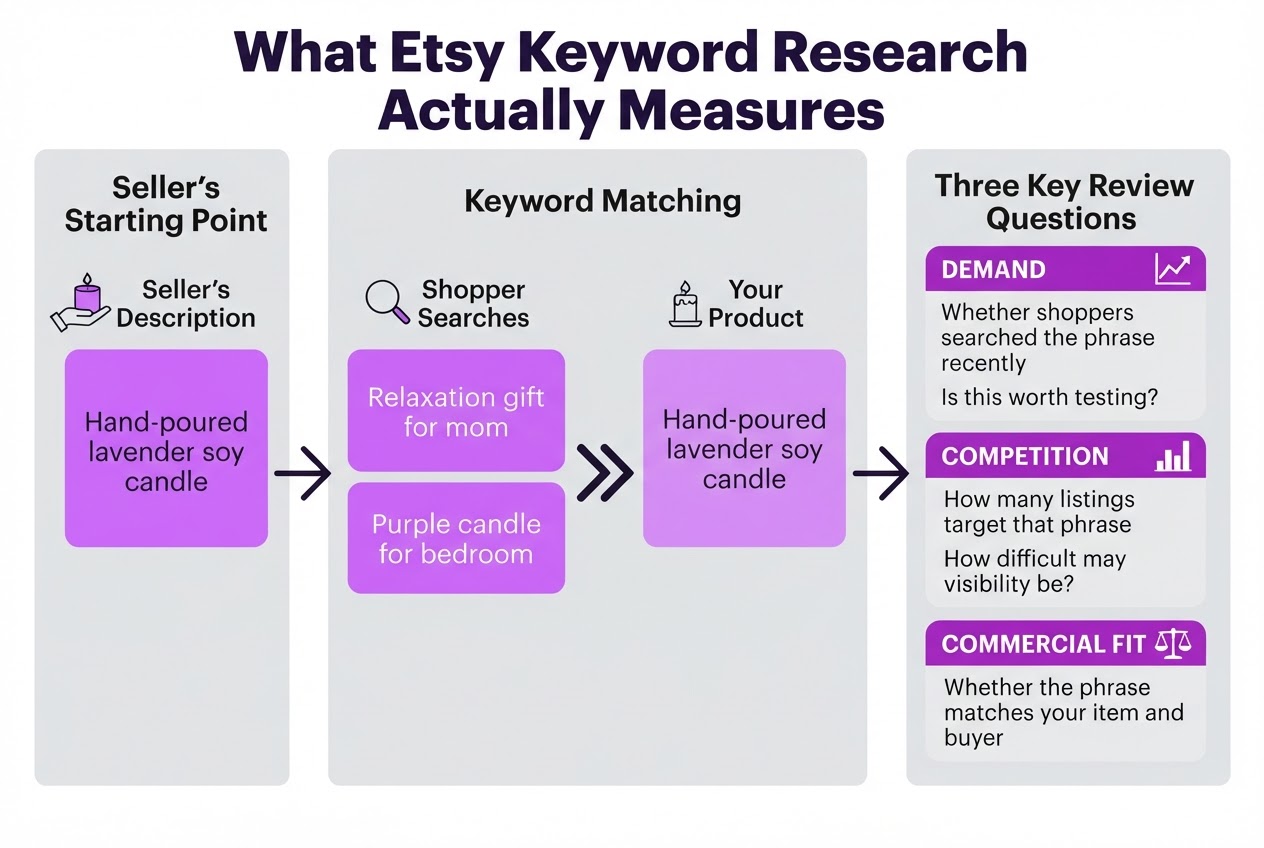
Etsy keyword research matches the words shoppers type with the product you actually sell. That sounds simple, but sellers often start with their own description, such as “hand-poured lavender soy candle,” while a shopper searches for “relaxation gift for mom” or “purple candle for bedroom.” Those phrases describe the same item while revealing different buying intentions.
When I review shop listings, I separate three questions before choosing a keyword:
| Measure | What it tells you | The decision it supports |
|---|---|---|
| Demand | Whether shoppers searched the phrase recently | Is this worth testing? |
| Competition | How many listings target that phrase | How difficult will visibility be? |
| Commercial fit | Whether the phrase matches your item and buyer | Could this search lead to a click or sale? |
Etsy’s Marketplace Insights data reports search activity and listing competition for the last 30 days. That window makes the data useful, but not permanent. Seasonal phrases can jump quickly, and a keyword that looked promising six weeks ago may no longer reflect current shopper behavior.
The awkward part is that demand alone does not make a keyword good. “Wall art” may attract more searches than “custom coastal nursery print,” but it tells you little about the buyer’s needs and puts your listing beside an enormous range of products. A popular phrase can attract the wrong shopper, create weak clicks, and leave your listing with poor sales signals.
Pro Tip: Treat competition as a constraint, not a verdict; a highly competitive phrase can still support a listing when it accurately matches a strong product and buyer intent.
Treat keyword selection as a starting decision, not a shortcut around good merchandising. Etsy also evaluates listing information holistically, including titles, tags, attributes, descriptions, photos, reviews, and shopper interactions. Your keyword must fit naturally into a clear listing, and your product must deliver what the query promises. For practical examples, see this guide to choosing a free Etsy keyword tool.
Those three measures let you judge keywords by usefulness rather than popularity alone. Next, turn that judgment into a focused research process.
How to Build an Etsy Keyword List From Scratch
I start with the item, not a keyword tool. Write down what you sell, who receives it, why they buy it, and what makes the version distinct. A handmade mug, for example, might have these attributes: ceramic, coffee lover, birthday gift, speckled glaze, 12-ounce, and personalized name.
-
Build your seed list from product attributes. Create columns for product type, recipient, occasion, material, style, size, and customization. Add plain-language terms such as “ceramic mug,” “gift for coffee lover,” “speckled mug,” and “personalized mug.” Do not worry about repetition yet. At this stage, coverage matters.
-
Combine the strongest attributes into specific phrases. Turn broad seeds into shopping needs, such as “personalized ceramic mug for mom” or “12 oz speckled coffee mug.” Etsy itself treats multi-word phrases such as “custom bracelet” as stronger keyword examples than isolated words. A phrase should tell you what the shopper wants, not merely describe a material.
-
Expand using Etsy’s own language. Type a seed into Etsy search and record useful autocomplete suggestions. Review competing listings for recurring wording, but do not copy awkward keyword piles. Then use Marketplace Insights to compare related terms. The tool reports search activity and listing competition from the last 30 days, which is more useful than guessing from one crowded search page.
-
Spend the free searches deliberately. Free sellers get up to 15 Marketplace Insights searches each week, and results stay available for seven days after the original search, according to Etsy’s Marketplace Insights guidance. Search your main phrase first, then terms where the decision could change your listing angle. Avoid spending searches on “personalized mug” versus “custom mug” unless the data will alter your choice.
Pro Tip: Spend free Marketplace Insights searches on decision points, such as competing product angles or high-value synonyms, instead of using all 15 searches on minor wording variations.
-
Record candidates in a worksheet. For each phrase, add intent, matching product, search activity, competition, source, and a short note. I also add “use,” “test,” or “discard” as a decision column. A simple Etsy keyword tool guide can help when manual checks become tedious, but the worksheet remains the source of truth.
-
Remove duplicates before choosing listing space. Normalize capitalization, plurals, punctuation, and word order, then group near-identical phrases. “Custom mug,” “personalized mug,” and “customized mug” deserve separate testing only when the evidence supports it. Ten tiny variations will not create ten different insights. Keep the phrase with clearer buyer intent and stronger evidence, and note rejected alternatives so you do not research them again.
A clean list gives you evidence for deciding which phrases belong in titles, tags, and descriptions. The next decision is which candidates deserve scarce listing space.
How to Choose Keywords Worth Targeting
The tempting choice is usually the phrase with the biggest search number. I would not trust it by itself. A broad term such as “wall art” attracts browsing, but it says little about style, size, room, or buying intent. A long-tail phrase such as “personalized nursery name wall art” gets fewer searches, yet the shopper already knows what they want.
| Keyword type | Typical example | Demand | Competition | Purchase intent |
|---|---|---|---|---|
| Broad | wall art | High | High | Low to medium |
| Mid-specific | nursery wall art | Medium | Medium | Medium |
| Long-tail | personalized nursery name wall art | Lower | Lower | High |
Use Etsy’s Marketplace Insights data to compare search activity and listing competition from the last 30 days. The numbers are useful, but they are not a verdict. Marketplace data can make an inaccurate phrase look attractive, especially when sellers chase a popular term that does not describe the product closely.
I score each candidate from 1 to 5, then calculate a weighted total:
- Product fit: 40%. Does the phrase describe the exact item, material, style, audience, and use case?
- Buyer intent: 30%. Does it suggest someone is close to choosing or purchasing?
- Competition: 20%. Give a higher score to phrases with fewer competing listings.
- Demand evidence: 10%. Use Etsy search data, existing visits, or repeated shopper wording as evidence.
You can use an Etsy keyword tool to collect candidates, but do not let a tool’s ranking replace your judgment. A new shop often wins with a lower-demand phrase because it faces fewer established listings and attracts visitors who need less convincing. The trade-off is obvious: fewer impressions mean the product and photos must do more work.
Pro Tip: Give product fit the highest score in your worksheet; a perfectly matched smaller audience is usually more valuable than a large audience that expects a different product.
Separate discovery terms from conversion terms. “Gift ideas” and “boho decor” can help shoppers discover you, while “custom oak wedding guest book” or “sterling silver birthstone ring” reflects a buying decision. Keep both types, but make the conversion phrase your primary target.
Finish by reducing the list to 1 primary phrase and 3 to 6 supporting terms for each listing. Reject duplicates, vague synonyms, and phrases your product cannot honestly satisfy. That shortlist gives you a clear starting point for placing keywords across the listing.

Where to Put Keywords in an Etsy Listing
A keyword list only earns its keep when each phrase has a sensible job in the listing. When I review Etsy listings, the common mistake is forcing the same phrase into every field until the copy sounds like a search query instead of a product someone would buy.
-
Lead with the main phrase in the title. Put the primary keyword near the beginning, followed by essential details such as recipient, material, occasion, or personalization. Etsy allows up to 140 characters in a listing title, but I would not treat that as a target. Clear wording under roughly 15 words usually beats a stuffed title that shoppers must decode.
-
Turn the remaining phrases into useful tags. Use all 13 tags when they genuinely describe the item, and keep every tag within Etsy’s 20-character limit. Favor complete phrases such as “personalized wedding gift” over splitting the words into vague fragments like “personalized” and “gift.” Count the characters before saving, because Etsy’s limit makes some promising long-tail phrases unusable.
If you need to compare variations before assigning them, this free Etsy keyword research guide can help narrow the list. Do not add irrelevant tags just to fill every slot. A tag describing a different product attracts the wrong click and wastes the opportunity.
-
Choose the narrowest accurate category and attributes. Categories and relevant attributes create matching opportunities beyond the tags you type manually. Etsy says specific categories can act like tags, while attributes help connect listings with shopper searches, so select options such as gift recipient, occasion, color, and material whenever they fit the product.
-
Write a description for the buyer, not a keyword block. Explain what gets personalized, the available size, production time, materials, packaging, and what the customer should enter at checkout. Use a keyword where it clarifies the item, then answer questions that otherwise trigger messages or abandoned carts. Repeating “personalized wedding gift” six times makes the listing harder to trust and does little for the shopper.
-
Map one product before publishing. For a hypothetical personalized wedding gift, the setup might look like this:
- Title: “Personalized Wedding Gift, Engraved Couple’s Keepsake Box”
- Tags: “personalized wedding gift,” “engraved keepsake,” “couple gift,” “newlywed gift,” plus other accurate variations within 20 characters
- Category: Gifts, then the most specific wedding or couple-related subcategory available
- Attributes: Occasion: wedding; recipient: couple; material: wood
- Description: personalization instructions, box dimensions, proofing details, and dispatch time
Exact matches can improve relevance when a shopper’s wording appears across appropriate listing fields, but they do not guarantee a top position. Etsy evaluates the listing as a whole, along with shopper response, so readable copy and an accurate product still matter. Next, use that mapped listing to decide which keyword opportunities deserve testing first.
How to Validate and Improve Your Keyword Choices
A keyword is not proven when a listing goes live. Give it time to collect useful evidence, then separate a search problem from a selling problem. Changing the title, tags, photos, and price on day two only creates noise.
Use this review cycle:
-
Days 1–14: leave the listing alone. Check that the item is indexed, the category and attributes are accurate, and the listing has all 13 tags where they fit. Do not judge a keyword from a handful of impressions. New listings need enough exposure for shopper behavior to mean anything.
-
Weeks 3–4: inspect Etsy Shop Stats. Look at the search terms that actually brought shoppers to each listing. Etsy Shop Stats shows the keywords shoppers used to find your listings, which is more useful than assuming your original list reflects real demand. Record the phrase, listing, impressions or visits, favorites, purchases, and other engagement data Etsy provides.
-
After 30 days: diagnose the gap. High impressions with few visits usually point to a weak first photo, vague title, poor price positioning, or a keyword that attracts the wrong shopper. Visits without favorites or purchases suggest a weak offer, unclear description, missing details, shipping friction, or trust concerns. Low impressions with strong conversion indicate that the keyword is relevant but too narrow, too competitive, or missing from an important field.
Do not blame keywords for every disappointing result. Etsy considers clicks, favorites, and purchases when evaluating listing placement, so engagement affects future visibility alongside relevance. Etsy also includes average review rating, message response rate, and case rate from the past three months among search-ranking factors. Slow replies or unresolved service issues can hurt a listing even when its tags are sensible.
Change one meaningful variable at a time. Replace one weak tag, or rewrite the first photo and title together only when they express the same hypothesis. Then wait another 2 to 4 weeks before judging the result. My preference is a change log with the date, listing, keyword, change, hypothesis, and outcome. It prevents convenient stories such as “the new tag worked” when the real change was a better photo or a seasonal sales spike.
For larger shops, an Etsy analytics tool can make this log easier to maintain, but a spreadsheet is enough. Once the evidence identifies the real constraint, you can make the next listing improvement with less guesswork.
My honest take on Etsy keyword research
I treat Etsy keyword research as a prioritization discipline, not a hunt for one magical phrase. My contrarian view is that many sellers care too much about search demand and too little about product fit. A lower-volume phrase naming a specific buyer, occasion, or use case can build a healthier shop than a broad term attracting curious people who never intended to buy.
I would rather create a repeatable system around 5 strong listings than stuff every listing with the same popular keyword. Repeating “personalized gift” everywhere feels safe, but it produces vague titles, weak clicks, and shoppers who still do not understand what you sell. Precision wins when the phrase matches the product and the buyer’s reason for purchasing it.
Marketplace Insights helps, but I treat its numbers as directional evidence, not a sales forecast. Keyword data cannot tell you whether your photos, pricing, shipping promise, or customer service will close the sale. I connect research to listing quality and keep a simple log of phrases, visits, favorites, orders, and shopper questions.
I watch three signals after each meaningful change:
- Traffic quality: Did the search phrase bring the right visitor?
- Listing response: Did visits produce favorites, messages, or purchases?
- Business friction: Did shipping, pricing, or service stop the sale?
Your own Shop Stats eventually matter more than any initial estimate. The long-term advantage is not finding one winning term. It is learning which language repeatedly brings the right customers to your products.
— Daniel
Turn keyword research into a repeatable content workflow
Keyword research only pays off if you can find the notes again and use them beyond one Etsy listing. I built TryRoki around that problem because repeating the same research each month is tedious, and most shop owners do not have time to turn every buyer question into a separate marketing plan.
With AI-assisted website content creation, you can develop supporting pages and posts around product categories, gift occasions, and questions shoppers ask before buying. Its weekly task system gives you a manageable way to keep working on Google and AI search visibility instead of abandoning the project after publishing two posts.
It will not replace Etsy’s search data, and you still need to reject awkward keyword ideas rather than force them into copy. The benefit is having a repeatable place to turn customer language into content and trackable search activity.
- Turn recurring buyer questions into content briefs.
- Review the weekly tasks and keep only work tied to a clear search or business goal.
- Check the resulting traffic instead of assuming publication equals demand.
Frequently Asked Questions
How often should I do Etsy keyword research?
Review keyword performance at least once a month for active listings, then complete a deeper research pass every 3 months or before a major seasonal launch. If a listing gets strong traffic but fewer than 2 favorites or purchases, review it sooner instead of waiting for the next quarterly check.
What is the best free Etsy keyword research tool?
Etsy Marketplace Insights is the most direct free starting point because it shows Etsy search activity and listing-competition data. Free sellers can search up to 15 keywords per week, so combine those searches with Shop Stats and manual reviews of competing listings rather than trusting one metric.
How many keywords should I use for one Etsy listing?
Choose 1 primary phrase, then add supporting terms for relevant product, audience, occasion, material, or style variations. Etsy allows up to 13 tags, but each tag should accurately describe the item because unrelated phrases attract the wrong shoppers and waste limited space.
Why are my Etsy keywords not getting views?
Low demand, heavy competition, poor product fit, or weak clicks after your listing appears in search can cause the problem. Check your Shop Stats, first photo, title clarity, price, reviews, and customer-service signals before replacing all 13 tags at once.
Can I use the same Etsy keywords on multiple listings?
You can reuse a relevant phrase, but avoid targeting the exact same terms across every listing. Give each product 1 distinct primary angle, then reuse shared keywords only when they genuinely describe the items and match different buyer needs.
Written by Daniel.
Recommended reads
- Best Free Etsy Keyword Tool 2026 Guide
- Etsy Keyword Tool How To Boost Your Shop S Visibility
- Etsy Analytics Tool How To Use One Well
- Etsy Seo Tools Guide Boost Your Shop Visibility Effectively
Sources
- How Do I Use Etsy's Marketplace Insights Tool?
- How to Create a Listing – Etsy Help
- How to Use Tags to Get Found in Search – Etsy Help
- Keywords 101: Everything You Need to Know
- How Etsy Search Works
- Creating Listings That Convert
- Shop Stats: How Shoppers Find Your Listings
- How Great Customer Service Can Improve Your Search Ranking