Daniel D.
To optimize AI content for Google’s 2026 algorithms, use AI for speed, then add original expertise, accurate sources, human review, clear authorship, and sound technical SEO before publishing. Track standard Search performance and generative-AI visibility in Search Console, then improve pages using impressions, engagement, and content quality rather than chasing volume or publishing 3–10 tasks a week without meaningful review.
Publishing AI-assisted content can feel like a trap: you can produce ten drafts before lunch, then wonder whether any deserve to rank. The harder part is proving that a page adds something useful when competitors can publish the same generic answer in minutes. Google’s 2026 update history lists two core updates and four spam updates, so treating AI detection or special schema as your strategy is a poor bet. In this guide, I’ll walk you through a practical workflow for planning, generating, reviewing, publishing, measuring, and refreshing AI-assisted content, with clear checks for originality, trust, usefulness, and real user value.
Table of Contents
- What Google’s 2026 systems reward in AI-assisted content
- A seven-step workflow for optimizing AI content
- How to measure performance beyond ordinary rankings
- Five AI content mistakes that can weaken organic visibility
- Structured data, traditional SEO, or AI-specific tactics?
- My honest take on optimizing AI content in 2026
- Turn AI content optimization into a weekly operating system
- Frequently Asked Questions
- Recommended reads
| Point | Details |
|---|---|
| Lead With Value | Every AI-assisted page should add first-hand insight, evidence, examples, or analysis that a generic draft cannot provide. |
| Review Every Claim | Run a human fact-checking pass before publication, especially for statistics, product details, medical topics, financial advice, and current events. |
| Optimize For Both | Traditional SEO still supports generative-AI visibility because Google’s AI features draw relevant pages from its Search index. |
| Measure AI Visibility | Use Google’s generative-AI reports to compare performance by URL, country, device, and date across at least 4 useful segments. |
| Publish Less, Improve More | A library of 20 genuinely useful pages is safer and more durable than publishing 200 minimally edited AI articles. |
What Google’s 2026 systems reward in AI-assisted content
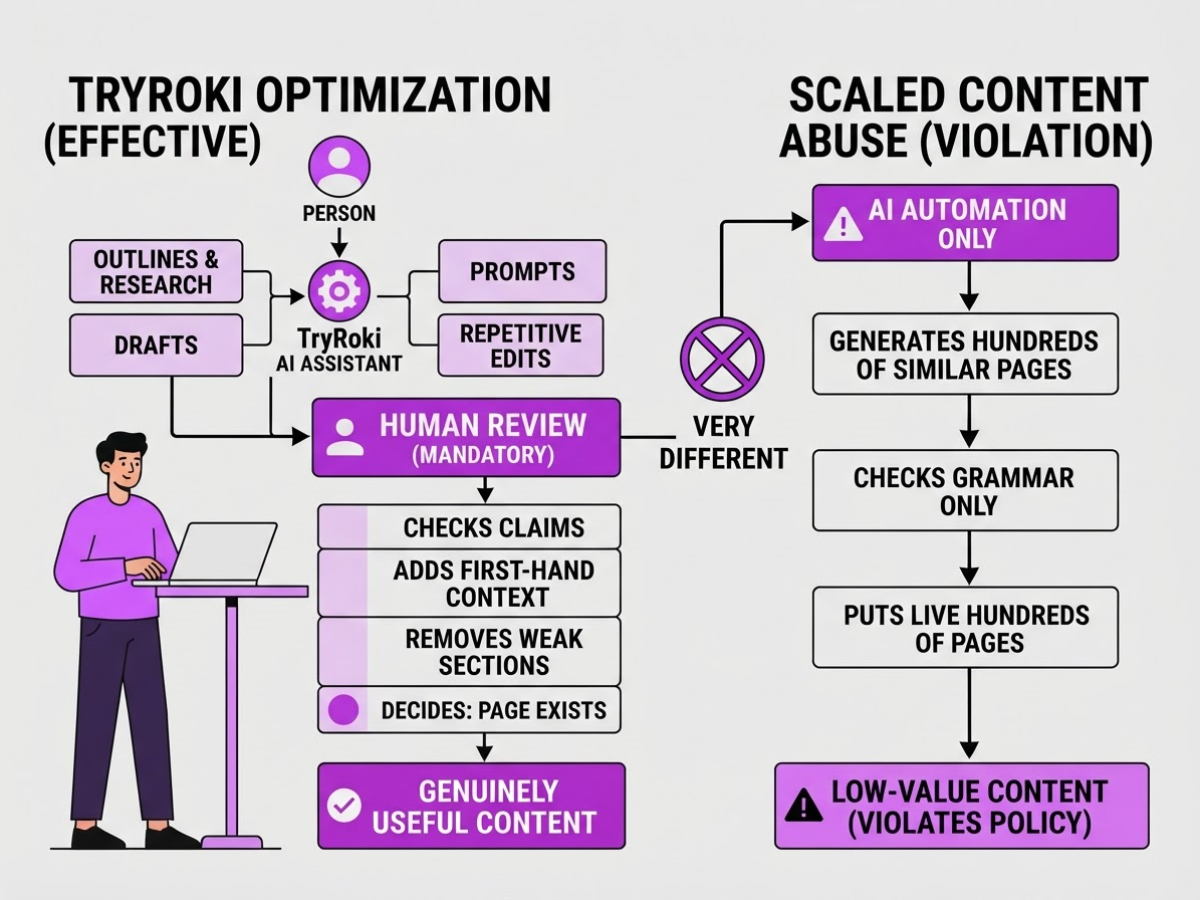
Optimization in 2026 means making AI-assisted content genuinely useful before you worry about wording, keywords, or publishing speed. At TryRoki, I treat AI as a production assistant: it helps with outlines, research prompts, drafts, and repetitive edits. A person still checks claims, adds first-hand context, removes weak sections, and decides whether the page deserves to exist.
That is very different from generating hundreds of similar pages, checking only for grammar, and putting them live. Google permits generative AI when it supports useful content, but warns that producing many pages without adding value may violate its scaled-content-abuse policy. The annoying part is that an AI draft can look polished while quietly repeating a wrong statistic or missing the reader’s real question.
Google also says traditional SEO remains relevant in generative-AI search. AI Overviews and related features use core Search ranking and quality systems, including retrieval from relevant pages in Google’s index. There is no special AI schema that guarantees inclusion, and no credible promise that a page will appear in an AI Overview.
I use this practical standard when reviewing a page:
| Signal | What you should be able to show |
|---|---|
| Intent | The page answers the question behind the query, not just the exact keyword. |
| Original contribution | You add testing, examples, comparisons, data, or a clear point of view. |
| Accuracy | Claims, dates, prices, and citations survive a human fact check. |
| Clarity and experience | Readers can follow the advice and see how it works in a real situation. |
| Trust | Authors, sources, limitations, and commercial interests are transparent. |
Google describes trust as the most important part of E-E-A-T, but E-E-A-T itself is not a single ranking factor. That distinction matters. AI-detector scores, rumored hidden signals, and guaranteed AI Overview tactics are speculation, not a publishing strategy. For a useful review workflow, see common AI content mistakes that hurt SEO.
Pro Tip: Treat every AI draft as research and production material, not as a finished editorial asset.
Quality also needs monitoring because the system keeps moving. Google’s 2026 update history lists two core updates plus several spam updates, so review traffic, rankings, impressions, and affected URLs after each rollout. The next step is to turn these principles into a repeatable content review process.
A seven-step workflow for optimizing AI content
Before I ask a model for a draft, I decide what the page must accomplish for a real reader and for the business. That order prevents the most common failure I see: polished copy answering a question nobody meant to ask.
-
Define the searcher’s job. Write down who is searching, what they need to do next, and whether the page should educate, compare, generate a lead, or support a purchase. Add likely follow-up questions, the reader’s experience level, and the business goal. A page for “AI content audit” may need to explain the process, show a checklist, and point qualified visitors toward a consultation.
-
Build a strict brief. Specify the claims you can prove, original evidence to collect, first-hand experience to include, required sources, internal links, target action, and sections competitors miss. I also record claims the writer must not make. This takes longer than dumping a keyword into a chatbot, but it saves hours of correcting confident nonsense later.
Pro Tip: Give the model a list of facts and experiences it is not allowed to invent before asking it to draft.
-
Use AI for options, not authority. Ask it for outlines, alternative angles, summaries, headline variations, and a rough draft. Keep positioning, prioritization, examples, and factual claims under human control. I reject drafts that sound finished but contain no reason for the reader to trust this particular company.
-
Add something only you can provide. Include a test, screenshot, customer pattern, expert comment, comparison, worked example, or original data. For instance, show the prompts you tested and where they failed. Google allows generative AI for useful content, but warns against producing many low-value pages without added value.
-
Review it in separate passes. Do not ask one final “is this good?” question. Check factual accuracy and source quality first, then search-intent coverage, originality, readability, internal links, and technical SEO such as indexing, canonicals, headings, speed, and structured data. The common AI content mistakes that damage SEO usually survive when teams combine all six reviews into one rushed edit.
-
Publish with honest context. Name the responsible author or reviewer, explain relevant first-hand involvement, and state how you use automation when that context helps readers judge the work. Set an update policy with triggers, such as a product change, outdated statistic, or quarterly review. “We keep this fresh” is not a policy.
-
Create a review loop. After publication, check rankings, clicks, conversions, reader feedback, and assisted revenue at 30, 60, and 90 days. Also inspect Google’s generative-AI visibility reports, which provide data by URL, country, device, and date. Fix weak sections, unanswered follow-ups, and poor calls to action, then record what changed.
This workflow gives you the raw evidence needed to judge whether a page is merely indexed or genuinely earning trust. The next section shows how I turn that evidence into performance decisions.
How to measure performance beyond ordinary rankings
I review performance in layers because rankings alone hide too much. Before changing an AI-assisted page, I record organic impressions, clicks, average position, conversions, indexed pages, engagement rate, and meaningful actions such as product views or demo requests. Without that baseline, a later improvement can feel real while actually reflecting seasonality or a broader Google update.
I use this measurement timeline:
- Day 0: Export the previous 28 to 90 days from Search Console and analytics. Save the page’s query groups, country, device, conversion rate, indexed status, and engagement data.
- Weeks 2 to 4: Check whether Google recrawled and indexed the revised URL. Early ranking movement is noisy, so I look for impressions and relevant query coverage before celebrating clicks.
- Days 30 to 60: Review Search Console’s generative-AI performance reports. Google launched these reports on June 3, 2026, covering AI Overviews, AI Mode, and generative AI features in Discover.
- Days 60 to 90: Compare visibility with assisted conversions, branded searches, qualified leads, and revenue. Then decide whether to keep, revise, merge, or expand the page.
The AI reports are useful because you can segment findings by URL, country, device, and date, including hourly, daily, weekly, and monthly views. A page can gain AI Overview impressions in the United States on mobile while losing desktop clicks in the United Kingdom. A single sitewide average would conceal that split.
Numbers still need a human check. I ask whether Google cites the page, whether the generated snippet matches the searcher’s intent, and whether visitors continue to another useful page or leave immediately. Search Console can show visibility, but it cannot tell you that the answer cited an outdated statistic or that the snippet promised a comparison the page never delivered.
Pro Tip: Compare AI-feature impressions with assisted conversions and branded searches; visibility without qualified action is not the whole result.
My decision rules stay practical: consolidate thin pages competing for the same demand, improve pages gaining impressions but weak clicks, refresh outdated evidence, and expand topics that produce qualified visits. I do not treat one ranking jump or one AI-feature appearance as lasting success, especially during Google’s changing update cycles. For a larger site, I also track rankings alongside broader SEO signals, then use the evidence to plan the next content test rather than rewrite everything at once.
With those measurements in place, the next job is to remove the recurring problems that make AI-assisted pages underperform.

Five AI content mistakes that can weaken organic visibility
AI-assisted publishing usually fails in predictable ways. When I audit a content library, I look for these problems before blaming a ranking change or the writing tool:
- Generic summaries: The page repeats the top results, changes a few headings, and adds no firsthand observation, decision framework, original data, or clear opinion. It may read smoothly, but readers have no reason to choose it over the pages already ranking.
- Unverified details: Unsupported claims, invented citations, outdated prices, and shifting terminology often survive when nobody checks the draft against primary sources. I have seen one article call the same feature three different names, which makes even correct advice look unreliable.
- Keyword-doorway pages: Publishing a separate URL for every minor keyword variation creates near-duplicates instead of meeting distinct search intents. “AI content audit” and “audit AI-generated content” may need one useful guide, not two thin pages.
- Optimization theater: Repeating a phrase, forcing unrelated entities into a paragraph, or adding awkward FAQ blocks does not make a page more relevant. It usually makes the copy harder to scan. Google’s March 2024 search changes reduced low-quality, unoriginal content in results by 45%, so imitation is a poor long-term strategy.
- Compliance as camouflage: A disclosure, author bio, or schema markup can add context, but none can rescue weak answers. Google says structured data does not guarantee enhanced visibility, and it still expects useful, accurate content.
- Technical neglect: Check crawlability, canonicals, indexation, page speed, and internal links. A strong article hidden behind a blocked resource, wrong canonical, slow template, or orphaned URL cannot earn its full opportunity.
Use a simple library triage: keep pages with unique value and clean signals; improve pages with fixable evidence or intent gaps; merge overlapping pages into the strongest URL; redirect retired pages with a relevant replacement; remove pages that add no value and have no strategic role. I also document why each decision was made, because otherwise the same weak page reappears six months later.
That cleanup gives your publishing workflow a sound base before you judge the next batch of AI-assisted drafts.
Structured data, traditional SEO, or AI-specific tactics?
When I review an AI-assisted page, I separate the work into foundations and experiments. Teams often spend too much time adding schema or rewriting headings for AI crawlers while a blocked page, vague title, or weak answer sits untouched.
| Investment | Main purpose | Expected benefit | Priority |
|---|---|---|---|
| Traditional SEO foundations | Help Google crawl, index, and interpret the page | Makes visibility possible in ordinary Search and AI features | Highest |
| Editorial quality | Give readers accurate, original, trustworthy information | Builds relevance, satisfaction, and long-term trust | Highest |
| Structured data | Clarify entities, content type, and page details | Can make a page eligible for certain Search features, but never guarantees enhanced visibility | Medium |
| AI-search formatting | Make answers easy to retrieve, quote, and verify | Improves clarity in generative responses, without creating a separate ranking shortcut | After foundations |
Structured data is useful when it accurately describes what is already on the page. It can help Google understand a recipe, product, author, or organization and qualify the page for a feature. It cannot force a rich result, a citation, an AI Overview mention, or a higher ranking. Google explicitly says correct structured data does not guarantee enhanced visibility.
You also do not need special schema markup just to appear in generative-AI search features. Google recommends the same essentials: crawlable pages, a clear technical structure, unique value, and content that answers the query. Its AI systems still depend on Search retrieval and quality signals, so traditional SEO remains relevant for generative AI search.
My baseline checklist is unglamorous: remove crawl and indexing blockers, write useful titles, connect related pages with internal links, keep important content accessible in the rendered page, and show who wrote or reviewed it. Then improve thin answers with concise definitions, scannable sections, direct responses, examples, and evidence. That is good content design, not a loophole. The frustration is that formatting cannot rescue inaccurate or generic writing.
With limited time, I use this order: fix technical blockers first, improve weak content second, experiment third. Test answer formats and schema only after the page works for readers and search systems. Those priorities set up the judgment call that matters most in 2026.
My honest take on optimizing AI content in 2026
I would not build a content strategy around making AI writing look human. That is the wrong target, and it usually produces bland copy with a few awkward phrases removed. I would build a publishing system that makes each page more useful than the raw material behind it: sharper positioning, stronger evidence, specific examples, and a point of view someone can disagree with.
AI has earned a place in my workflow because it compresses research, outlining, and production time. It also creates a dangerous illusion of progress. A draft can arrive in minutes, but checking claims, adding firsthand detail, fixing weak logic, and deciding whether the page deserves to exist still takes judgment. That work is slower and less glamorous, but it is where quality comes from.
My contrarian view is that many companies should publish fewer AI-assisted articles, not more. A focused library of 20 genuinely useful pages can earn more trust, links, qualified leads, and repeat visits than 200 interchangeable posts. More URLs are not a strategy. They are often just more maintenance.
I also expect measurement to move beyond blue-link rankings in 2026. I want to know where a page appears, whether it supports visibility in AI-generated answers, and whether that visibility brings qualified business outcomes. The winning workflow is not AI versus humans. It is disciplined human judgment applied exactly where automation is weakest.
— Daniel/Aleksandra
Turn AI content optimization into a weekly operating system
I built Roki AI as the practical execution layer for this workflow, not as a substitute for editorial judgment. It can draft or refine website content, surface Reddit discussions where you can contribute something genuinely useful, and send you 3 to 10 weekly tasks aimed at improving visibility in Google and AI search engines.
The rhythm is simple: generate or improve a piece, complete a few visibility tasks, review what changed, and repeat. It is not hands-off magic. You still need to fact-check claims, add real expertise, and reject thin suggestions, especially when a topic affects people’s money, health, or decisions. The setup can feel like another system to manage at first, which is a fair trade-off if it keeps execution from slipping. Explore Roki AI’s workflow and decide whether it fits your publishing process.
Frequently Asked Questions
Google does not publicly rely on a simple AI-written label; its guidance focuses on usefulness, accuracy, originality, and whether people made the content. AI assistance becomes risky when it creates 100 nearly identical pages with little human review or information that readers cannot find elsewhere.
Yes, AI-assisted content can rank in 2026 when it matches search intent, gets important facts right, and adds original experience or analysis. The draft’s origin matters less than whether a qualified editor checks it, improves it, and accepts responsibility for the final page.
Update a page when its facts, products, regulations, or recommendations change instead of forcing every article onto a monthly schedule. For time-sensitive topics, start with a 30-day, 90-day, or 180-day review cycle, then adjust it using traffic, rankings, and reader feedback.
The right tool supports the entire workflow, from topic selection and drafting to fact-checking, publishing, measurement, and revision. When I compare tools, I look at five things: output quality, editorial controls, integrations, reporting, and whether the system turns weekly SEO work into actions someone can actually finish.
Disclosure does not repair inaccurate or unhelpful writing, but it can clarify how a page was produced when automation shaped a substantial part of it. Follow the expectations of your industry, and keep at least 1 qualified human responsible for checking the claims, examples, and recommendations.
Written by Daniel/Aleksandra.
Recommended reads
- Maximizing Google Rankings Using Ai Generated Content
- Avoiding Common Ai Content Mistakes For Better Seo
- Creating High Quality Seo Content With Roki Ai
- How Roki Ai Streamlines Your Seo Content Workflow
Sources
- Incident details | Google Search Status Dashboard
- History for Ranking | Google Search Status Dashboard
- Introducing Search Generative AI performance reports in Search Console
- Google's Guide to Optimizing for Generative AI Features on Google Search
- Google's Guide to Optimizing for Generative AI Features on Google Search
- Google Search's Guidance on Generative AI Content on Your Website
- Creating Helpful, Reliable, People-First Content
- Google Search: New updates to address spam and low-quality results
- General Structured Data Guidelines