Aleksandra D.
Roki AI generates blogs on autopilot by combining SEO research, topic planning, AI-assisted drafting, optimization, and publishing in one workflow. You still need to provide direction, check facts, add first-hand insight, and complete the 3–10 weekly tasks that support visibility in Google and AI search engines.
Publishing every week sounds simple until you are juggling keyword research, content briefs, drafting, fact-checking, optimization, and promotion. As a founder, I have watched good teams stall because an AI prompt produces words, not a working content process. Content Marketing Institute found that 39% of marketers planned to increase investment in AI for content creation in 2025, but automation still needs judgment. This guide explains how Roki AI discovers topics, combines multiple models, creates and reviews articles, publishes them, finds relevant Reddit conversations, and assigns the human improvements needed for lasting Google and AI-search visibility.
| Point | Details |
|---|---|
| Research Comes First | TryRoki starts with search demand, competition, and audience intent instead of relying on one unstructured prompt. |
| Human Review Matters | You still need fact-checking, first-hand examples, and a final editorial review before publishing each article. |
| Models Work Together | The reported workflow combines Ahrefs and DataForSEO data with 4 AI models: Claude, ChatGPT, Gemini, and Perplexity. |
| Publishing Continues Weekly | TryRoki assigns 3 to 10 weekly tasks, including site improvements, outreach, Reddit comments, and other work beyond writing. |
| Originality Protects Quality | Google prioritizes useful, original information and warns that publishing large volumes of low-value AI pages can become scaled content abuse. |
What “autopilot blogging” means in Roki AI
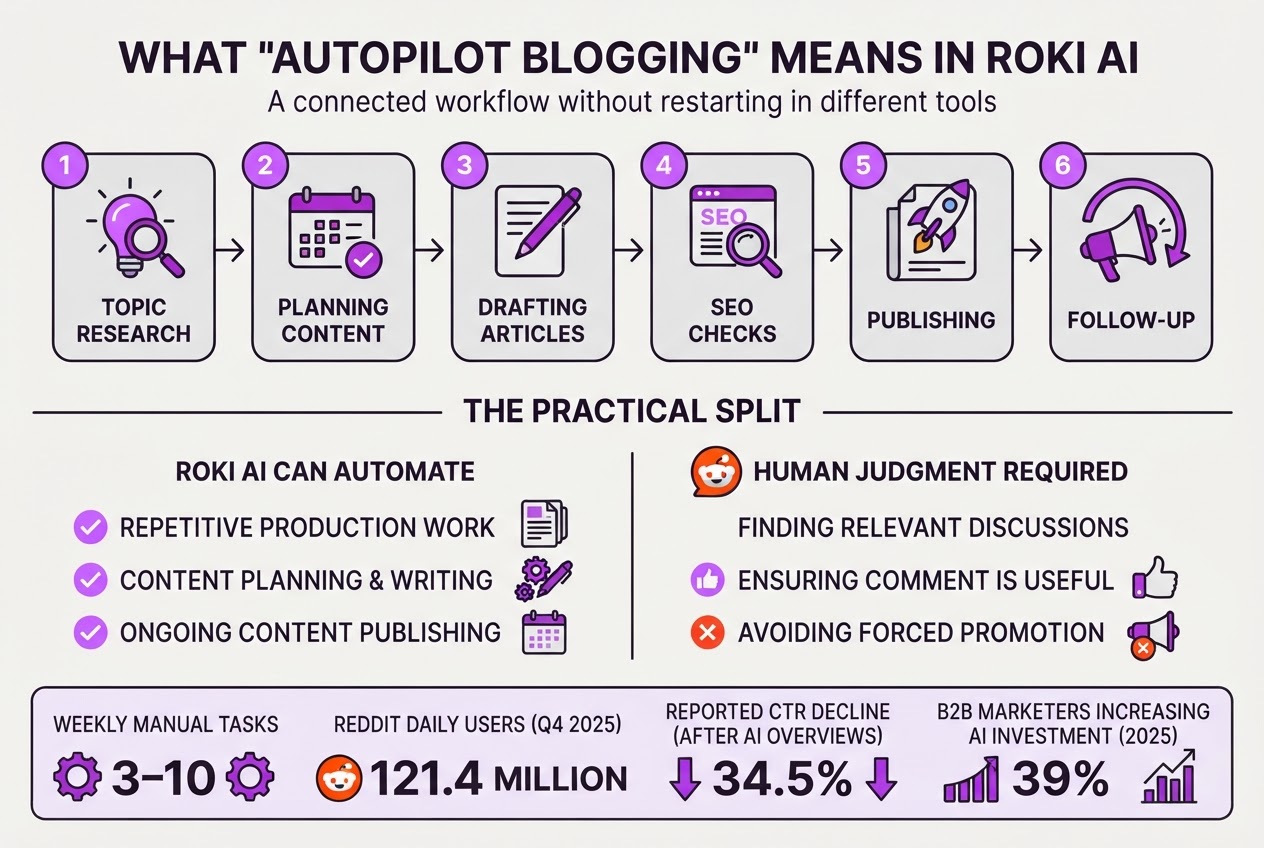
Autopilot blogging is not a button that turns a blank website into a trusted publication. It is a connected workflow in which Roki AI helps move an article from topic research to planning, drafting, SEO checks, publishing, and follow-up without making you restart the process in five different tools.
Roki’s reported system plans, writes, and publishes content on an ongoing basis. In practice, you can set your site’s topics, audience, and publishing direction, then let the system handle much of the repetitive production work. It can also surface Reddit discussions where a relevant, useful comment may mention your website. That part still needs judgment. A forced promotional reply usually does more harm than good.
Here is the practical split:
| Workflow area | Roki AI can automate | You still own |
|---|---|---|
| Research and planning | Topic discovery, search-focused planning, and article briefs | Which subjects fit your customers and expertise |
| Drafting and optimization | First drafts, structure, keywords, and on-page details | Accuracy, distinct opinions, examples, and sensitive claims |
| Publishing | Formatting and sending finished content to your website | Approval rules, brand voice, and publication timing |
| Follow-up | Suggested Reddit activities and recurring tasks | Whether each comment, update, or outreach action is worth doing |
That distinction matters because operational automation is not editorial responsibility. Roki can reduce the hours spent collecting ideas, outlining posts, fixing repetitive SEO details, and uploading drafts. It cannot know that your pricing changed last Tuesday, that a customer example is confidential, or that the obvious answer in your industry is wrong for a particular buyer.
I consider a strong blog article example a useful quality check before you automate publishing. If the output reads like a rearranged version of pages already ranking, the workflow is producing volume, not authority. Google also warns that generating many AI pages without adding user value can fall under its scaled-content-abuse policy, so autopilot should never mean mass-producing generic pages.
Pro Tip: Define a quality threshold before turning on recurring publishing. For example, require every article to include one original example, one useful data point, and one expert judgment.
The workflow becomes more useful once you can see what happens between the initial topic and the finished draft.
Inside the Roki AI content-generation workflow
A publishable article starts long before the first paragraph. When we designed Roki AI, we treated content production as a chain of decisions, not a single prompt. The sequence below shows how TryRoki turns SEO inputs into a draft your team can inspect and publish.
-
Connect the website and define the context. You start by connecting your site, then provide the business details Roki cannot infer reliably from a homepage: what you sell, who you serve, your tone, and what you want content to achieve. A local service business needs different examples and calls to action than a software company. Skipping this setup usually produces bland copy that sounds plausible but could belong to any competitor.
-
Find topics that fit the site. Roki uses SEO data to evaluate subjects, keywords, search demand, and ranking opportunities against your existing website. The point is not to chase every high-volume phrase. A lower-volume keyword with clear buying intent can be more useful than a broad term dominated by major publishers. A 2026 review reports that Roki combines Ahrefs and DataForSEO data in this planning stage.
-
Build the article brief. Before drafting, the workflow turns the selected opportunity into a working brief: search intent, proposed headings, related questions, useful angles, keyword coverage, and optimization requirements. This is where you can catch a bad premise early. If the searcher wants a comparison and the brief proposes a generic beginner guide, polished writing will not fix the mismatch.
-
Route research and drafting through several models. Roki does not treat one model’s first answer as finished research. The reported workflow routes different tasks through Claude, ChatGPT, Gemini, and Perplexity, then combines the results into a draft. That extra routing takes longer than asking one chatbot for 1,500 words, but it reduces the risk of inheriting one model’s omissions, weak examples, or confident factual errors.
Pro Tip: Give Roki a small library of customer language, product details, and real examples. Specific source material produces more distinctive drafts than longer generic instructions.
-
Optimize the article for readers and search. The draft is checked for readability, relevance, metadata, internal links, headings, and search visibility. You can also use a meta description writer to sharpen the page snippet, but do not mistake keyword placement for quality. Google allows AI to help research and structure content while still requiring original value and compliance with its spam policies.
-
Review, improve, approve, and publish. Your final job is not ceremonial. Add first-hand details, correct product claims, remove awkward sections, and approve the version that represents your business. Roki can then publish through the website workflow, but editorial judgment stays with you. Consistency should make good decisions repeatable, not remove the need to make them.
The workflow explains production. Quality depends on what you add before the publish button is pressed.
How to keep automated blogs genuinely high quality
Roki AI fits best when you need a steady publishing rhythm but cannot spend every morning outlining posts. I would use it for educational articles, product-led content, niche sites with repeatable questions, and small teams without a full-time editor. It can keep the pipeline moving, but it cannot decide what your company should stand for.
Automation should express a clear point of view, not rewrite competitor summaries with different adjectives. Google’s people-first content guidance favors original information, research, analysis, and first-hand expertise. If your draft contains none of those, publishing it faster only makes the weakness more visible.
Before approving a Roki draft, I look for five things:
- A first-hand example, customer situation, test, or observation.
- Original analysis that explains why the advice matters.
- Claims checked against current, trustworthy sources.
- A useful visual, comparison, example, or calculation where text alone falls short.
- One clear reader outcome, such as choosing a tool, fixing a problem, or taking the next step.
A practical review should also cover the unglamorous details. Check every statistic and product claim, confirm that the article matches search intent, and remove phrases that do not sound like your team. Then inspect internal links, the title, metadata, headings, calls to action, and conversion relevance. A guide for beginners should not push a sales demo in the opening paragraph, while a product comparison should not hide the buying decision until the end. This blog article example gives you a useful reference for judging structure before you publish.
Pro Tip: Add a “what would a competitor fail to mention?” pass before publishing. That question often creates more differentiation than another round of keyword optimization.
Slow the system down for medical, legal, financial, safety, or emotionally sensitive topics. Reject automation when a qualified specialist must verify the advice, when a claim could cause harm, or when you cannot supply credible source material. The small time saved is not worth correcting a public mistake later.
Quality compounds in traditional search and generative AI results because both reward material that answers a question with evidence and a distinct perspective. Google’s generative-AI search guidance also points toward unique, non-commodity content. That standard needs to continue after publication.

From published article to ongoing SEO improvement
Publication is the start of the useful work, not the finish line. As the owner of TryRoki, I look at every article as part of a recurring loop: watch visibility, find the weak point, improve the page, and create relevant opportunities for people to discover it. Publishing volume alone is a poor scorecard. Ten new posts do not matter if Google cannot index them or visitors never take the next step.
I normally judge the loop in four milestones:
- Weeks 1–2: Check indexed pages, impressions, clicks, rankings, crawl issues, redirects, canonical tags, and obvious technical errors.
- Weeks 3–6: Compare impressions with clicks. A page gaining impressions but few clicks may need a clearer title, better search intent match, or stronger introduction. A page with no impressions may have a topic, authority, or indexing problem.
- Months 2–3: Improve thin sections, add first-hand examples, strengthen internal links, and update outdated claims. You can also pursue relevant distribution, including practical backlink outreach, but random links are usually wasted effort.
- Ongoing: Track conversions and assisted revenue alongside impressions, clicks, rankings, and indexed pages. Those numbers tell you whether content helps the business, not merely whether it exists.
Roki’s weekly workflow reflects that reality. A 2026 review reports that Roki assigns three to ten tasks every Monday, including site fixes, content improvements, and backlink outreach. I consider those tasks an execution layer for the owner, not a promise of growth requiring no human attention. Some weeks the right task is fixing a broken page. Other weeks it is improving an article or contacting a genuinely relevant site.
Reddit can fit that process when the discussion matches your expertise. Answer the question properly first, include useful detail, and mention your website only when it adds context. Reddit reported 121.4 million daily active uniques in Q4 2025, but that scale does not justify dropping links into unrelated threads. Moderators and readers notice that shortcut quickly.
Content can compound, but the pace depends on topic fit, site authority, competition, technical health, and execution. The limits become clearer when teams automate without a review gate.
Common mistakes when automating blog production
Automation removes repetitive work, not editorial judgment. As we review Roki-generated articles, the same avoidable problems appear when teams mistake a faster draft for a finished publication.
-
Publishing every draft unchanged. A generated article may sound clean while missing your customer’s real objections, your product’s edge cases, or a useful first-hand example. Add one specific experience, test the important claims, and cut anything you would not say to a customer. Google’s people-first guidance specifically looks for original information and first-hand expertise.
-
Picking topics for keywords alone. Search volume does not prove that a reader wants your offer. Before approving a topic, identify the searcher’s job, the likely next action, and the connection to your business. A keyword with traffic but no buying or trust-building path is usually a distraction.
-
Treating model output as evidence. Verify statistics, product features, quotations, prices, regulations, and current events against the original source. Models can confidently combine an old figure with a new claim, and that error can survive several editing passes.
-
Counting articles instead of outcomes. Twenty posts do not matter if qualified visits, sign-ups, sales, or meaningful visibility stay flat. Track those outcomes in your website traffic review process, then update or retire pages that attract the wrong audience.
-
Adding links and mentions mechanically. Too many internal links interrupt reading. Repeated phrases make the article feel assembled, while a forced Reddit mention looks like promotion rather than participation. Link when it helps the reader, and comment on Reddit only when you can answer the actual discussion.
-
Assuming automation owns the whole job. Roki can help with planning, writing, and publishing, but you still need technical SEO checks, content updates, distribution, and a named reviewer. Google warns that producing many low-value pages without adding user value can fall under scaled-content-abuse policies. That is a publishing failure, not a software setting.
Before publishing, use one gate: Is the topic relevant, are the facts verified, does the draft add original experience, do the links earn their place, and is one person accountable for the result? If any answer is no, hold the article. That gate is what makes the workflow repeatable rather than reckless.
My honest take on Roki AI and autopilot blogging
I built Roki AI around a problem I kept seeing: content teams were not short of ideas, they were short of operating time. The real value is not pressing a button and forgetting the website. It is compressing research, planning, drafting, optimization, and publishing into a repeatable system that a small team can actually maintain.
Here is the contrarian part: publishing less is often the smarter choice. If you cannot add original expertise, answer a customer’s real question, or connect a topic to a useful business perspective, another article may only add noise. I would rather see one carefully reviewed post than five thin pages that create work without earning trust.
Automation should give you more time for customer interviews, product improvements, editorial review, and distribution. It should not quietly remove those responsibilities. Roki’s weekly 3–10 tasks matter for that reason. Finding relevant Reddit discussions to join and identifying practical ways to improve visibility in Google and AI search engines keeps the work moving beyond article generation, although the suggestions still need judgment and can occasionally feel repetitive.
My standard is simple: use autopilot for consistency, not credibility. Let the system handle the repeatable workload, but keep the final promise to the reader human.
— Daniel
Turn your content workflow into a repeatable growth system
An inconsistent publishing process usually breaks in the gaps: topic research sits in one tool, drafts in another, and useful promotion ideas never become tasks. I built TryRoki’s integrated workflow to keep those decisions connected. Roki AI can identify content opportunities, generate and publish high-quality blog posts, and surface 3 to 10 weekly tasks that support visibility in Google and AI search, including relevant Reddit discussions where your site may add value.
It is not a rankings vending machine. Setup takes thought, and the output improves when you provide real business context, define your audience and goals, and approve content before publication. Start by connecting your website and reviewing the first recommended workflow. If you want more control over how the system connects with your process, explore Roki’s MCP option, then decide whether the automation fits your publishing cadence.
Frequently Asked Questions
Yes, but using AI does not guarantee rankings. Google still looks for usefulness, originality, expertise, and compliance with its spam policies, so review every Roki-generated post before publishing and add at least 1 piece of first-hand insight or evidence.
There is no fixed timeline, and expecting traffic in 2 weeks usually leads to bad decisions. A new page can need weeks or months to gain visibility, so track impressions and rankings for at least 8 to 12 weeks while considering competition, site authority, indexing, and content quality.
Roki AI can handle much of the research, planning, drafting, optimization, and publishing workflow, but it does not replace subject expertise or editorial judgment. A human should verify claims, add original examples, and approve important content, especially when a mistake could affect customers or credibility.
Give it at least 7 inputs: your audience, search intent, business context, product details, preferred tone, examples, and internal resources. Also list facts to include or avoid, because specific first-hand information produces a better draft than sending only 1 keyword.
Review important pages every 3 to 6 months, and update them sooner when facts, products, regulations, or search intent change. Waiting a full year can leave outdated prices, features, or recommendations live on pages that still attract visitors.
Written by Daniel/Aleksandra.
Recommended reads
- Seo Ai Generator How To Automate Content Creation Effectively
- How To Write A Perfect Article 7 Steps
- Organic Traffic Growth A Strategic How To Guide
- How To Monitor Website Traffic Practical Guide
Sources
- Google Search's Guidance on Generative AI Content on Your Website
- Creating Helpful, Reliable, People-First Content
- Google's Guide to Optimizing for Generative AI Features on Google Search
- Roki: Automated SEO on autopilot – AI Search Tools
- Reddit Reports Fourth Quarter and Full Year 2025 Results; Announces $1 Billion Share Repurchase Program
- What AI Means for SEO
- B2B Content Marketing: 2025 Benchmarks & Trends