
Etsy Marketing Tool: A Practical Guide
TL;DR: An Etsy marketing tool helps you research keywords, improve listings, track performance, promote products, and spot growth opportunities that Etsy’s built-in tools may miss. The most reliable workflow combines Etsy data, careful listing updates, external content, and regular measurement instead of relying on ads alone, with tools such as Roki AI assigning 3–10 weekly tasks to support visibility beyond Etsy.
Running an Etsy shop can feel like managing five separate jobs: researching keywords, rewriting listings, checking ads, reading analytics, and promoting products elsewhere. The frustrating part is that disconnected tools often leave you with more tabs and reports, not a clearer next move. The opportunity is still substantial: Etsy reported 86.5 million active buyers and 5.6 million active sellers as of December 31, 2025. This guide explains what an Etsy marketing tool should do, how to compare tool categories, how to build a repeatable workflow, and how to measure whether your investment is bringing useful traffic or sales.
| Point | Details |
|---|---|
| Match The Bottleneck | Choose an Etsy marketing tool for your specific problem, such as keyword discovery, listing optimization, analytics, ads, or external promotion, rather than its longest feature list. |
| Use Etsy Signals | Etsy allows up to 13 tags per listing, and each tag can contain no more than 20 characters, so structured keyword research helps you use that limited space well. |
| Separate Paid Reach | Etsy Ads can increase visibility in advertising spaces, but they do not directly improve a listing’s organic search position. |
| Measure Every Week | Review Etsy Shop Stats and Listing Stats at least once a week to compare search terms, referral sources, visits, and listing-level results. |
| Build Beyond Etsy | Combine marketplace optimization with useful website content and relevant external discovery channels so your marketing does not depend on a single platform. |
What an Etsy marketing tool actually does
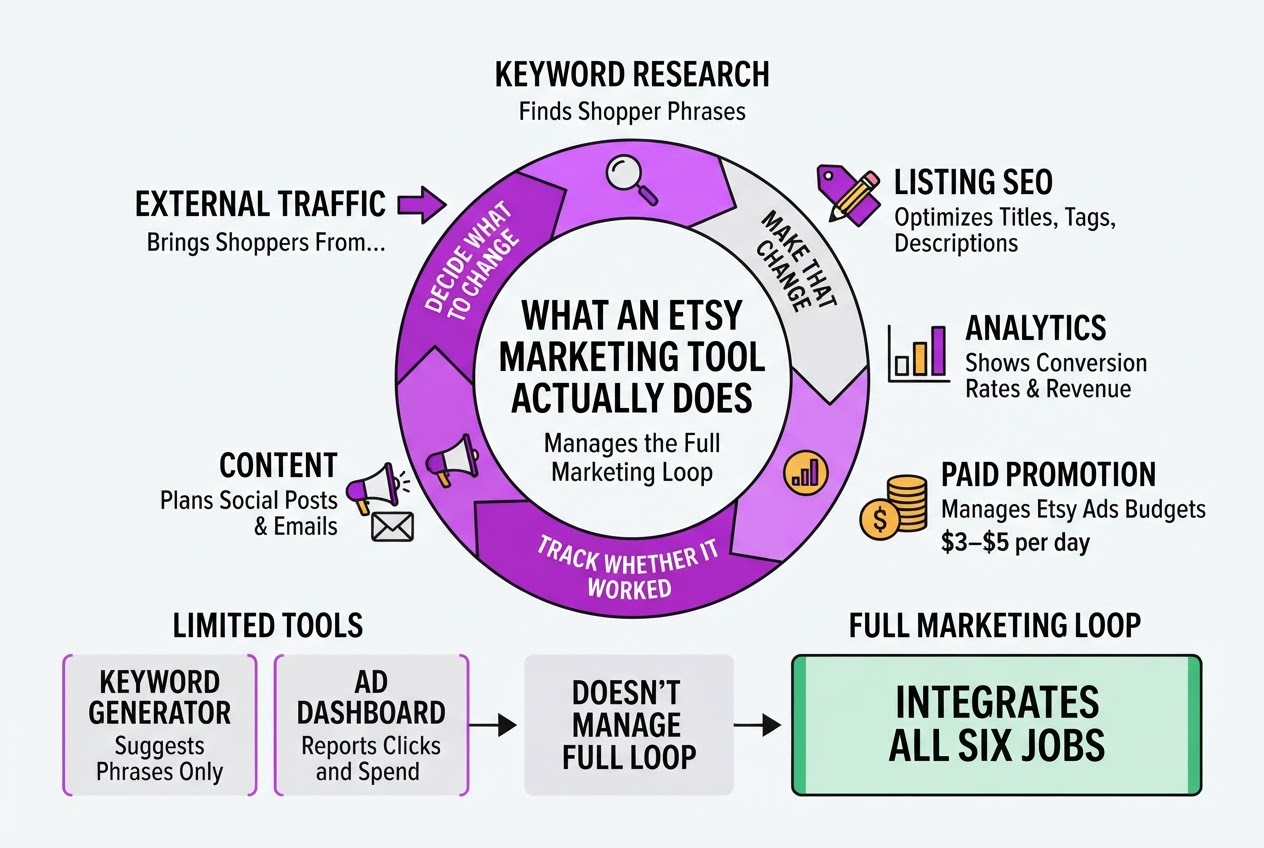
An Etsy marketing tool helps you decide what to change, make that change, and track whether it worked. A keyword generator only suggests phrases. An ad dashboard only reports clicks and spend. Those can be useful, but neither one manages the full marketing loop.
The category usually covers six jobs:
- Keyword research: Finds shopper phrases, related terms, and competing listings.
- Listing SEO: Helps you improve titles, tags, attributes, descriptions, and images.
- Analytics: Shows searches, visits, clicks, conversion rates, revenue, and referral sources.
- Paid promotion: Manages Etsy Ads budgets, bids, campaign tests, and results.
- Content: Plans social posts, emails, videos, or blog content that supports your listings.
- External traffic: Brings shoppers from Google, Pinterest, Reddit, or your own audience to Etsy.
The important distinction is data versus execution. A data tool might tell you that “linen wedding napkins” gets more relevant traffic than your current phrase. An execution tool can update a listing, schedule a recurring report, flag a falling conversion rate, or produce content every week. I prefer tools that handle repeatable work, because manually exporting stats every Monday is exactly the kind of task sellers abandon after three weeks. Automation still needs review, though. A tool can apply an awkward title across 40 listings faster than you can catch the mistake.
Etsy search also does not rank a listing from keywords alone. Etsy describes search as a two-stage process that considers listing content and shop signals holistically, including titles, tags, attributes, descriptions, photos, reviews, engagement, and customer experience. That makes a keyword-only tool a narrow starting point, not a complete marketing system.
Use this needs-first test before paying for software:
| Need | Look for |
|---|---|
| Discovery | Keyword and competitor research |
| Conversion | Listing tests, photos, and offer analysis |
| Retention | Content, customer follow-up, and repeat-purchase workflows |
| Measurement | Clear sales, traffic, and attribution reports |
Pro Tip: Pro Tip: Start by writing down the one weekly marketing decision the tool should improve; this prevents paying for overlapping dashboards.
The scale makes small workflow gains worthwhile: Etsy had 86.5 million active buyers and 5.6 million active sellers on December 31, 2025. Next, compare the features that matter most for your shop’s current bottleneck.
Which Etsy marketing tool fits your bottleneck?
When I review an Etsy shop, I start with the bottleneck, not the tool’s feature list. A free native feature is often enough for one clear question. Pay for software when you need historical comparisons, bulk recommendations, exports, or actions across several channels.
| Tool type | Best use case | Main data and automation | Likely outcome |
|---|---|---|---|
| Keyword tool | You have impressions but weak search reach | Keyword databases, trend estimates, tag suggestions; usually manual | More relevant titles and tags |
| Analytics tool | Visits do not become orders | Etsy Shop Stats, listing visits, referrals, orders; low automation | Better diagnosis of conversion leaks |
| Listing optimizer | Many listings need consistent edits | Titles, tags, attributes, photos, and descriptions; medium automation | Faster listing tests and cleaner catalog structure |
| Etsy Ads | You need paid visibility for selected listings | Etsy click and spend data; native campaign controls | Additional visits, with a direct advertising cost |
| Content platform | You want demand beyond Etsy | Blog, social, or Reddit topics; high publishing automation | Referral traffic and repeat demand |
| SEO agent | Several channels need coordinated work | Search data, content tasks, integrations; highest automation | A connected queue of actions, not just reports |
Start with Etsy Shop Stats when you need to know which queries and websites already send people to you. That free data is sufficient for a shop with a small catalog and an owner willing to make weekly edits. A dedicated Etsy analytics tool earns its cost when you need trend history, listing-level comparisons, or exports for a spreadsheet.
Do not confuse impressions and visits with business results. Impressions are a leading indicator; orders, revenue, repeat purchases, and recurring referral demand pay the bills. Etsy Ads can raise paid visits, but Etsy charges for clicks, not views, so judge the campaign by profit after ad spend, not its impression count.
Pro Tip: Pro Tip: Prefer a tool that turns data into a next action—rewrite a title, test a tag, publish content, or review a referral source—over one that only displays charts.
One specialized tool is easier to learn, but it leaves gaps. I prefer a connected workflow when a keyword finding can trigger a listing edit, a content brief, and a referral check. Tools such as AI agents and automation services can coordinate that work, though setup, integration limits, and monthly pricing often create more friction than vendors admit. Check data freshness, CSV export, Etsy and marketing integrations, total price, and whether each recommendation tells you exactly what to change. Next, match those criteria to the shop’s size and the work you can realistically maintain.
How to build an Etsy marketing workflow in one afternoon
I can usually get a shop’s first useful marketing workflow running in an afternoon, but only if I resist the urge to audit everything. Start with five to ten listings, not your entire catalog. A smaller sample gives your Etsy marketing tool enough focus to produce decisions you can actually finish.
-
Set your baseline. Choose listings with a clear product, recent activity, and room to improve. Record each one’s visits, favorites, orders, and revenue for the same period, such as the previous 30 days. Note the listing URL, price, stock status, and current thumbnail too. Without this snapshot, “better” usually means “I changed something and hope it worked.”
-
Collect buyer language. Pull search terms from Etsy Shop Stats, listing statistics, customer messages, and your tool’s keyword suggestions. Group phrases by intent: gift, recipient, style, material, occasion, or problem solved. “Teacher gift” and “personalized teacher stamp” may describe the same product, but the second phrase shows a more specific buying purpose. My preference is to keep a simple sheet rather than bury these decisions in a crowded dashboard. This practical Etsy keyword research guide can help you structure the first pass.
-
Turn phrases into listing assets. Give every priority listing one primary phrase and several supporting phrases. Place them naturally across the title, tags, attributes, description, and image choices. Etsy allows up to 13 tags, with each tag limited to 20 characters, while listing titles can contain up to 140 characters. Do not cram every variation into the title. Use the first image to prove the main promise, then use later images for scale, personalization, packaging, or real-life context.
Pro Tip: Pro Tip: Change one meaningful variable at a time on a priority listing and record the date; otherwise, you will not know which adjustment affected performance.
-
Add one weekly support task. Schedule a useful action for each listing, such as publishing a short product video, refreshing a seasonal image, answering a recurring buyer question, or sharing a relevant guide. Do not force links into unrelated posts just to create activity. That wastes time and can make your shop sound like a keyword list.
-
Review after a fixed period. Wait at least 30 days unless a serious error needs an immediate correction. Compare visits, favorites, orders, revenue, and conversion patterns with the baseline, then keep a change log showing what changed, when, and why. The tool should reduce guesswork, not replace judgment.
With that record in place, you can decide which Etsy marketing tool deserves a permanent place in your weekly routine.

Common Etsy marketing tool mistakes to avoid
The costliest Etsy mistakes usually start with a tool that looks precise. A dashboard can show search volume, an estimated rank, or a promising trend, but none of those numbers guarantees a sale. I have seen sellers chase a high-volume phrase for weeks when a smaller, specific phrase would have matched the buyer and the product far better.
Watch for these errors:
- Treating estimates as outcomes. Keyword volume and ranking data are directional, not a sales forecast. Use Shop Stats, visits, favorites, and orders to check whether a phrase attracts the right shopper. Our practical Etsy keyword research guide covers the difference between search demand and buying intent.
- Stuffing titles and tags. Filling a 140-character title with awkward variations makes the listing harder to understand. Etsy allows 13 tags, each up to 20 characters, but that does not mean you should repeat the same generic term 13 times. Name the exact item, recipient, material, size, or use case a buyer cares about.
- Expecting Etsy Ads to lift organic rank. Ads can place a listing in designated advertising spaces, but Etsy says they do not change organic search ordering. Judge ads by paid clicks, orders, and profit, not by an assumed organic boost.
- Changing everything at once. If you rewrite the title, replace photos, alter the price, and start ads on Monday, you cannot tell what caused the result. Change one meaningful variable, then give the listing enough traffic and time to produce a readable comparison. Declaring victory after two days is usually just noise.
- Ignoring shop health. Search tools cannot repair slow replies, poor reviews, or preventable cases. Etsy includes average review rating, message response rate, and case rate from the previous three months in customer-service-related search signals, so operational work belongs in your marketing plan.
- Automating badly. Irrelevant comments, artificial backlinks, scraped posts, and generic AI descriptions waste attention and can violate platform rules. Automation should support a useful message or accurate listing, never create noise around your shop.
The safer approach is to combine tool data with customer behavior, listing quality, and shop service before you decide what worked.
How to tell whether the tool is working
A useful scorecard starts before you switch on an Etsy marketing tool. Record the previous 30 days for impressions, visits, favorites, orders, conversion rate, revenue, and ad spend. Then choose two or three primary metrics, such as visits, conversion rate, and profit. Tracking every number feels thorough, but it usually produces noise and post hoc excuses.
Keep Etsy activity separate from traffic you send elsewhere. Marketplace metrics include impressions, visits, favorites, orders, and conversion rate. External metrics include referral visits, email clicks, social traffic, and assisted demand, where someone discovers your shop away from Etsy but purchases later. Etsy Shop Stats shows both shopper keywords and referral websites, so use that data rather than guessing which channel deserves credit. This practical guide to using Etsy Analytics can help you find the right reports without drowning in them.
Review results at listing level, not only at shop level. Compare five to ten listings that received the same workflow: updated tags, revised titles, new photos, or scheduled promotion. One product may gain impressions but lose conversion, while another gets fewer visits and twice the orders. That difference tells you whether the change improved matching, the offer, or neither.
Use this review timeline:
- Week 0: Capture the baseline and note price, stock, seasonality, active discounts, and existing ad status.
- Weeks 1 to 4: Check weekly for completed tasks, broken tracking, sudden impression drops, and unusual order changes. Do not rewrite listings every few days.
- After 30 days: Make the first directional decision. If you run Etsy Ads, evaluate them separately from organic discovery. Etsy recommends a $3 to $5 minimum daily budget for at least 30 days, and you pay for clicks, not views. Ads can produce sales without improving organic search position.
- After 60 to 90 days: Decide whether the pattern is durable. Seasonal demand and small shops need this longer window more often than the dashboard suggests.
Keep the tool when it saves time and improves a primary metric without creating extra cleanup. Revise the workflow when visibility rises but conversion does not. Downgrade when you use only one minor feature, and replace it when data is unreliable, recommendations repeat, or the cost exceeds measurable profit. The next step is turning that judgment into a tool budget you can defend.
My honest take on Etsy marketing tools
I’ve watched Etsy sellers spend hours comparing dashboards, then make no meaningful change to a listing. That is the wrong operating rhythm. A useful Etsy marketing tool should shorten the distance between spotting a signal and taking a sensible action: test a sharper phrase, rewrite a weak title, check where visits came from, or publish supporting content.
My contrarian view is that the best tool for an Etsy seller is not always built only for Etsy. Marketplace data matters, but a broader system can be more useful when it connects listing decisions with website content and external discovery. A seller who depends entirely on Etsy is also depending entirely on Etsy’s traffic rules. That dependency is easy to ignore until impressions fall.
I see this friction at TryRoki. Recommendations can save time, but they still need a human check for product accuracy, buyer intent, and Etsy’s format. Automation that suggests an awkward phrase or describes a product incorrectly creates cleanup, not growth.
I’d rather see sellers make three clear decisions every week than collect fifty new metrics. At Roki AI, our aim is to help organize those decisions across Google, AI search, Reddit discovery, and website content. The right tool earns its place by making progress visible and keeping the work tied to real products.
— Daniel
Turn Etsy marketing tasks into a repeatable growth system
Etsy insights can show you what shoppers want, but listing edits are only one part of the job. I built Roki AI for the next layer: turn those insights into useful website content, spot relevant Reddit discussions where a genuinely helpful mention might fit, and receive 3 to 10 weekly tasks for improving visibility in Google and AI search engines.
Start by choosing a topic from your Etsy research, then use Roki AI’s content workflow to create supporting content without staring at a blank page. Review the suggested tasks each week and keep only the ones that fit your shop. The Reddit suggestions still need judgment, and rushed comments can look like spam. If you want to test this wider marketing routine, learn more about Roki AI.
Frequently Asked Questions
What is the best marketing tool for Etsy sellers?
The best Etsy marketing tool depends on your bottleneck, but I would start with one tool that improves a recurring decision, such as choosing keywords or reviewing listing performance. Test it for 30 days before adding another, because a crowded tool stack often creates more data to sort through rather than more sales.
Does Etsy have a free marketing tool?
Yes. Etsy’s Shop Stats and Listing Stats are available without a separate subscription and can show search terms, visits, and referral sources, while Etsy Ads charges for paid clicks. Give the free reporting tools at least 2 weeks of data before judging a listing or campaign.
How can I promote my Etsy shop for free?
Improve your listings, publish useful content, answer questions in relevant communities, and use the social channel where your buyers already spend time. Track at least 3 numbers, such as qualified visits, favorites, and sales, because likes and comments alone can make free promotion look more effective than it is.
Are Etsy marketing tools worth paying for?
They can be worth paying for when they save several hours each month or help you make a decision that improves sales, conversion rate, or listing quality. Set a baseline, run a 30-day trial, and cancel the tool if its cost exceeds the value of the changes it helps you make.
How can I get more views on Etsy without using ads?
Use all 13 relevant tags, complete accurate attributes, improve your first photo, and write listing copy that matches the phrases buyers actually search. Etsy says ads do not directly change organic search ordering, so measure paid clicks and organic views as 2 separate results.
Written by Daniel/Aleksandra.
Recommended reads
- Etsy Tools For Sellers A Practical Guide
- Etsy Analytics Tool How To Use One Well
- Etsy Keyword Research A Practical Guide
- Best Free Etsy Keyword Tool 2026 Guide
Sources
- February 19, 2026 - 10-K: Annual report [Section 13 and 15(d), not S-K Item 405] | Etsy, Inc. (ETSY)
- How Etsy Search Works
- How to Use Tags to Get Found in Search – Etsy Help
- How to Create a Listing – Etsy Help
- Shop Stats: How Shoppers Find Your Listings
- Getting Started With Etsy Ads
- 7 Common Questions About Etsy Ads
- How Great Customer Service Can Improve Your Search Ranking
- Tivius