Aleksandra D.
Target keywords are the specific search terms your page is built to rank for and answer well. Choose realistic terms, assign each keyword to one page, use it naturally in the content, and track results across Google and AI search; tools such as Roki AI can provide 3–10 weekly tasks to support that work.
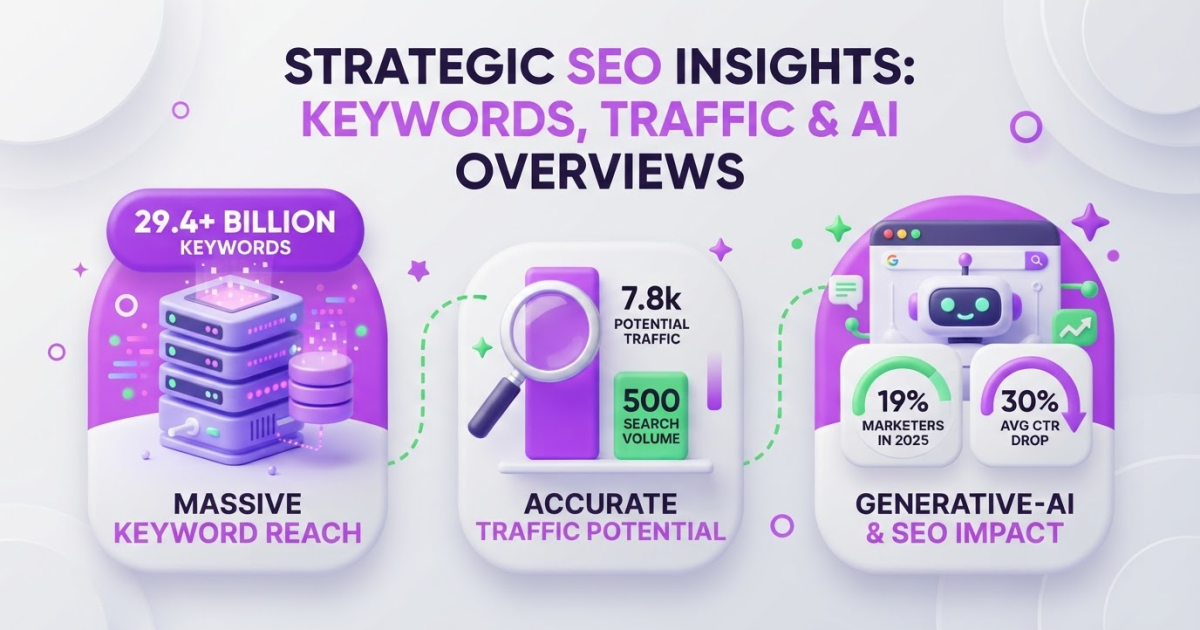
Choosing target keywords because they sound relevant can leave you with pages nobody needs, fierce competition, or traffic that never turns into customers. I have seen teams spend weeks polishing content around a phrase that looked perfect in a spreadsheet but matched the wrong search intent. Ahrefs shows that “submit website to search engines” has 7.8k traffic potential despite only 500 reported monthly searches, a useful warning against treating search volume as the whole decision. This guide gives you a practical workflow to define your target, judge intent and competition, assign one primary keyword per page, build supporting coverage, and review results without keyword stuffing.
| Point | Details |
|---|---|
| Define Search Purpose | Choose a target keyword that describes a query your page can answer clearly, rather than chasing high search volume alone. |
| Match Search Intent | Classify each keyword as informational, commercial, navigational, or transactional before you create the content. |
| Choose One Primary | Assign 1 main keyword and a small group of closely related terms to each page to reduce cannibalization. |
| Measure Real Visibility | Review impressions, clicks, click-through rate, conversions, and AI-search visibility over 30 to 90 days. |
| Write For People | Prioritize natural, useful coverage because Google treats helpful, reliable, people-first content as a central SEO principle, not repeated keywords. |
What Are Target Keywords in SEO?
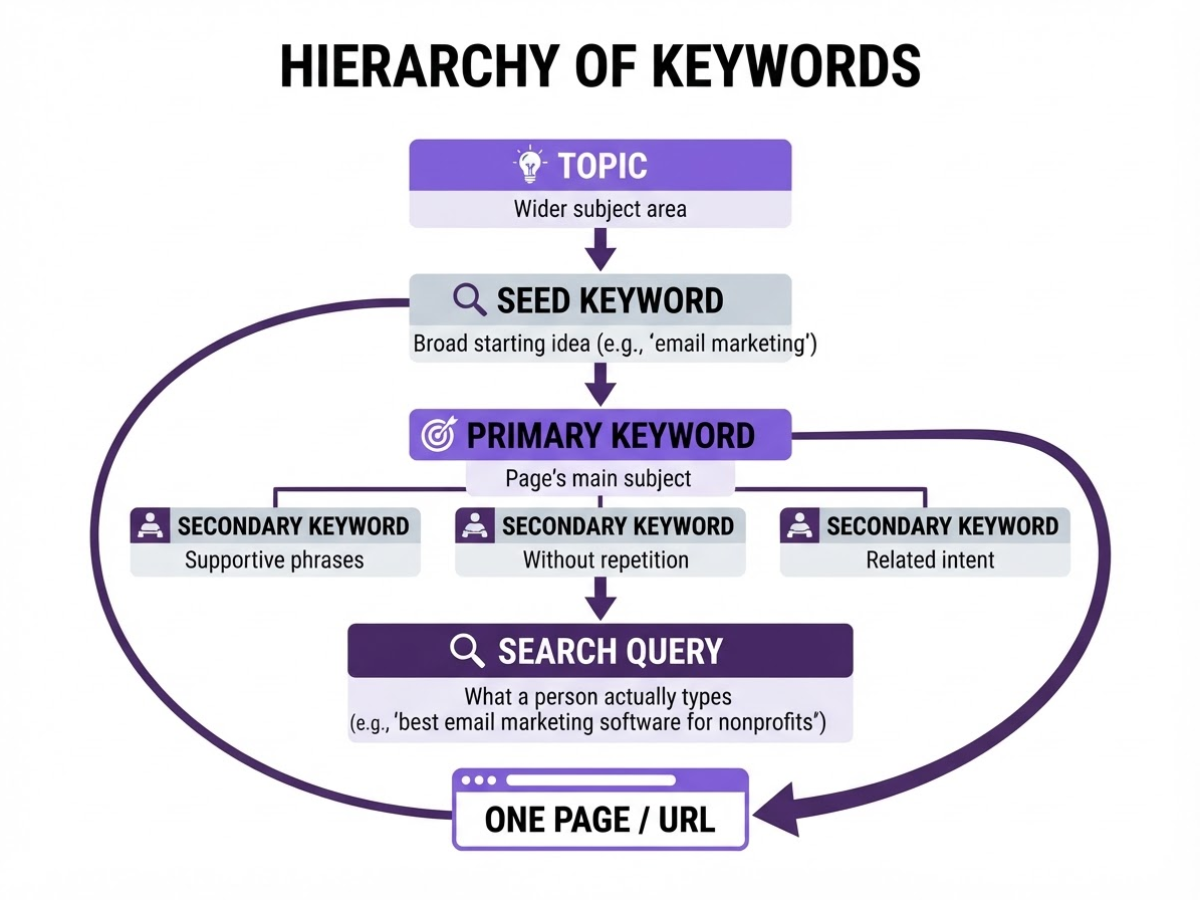
A target keyword is the query, or closely related query family, that you intentionally build one page to satisfy. It gives the page a job: answer a question, compare options, help someone choose a product, or support a purchase. When I review content plans, the biggest mistake is treating a keyword as a label rather than a promise to a specific searcher.
The primary target keyword is the page’s main subject. Secondary keywords support that subject without turning the copy into a list of repeated phrases. A seed keyword is a broad starting idea, such as “email marketing.” A topic is the wider subject around it. A search query is what a person actually types, such as “best email marketing software for nonprofits.” A target keyword connects those pieces to one URL.
| Term | Practical meaning |
|---|---|
| Primary target keyword | The main query or query family for one page |
| Secondary keyword | A related need, feature, question, or variation |
| Seed keyword | A broad phrase used to begin research |
| Topic | The full subject the page should cover |
| Search query | The words a person enters into a search engine |
Your target should also match four decisions: search intent, page type, audience need, and business goal. A product page might target “AI content generator pricing” because the visitor is comparing a purchase. An educational article might target “how to choose target keywords” because the reader needs a process, not a checkout button. For research ideas, our free SEO tools can help, but a tool cannot choose the right page purpose for you.
Pro Tip: Choose the page format before finalizing the keyword; the wrong format is often a stronger ranking obstacle than moderate competition.
High search volume is not automatically a good target. A broad phrase may attract thousands of curious visitors and almost no qualified buyers, while a lower-volume phrase can reflect a clear problem and stronger intent. Ahrefs shows how one keyword can have 7.8k traffic potential despite reporting only 500 searches. Write for the need first, since Google emphasizes helpful, reliable, people-first content, then use the target keyword to keep the page focused.
The next step is turning that definition into a repeatable target-keyword selection process.
How to Choose Target Keywords Step by Step
Before opening a keyword tool, decide what you need the searcher to do. When I plan content for TryRoki, I start with the customer’s problem, the product category, and the desired conversion, such as starting a trial, booking a call, or subscribing. A spreadsheet full of attractive phrases is useless if none can lead to a sensible business action.
-
Define the starting point. Write one sentence describing the customer, problem, offer, and conversion. For example: “A small agency needs a faster way to find content opportunities and may start a free SEO tool.” This keeps research tied to a real buyer instead of whatever phrase happens to show high volume.
-
Build a raw seed list. Collect the words customers use in sales calls, support tickets, reviews, existing articles, competitor pages, Reddit discussions, and Google autocomplete. Browse relevant Reddit conversations carefully, though promotional replies can annoy communities and rarely build trust. Add product categories, symptoms, alternatives, comparisons, and action phrases. Do not filter too early.
-
Expand each seed. Add related questions, long-tail variants, misspellings that customers genuinely use, and terms for different funnel stages. “What is keyword research?” signals learning, “keyword research template” signals evaluation, and “keyword research tool” may signal a product search. Research platforms can expand this list quickly. Semrush reports that its Keyword Magic Tool contains more than 29.4 billion keywords, but a huge database still produces plenty of irrelevant noise.
-
Check the search landscape. Review intent, relevance, ranking difficulty, traffic potential, SERP features, and business value for every serious candidate. Look at the actual results, not only a difficulty score. A keyword with modest volume may expose several related queries, while a broad term may attract visitors who will never buy. Also check whether ads, videos, local packs, or AI answers leave enough room for an organic click.
-
Score and prioritize. Give each candidate a 1-to-5 score for relevance, intent, business value, ranking feasibility, and traffic potential. Add the scores, then mark any deal-breakers. I usually reject a high-volume phrase when its intent is wrong; chasing it wastes weeks and produces a page that satisfies nobody.
Pro Tip: Keep rejected keywords in the worksheet with a reason; this prevents the same weak ideas from returning during every content-planning cycle.
- Turn the decision into a page brief. In your keyword map, assign one primary keyword to each planned URL, then list supporting terms, the intended page type, target audience, conversion, and content angle. Avoid forcing every variation into the copy because Google warns that excessive keyword repetition can become keyword stuffing. Write for the question behind the query, and record the date and owner so someone can review the choice later.
With the map complete, you can judge whether each target keyword deserves its own page or belongs in an existing content cluster.
Target Keywords vs. Related Terms, Topics, and Queries
The primary keyword names the page’s main job. Secondary keywords support that job, while close variants reflect how different people phrase the same need. Subtopics, entities, and customer questions add the information a complete answer requires.
| Term type | What it does | Example for a page targeting “target keywords” |
|---|---|---|
| Primary keyword | Sets the central topic and intent | target keywords |
| Secondary keyword | Covers a related angle | SEO target keywords |
| Close variant | Captures natural wording differences | target keyword SEO, SEO target key words |
| Subtopic or entity | Adds depth and context | search intent, keyword mapping, Google Search |
| Customer question | Answers a real decision point | How do I choose target keywords? |
Do not create a new page for every minor variation. I usually keep two phrases together when they return nearly identical results, serve the same audience, and lead to the same next action. Create separate pages when the intent, audience, funnel stage, or expected format changes. “Target keywords” and “how to track keyword rankings” may relate, but one calls for selection advice and the other needs measurement instructions.
Pro Tip: If two keywords produce nearly identical top-ranking pages, treat them as one content opportunity until the SERP proves otherwise.
Research the connection instead of guessing. Review headings across the top results, note topics competitors cover repeatedly, and compare their product terminology with the words customers use in sales calls, support tickets, Reddit discussions, and reviews. The gaps are useful, but copying every competitor heading creates a bland page. Some phrases belong in a paragraph, not a heading.
A practical brief should include six fields: primary keyword, search intent, intended audience, required customer questions, proof points, and internal links. For example, a page for a small business owner might link to a web content plan template, cite a product example, and answer whether one page can rank for several close variants. This keeps the writer focused on decisions rather than keyword inventory.
Natural language wins here. Google warns that repeating keywords excessively can tire readers and count as keyword stuffing, including forced variations. Write the clearest answer first, then check whether your coverage is complete.
Next, map those decisions into a focused page plan before you start drafting.

Common Target Keyword Mistakes That Limit Growth
Growth usually stalls before rankings do. The planning mistake is often visible in the brief: an ambitious keyword, a vague audience, and no clear reason for that page to exist.
Common mistakes include:
- Starting with the biggest term. A new site rarely wins quickly for broad, high-competition phrases. Build authority around narrower, related queries first, then move toward the head term. Chasing “SEO” before earning trust usually produces months of work and little qualified traffic.
- Ignoring business fit. A keyword can bring visitors who will never buy, book, or contact you. Before publishing, ask whether the searcher has the problem your product solves. Traffic from curious students is not a win for a B2B software company.
- Giving several pages the same job. If three articles target “target keywords,” they compete for the same signals and confuse your internal linking. Assign one primary page to the term, then give supporting pages distinct questions and link them deliberately.
- Mismatching search intent. Search the phrase before you write. If the results are comparison pages and you publish a broad beginner guide, the format is wrong even if the copy is excellent. The dominant SERP format reveals what users expect.
- Counting repetitions instead of usefulness. Keyword density is not a success metric. Excessive repetition tires readers and can qualify as keyword stuffing under Google’s guidance. Use the phrase where it clarifies the page, then cover the decisions, examples, and objections surrounding it.
- Publishing unedited AI pages. A draft assembled from generic summaries has no firsthand evidence, original examples, or defensible opinion. We use automation to reduce blank-page work, not to replace customer knowledge. Light editing is still thin editing.
- Treating Reddit promotion as link building. Repeating your business URL in unrelated threads creates annoyance, not authority. Reddit advises users to consider frequency when most contributions contain links to a business they own or benefit from. Participate where you can answer a real question, and use Reddit monitoring for relevant conversations rather than dropping promotional comments everywhere.
The fix is a page-level review: check difficulty, audience, intent, ownership, and evidence before you publish. Next, turn those checks into a repeatable target-keyword workflow.
How to Track Whether Target Keywords Are Working
Keyword tracking starts before you publish. I record each target page’s current rankings, impressions, clicks, click-through rate, indexed status, and conversions. I also note the page’s organic engaged sessions, leads, sign-ups, or revenue, because a position 8 ranking means little if it attracts people who never take the next step.
Use this timeline as a working expectation, not a promise:
- Before launch: Export a baseline from Google Search Console and analytics. Save query-level impressions, clicks, CTR, average position, indexed pages, and conversion data for at least the previous 28 days. Check that analytics events actually fire. Broken form tracking can make a successful page look worthless.
- After 30 days: Look for indexing, impressions, new queries, and early movement in average position. Do not rewrite a page because clicks remain low after four weeks. Search demand can be uneven, and Google may still be testing where the page belongs.
- After 60 to 90 days: Judge meaningful ranking movement, qualified traffic, and conversions. Compare branded and non-branded queries separately. A page can gain impressions while losing CTR, especially when search results answer more of the question directly.
- After 90 days: Decide whether the page deserves expansion, consolidation, a refresh, stronger internal links, or retirement. Tie that decision to business outcomes, not a vanity ranking screenshot.
AI search makes the old impressions-to-clicks relationship less tidy. BrightEdge reported a 30% decline in average click-through rates when AI-generated answers appeared in search results, while Google says AI responses include prominent links, visible citations, and inline attribution to sources. Track whether your brand or page gets cited, even when the user never visits. That visibility may influence later branded searches, direct visits, and sales that standard last-click reporting misses.
I run a monthly review rather than checking rankings every morning. Each month, I tag pages to expand, consolidate, refresh, internally link, or retire, then record the reason and expected result. Roki’s recurring SEO tasks help create that operating rhythm through content improvements, Reddit discovery, and technical checks. They surface work; they do not decide whether a page deserves another 1,000 words. That judgment still belongs to you.
With the baseline and review loop in place, you can diagnose which target keywords deserve more deliberate optimization next.
My honest take on target keywords
I would not build an SEO strategy around a spreadsheet packed with target keywords. I would build it around the questions customers ask, the pages we can make genuinely useful, and a measurement system that shows whether those pages create qualified demand.
Here is the less popular view: fewer target keywords can produce a stronger strategy. Giving each page one clear primary target usually creates more focus than forcing every variation into the same article. A page trying to rank for twelve loosely related phrases often satisfies nobody, including the search engine.
I have also seen teams treat keyword research as finished the moment an article goes live. That is a mistake. Search behavior changes, competitors improve their pages, and AI search interfaces change how visibility turns into visits. The work is less glamorous than publishing another article: revisit weak targets, update stale sections, add first-hand details, and accept that some pages should be rewritten or removed.
TryRoki reflects that operating model by turning ongoing improvement into practical weekly tasks, including content work and relevant Reddit opportunities. The tool can speed up research and execution, but it cannot decide what deserves to exist. My standard is simple: every target keyword needs a clear audience, a credible page format, a business reason, and a plan for learning from the result.
— Daniel/Aleksandra
Turn target keywords into a consistent SEO workflow
If you understand your target keywords but keep postponing the work, TryRoki gives you a more practical operating rhythm. I built Roki AI for the gap between knowing what to target and publishing, testing, and improving consistently. It can generate website content, surface relevant Reddit discussions where a useful comment may include your site, and assign 3 to 10 weekly tasks aimed at improving visibility in Google and AI search engines.
The tasks will not replace judgment, and the first suggestions may need refining. That is preferable to pretending rankings are guaranteed. Start with a few high-value target keywords, create genuinely useful pages, then use the recurring tasks to respond to what your data shows. Review the available Roki features and choose a workflow that matches your current publishing capacity, even if that means starting with one page a week.
Frequently Asked Questions
Examples include “free SEO tools,” “how to create a content plan,” and “AI content generation platform.” Choose based on the audience, page purpose, search intent, and business goal rather than picking a phrase simply because it has high search volume.
Start with 1 primary target keyword and a small group of closely related terms. A page can cover 5 or more supporting phrases when the topic naturally requires them, but forcing dozens of unrelated keywords into one draft usually makes the writing worse.
No, although you should use the primary phrase accurately in important places when it fits the sentence. Google can understand related wording and concepts, while repeating the same phrase 10 times in awkward copy can create keyword-stuffing problems.
In everyday SEO work, the terms usually mean the same thing: the main phrase a page aims to address. Some tools call the phrase entered into their editor a focus keyword, while marketers may use target keyword for the wider planning decision behind the page.
There is no fixed timeline because competition, site authority, content quality, technical health, and search intent all affect the result. Check early signals after about 30 days, but give a meaningful SEO change 60 to 90 days or longer before deciding whether it worked.
Written by Daniel/Aleksandra.
Recommended reads
- Seo Template A Practical Guide To Better Rankings
- Content Gaps A Practical Seo Guide
- Seo For Llms A Practical Optimization Guide
- Free Seo Tools
Sources
- SEO Starter Guide: The Basics | Google Search Central | Google for Developers
- SEO Starter Guide: The Basics | Google Search Central | Google for Developers
- General Structured Data Guidelines | Google Search Central | Documentation | Google for Developers
- Keyword and search traffic metrics
- Statistics
- HubSpot — The State of Marketing 2025
- May 2025: BrightEdge Generative Parser(TM) Key Findings for Search Marketers
- Spam – Reddit Help
- AI in Search: Driving more queries and higher quality clicks