Daniel D.
SEO for LLMs does not replace traditional SEO: you make your site crawlable, trustworthy, clearly structured, and genuinely useful so search engines and AI systems can understand, retrieve, and cite it. Build content around clear answers, measure both search and AI visibility, and avoid low-value AI publishing; tools such as Roki AI can provide 3–10 weekly tasks to keep those improvements moving.
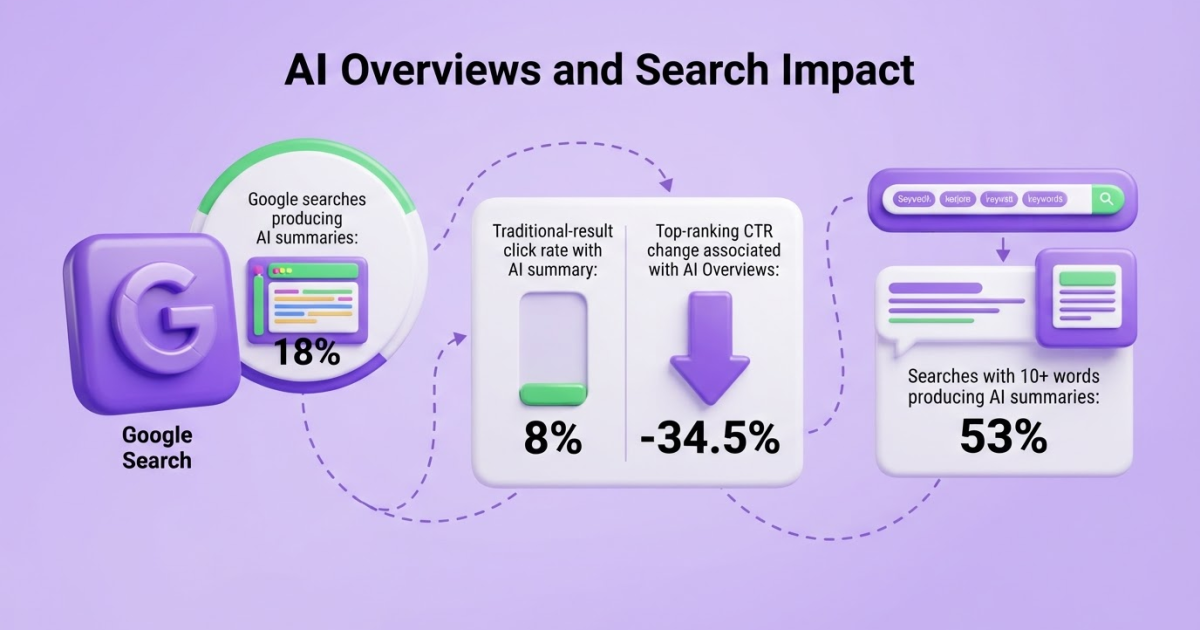
You may be watching your rankings hold steady while clicks quietly disappear, and wondering whether SEO for LLMs requires rebuilding your entire strategy. That uncertainty is understandable when 18% of Google searches produced an AI-generated summary in March 2025. The shift matters, but LLM visibility is not a separate technical trick: crawlable pages, clear expertise, and useful evidence still do the heavy lifting. This guide covers crawlability, entity clarity, question-led content, citation-worthy proof, monitoring, and a repeatable workflow small teams can run without abandoning conventional search.
| Point | Details |
|---|---|
| Keep SEO Fundamentals | Google says AI Overviews and AI Mode require no special schema or technical requirements beyond standard search eligibility. |
| Write For Answers | Question-based searches matter because 60% of searches beginning with question words produced an AI summary in Pew’s dataset. |
| Build Citation Signals | Use clear claims, original evidence, named sources, concise definitions, and distinctive expertise that AI systems can summarize accurately. |
| Measure AI Visibility | Track branded mentions, cited pages, referral traffic, and query coverage alongside traditional rankings across at least 4 visibility signals. |
| Avoid Scaled Filler | Google warns that generating many low-value AI pages mainly to manipulate rankings can violate its scaled content abuse policy. |
What SEO for LLMs Actually Means
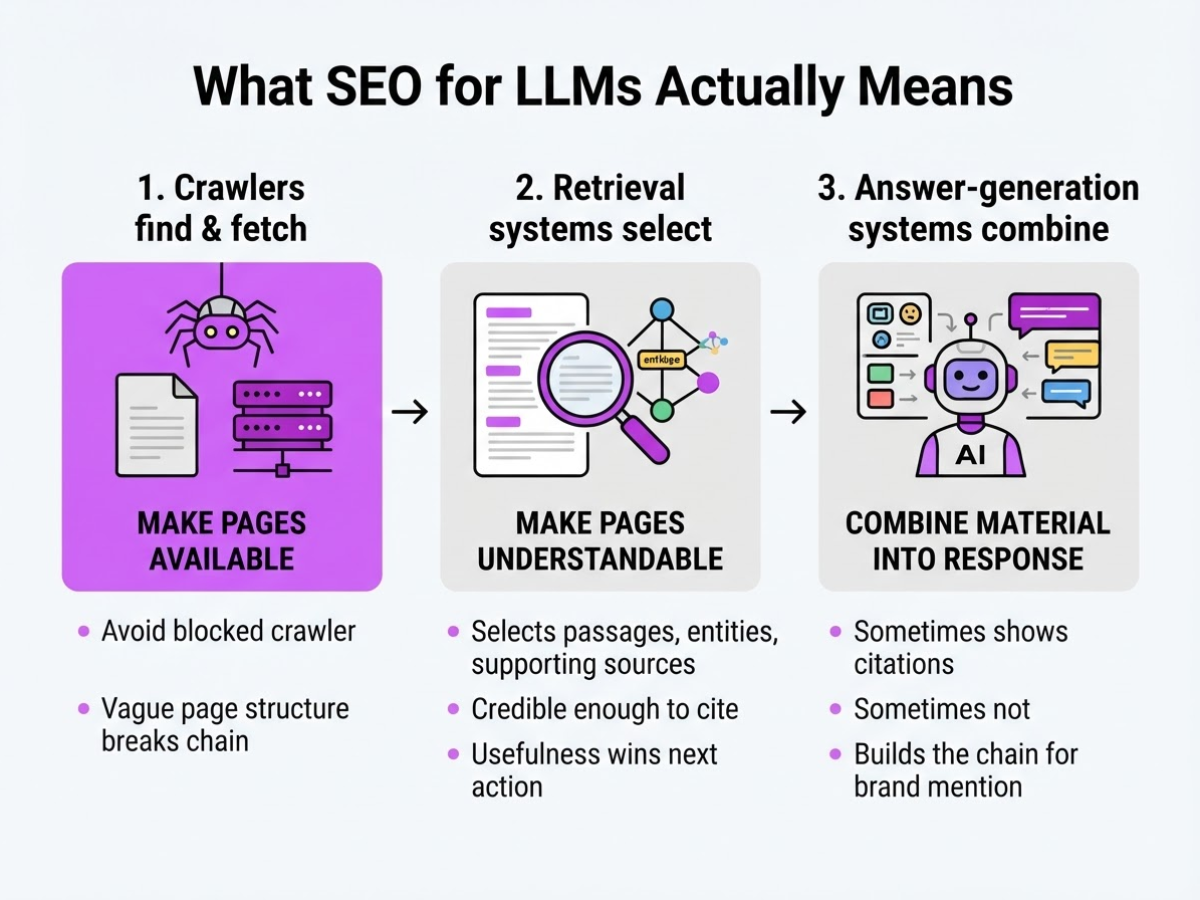
When I explain SEO for LLMs to customers, I avoid calling it a secret ranking system for ChatGPT or Google. It is the work of making your public pages available to crawlers, understandable to retrieval systems, credible enough to cite, and useful enough to win the next action. It extends technical SEO and content SEO. It does not replace either one.
Search systems generally move through three jobs. Crawlers find and fetch pages. Retrieval systems select passages, entities, and supporting sources for a query. Answer-generation systems then combine that material into a response, sometimes showing citations and sometimes not. A blocked crawler, vague page structure, or unsupported claim can break the chain before your brand gets mentioned.
I measure the work in four stages rather than using “AI visibility” as a loose score:
| Stage | What must happen | Practical measurement |
|---|---|---|
| Discoverability | A system can find, crawl, and index the page | Index coverage, crawl access, impressions |
| Interpretation | It can identify the topic, entity, audience, and answer | Query matches, impressions by intent, snippet accuracy |
| Citation | It selects the page as evidence or a source | Cited queries, linked mentions, referring visits |
| Conversion | The visitor takes a valuable next step | Qualified clicks, sign-ups, calls, or sales |
The labels GEO, or generative engine optimization, and AEO, or answer engine optimization, describe overlapping versions of this same discipline. GEO usually emphasizes visibility in generated responses. AEO focuses more narrowly on winning direct answers. Neither is a replacement for clean canonicals, accessible HTML, clear headings, original evidence, or useful internal links. Avoiding common AI content mistakes matters because fluent filler gives retrieval systems little worth quoting.
Pro Tip: Treat every important page as a source document first and a keyword-targeting asset second.
Google confirms that existing SEO fundamentals remain relevant for AI Overviews and AI Mode, with no special AI schema or extra technical eligibility requirement. That is good news, although it makes careless publishing harder to excuse.
The core principle is simple: make your best answer easy to crawl, understand, verify, and revisit. The next step is turning that principle into page-level actions.
Build the Technical and Entity Foundation
LLM-facing SEO starts with a page that can be crawled, understood, and tied to the right entity. When we review sites at Roki AI, the biggest failures are usually ordinary: a blocked resource, three versions of the same URL, or an author name that changes from page to page.
-
Test access before changing content. Check
robots.txt, XML sitemaps, indexability directives, canonical URLs, and HTTP status codes. Important pages should return200, resolve to one preferred URL, and connect to related pages through ordinary internal links. Anoindextag on a product page will matter more than another round of keyword editing. If canonical tags are confusing, use this canonical link check guide to compare the declared and selected URLs. -
Inspect what a crawler can actually retrieve. Render key templates with JavaScript disabled, then compare the result with the browser view. Look for pricing, specifications, author bios, addresses, and answer summaries that appear only after scripts run. Tabs and accordions are not automatically a problem, but hiding the only explanation of a product inside an interaction creates unnecessary risk. Login walls, image-only instructions, uncaptioned videos, and PDF-only evidence create similar gaps.
Pro Tip: Compare the page a browser displays with the text and links a crawler can retrieve; important claims should exist in crawlable HTML.
-
Make entity details boringly consistent. Use the same organization name, official domain, logo, founding details, contact information, locations, and social profiles across the site. Give every author a stable bio page, every product a permanent page, and every location a specific address and service description. Do not alternate between “Roki,” “Roki AI,” and a legal company name without explaining the relationship.
-
Write for extraction, not decoration. Give each page a descriptive title, one clear main heading, useful subheadings, a short summary, and direct answers near the relevant claim. Use tables for comparable specifications and lists for requirements or steps. Add relevant structured data, such as Organization, Person, Product, or LocalBusiness, only when the visible page supports it. Google says existing SEO fundamentals still apply to AI Overviews and AI Mode, with no special AI schema required.
-
Check ChatGPT access. If you want public content discovered and cited in ChatGPT search, review
robots.txtand avoid blocking OAI-SearchBot. That permission does not guarantee inclusion, but blocking the crawler closes the door.
Quarterly checklist: crawl important URLs; verify status codes and canonicals; test mobile and rendered HTML; inspect internal links; confirm entity details; review structured data; test media, tabs, and login barriers; and check robots.txt for OAI-SearchBot changes.
Once the foundation is clean, you can improve the content signals that help language models select and quote your pages.
Turn Topics Into Citation-Worthy Content
At TryRoki, I start content planning with the questions customers ask when they are close to making a decision, not with a list of keyword variants. Pull questions from sales calls, support tickets, Reddit threads, reviews, and product demos. Capture the follow-up questions too: “Which option is cheaper?”, “Will it work with WordPress?”, “What happens if traffic doubles?”, and “What are the drawbacks?”
-
Map the decision, not just the topic. List the customer’s use case, alternatives, budget, deadline, technical limits, and reasons they might reject your recommendation. A page about SEO for LLMs, for example, should address citations, crawlability, original evidence, measurement, and whether the work differs from ordinary SEO. Longer searches create a useful opening here: Pew found that 53% of searches containing 10 or more words produced an AI summary, compared with 8% of one- or two-word searches. Those searches contain more context, so answer-focused pages have more substance to match.
-
Put the answer first. Open each section with a plain answer in one or two sentences. Then explain the reasoning, show an example, state caveats, and link to supporting evidence. If you claim that a page needs original information, show the data, method, date, and limitations. A vague conclusion such as “AI prefers quality content” gives a retrieval system little distinctive material to quote.
-
Give every heading one job. Use one clear concept per heading and define unfamiliar terms before using them. “Entity” means a recognizable person, company, product, place, or concept that a search system can identify. Add first-hand observations, worked examples, expert quotes, and transparent source links. I would rather publish one small test with its sample size and result than inflate a page with ten recycled claims. Avoiding common AI content mistakes usually means removing unsupported generalizations, not adding more paragraphs.
Pro Tip: Add a short ‘what would change this answer?’ subsection to expose assumptions and make the page more useful than a generic summary.
- Build a problem cluster. Connect a central page to focused pages about entities, use cases, comparisons, implementation, and troubleshooting. Link them because they solve related customer problems, not because each contains a slightly different version of the target keyword. This structure gives AI systems repeated, consistent context while giving readers a clear path through a complicated decision.
The next step is making that useful material easy for search and answer systems to access, interpret, and verify.
Measure Visibility Beyond Rankings
Rankings still matter, but they now describe only one part of search visibility. I track five separate signals: traditional rankings, inclusion in AI summaries, direct citations, branded mentions, and referral visits. A page can rank tenth, appear in a ChatGPT answer, and influence a sale without receiving the first click.
I build a test set of 30 to 50 priority questions, including comparison, problem-solving, and product-specific queries. I run the same set across Google AI Overviews and AI Mode, ChatGPT search, Microsoft Copilot, and any industry platforms my customers use. The wording will vary, so I do not treat one manual check as a reliable result.
- Week 1: establish the baseline. Record the traditional ranking, whether an AI answer appears, the cited URLs, cited competitors, exact answer wording, source publication or update date, and whether the citation opens a useful page rather than a thin category or outdated article.
- Weeks 2 to 4: connect visibility to behavior. Use server analytics, Search Console, referral data, CRM records, and brand-monitoring alerts. Tag visits from ChatGPT and other assistants where possible, then check whether those visitors view key pages, return later, request a demo, or convert through an assisted path.
- Every month: repeat the test set. Compare citation share, competitor share, branded mentions, referral visits, and page-level conversions. I also review answers manually because a citation can remain technically present while the model misstates your pricing, audience, or recommendation.
Bing Webmaster Tools’ AI Performance dashboard is one useful visibility source. Its public preview reports citations, cited pages, grounding queries, page-level activity, and visibility trends across Microsoft Copilot, Bing AI summaries, and selected partner integrations. It will not cover every assistant, and the interface is still a preview, so I use it alongside a Google rank tracker API, not instead of one.
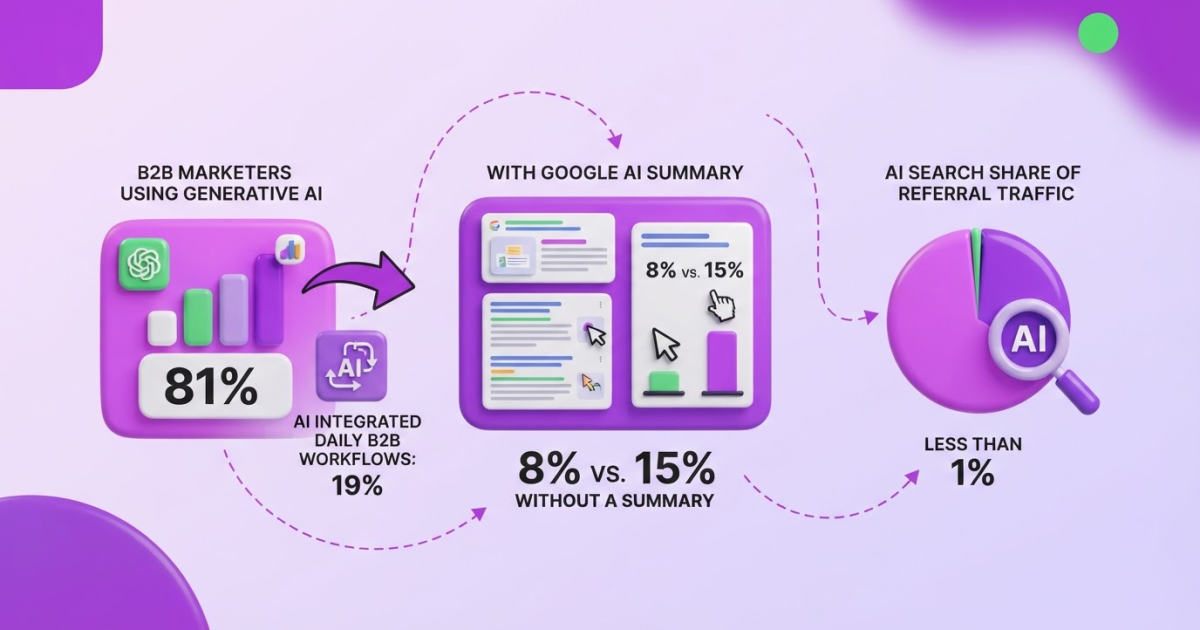
Do not panic when clicks fall. Pew recorded traditional-result clicks in 8% of visits when a Google AI summary appeared, versus 15% without one, while only 1% clicked a link inside the summary. Visibility can rise as direct traffic shrinks, especially when people remember your brand, return later, or convert after an assisted visit.
The next step is turning these observations into content updates that improve both citation quality and customer action.
Avoid the Shortcuts That Reduce Trust
AI can help you produce a first draft, but it cannot take responsibility for what gets published. As a company owner, I have seen teams chase visibility by creating hundreds of pages that differ only by city name, keyword, or one substituted paragraph. That approach frustrates readers, weakens conventional SEO, and gives language models little reason to cite one page over another.
Common mistakes include:
- Mass-producing near-duplicate pages for minor keyword variations
- Publishing thin summaries that add nothing beyond the top three results
- Accepting invented statistics, unattributed claims, fake first-hand experience, or outdated references
- Repeating keywords until the copy sounds unnatural
- Hiding who wrote, reviewed, or approved the page
- Leaving related pages disconnected through weak internal linking
- Answering a keyword without helping someone make a real decision
Google warns that generating many AI-assisted pages without adding value can fall under its scaled content abuse policy. I treat that as a useful quality test, not merely a search penalty warning. If you cannot explain why a page deserves to exist as a separate resource, do not publish it.
An AI-generated draft needs a subject expert to check every material claim, an editor to remove repetition, and a human owner to add evidence, examples, limitations, or original analysis. A generic summary of pricing options is forgettable. A comparison based on your own implementation costs, selection criteria, and observed trade-offs can earn trust. Avoiding common AI content mistakes is worth reviewing before you turn a prompt into a publishing workflow.
Use data-nosnippet selectively when a specific sentence should not appear in Bing previews or AI-generated answers, such as sensitive, paywalled, or temporary text. Bing supports the attribute while keeping the page discoverable. Do not apply it to the entire page just to hide weak writing.
Before publishing, I require an owner to confirm:
- Usefulness: Does the page answer a real question or decision?
- Accuracy: Has someone checked facts, dates, figures, links, and sources?
- Originality: Does it add experience, evidence, judgment, or a meaningfully different angle?
- Accessibility: Can people scan, navigate, and understand it on mobile?
- Review ownership: Is a named person responsible for approval and future updates?
That checklist keeps AI in its proper role: a drafting assistant, not the final editor of your reputation.
My honest take on SEO for LLMs
I see SEO for LLMs as an operating discipline, not a magic layer that replaces search optimization. As the owner of TryRoki, I have watched teams spend hours testing speculative prompt tricks while their core pages still bury the answer, make vague claims, or offer no evidence. That is usually the wrong trade-off.
Most companies should spend less time trying to force mentions in AI-generated answers and more time making their existing pages clearer, more defensible, and more useful to real customers. AI systems still need accessible sources, coherent entities, accurate claims, and enough context to summarize a page safely. That sounds like familiar SEO work because much of it is. The difference is that position one is no longer the only useful signal.
At TryRoki, I treat AI visibility as a weekly learning loop. We identify customer questions, improve the pages that should answer them, check how search systems represent those pages, and use the findings to choose the next task. Automation helps keep that process from slipping, though it also creates noise when teams chase every strange result. Accountability stays with the publisher. The goal is not to manufacture mentions. It is to become the source an answer system can confidently select because the underlying page has earned that confidence.
— Daniel
Turn SEO for LLMs Into a Weekly Workflow
SEO for LLMs is not a publishing race. The difficult part is keeping the basics moving: finding a genuine content gap, fixing technical issues, and checking whether your site appears in the places people and AI tools actually use. TryRoki acts as the execution layer for that work, not a replacement for your strategy. It creates website content on autopilot, surfaces relevant Reddit discussions where a thoughtful mention may fit, and sends you 3 to 10 weekly tasks aimed at visibility in Google and AI search engines.
Start with one content gap, one technical check, and one visibility review. Then use Roki to maintain the cadence. Review every draft, verify claims, add first-hand insight, and contribute helpfully in communities. The system can reduce the busywork, but it cannot decide whether a link belongs in a conversation. Publishing more is not the goal. Publishing something useful, consistently, is.
Frequently Asked Questions
Yes. Google’s AI features still depend on core requirements such as crawlability, indexability, useful content, and relevance, so you need all 4 foundations in place before expecting visibility. AI search changes how people see your information, but it does not rescue a weak or inaccessible source page.
No public scoring formula explains every citation, but an LLM needs content it can access, interpret, and connect to a specific question. In practice, I look for 4 signals: clear claims, recognized expertise, original evidence, and consistent information about the company, because vague copy and anonymous pages rarely make dependable sources.
Yes, AI-assisted content can appear when it gives readers accurate, useful information rather than existing only to manipulate rankings. Google’s guidance treats producing large volumes of low-value pages as a problem, so publishing 100 thin articles is a worse strategy than carefully reviewing and improving 10 genuinely useful ones.
SEO traditionally aims to earn visibility in search results, while GEO usually describes efforts to appear in generative answers and citations. The labels differ, but the work overlaps across 2 goals: make your content accessible and make it useful enough for a search system to trust, understand, and reference.
Create a fixed set of 20 to 50 relevant questions, run them on a regular schedule, and record your brand mentions, cited URLs, and the wording used in each answer. Manual checks are annoying and results can change between runs, so combine them with referral analytics and AI-visibility tools rather than trusting one report to capture every answer surface.
Written by Daniel.
Recommended reads
- Avoiding Common Ai Content Mistakes For Better Seo
- Optimizing Ai Content For Google S 2026 Algorithms
- How Roki Ai Streamlines Your Seo Content Workflow
- Content Gaps A Practical Seo Guide
Sources
- AI Features and Your Website | Google Search Central | Documentation | Google for Developers
- Google users are less likely to click on links when an AI summary appears in the results
- AI Overviews Reduce Clicks by 34.5%
- Publishers and Developers - FAQ | OpenAI Help Center
- Google Search's Guidance on Generative AI Content on Your Website | Google Search Central | Documentation | Google for Developers
- Introducing AI Performance in Bing Webmaster Tools Public Preview
- Bing Introduces Support for the data-nosnippet HTML Attribute