Aleksandra D.
Targeted keywords are specific search terms chosen to fit your audience, page topic, search intent, and realistic ranking chances, not just high search volume. Find and qualify them, map each term to the right page, use them naturally without stuffing, and measure results over time; tools such as Roki AI can provide 3–10 weekly tasks to support ongoing SEO and AI-search visibility.
You can spend weeks chasing broad keywords, only to attract visitors who never needed your offer, understood your page, or came close to buying. That mismatch is frustrating: traffic looks healthy in a report, yet your conversion goal stays out of reach. Backlinko found that search queries containing 10 to 15 words received 1.76 times more clicks than single-word keywords, which is a useful reminder to listen to how real prospects search. This guide shows you how to turn audience language into targeted keywords, assign one primary term to each page, build supporting coverage, and judge results through impressions, clicks, and qualified outcomes.
| Point | Details |
|---|---|
| Match Search Intent | Choose a targeted keyword that reflects what the searcher wants and what your page can genuinely deliver. |
| Prioritize Business Fit | A lower-volume query may bring more value when it closely matches your product, audience, and conversion path. |
| Map One Main Term | Assign 1 primary targeted keyword to each page, then add closely related terms without creating competing URLs. |
| Write Naturally | Use the keyword in important page elements, but remove repetitive phrases that make the copy harder to read. |
| Measure Real Progress | Review impressions, clicks, relevant traffic, and rankings across at least 3 metrics instead of judging success by position alone. |
What Are Targeted Keywords?
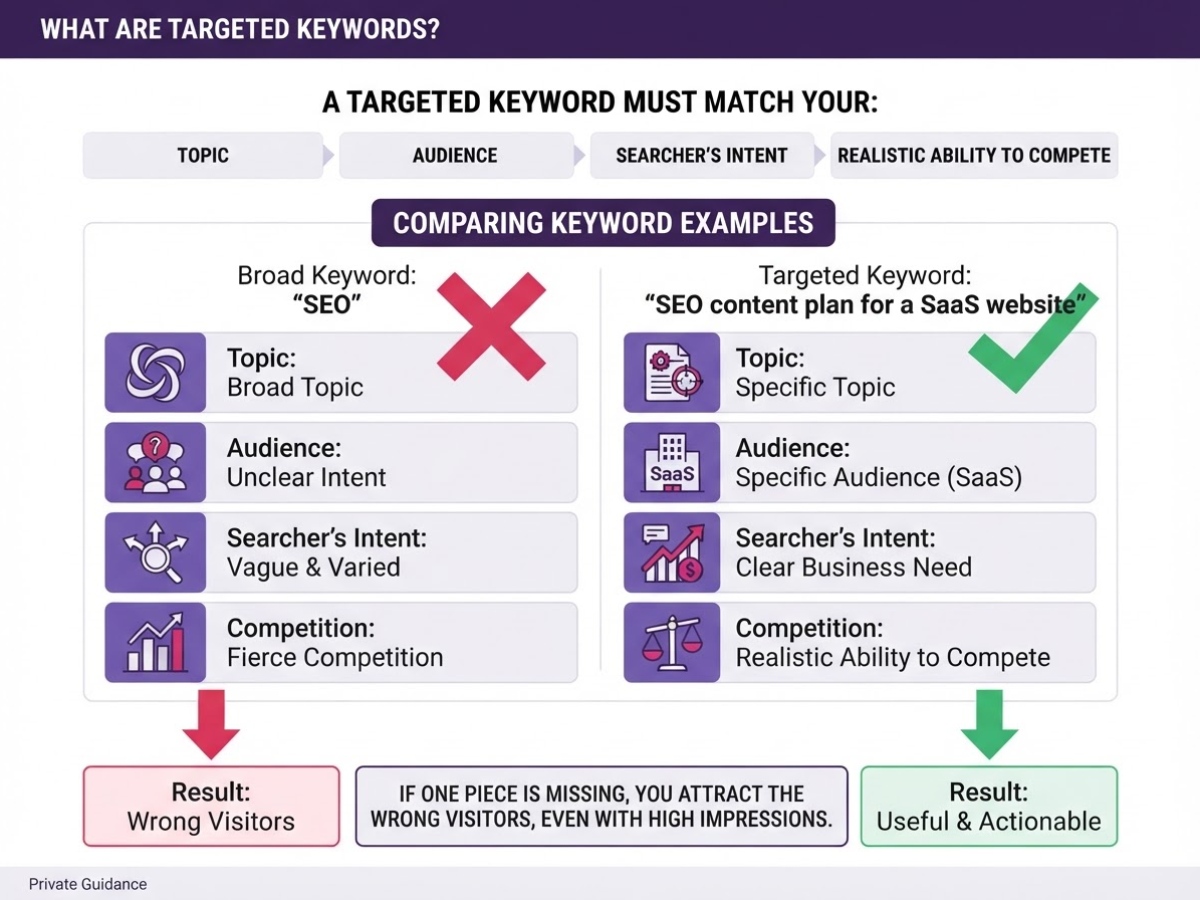
A targeted keyword is not simply a phrase with a large number beside it in an SEO tool. I define it as a search term that matches your topic, your audience, the searcher’s intent, and your realistic ability to compete. If one of those pieces is missing, the keyword may bring impressions but still attract the wrong visitors.
Compare these examples:
| Keyword | What it suggests |
|---|---|
| “SEO” | A broad topic with unclear intent and fierce competition |
| “SEO content plan for a SaaS website” | A specific audience, problem, format, and likely business need |
The second phrase gives you something useful to build. You can explain the planning process, show a SaaS example, and offer a template or service. The first phrase could mean a beginner wants a definition, a marketer wants tools, or an agency wants clients. Writing one page for all of those people usually produces vague content that satisfies nobody.
A page normally has one primary keyword, such as “SEO content plan for a SaaS website.” Supporting terms expand the subject without forcing awkward repetition: SaaS content strategy, B2B topic research, and content calendar for software companies might all belong on the same page. Long-tail variations are more specific versions of the idea, while natural language lets you answer the question as a person actually asks it. Longer queries can attract more clicks than single-word terms, although lower volume does not guarantee easy rankings.
Search volume is only an estimate, and high volume often hides weak intent or powerful competitors. A keyword with 10,000 monthly searches is a poor choice if your page cannot meet the searcher’s need. A term with 80 searches may be far more valuable when those searchers are ready to compare products, request help, or buy.
Pro Tip: Describe the target keyword as a promise to the searcher: if the page cannot keep that promise, the term is not truly targeted.
For each important page, choose one clear search problem to solve. That discipline prevents keyword stuffing, overlapping pages, and the frustrating habit of creating content because a tool displayed an attractive number. For a closer look at the planning process, see this practical guide to target keywords.
The next step is turning that definition into a repeatable method for finding targeted keywords.
When Should You Use a Targeted Keyword?
Before you commit a page to a keyword, make it pass five questions. I use this test when planning content for TryRoki because an attractive volume number can hide a poor business fit:
- Who searches for it? Name the person, market, location, and level of knowledge. “SEO tools” could attract a student, an agency owner, or someone looking for a free browser extension.
- What do they want? Classify the intent as informational, commercial investigation, transactional, navigational, or local. “What are targeted keywords?” needs an explanation, while “buy SEO software” needs product comparisons, pricing, and a clear route to purchase.
- Why should your page rank? Identify your first-hand knowledge, original data, product experience, or a genuinely better explanation. If your page adds nothing, publishing it is mostly busywork.
- What action matters afterward? Decide whether you want an email signup, demo request, sale, tool use, or simply a visit to a related guide.
- Can your business satisfy the query? A local dentist should not target a national software term just because its volume looks high. The traffic may be real and still be useless.
Pro Tip: Before checking volume, write the page’s intended next action; this quickly exposes keywords that may generate visits but not useful demand.
Search intent also tells you what kind of page to build. Informational results usually favor guides, commercial investigation favors comparisons and reviews, transactional queries favor product or category pages, navigational searches favor a known brand, and local intent favors location pages, maps, reviews, and practical business details. Do not force a sales page into an informational SERP.
Inspect the first page manually. Note whether Google favors short answers, detailed guides, videos, category pages, forums, or local listings. Check how current the results are, how deeply they cover the problem, and whether the ranking brands have obvious topical authority. A keyword is more promising when you can match the dominant format and improve weak pages, not merely copy them.
I also compare competition with existing performance. A site already earning impressions for related terms has a head start, even if its domain is not famous. Review Search Console clicks and impressions, internal links, content quality, and relevant backlinks. For a practical framework, see this guide to target keywords. If the audience is right but the SERP is crowded, test low-competition keywords instead of lowering page quality.
Once a keyword survives this test, you can judge its place in your wider content plan.
How to Find and Map Targeted Keywords
The best keyword map I have built never started inside an SEO tool. It started with the phrases customers used when they were confused, comparing options, or ready to buy. Use this process to turn that language into a focused set of targeted keywords.
- Collect customer language. Review sales-call notes, support questions, product reviews, Reddit discussions, and your site-search reports. Copy the wording exactly, including awkward phrases such as “how do I get more traffic without writing every day?” Those details often reveal the problem and buying stage better than a broad term like “SEO.”
Pro Tip: Mine real customer wording first and use tools second; the language customers use often produces more commercially precise targets than generic seed terms.
-
Expand each seed topic. Turn a phrase such as “SEO content” into problem-based queries, use-case searches, comparisons, feature searches, and outcome-based questions. You might find “how to plan SEO content,” “SEO content for Shopify,” “Roki vs. an agency,” “AI content workflow,” and “how to get more organic leads.” Search-volume tools can help, but do not treat their numbers as facts. Ahrefs says its estimates were roughly accurate for only 60% of keywords in one comparison with Google Search Console impressions, so use volume directionally.
-
Group by intent, not spelling. Put “keyword mapping process,” “how to map keywords,” and “keyword-to-page mapping” in one cluster if the searcher wants the same answer. Do not publish three thin articles just because the wording differs. That creates maintenance work, internal competition, and pages nobody needs.
-
Build a simple keyword map. For every candidate, record the main intent, audience stage, business value, likely format, competition, and page owner. Add the proposed URL and status. I also mark whether a term supports revenue, product education, or only awareness. A low-competition query with no connection to your offer is not automatically useful; low-competition keywords need a business reason.
-
Assign one primary term per URL. Choose the phrase that best matches the page’s purpose, then list the supporting questions it must answer. A product page may target “Reddit lead generation tool,” while its supporting questions cover setup, pricing, integrations, and reporting. Keep related variants in the copy naturally instead of forcing each one into a separate heading.
-
Check the SERP before drafting. Search the candidate in an incognito window and inspect the top results, featured answers, videos, product pages, and discussion threads. If Google mainly rewards comparison pages, do not write a generic guide and hope it wins. This final check catches the expensive mistake: assigning the right phrase to the wrong page type.
Once the map is complete, the next decision is which targeted keyword deserves priority first.

Targeted vs Broad, Long-Tail, and Competitive Keywords
“Targeted” describes your decision, not a fixed keyword shape. A targeted keyword matches a specific page, audience, and action, so it may also be broad, long-tail, or competitive. For example, “running shoes” is broad but targeted for a category page, while “best trail running shoes for flat feet” is long-tail and targeted for a buying guide.
| Keyword category | Intent clarity | Traffic and conversions | Content and ranking demands |
|---|---|---|---|
| Broad | Usually low to mixed | Higher potential traffic, but weaker conversion signals | Requires strong topical coverage and often faces stiff competition |
| Long-tail | Usually clearer and more specific | Lower individual volume, often better conversion potential | Needs a focused page that answers the exact query |
| Competitive | Depends on the phrase | May carry valuable commercial intent, but traffic is harder to win | Requires excellent content, authority, links, and a close SERP match |
| Targeted | Defined by your page and business goal | Measured by fit, qualified visits, and useful actions | Requires clear intent mapping, regardless of volume or length |
These labels are not interchangeable. A phrase such as “email marketing software for nonprofits” is long-tail, commercially valuable, and potentially highly competitive. Conversely, a broad phrase can be relatively easy in a small niche, while a five-word query can still attract established brands and comparison pages.
I use broad terms to build the site’s topical structure: main category pages, pillar guides, and internal-link hubs. I usually prioritize targeted long-tail terms for nearer-term page opportunities because the intent is easier to serve and the brief is less vague. The practical guide to target keywords covers that mapping problem in more detail.
Do not let a keyword tool make the final decision. Volume estimates can be noisy, and keyword difficulty is only a proxy. Open the actual SERP: check whether the results match your format, whether small sites rank, how fresh the pages are, and whether searchers want information, a product, or a comparison. A low-volume term with a clear need can outperform a vanity keyword that attracts the wrong visitors.
Build a portfolio instead of choosing one category. Pair broad pages for structure with targeted pages for demand, then test a few competitive terms when your site has the evidence and authority to support them. That mix gives you a more sensible starting point for deciding which page deserves attention next.
How to Use and Measure Targeted Keywords
I place a targeted keyword where it helps a reader understand the page, not wherever an SEO checklist demands it. Use the main phrase in the title, opening paragraph, one relevant heading, and the URL when the wording stays short and readable. Add close variants in internal-link anchors, image file names or alt text when accurate, captions, and supporting copy. Do not force “targeted keywords” into every paragraph.
When I review content for TryRoki, I care more about whether the page answers the complete question than whether it repeats one phrase 12 times. Explain the related concepts, comparisons, examples, and next steps a searcher needs. Our practical guide to target keywords covers the planning side, but the page itself still has to be useful without sounding like a keyword list.
The failures are predictable:
- Stuffing: Repeating the exact phrase makes the copy stiff and can reduce trust.
- Awkward synonyms: Swapping in unnatural variants creates sentences nobody would say.
- Near-duplicate pages: Publishing one page for “targeted keyword research” and another for “target keyword research” can split signals instead of expanding reach.
- Intent mismatch: A guide will not satisfy someone looking for a product, calculator, or pricing page.
- Scaled publishing without value: Google defines scaled content abuse as producing many pages mainly to manipulate rankings, including low-value AI-generated pages. That policy matters because volume is not a substitute for original examples and clear answers.
Set a baseline before changing anything. Record indexed pages, impressions, clicks, click-through rate, conversions, and assisted outcomes such as qualified leads or demo requests. Google recommends judging search performance through impressions and clicks rather than position alone, so Search Console’s guidance is a better anchor than a rank tracker screenshot.
Use this review rhythm:
- Day 0: Capture the baseline and confirm the page matches search intent.
- Days 28 to 56: Compare impressions, clicks, CTR, conversions, and queries by page. Ignore noisy daily ranking changes.
- After the review: Refresh a page when useful queries reveal missing answers, consolidate it when two pages compete, retarget it when intent has changed, or expand it when related queries show clear demand.
That process turns query data into decisions, which sets up the next step: choosing where your content can win.
My Honest Take on Targeted Keywords
I have learned that targeted keywords are not a treasure hunt for one magic phrase. They are page-level decisions. Before I approve a topic, I ask who would search for it, what they expect to find, and whether our business can make a useful promise on that page. Search volume and keyword tools help, but they do not answer those questions.
Here is the contrarian part: the smallest, easiest keyword is not automatically the smartest target. I have watched teams spend hours producing pages for low-competition terms that attracted almost nobody and helped no real customer. That is not efficient SEO. It is production capacity pointed at the wrong audience.
The harder work is keeping the decisions consistent. Customer wording, intent, page quality, and business relevance need equal weight, even when a spreadsheet makes one metric look attractive. Roki AI helps our team maintain that execution across content creation, SEO tasks, and discovery opportunities, including relevant Reddit posts. It does not decide our audience or quality bar for us, and it should not. I still have to reject thin ideas, fix awkward drafts, and protect the reader’s trust.
My rule is simple: publish fewer pages with clearer promises, measure their real search response, and improve them before multiplying output. More URLs do not compensate for unclear strategy.
— Daniel/Aleksandra
Turn Targeted Keywords Into Consistent SEO Execution
Once you have a list of targeted keywords, the difficult part is usually not finding another idea. It is turning qualified terms into weekly work, publishing consistently, and noticing useful opportunities before they go stale. I built Roki AI’s automated content workflow for that gap: it can turn keyword ideas into website content tasks and help keep your publishing schedule moving without another spreadsheet to maintain.
Roki AI also surfaces relevant Reddit posts where a genuinely useful answer may include your website. That requires judgment, and forced promotion will only damage trust, so you still decide what to write and where to participate. Each week, you receive 3 to 10 practical tasks tied to improving visibility in Google and AI search. Explore the platform and its weekly task system to see whether it fits the way your team turns SEO plans into finished work.
Frequently Asked Questions
Start with the problems your audience describes in their own words, then check search intent, business value, competition, and whether your site can answer the query properly. I would begin with 10 to 20 closely related terms, because chasing large search volumes before understanding relevance usually wastes time.
A focus keyword is usually the main phrase assigned to 1 page, while a targeted keyword represents a broader strategy that includes the audience, intent, business value, and ranking opportunity. One targeted keyword can therefore guide the page’s focus keyword plus several supporting phrases.
Use 1 primary keyword or topic focus, then cover related questions and variations only when they help the reader. There is no fixed maximum, but forcing 20 or 30 phrases into one page often makes the writing awkward and mixes different search intents.
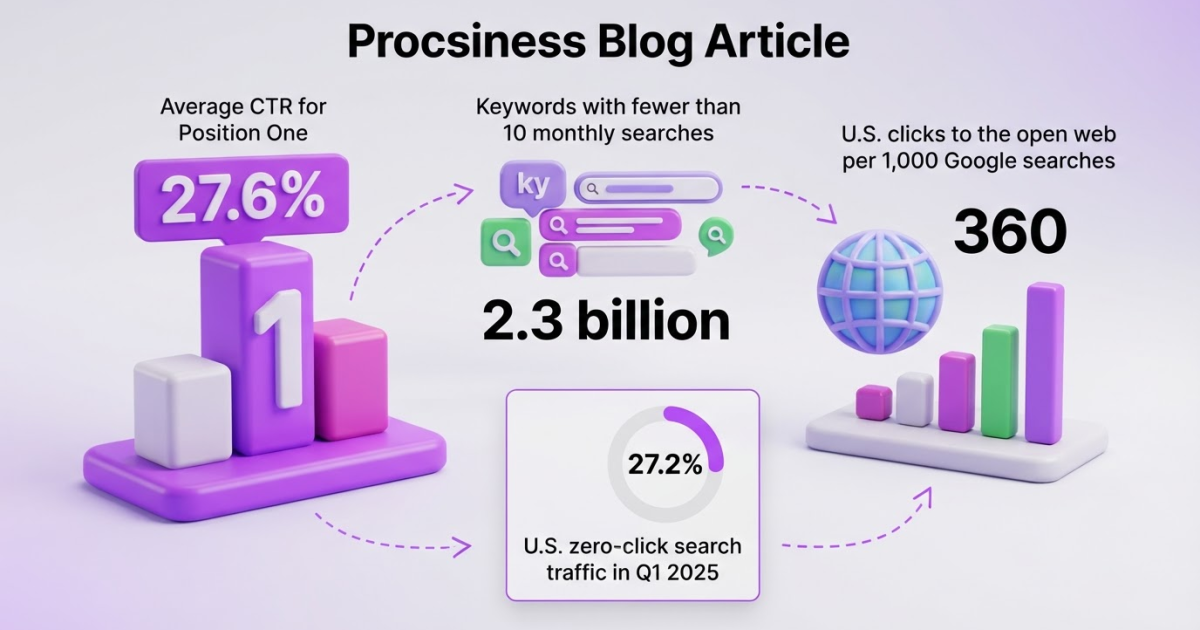
Yes, especially when a query describes a specific problem, signals purchase intent, or targets a clearly defined audience. Ahrefs identified 2.3 billion keywords with fewer than 10 monthly searches in one analysis, so rejecting every low-volume term is a poor shortcut.
Review the unexpected queries and compare them with the page’s existing promise before changing anything. If the new demand fits, add useful coverage and perhaps 2 or 3 internal links; if it reflects a different intent, create a separate page instead of forcing the original to serve two audiences.
Written by Daniel/Aleksandra.
Recommended reads
- Target Keywords A Practical Seo Guide
- Low Competition Keywords How To Find And Use Them Effectively
- Competitive Keywords A Strategic Guide To Win In Seo
- Seo Roadmap Template A Practical 90 Day Plan
Sources
- We Analyzed 4 Million Google Search Results. Here's What We Learned About Organic CTR
- Long-tail Keywords: What They Are and How to Get Search Traffic From Them
- 2024 Zero-Click Search Study: For every 1,000 EU Google Searches, only 374 clicks go to the Open Web. In the US, it’s 360.
- Is zero-click search traffic increasing?
- How accurate is keyword search volume in Ahrefs?
- Spam Policies for Google Web Search | Google Search Central
- Performance report (Search results): Common tasks and use cases