Daniel D.
Keyword difficulty is a third-party estimate, usually scored from 0 to 100, of how hard it is to rank for a search term based mainly on the strength of pages already ranking. Treat it as a prioritization signal, not a promise: compare the score with search intent, topic fit, backlink requirements, content quality, and your website’s authority before choosing a keyword.
You can spend weeks targeting a keyword with decent search volume, only to find that another phrase with similar demand is far easier to win. That mismatch wastes time, especially when a difficulty score looks precise but hides what the search results actually demand. Keyword difficulty is a tool-generated estimate, not a Google ranking factor: Ahrefs defines it as the location-specific difficulty of reaching the top 10 organic results and reports it on a 0–100 scale. I’ll explain how these scores are calculated, why tools disagree, how to inspect a SERP manually, and how to turn realistic targets into a repeatable content workflow with TryRoki and Roki AI.
| Point | Details |
|---|---|
| Estimated, Not Official | Keyword difficulty is a third-party prediction, not a score published by Google. |
| Tools Use Different Scales | Ahrefs, Semrush, and Moz use different inputs and scales, so a score of 40 is not universally equivalent. |
| Intent Comes First | A keyword with a difficulty score of 20 is still a poor target if the current results do not match what your audience wants. |
| Review The SERP | Check the top 10 results for relevance, content quality, backlinks, domain strength, and genuine weaknesses before committing. |
| Target Realistic Wins | Build a keyword set that combines achievable low-difficulty topics with selective long-term targets, such as 5 easier terms and 1 competitive term. |
Keyword Difficulty Explained: What the Score Actually Means
Keyword difficulty estimates the work required to compete with pages currently ranking for a query. In practical terms, it asks: can your site produce a better result, earn comparable authority, and satisfy the searcher more completely than the pages already in the top 10? Ahrefs defines it as a location-specific estimate of the difficulty of ranking in the top 10 organic results.
Google does not publish one official keyword difficulty score. Google Search uses many automated systems and signals rather than a public difficulty number, so a score from Ahrefs, Semrush, Moz, or another platform is a third-party estimate. These tools weigh backlinks, domain strength, content quality, and other signals differently. That is why two tools can give the same keyword noticeably different scores.
The estimate also depends on the search results you measure. A query checked in New York on a mobile phone in English shows different competitors from the same query checked in London on desktop in Spanish. Results change as Google tests layouts, updates rankings, and adds local packs, videos, forums, or AI features. A score can become stale while the visible results have already shifted.
Use this simple framing, not universal score thresholds:
| Difficulty level | What it usually suggests | Your practical response |
|---|---|---|
| Low | Weaker or less specialized competing pages | Publish a focused page and cover the intent clearly |
| Medium | Several credible pages already meet the search need | Improve depth, evidence, internal links, and authority |
| High | Strong sites dominate, often with substantial links and brand trust | Narrow the topic, target a related query, or plan a longer campaign |
Difficulty is not search volume. Volume estimates how often people search; traffic potential considers how many clicks a ranking page attracts; business value asks whether those visitors can become customers. A low-volume keyword with clear buying intent can matter more to TryRoki than a high-volume term that brings curious readers who never take action.
Pro Tip: Treat the score as a screening signal, then spend most of the decision-making time examining the actual search results.
I usually check keyword difficulty by reviewing the competing pages, because the number alone hides the annoying parts: thin pages can be beatable despite a high score, while a low score can still conceal strong brands. The next question is how these estimates are calculated.
Ahrefs vs. Semrush vs. Moz: Why Scores Do Not Match
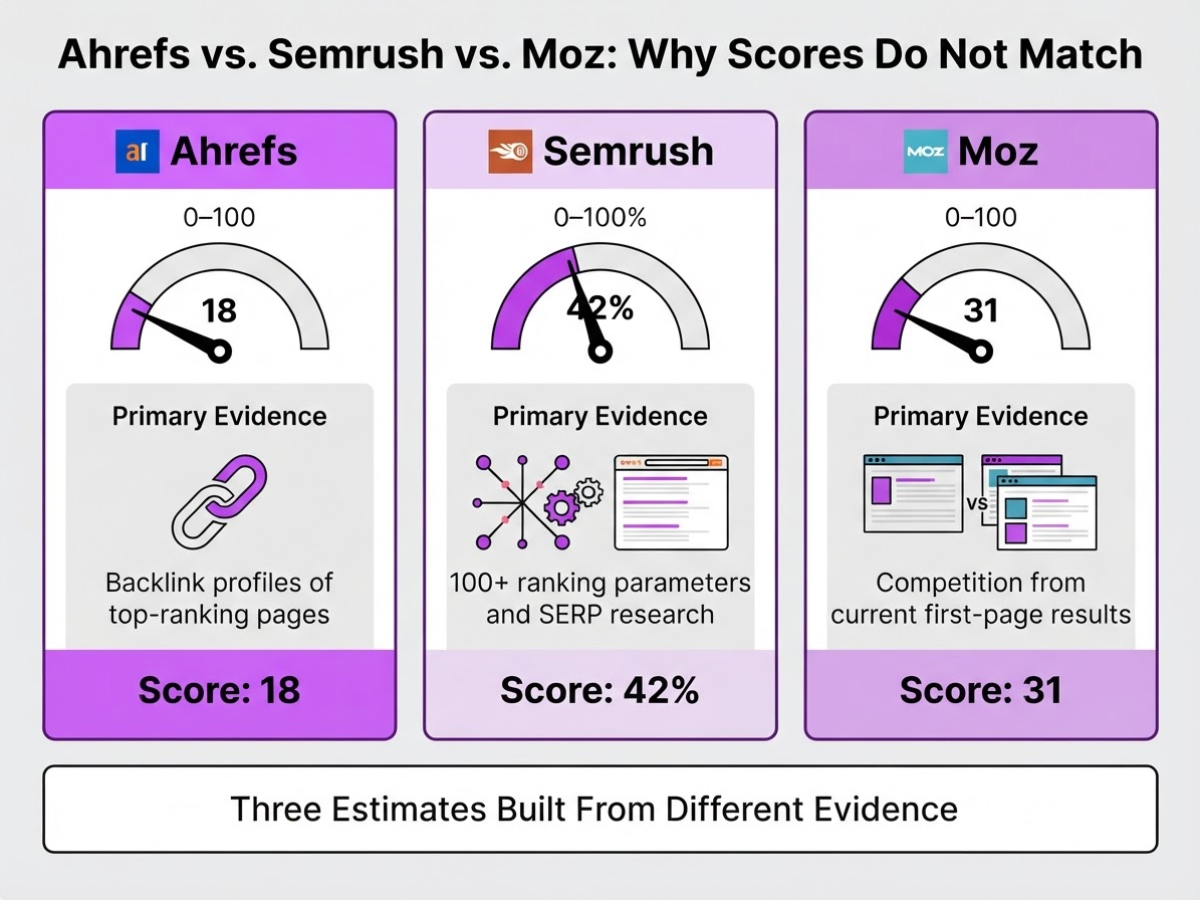
When I review keyword research for TryRoki, mismatched scores are one of the first sources of confusion. A keyword marked 18 in Ahrefs can appear as 42% in Semrush and 31 in Moz. That does not mean one platform is broken. It means you are looking at three estimates built from different evidence.
| Tool | Scale | Main emphasis | What a higher score suggests |
|---|---|---|---|
| Ahrefs | 0–100 | Backlink profiles of top-ranking pages | More referring-domain strength to overcome |
| Semrush | 0–100% | More than 100 ranking parameters and SERP research | More predicted effort to reach Google’s top 10 |
| Moz | 0–100 | Competition from current first-page results | Greater difficulty outranking those competitors |
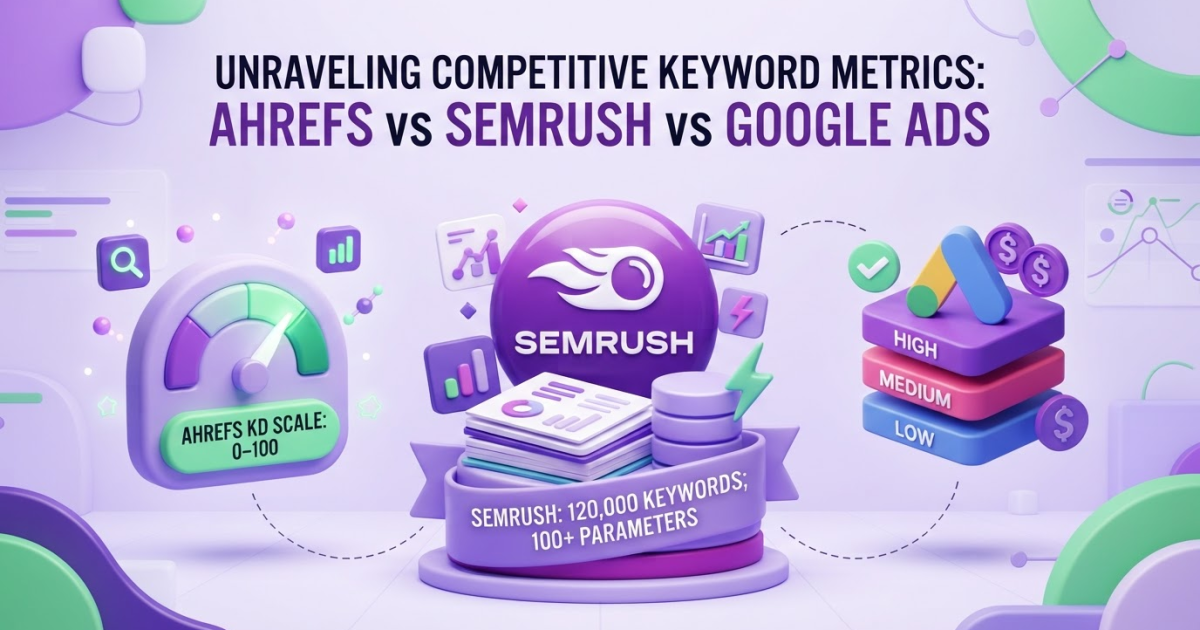
Ahrefs bases its Keyword Difficulty calculation primarily on the backlink profiles of top-ranking pages. Its score is location-specific and uses a logarithmic 0–100 scale, so a jump from 10 to 20 does not represent the same change as a jump from 70 to 80.
Semrush reports KD as a percentage. Semrush says a higher KD% indicates a harder predicted ranking environment, drawing on research across 120,000 keywords and more than 100 ranking parameters. Moz also uses 0–100, but its score estimates how difficult it is to rank above the current first-page competitors.
The annoying part is that each tool refreshes data on its own schedule, uses different country settings, and can see a different SERP mix. Competitor authority, page intent, links, content quality, and search features therefore receive different weight. A high score means “harder” inside that platform, not “harder by exactly this percentage” everywhere.
Pro Tip: When migrating tools, preserve the underlying SERP observations instead of copying old difficulty thresholds into the new platform.
Use one platform for primary comparisons. Sort its keyword list, inspect the ranking pages, and decide whether a score fits your site’s resources. Use this practical guide to checking keyword difficulty for a repeatable review process.
When you save a decision, record the tool, date, country, and exact keyword. That small habit prevents a frustrating mistake: treating last month’s Ahrefs score and today’s Semrush percentage as interchangeable evidence. The next task is applying the same discipline to the actual search results behind the number.
How to Evaluate Keyword Difficulty Before You Write
Before trusting a keyword difficulty score, recreate the search conditions and inspect the pages you would have to beat. I use this process when planning TryRoki content because a neat number in a dashboard often hides an awkward SERP, weak business fit, or a site that is not ready to compete.
-
Record the search precisely. Write down the exact keyword, country, language, device, and search intent. “Keyword difficulty” produces different results in the United States on desktop and in the United Kingdom on mobile. Label the intent as informational, commercial, navigational, or transactional, then check whether you can serve it honestly.
-
Read the first page, not just the score. Open the top 10 results in a neutral search session and compare their intent, content depth, publication dates, brand presence, and page types. Note whether Google shows featured snippets, videos, product results, local packs, forums, or AI features that reduce clicks to ordinary organic listings. A page ranking for the right phrase but answering a different question is a real opening.
Pro Tip: Open several top-ranking pages in a private or neutral search session and note repeated weaknesses before deciding that a high score makes the topic impossible.
-
Audit what gives those pages an advantage. Check whether each result covers the topic thoroughly, earns relevant backlinks, comes from a recognizable authority, or benefits from a strong domain. Google lists link analysis and PageRank among its ranking systems, so links matter, but they are not the whole contest. Ahrefs, for example, builds its difficulty estimate primarily from the backlink profiles of top-ranking pages, which explains why its number can miss thin content or a clear unanswered subtopic.
-
Compare the SERP with your own site. Put your expertise, existing authority, internal links, and production capacity beside the top 10. Can you add first-hand examples, clearer steps, original data, or a more useful template? Be realistic about link acquisition too. A brilliant article still stalls if your site has no relevant pages supporting it and you cannot attract legitimate mentions. For a broader explanation of using a score strategically, see how to evaluate and use keyword difficulty.
-
Score the opportunity on three dimensions. Rate ranking feasibility, business relevance, and traffic potential from 1 to 5. A keyword with feasibility 2, relevance 5, and traffic 4 deserves a long-term project; one with feasibility 5, relevance 1, and traffic 2 probably does not.
Finish with a go or no-go decision and a reason tied to evidence: “Go because three top pages are outdated and we can answer the missing comparison,” or “No-go because every result has stronger authority and the query cannot support a sale.” That judgment becomes the basis for a practical target-keyword plan.

Common Keyword Difficulty Mistakes That Waste Content Budget
After reviewing content plans at TryRoki, I see the same budgeting errors repeat. A low keyword difficulty score looks like an easy win, but the score describes only part of the work required to earn traffic and business results.
- Mistaking volume for value: A keyword with 10,000 monthly searches can attract researchers, students, or people in the wrong market. A phrase with 300 searches can produce more qualified leads if it reflects a clear buying problem. Low difficulty also does not guarantee conversions. Check the searcher’s intent, your offer, and the likely next action before assigning a writing budget.
- Reading Google Ads Competition as SEO difficulty: Google Ads Competition shows how many advertisers compete for a term relative to other advertising keywords, not how difficult it is to rank organically. Google defines this metric as advertiser competition, so a low advertising score does not mean weak organic competitors.
- Publishing thin content because the score is low: A score of 12 is not permission to produce 600 generic words. If the current results include detailed comparisons, original examples, tools, or first-hand advice, your page must satisfy that need. Google recommends people-first content rather than pages made mainly to attract search visits.
- Treating backlinks as the whole contest: Links matter, but they are not the only variable. Compare intent, topical coverage, author trust, page speed, clarity, and whether competitors actually answer the query. I find teams often obsess over referring-domain counts while ignoring a weak offer or confusing page.
- Trying to buy your way through difficulty: Automated link programs, paid links that pass ranking credit, and excessive exchanges create risk instead of authority. Google classifies links created primarily to manipulate rankings as link spam. Build useful relationships and publish assets worth citing instead.
Recheck the score when the SERP changes, your site gains or loses authority, or the business goal shifts from awareness to sales. Use this guide to evaluating keyword difficulty alongside a manual review of the results. Those checks lead to a practical decision about which keywords deserve priority.
Turn Difficulty Scores Into a Practical Keyword Strategy
My content calendar starts with a portfolio, not a hunt for one perfect keyword difficulty score. I sort targets into three groups: quick wins with clear intent and realistic competition, growth terms that need stronger content and links, and authority terms worth pursuing because they support a valuable product or topic. A low score can bring traffic, but a random low-difficulty win rarely builds a business.
I then group those terms into topic clusters. One main page targets the broad subject, while easier supporting pages answer narrower questions and link back to it. That structure gives readers a useful path and helps search engines understand coverage. I explain the score mechanics in my guide on how to check keyword difficulty strategically, but I do not let the number decide the plan. Search results, intent, business value, and the quality of competing pages matter more than a tidy score.
Before publishing, I record the baseline for each page: current rankings, impressions, clicks, click-through rate, conversions, and assisted revenue. Without that snapshot, teams celebrate a position change that produced no leads, or rewrite a page that was already earning valuable assisted conversions. The reporting setup is tedious, especially when analytics and Search Console use different attribution windows, but skipping it makes the review guesswork.
I use this review schedule:
- At 30 days: Check indexing, impressions, query coverage, and technical problems. Early ranking movement is a signal, not a verdict.
- At 60 days: Compare clicks and ranking groups with the baseline. Improve weak titles, missing sections, internal links, and pages attracting the wrong intent.
- At 90 days: Judge conversions, assisted revenue, and cluster performance. Keep investing in pages gaining traction, consolidate overlap, and reconsider targets with no meaningful impressions.
Roki AI helps me turn this into a weekly operating rhythm. I use it to create content drafts and review the 3 to 10 SEO improvement tasks it surfaces each week, including opportunities tied to Google and AI search visibility. The drafts still need editing, fact checks, and a human point of view. Automation saves planning time, but it does not rescue thin or interchangeable content.
The result I want is a portfolio of relevant rankings that supports revenue, not one impressive low-difficulty win. With that portfolio in place, the next decision is whether a page needs more content, stronger links, or a different target.
My Honest Take on Keyword Difficulty
I treat keyword difficulty as a useful filter, never as a verdict. In practice, it stops a team from spending three months chasing a term whose results are dominated by established pages. But a score cannot measure our first-hand expertise, a sharper angle, a better product, or a distribution plan that reaches the right people.
Here is my contrarian view: teams overvalue low-difficulty keywords. A low score can describe a weak opportunity with almost no commercial intent, while a moderately difficult term deserves priority because it sits at the center of the market we want to own. Chasing easy phrases can keep a content program busy without bringing it closer to revenue.
I prefer a portfolio: achievable supporting topics, commercially relevant mid-range terms, and a small number of ambitious targets. At Roki, I record the tool, date, location, search intent, and what the SERP actually shows. The data gets stale, and tools sometimes disagree enough to create needless debate. We revisit decisions as the site earns authority. That operating discipline matters more than the score itself. It turns keyword difficulty from a vanity metric into a planning input.
- Daniel/Aleksandra
Use Keyword Difficulty to Guide a Smarter Content Workflow
Keyword difficulty is a useful filter, not a final verdict. I still check search intent, competing pages, business value, and whether your team can produce something genuinely better. That manual review matters because a low-difficulty phrase can attract the wrong audience, while a harder term can be worth pursuing for the right reason.
Once you select an opportunity, Roki AI can turn it into high-quality website content on autopilot. Each week, Roki AI assigns 3–10 tasks to help you build a practical rhythm for improving visibility in Google and AI search engines. It is not a substitute for reviewing drafts or making strategic decisions, and the setup takes some adjustment. If you want keyword research, content production, and ongoing SEO actions in one workflow, explore Roki AI’s features and decide whether the process fits your team.
Frequently Asked Questions
There is no universal “good” score because each tool uses a different formula, but many teams start by reviewing terms below 30 in the same platform. Treat that number as a filter, not a verdict: inspect the top 10 results and compare their authority, content quality, and backlink profiles with your own site.
Most tools examine ranking pages for signals such as backlinks, referring domains, authority, and content strength. Because platforms weigh those signals differently, one keyword can receive 3 different scores in Ahrefs, Semrush, and Moz.
No. Search volume estimates how often people search for a term, while keyword difficulty estimates how hard it is to rank for it. A keyword with 10,000 monthly searches can be less useful than a highly relevant term with only 100 searches.
Yes, but expect a longer campaign that combines strong topical coverage, close intent alignment, consistent publishing, and credibility-building links. In practice, a new site should target difficult terms alongside lower-difficulty supporting topics instead of betting everything on 1 ambitious keyword.
Keyword difficulty predicts how challenging organic ranking is, while Google Ads Competition measures advertiser competition for paid placements. The 2 metrics can move together in some markets, but neither should replace the other when you choose an SEO target.
Written by Daniel/Aleksandra.
Recommended reads
- Check Keyword Difficulty How To Evaluate And Use It Strategically
- Target Keywords A Practical Seo Guide
- Content Gaps A Practical Seo Guide
- Seo Roadmap Template A Practical 90 Day Plan
Sources
- Keyword and search traffic metrics
- Keyword Difficulty score
- Free Keyword Difficulty Checker: Check Keyword Competition
- Find Keyword Suggestions With Keyword Explorer
- A Guide to Google Search Ranking Systems
- About Keyword Planner forecasts
- A Guide to Google Search Ranking Systems
- Spam Policies for Google Web Search
- Creating Helpful, Reliable, People-First Content