Aleksandra D.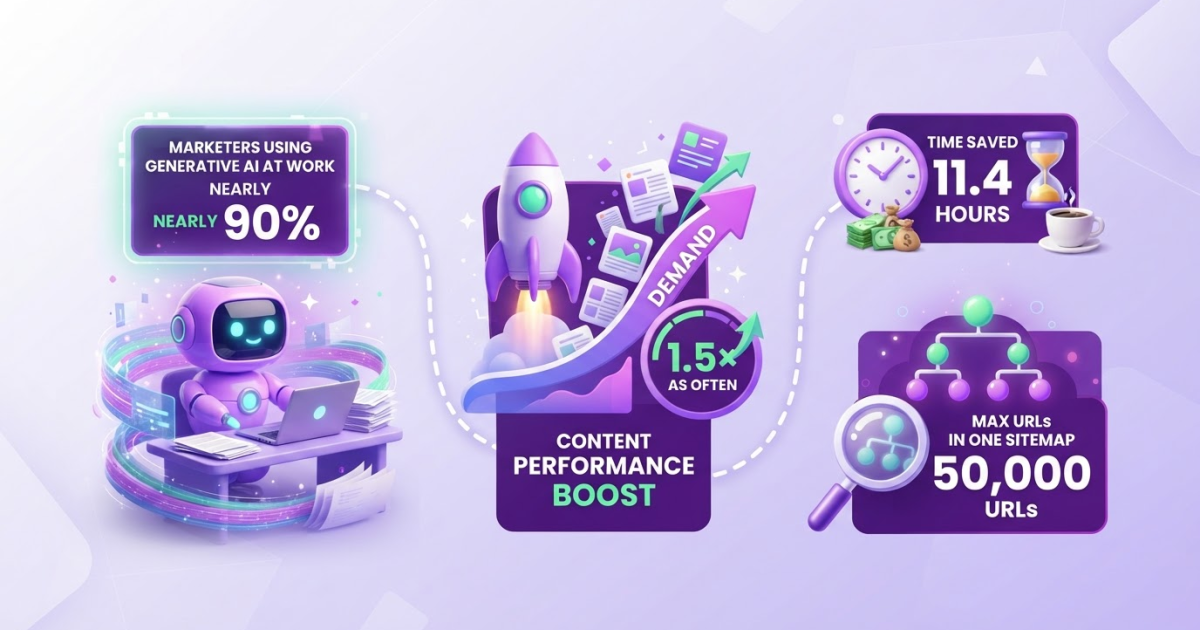
AI-generated content can improve Google rankings when it matches search intent, adds original value, and receives careful human review before publication. Use AI for research, drafting, optimization, measurement, and responsible promotion, but avoid mass-produced pages and artificial links; Roki AI delivers 3 to 10 weekly tasks to help improve visibility in Google and AI search.
Many website owners assume Google automatically penalizes AI-written content, then hesitate to publish anything created with a tool. In practice, the production method matters less than whether the page is useful, original, and trustworthy, while nearly 90% of marketers surveyed by the American Marketing Association had used generative AI at work by September 2024. I have seen rushed AI drafts fail because they repeat obvious advice and lack firsthand detail. At TryRoki, we use AI to speed up research and production, then put a person in charge of the page’s claims and usefulness. That means choosing the topic, briefing the model, adding real expertise, checking technical signals, measuring rankings, and promoting the finished work responsibly.
| Point | Details |
|---|---|
| Value Beats Volume | Google rewards pages that help people, so add at least 1 original insight, credible evidence, or useful analysis to every AI-assisted draft. |
| Human Review Matters | Have a subject-matter expert review each page before publishing to verify claims, examples, tone, and recommendations. |
| Follow Search Intent | Build each page around the reader’s specific task instead of turning 1 keyword into a generic article. |
| Measure Delayed Results | Give Google at least 7 days to notice many new pages, then judge performance across a defined 30-day tracking period. |
| Promote Ethically | Avoid mass-produced comments and artificial link campaigns because links created mainly to manipulate rankings can violate Google’s spam policies. |
What Google Actually Rewards in AI-Assisted Content
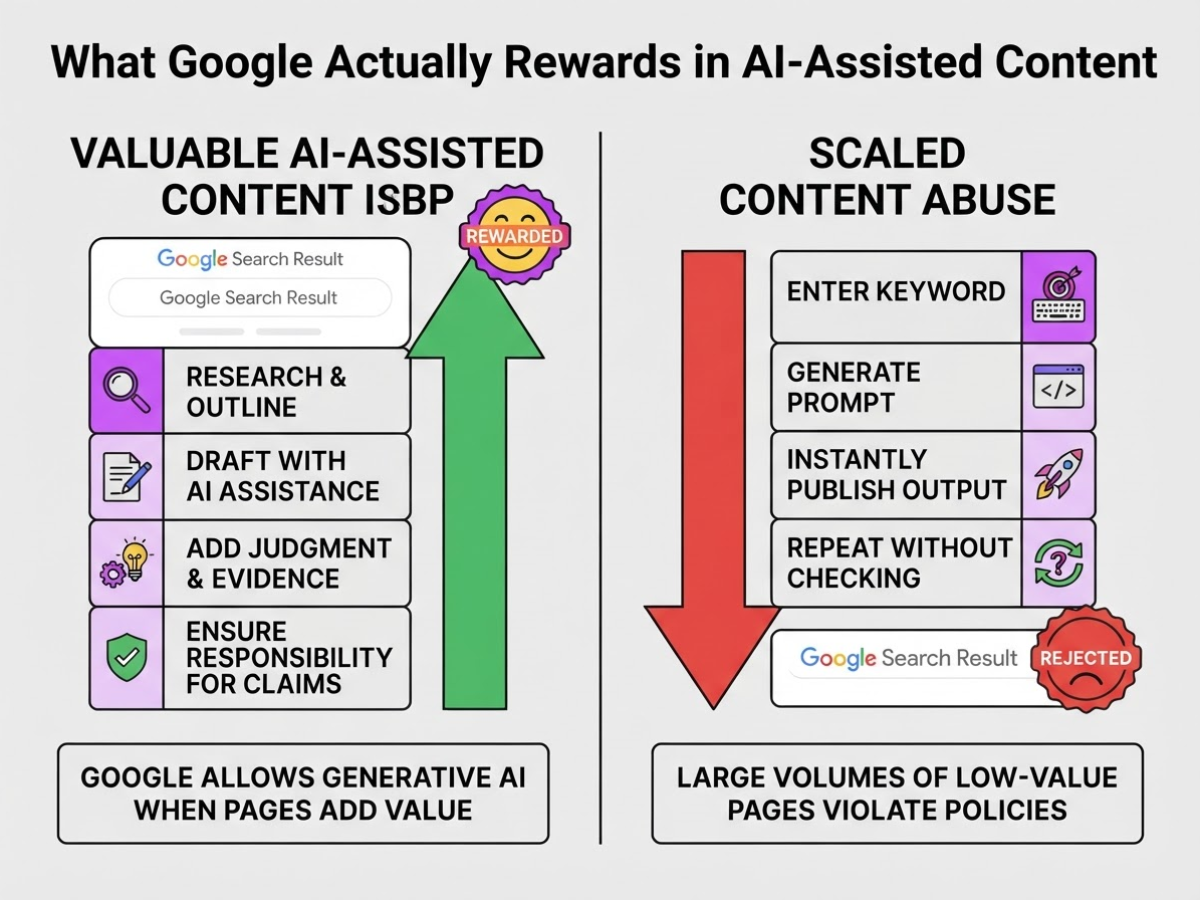
Google does not reject a page because you used generative AI to draft it. The issue is what the finished page contributes. Google allows generative AI content, while warning that publishing large numbers of pages without adding value can fall under scaled content abuse.
That distinction matters when you plan content for a real business. AI assistance can help you research a topic, organize an outline, or turn rough notes into a readable draft. Scaled abuse starts when the process becomes: enter a keyword, generate a prompt, publish the output, and repeat without checking whether anyone learned something useful.
A keyword is not a strategy. Neither is a prompt. A published draft is only raw material until someone adds judgment, evidence, and responsibility for the claims.
Google’s people-first guidance asks whether a page provides original information, reporting, research, analysis, or a complete treatment of the subject. I use that as the practical test at TryRoki:
| Weak AI workflow | Human-owned editorial standard |
|---|---|
| Rephrases the top-ranking pages | Adds customer evidence, testing, or a distinct point of view |
| Fills headings to reach a word count | Covers the decisions, risks, and details readers actually face |
| Repeats broad claims without proof | Checks facts, dates, examples, and recommendations |
| Publishes immediately after generation | Assigns a named person to edit, approve, and maintain the page |
Pro Tip: Have the author add one concrete observation from customer questions, support conversations, or first-hand testing that an AI model could not infer reliably.
This is why our approach to creating high-quality SEO content with Roki AI treats generation as part of the workflow, not the editorial decision. AI saves time, but it also introduces irritating errors: invented specifics, stale advice, and confident wording around a point nobody verified. A human must own the page’s purpose and final claims.
The standard is simple: use AI to assist production, then make the result unmistakably useful, accurate, and accountable to a reader. The next task is to apply that standard to the signals that make an AI-assisted page worth ranking.
The 7-Step AI Content Workflow for Better Rankings
When I review an AI-assisted page before publication, I look for the decisions behind it, not the polish of the prose. A repeatable workflow keeps AI useful while leaving judgment, evidence, and accountability with your team.
-
Define the query and outcome. Identify whether the searcher wants a comparison, explanation, purchase decision, or practical fix. Then write the outcome in one sentence, such as “the reader can choose an AI content tool for a five-person marketing team.” This prevents a broad keyword from turning into a vague article.
-
Collect evidence before prompting. Gather customer questions, product documentation, first-party data, expert notes, forum discussions, and the strongest competing pages. Record what competitors omit, such as screenshots, pricing conditions, implementation details, or honest limitations. Most weak AI briefs skip this step and produce summaries nobody needs.
-
Build a constrained brief. Give the model the audience, search intent, angle, outline, required claims, evidence for each claim, tone, word range, and internal-link destinations. I also specify what the page must not pretend to know. A useful brief often saves more editing time than a longer prompt.
Pro Tip: Give the AI a short list of claims it must not make without a cited source; this reduces confident filler more effectively than asking for “high quality” alone.
-
Generate a deliberately imperfect draft. Ask for clear explanations, specific examples, and marked placeholders where evidence is missing. Reject generic openings, unsupported statistics, copied phrasing, and claims that blur your product with a competitor’s. Google permits generative AI assistance, but warns that large-scale pages created without added value can violate its scaled content abuse policy.
-
Add human substance. A contributor should supply an original example, screenshot, test result, opinion, or practical sequence of actions. When we publish advice from inside the company, we include the annoying setup step and the trade-off, not just the clean outcome. That detail is usually what separates a useful page from interchangeable AI copy.
-
Optimize the finished page. Rewrite the title and headings for clarity, then check the description, image filenames and alt text, canonical URL, internal links, structured data, mobile layout, and crawlability. Article structured data can help Google understand the title, images, dates, and author information, but it cannot rescue thin content or a blocked page.
-
Publish, verify, and measure. Submit the URL through your normal discovery process, confirm that it is indexable, and watch impressions, clicks, rankings, assisted conversions, and direct conversions. Do not panic when the page is absent on day one. Google says most sites should expect new pages to take several days to be noticed, so review performance after two to four weeks and revise based on real queries.
Once the workflow is in place, judge whether the published page is genuinely helping its reader rather than merely filling the calendar.
Five AI SEO Mistakes That Quietly Limit Visibility
High publishing volume can hide a weak process. As an owner, I have seen teams celebrate 100 new URLs while missing the more important question: does each page give a searcher something distinct and useful? These are the five mistakes I check first:
-
Creating near-duplicate pages: Changing “AI SEO tools” to “SEO tools using AI” does not create two topics. It creates competing URLs with nearly identical answers, scattered internal links, and diluted signals. Group close keyword variations around one page unless the search intent genuinely differs.
-
Publishing unchecked claims: AI can produce outdated statistics, invented citations, and confident statements that no one on your team would defend. Check names, dates, product details, and references before publication. A practical quality-control workflow for AI-assisted SEO content should include a human fact check, not just a grammar pass. Google permits generative AI assistance, but large-scale pages created without added user value may violate its scaled content abuse policy.
-
Writing for keyword frequency: Repeating the target phrase eight times will not fix a page that fails the underlying task. If someone searches for a comparison, give them clear differences, prices, limitations, and a recommendation. If they want instructions, show the actual steps and likely failure points.
-
Ignoring trust and site structure: Thin author bios, no first-hand examples, vague claims, and orphaned pages make content feel disposable. Add the real author, explain how you reached conclusions, link related pages from relevant paragraphs, and remove sections that only restate other results. Polished AI prose cannot cover for missing experience.
-
Mistaking promotion or timing for SEO: Automated Reddit comments and mass link outreach often look promotional rather than helpful. Treating them as growth shortcuts can create spam signals, while Google says new pages commonly take several days to be noticed, so an unindexed page is not automatically a ranking failure. After a reasonable waiting period, inspect crawling and indexing, then improve, consolidate, or redirect thin URLs instead of endlessly publishing replacements.
Pro Tip: Audit the weakest 10% of AI-assisted URLs first; improving or consolidating them can reveal whether the underlying process is the problem before you publish more.
Turn these checks into a repeatable review before every AI-assisted page goes live.

How to Measure Whether AI Content Is Improving Rankings
I judge an AI-assisted content program by what happens after publication, not by how many drafts leave the pipeline. Before publishing, I record impressions, clicks, average position, indexed URLs, organic conversions, and assisted conversions for the previous 28 days. Without that baseline, a traffic increase can look impressive while sales stay flat.
I also tag every URL by topic, search intent, publication date, and editing level: AI draft with light review, AI draft with substantial human editing, or fully human-led. That grouping exposes uncomfortable differences. If lightly edited pages publish faster but attract no qualified visits, the efficiency gain is mostly cosmetic. For larger teams, a keyword ranking API can reduce spreadsheet work, although setup and inconsistent keyword naming often create their own mess.
Use this review timeline rather than reacting to every fluctuation:
- Days 1 to 14: Confirm that Google can crawl and index the URL, then check impressions, queries, and engagement. Google says most sites should expect new pages to take at least several days to be noticed, so same-week conclusions are usually premature. New pages may take several days to be noticed, especially on smaller sites.
- Day 30: Compare impressions, clicks, average position, and conversions with the prior 28 days. Compare the AI-assisted cohort with similar non-AI pages published in the same season, not with your site’s strongest evergreen article.
- Day 60: Inspect query-level data. Pages earning impressions but holding a weak CTR, such as below 2% for queries where they rank in the top 10, usually need a sharper title, description, or answer to the visible intent.
- Day 90: Keep, refresh, consolidate, or retire each page. Refresh when facts, products, search intent, or competing results have changed. Set success thresholds before launch, such as a 20% impression increase, a 10% click increase, or one qualified conversion within 90 days.
I review leading indicators weekly and make content decisions at 30, 60, and 90 days. That discipline shows which pages deserve another editorial pass before you publish the next batch.
AI Content, Freelancers, or an In-House SEO Team?
The right operating model depends less on the writing tool than on the decisions your team can make around it. I have seen businesses waste weeks briefing freelancers for routine updates, then publish AI drafts without anyone checking the claims. Neither extreme works well for competitive search.
| Model | Where it wins | Where it breaks |
|---|---|---|
| AI-assisted production | Speed, lower cost, repeatable briefs, updates, and on-page optimization | Weak judgment, generic examples, unsupported claims |
| Freelancers | Flexible subject knowledge and a human editorial voice | Availability varies, context gets lost, quality needs active management |
| In-house SEO team | Strategy, brand control, evidence, and close expert review | Highest fixed cost and limited output when the team is small |
AI is useful for synthesizing research, clustering keywords, drafting outlines, refreshing outdated sections, and spotting repetitive optimization work. Roki AI can create content on autopilot and send 3 to 10 weekly SEO improvement tasks, which helps a small team keep moving. I still would not approve every suggested topic or publish every draft. The setup saves time, but the first workflows can feel fiddly, and automation does not know which customer complaint contains the insight your competitors missed. See how Roki AI streamlines an SEO content workflow.
People should own the strategy, source selection, final claims, and publication decision. Use specialist review for medical, legal, financial, safety, or regulated advice; original reporting; product testing; and subjects where first-hand experience changes the recommendation. Google says generative AI content can violate its spam policies when it produces many pages without adding value, so volume alone is a poor target.
My decision rule is simple: choose AI-first when volume is high, internal expertise is available, risk is low, and someone can review each page. Choose freelancers or an in-house team when expertise or originality matters more than output. In most cases, use the hybrid model: let software handle repeatable production while people own evidence, judgment, and consequences.
The operating model only earns its keep if it produces measurable ranking gains, not merely more published URLs.
My honest take on ranking with AI-generated content
As the owner of TryRoki, I have learned that AI works best as the operating system for a disciplined content process, not as a shortcut around expertise. The contrarian point is simple: publishing more AI-assisted pages can damage your SEO when nobody has the time to review, differentiate, and maintain them. A larger URL count is not progress if every page sounds interchangeable or answers a question your customers never ask.
I would rather publish 20 useful pages with a clear point of view than 200 technically tidy summaries. AI should remove repetitive work such as briefing, outlining, updating, monitoring, and finding opportunities. It should not remove accountability. Someone still needs to challenge weak claims, add firsthand detail, check accuracy, and decide when a page deserves to exist.
That is how I think about Roki AI. It can create website content on autopilot, then give owners 3 to 10 weekly tasks to improve visibility in Google and AI search. The task list is useful, but it is not magic. You still have to do the irritating work, especially reviewing drafts and fixing pages that miss the buyer’s real concern.
I also treat Reddit discovery carefully. A helpful comment can earn attention; mass-posting promotional links usually earns distrust. Measure qualified visits, inquiries, and assisted sales, not a growing pile of URLs.
— Daniel/Aleksandra
Turn the AI SEO workflow into a weekly system with Roki AI
If you want to improve Google rankings with AI-generated content, the difficult part is usually consistent execution, not producing another draft. I built TryRoki to handle that workload without asking you to hand your strategy to an unchecked generator. It creates website content on autopilot, then gives you 3 to 10 weekly tasks aimed at improving visibility across Google and AI search engines.
The platform can also surface relevant Reddit discussions where your experience may help. Treat that as a research prompt, not a link-dropping shortcut. Your comment should answer the question, follow the community rules, and mention your website only when it genuinely adds context.
You can explore how Roki AI organizes ongoing content work, or start at the TryRoki product site. It will not guarantee rankings, but it can make a sensible publishing routine easier to maintain.
Frequently Asked Questions
Google can identify patterns associated with automatically produced pages, but AI authorship alone is not the main eligibility test. In practice, you need at least 1 human review that removes generic claims, checks facts, and adds original experience, because publishing hundreds of thin pages is far riskier than using AI as a drafting tool.
There is no fixed schedule, but Google takes at least 3 days to notice some new pages, while meaningful ranking movement often takes several weeks or months. Competition, site history, indexing, search intent, and the quality of your edits matter more than whether AI helped write the first draft.
Disclosure depends on your audience, industry, and any rules that apply to your publication, but you should never hide who checked and approved the claims. I recommend assigning 1 qualified person to verify the article, add firsthand expertise, and take responsibility for what goes live, even when AI wrote most of the draft.
AI-assisted writing can appear in Google AI Overviews when the page is indexed, useful, accurate, and relevant to the search, just like ordinary web content. Google has not added separate technical requirements for the 2 experiences, AI Overviews and AI Mode, so fixing weak evidence or poor answers is more useful than chasing a special AI format.
Only write a comment when it adds a specific answer to the discussion, and start with 1 genuinely useful contribution rather than dropping a promotional link. Reddit communities often remove obvious outreach, and links created mainly to manipulate rankings can be treated as spam, so mass-producing comments creates more reputation risk than SEO value.
Written by Daniel/Aleksandra.
Recommended reads
- Creating High Quality Seo Content With Roki Ai
- How Roki Ai Streamlines Your Seo Content Workflow
- Seo Ai Generator How To Automate Content Creation Effectively
- Best Ai Content Optimization Platforms 2026 A Strategic Guide
Sources
- Google Search's guidance on using generative AI content on your website
- Creating Helpful, Reliable, People-First Content
- AI Features and Your Website | Google Search Central
- Spam Policies for Google Web Search
- Learn About Article Schema Markup | Google Search Central
- Build and Submit a Sitemap
- Troubleshoot Google Search Crawling Errors
- Generative AI Takes Off with Marketers
- Deloitte Digital