Daniel D.
An effective seo plan connects business goals to target keywords, useful content, technical fixes, authority building, and measurable outcomes. Set a 90-day cycle, assign weekly work, and use tools such as Roki AI to receive 3–10 practical SEO tasks each week instead of guessing what to do next.
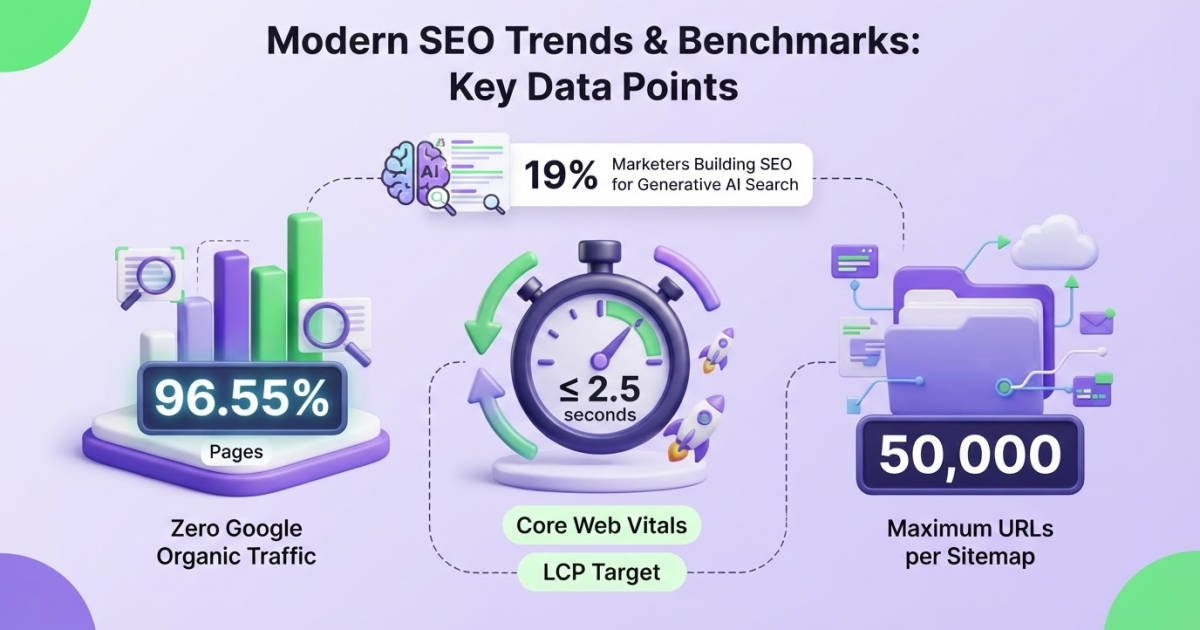
Many businesses treat SEO as disconnected chores: a blog post here, a backlink there, and no clear owner or way to tell whether the work helped. That confusion gets expensive when you are balancing growth, limited time, and conflicting advice. Ahrefs found that 96.55% of pages in its 2023 Content Explorer study received zero organic traffic from Google, so publishing more is not a strategy by itself. I built this guide around goals, audience research, technical priorities, ethical promotion, AI-search visibility, a 90-day cadence, and metrics that show what to keep, change, or stop.
Key Takeaways
| Point | Details |
|---|---|
| Define clear goals | Choose 1 primary business outcome and 2–3 supporting SEO metrics before selecting keywords or publishing content. |
| Rank real opportunities | Score each initiative for business value, search intent, effort, and confidence instead of chasing every keyword. |
| Create useful content | Build pages around a specific audience need and add first-hand expertise rather than writing for algorithms alone. |
| Measure monthly results | Review Search Console clicks, impressions, CTR, average position, queries, and pages at least once every 30 days. |
| Run 90-day cycles | Use a 90-day planning cycle with weekly execution and monthly analysis so evidence guides the next decision. |
What an SEO Plan Should Include
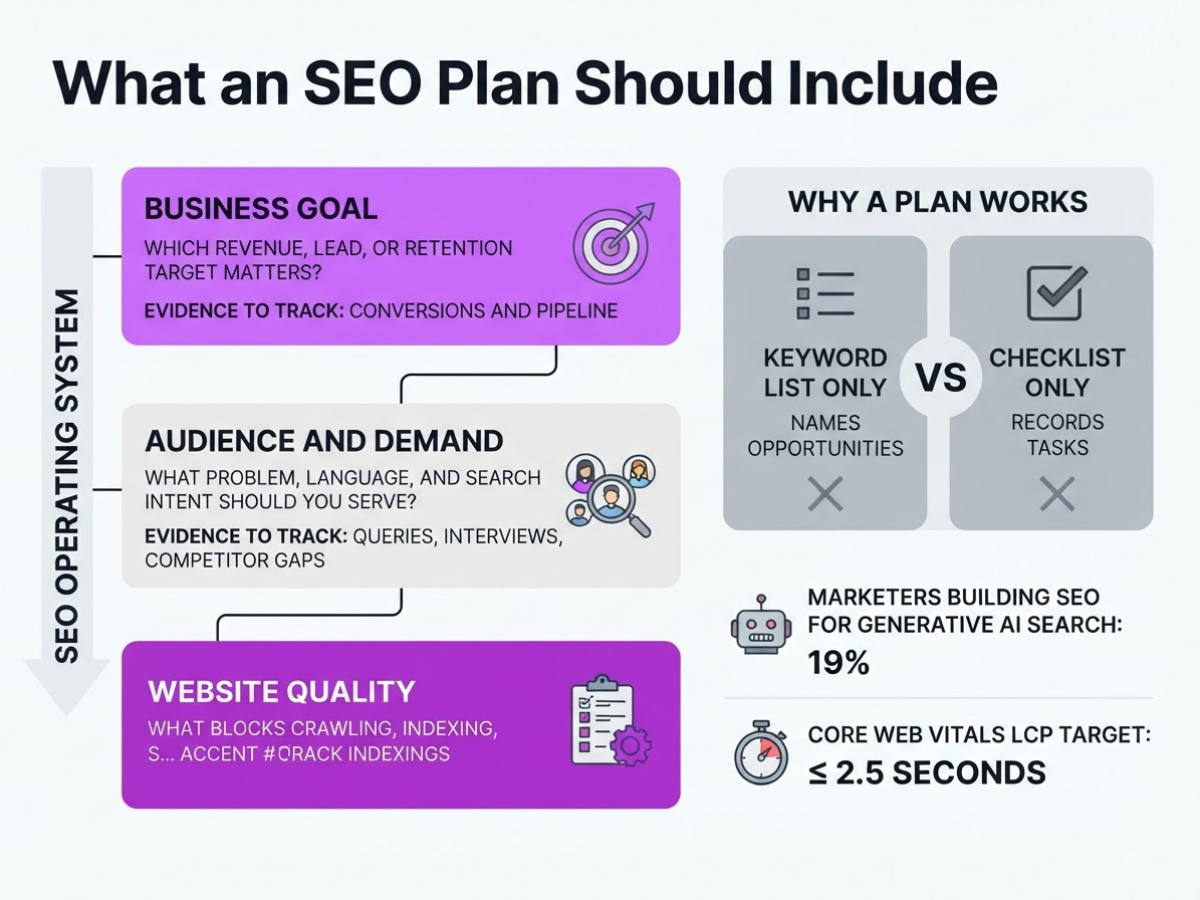
An SEO plan connects what the business needs, what your audience searches for, what your website can deliver, and how you will measure progress. A keyword list only names opportunities. A checklist records tasks. Neither tells you which work comes first, who owns it, or whether a ranking produced a qualified customer.
I build plans around one page that makes dependencies and trade-offs visible:
| Planning layer | Decision to make | Evidence to track |
|---|---|---|
| Business goal | Which revenue, lead, or retention target matters? | Conversions and pipeline |
| Audience and demand | What problem, language, and search intent should you serve? | Queries, interviews, competitor gaps |
| Website quality | What blocks crawling, indexing, speed, trust, or conversion? | Audit findings and technical data |
| Content and authority | Which pages deserve creation, improvement, or promotion? | Rankings, links, mentions, assisted conversions |
| Ownership and timing | Who ships each change, and what must happen first? | Milestones and completion dates |
| Reporting | What will make you continue, change, or stop? | Impressions, clicks, leads, revenue |
Add a baseline audit, measurable objectives, a keyword-and-intent map, technical priorities, a content calendar, promotion channels, named owners, a timeline, and reporting rules. The technical queue might begin with indexation or internal linking, while the content queue targets comparison pages, product education, or local demand. Do not hide these decisions under fifty minor tasks. Most teams overrate metadata tweaks and underrate page usefulness.
Google’s SEO Starter Guide prioritizes helpful, reliable, people-first content, so keyword insertion cannot be the strategy. Give readers an accurate answer, useful evidence, clear next steps, and a reason to trust your business. Then promote that work through relevant communities, partnerships, digital PR, and links earned from genuine usefulness, not random submissions.
Pro Tip: Write the plan around decisions and owners, not activities; “publish three posts” is weaker than “earn qualified product-demo visits from comparison searches.”
Include Google Search, but do not stop there if your customers use AI search experiences. Track branded mentions, citations, referral visits, and the questions those systems answer, while keeping the same people-first standard. The next step is turning this framework into a schedule.
How to Build an SEO Plan in 7 Steps
Start with the commercial result, not a list of keywords. A useful SEO plan connects search work to one measurable objective, such as 40 qualified demo requests per month, a 15% increase in non-branded revenue over 90 days, or 10% fewer support tickets. Record the baseline first: organic clicks, conversions, rankings, indexed pages, and revenue. Google Search Console reports clicks, impressions, click-through rate, average position, queries, and pages, so use those figures instead of guesses. Define the audience segments that can buy or influence the purchase.
-
Audit what already exists. Crawl your pages and check indexation, redirects, canonicals, broken links, duplicate titles, internal links, and sitemap coverage. Review mobile usability and Core Web Vitals, then compare important pages with competitors. Note thin pages, outdated claims, and pages that attract traffic but produce no business result. New content is often the wrong first move.
-
Research keywords by intent. Collect terms from customer calls, Search Console, sales emails, competitor pages, and keyword tools. Score each phrase for relevance, commercial value, difficulty, and realistic opportunity. “How to fix a leaking tap” and “emergency plumber near me” need different pages, even when the subject overlaps. Check the results page to see whether people expect a guide, category page, comparison, local listing, or product page.
-
Build clusters and assign pages. Group related terms around a clear topic, then give every planned page one primary intent and keyword. Keep supporting phrases beneath that page instead of creating five thin URLs for minor variations. A practical targeted-keyword guide can help when the list becomes unwieldy. This structure reduces cannibalization and gives writers a definite job.
-
Prioritize the backlog. For every recommendation, record expected impact, effort, confidence, owner, deadline, and dependencies. Fix an indexing block before commissioning ten articles. I rank quick technical fixes and high-intent pages ahead of low-confidence experiments, even when the experiment sounds more interesting.
-
Turn priorities into briefs. Specify the search intent, audience, angle, evidence, outline, title, metadata, internal-link targets, conversion action, and update owner. Plan on-page improvements for existing pages, not only new drafts. Google’s SEO guidance favors helpful, reliable, people-first content, so do not pad a brief to hit an arbitrary word count.
-
Plan distribution responsibly. Schedule internal links from relevant pages, email promotion, partnerships, and expert outreach. Community participation can work, but contribute a useful answer first and mention your company only when it genuinely helps. Repeated self-promotional links create distrust and can be treated as spam.
-
Build a 90-day calendar. Assign weekly tasks for audits, fixes, briefs, publishing, link updates, promotion, and measurement. Review progress at the end of each month: compare the baseline, record wins and failures, and re-score the backlog. Reserve the final week for decisions, not busywork.
Pro Tip: Reserve a small portion of every quarter for opportunities revealed by new queries, competitor changes, or customer questions.
Once the plan is scoped and scheduled, priority setting becomes the next practical decision.
What to Prioritize: Technical SEO, Content, or Authority?
The right priority depends on the problem blocking growth, not on the tactic receiving the most attention. I have seen teams commission six articles while Google could not reliably index the pages they already had. That is expensive activity, not an SEO plan.
| Workstream | Problem it solves | Typical time to impact |
|---|---|---|
| Technical SEO | Indexing, rendering, crawl, duplication, and site-speed barriers | Days to 8 weeks after fixes |
| Content | Unmet search intent and weak topic coverage | 2 to 6 months |
| Internal linking | Poor discovery and diluted page importance | 2 to 8 weeks |
| Digital PR and link earning | Low trust or authority in a competitive category | 3 to 9 months |
| Local SEO | Weak visibility in map and location-based searches | 1 to 4 months |
| AI-search visibility | Missing clear, citable answers across AI search experiences | 1 to 6 months, still variable |
Put technical work first when important pages return errors, sit behind blocked JavaScript, carry incorrect canonicals, or remain excluded from the index. Check Core Web Vitals as a quality checkpoint: Google’s recommended thresholds are LCP at 2.5 seconds or less, INP at 200 milliseconds or less, and CLS at 0.1 or less at the 75th percentile. Performance alone does not guarantee rankings. A fast page with no useful answer still loses.
Pro Tip: If a page cannot be found, understood, or trusted, improving its copy is usually a lower priority than fixing the blocking layer.
Content deserves the budget when you find an unmet intent, existing results offer thin coverage, and your team can add first-hand evidence, examples, or a better tool. Use a content gaps guide before ordering another generic article. Internal links usually belong alongside that work because they are cheap and reversible.
Authority building should mean earning relevant mentions through research, useful data, partnerships, or newsworthy work. Buying bulk links, posting the same business link everywhere, or paying for indiscriminate promotion creates risk and rarely builds trust. Local SEO outranks digital PR for a service business with a defined area; AI-search work rises when customers already ask comparison and recommendation questions.
Score each proposed task from 1 to 5 for impact, effort, strategic fit, evidence, and reversibility. Use this formula: priority = impact + fit + evidence + reversibility - effort. A confirmed indexing fix can score 5, 5, 5, 5, and 1 for effort, while an untested PR campaign can score 3, 3, 2, 2, and 5. Start with the higher result, then review Search Console data after 4 to 8 weeks.
That score turns competing ideas into a sequence you can defend, making the next review less subjective.

Common SEO Plan Mistakes That Waste Months
The most expensive SEO mistakes rarely look dramatic at first. They appear as busy dashboards, rising page counts, and months of work that produce no qualified visitors, leads, revenue, or repeat customers. As a company owner, I care far less about a broad keyword ranking than whether the right people take the next commercial step.
Watch for these failure patterns:
- Chasing vanity rankings: A position for “software” or “marketing” means little if the searcher has no reason to buy from you. Tie each target term to qualified traffic, leads, revenue, or retention.
- Publishing generic AI content at volume: AI can speed up drafting, but unreviewed pages with recycled advice, no evidence, and no original experience give readers no reason to trust you. Use a clear audience need, expert review, first-hand examples, and a useful point of view.
- Changing everything too soon: Rewriting titles on Monday, changing URLs in April, and replacing the strategy in May makes performance impossible to evaluate. Give important changes enough time to produce a signal, and record what changed.
- Letting the site compete with itself: Keyword cannibalization, weak internal links, orphan pages, thin location pages, and outdated articles quietly dilute your work. Review important pages quarterly, connect related content deliberately, merge overlap, and improve pages with no useful purpose.
- Buying questionable attention: Paid links, irrelevant blog comments, and promotional Reddit replies damage trust and create platform risk. Reddit’s spam guidance warns against contributions that mainly link to a business you own or benefit from. Participate because you can help, not because you found a place to drop a URL.
For every major initiative, write down the hypothesis, launch date, changes made, expected outcome, and review date. Track clicks, impressions, queries, pages, and conversions rather than relying on rank screenshots. A simple 90-day SEO roadmap keeps those decisions visible when results become noisy.
That record turns disappointing results into evidence and gives the next measurement cycle a clear starting point.
How to Measure and Improve Your SEO Plan
I judge an SEO plan by the decisions it produces, not by how impressive the spreadsheet looks. When I review results, I separate work completed from business impact because rankings often lag behind implementation by several weeks.
Track leading indicators first: technical fixes completed, pages published, URLs indexed, internal links added, and relevant mentions earned. These show whether the team did the work. Lagging indicators tell you whether that work mattered: qualified organic conversions, revenue, pipeline value, sign-ups, or booked calls. A traffic increase without qualified actions is usually a distraction.
Use Search Console to monitor queries, pages, impressions, clicks, CTR, and average position. Connect those trends to analytics and your CRM when possible, then separate branded from non-branded performance. Segment reports by device, country, page type, topic, and search intent. A page can look healthy overall while losing mobile visibility in one country or attracting clicks from the wrong intent.
Use a 30-day review loop:
- Days 1 to 7: Confirm the baseline and check leading indicators. Record completed fixes, published pages, indexed URLs, and earned mentions. Do not call a page a failure after ten days because it has no conversions.
- Days 8 to 21: Inspect query and page trends. Refresh pages that earn impressions but have weak CTR by testing a clearer title and description. Expand pages that attract qualified clicks with stronger examples, related sections, and a direct next step.
- Days 22 to 30: Investigate pages that still gain no visibility after a reasonable period, usually 6 to 12 weeks for a new page. Check indexing, intent match, internal links, competition, and content quality before rewriting everything.
Add AI-search visibility as an observation category. Log where your brand or pages appear in relevant answer experiences, but treat citation or answer inclusion as an observation, not a promised outcome. Results vary by query, location, device, and time.
At each 30-day review, make three decisions: continue, change, or stop. A 90-day SEO roadmap makes those decisions easier to assign and revisit. Begin the next cycle with evidence, not another untested list of tactics.
My honest take on building an SEO plan
I have seen teams mistake a longer SEO plan for a better one. My contrarian view is that the strongest plan usually contains fewer tasks, not more pages. I would rather watch a small business complete five well-researched improvements in 90 days than publish a 50-item roadmap that nobody owns, measures, or finishes.
As the owner of TryRoki, I use AI to speed up research, content briefs, drafts, and weekly follow-up. It can also surface relevant Reddit conversations, but it cannot decide whether a page genuinely helps a customer, whether a claim is accurate, or whether a brand will look foolish joining a discussion just to drop a link. That judgment still belongs to you. The setup is not always tidy. AI drafts need editing, search data can point in the wrong direction, and a small task can expose a larger technical problem.
I build an SEO plan around durable foundations, a few useful pages, and disciplined measurement. I want to know what changed, when it changed, and whether the right visitors took action. Community participation belongs in the plan as relationship-building, not backlink hunting. Automation should help your team act consistently and learn faster. It should never turn your website into a content warehouse.
— Daniel/Aleksandra
Turn Your SEO Plan Into Weekly Action With Roki AI
An SEO plan only works when someone carries it into the week. I built Roki AI’s weekly execution layer for that gap: it turns your existing priorities into 3 to 10 tasks each week, including website content ideas and relevant Reddit discussions where a useful contribution makes sense. Those tasks can support visibility in Google and AI search engines, but they are not a substitute for judgment.
You still need to review suggestions, add your expertise, verify every claim, and ignore work that does not fit your audience. The first setup can feel tedious, and automated drafts still need an editorial pass. That trade-off is preferable to chasing disconnected tactics. Start with the SEO priorities you already chose, then use Roki AI to keep a consistent content workflow moving week after week.
Frequently Asked Questions
You can see more impressions, indexed pages, and new search queries within 2 to 6 weeks, but meaningful traffic and conversion gains often take 3 to 6 months. Review progress every 30 days, then judge the full 90-day cycle before changing direction because early data is noisy.
An SEO strategy sets your direction, such as prioritizing product-led topics over broad informational keywords. An SEO plan assigns those choices to tasks, owners, deadlines, and metrics. The strategy can remain steady for 12 months, while the plan should change when results, capacity, or customer demand contradict your assumptions.
Yes. Start with Google Search Console, website analytics, customer questions, and a spreadsheet tracking roughly 20 priority topics. Paid tools save time when you compare competitors or build keyword lists, but they cannot decide whether a topic matches your customers, offer, or ability to produce something useful.
Review completed work once a week, inspect performance every month, and revisit the broader roadmap at least every 90 days. Update it sooner if your business changes direction, a technical problem blocks crawling, search behavior shifts, or new evidence disproves a core assumption.
AI can help with research, first drafts, content refreshes, and recurring workflows, but require human review before publishing every page. Give each draft at least 3 checks for factual accuracy, originality, usefulness, and first-hand expertise. Automatic publishing often produces bland claims, missed context, and errors that take longer to repair than to prevent.
Written by Daniel/Aleksandra.
Recommended reads
- Seo Roadmap Template A Practical 90 Day Plan
- Web Content Plan Template A Practical Strategy
- Ai Seo Content Generator A Practical Guide
- Seo For Llms A Practical Optimization Guide
Sources
- Google Search Overview and Improvements - Google Search
- SEO Starter Guide: The Basics | Google Search Central | Documentation | Google for Developers
- 96.55% of Content Gets No Traffic From Google. Here's How to Be in the Other 3.45% [New Research for 2023]
- Web Vitals | Articles | web.dev
- Build and Submit a Sitemap | Google Search Central | Google for Developers
- General Structured Data Guidelines | Google Search Central | Google for Developers
- Using Search Console and Google Analytics Data for SEO | Google Search Central | Google for Developers
- Spam – Reddit Help
- Global Social
- Semrush Report: AI Overviews’ Impact on Search in 2025